More intake noise with almost no noticeable acceleration is the most common cold-air-intake disappointment, especially in city driving. The engine may sound more eager while the car feels unchanged at 1,500–2,500 rpm, where the throttle is often only partly open and the engine is not using its maximum airflow.
The physics is sound: cooler air is denser, so each cylinder can receive more oxygen if the intake system supplies it with low restriction. The marketing is less dependable. Claims of 5–15 hp or 10–15% gains often sit well above repeatable results from stock naturally aspirated engines.
A useful evaluation has to separate a genuine airflow improvement from dyno variation, weather changes, heat soak, and the psychological effect of a louder intake. The relevant result is the repeatable change across comparable runs and the part of the rev range where that change occurs.
- Cold Air Intake Gains: What Actually Creates Power
- Realistic Cold Air Intake Gains by Engine Type
- Why Marketing Numbers Beat Repeatable Results
- The Filter Is Not the Whole Intake System
- Why You May Feel Little Difference on the Road
- Turbocharged vs Naturally Aspirated Engines
- How to Test Intake Gains Honestly and Decide if the Kit Is Worth It
- Frequently asked questions
- What is the downside of a cold air intake?
- How can I tell whether an intake kit is genuinely restrictive?
- How should I test a cold air intake before and after installation?
Cold Air Intake Gains: What Actually Creates Power
A cold-air intake can create power through air density. Lower intake temperature means a given volume of air contains more oxygen, which gives the engine greater potential to burn fuel and produce torque. That potential exists only if the engine can actually draw the additional mass of air into the cylinders.
Temperature is therefore one part of the system rather than a complete explanation. The intake must maintain sufficient airflow, keep pressure losses low, and avoid restrictive bends, undersized passages, or poorly positioned sensors. A filter with a large surface area cannot compensate for a hot air source or a narrow section elsewhere in the tract.
Engine control also determines how much of the theoretical benefit reaches the crankshaft. The ECU may adjust fueling, ignition timing, throttle position, and, on some engines, valve timing in response to intake conditions. Combustion quality, engine load, and the calibration’s response to temperature all influence the final result.
A commonly repeated rule of thumb says that every 5–6°C reduction in intake temperature is worth about 1% more power. That estimate is too simplified to use as a prediction. ECU control, combustion, throttle position, airflow demand, and test conditions intervene, so the relationship is neither linear nor universal.
Realistic Cold Air Intake Gains by Engine Type
Expected gains depend more on the complete engine and intake layout than on the product label. The ranges below describe practical tuning discussions and typical limitations, rather than guaranteed results from every vehicle.
| Engine type | Commonly discussed result | Where the effect appears | Main limitations |
|---|---|---|---|
| Small-displacement naturally aspirated | About 2–3 hp is often described | Usually near high rpm and wide-open throttle | Small airflow demand, heat soak, and dyno variation can hide the change |
| Naturally aspirated, around 2.0 L and above | Often discussed around 3–7 hp or 3–8% | More visible near the top of the rev range and at full throttle | Results can remain near the low end or within dyno error on a stock engine |
| Turbocharged | Potentially larger, with no dependable universal range | Depends on compressor demand, boost operation, and calibration | Intercooling, boost control, factory intake design, and ECU strategy may absorb the benefit |
Small naturally aspirated engines are the least likely to deliver an impressive peak number from a simple bolt-on. A result around 2–3 hp may be genuine, yet difficult to identify from one dyno pull. On engines around 2.0 L and above, the change can be more noticeable, especially at high rpm and wide-open throttle, where airflow demand is highest.
Practical tuning discussions commonly place naturally aspirated gains around 3–7 hp or 3–8%. That range should be read as a broad description of possible outcomes, not a product guarantee. Many stock naturally aspirated results remain near the low end, and some fall within the uncertainty of the test equipment and operating conditions.
Turbocharged engines require a different interpretation. A less restrictive compressor-side path can help in a layout where the original intake is a genuine limitation, while cooler inlet air may support the system under sustained load. An intercooler and factory boost management already address part of the temperature problem on many turbo engines, so a bolt-on intake can deliver less than the theoretical airflow potential suggests.
Peak horsepower can also overstate the useful improvement. A small increase concentrated at the final part of the rev range may look attractive on a graph while leaving normal acceleration unchanged. The shape of the torque curve, the area under the curve, and the consistency of the result matter more to road performance than the largest number printed on an advertisement.
Why Marketing Numbers Beat Repeatable Results
Intake advertising usually favors the highest observed peak. That figure may come from a narrow point near the top of the rev range, where the engine is operating at wide-open throttle and the difference is easiest to display. It says less about acceleration through the middle of the rev range, where most road driving occurs.
Claims of 5–15 hp or 10–15% are common in marketing and SEO material. Such claims may reflect a favorable vehicle, a modified engine, a tuned ECU, a hot restrictive factory system, or a comparison against a poor baseline. On a stock naturally aspirated engine, repeatable results are often closer to a few horsepower and can sit within dyno error.
Test conditions can make the advertised gap larger. A cooler post-installation pull, different fuel, a changed fan position, or a baseline run taken after heat soak can alter the result before the intake itself is considered. If the baseline and final runs occur on different days, the weather may contribute as much to the apparent gain as the hardware.
Sound creates another source of confusion. An open filter and a larger intake tube can produce a sharper induction note, especially under load. That extra noise gives the driver a stronger sense of acceleration even when the measured increase is small, so subjective impressions should support instrumented testing rather than replace it.
A genuine gain of only a few horsepower still has value if it repeats and arrives without a drivability penalty. The problem is the presentation: a narrow peak is often treated as a broad improvement, while the uncertainty around the comparison remains invisible. A graph with a larger peak does not automatically prove a meaningful change across the usable power band.
The Filter Is Not the Whole Intake System
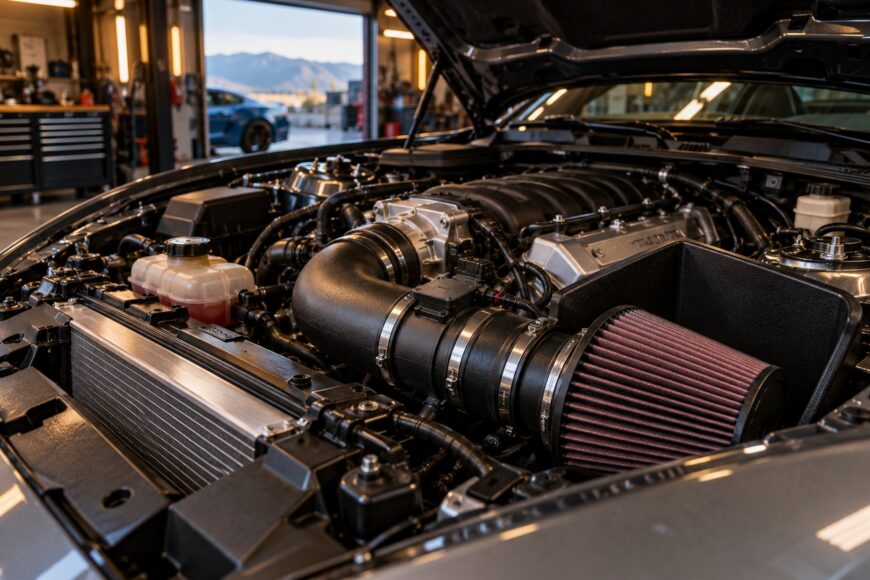
A genuine cold-air design moves the air source away from hot under-hood air. Replacing the factory filter while leaving the intake opening inside the engine bay may increase noise and reduce restriction, yet it does not guarantee colder air. The location of the opening and the path from that opening to the throttle body define the system’s thermal behavior.
Heat shielding matters because the surrounding air becomes much hotter after traffic or a long idle period. A shield can reduce direct exposure to radiant and convective heat, but it works best when paired with a sealed or well-positioned source of outside air. A loosely fitted panel around an exposed filter may provide little protection once the engine bay is heat-soaked.
Tract length, bends, diameter changes, and sensor placement also affect the result. The intake path must deliver the required airflow while preserving stable sensor readings and acceptable throttle response. An excessively long or poorly shaped system can add volume and noise, slow response, or introduce turbulence around the mass-airflow sensor.
Restriction remains important even with cold air. A narrow inlet, sharp bend, contaminated filter, or poorly designed adapter can create pressure loss that consumes the density benefit. Filter branding is therefore a weak basis for comparison; the complete path, shielding, sealing, and sensor compatibility matter more than the material or color of the filter.
The common failure is easy to identify after installation: the intake temperature rises sharply in traffic, the engine bay smells hot, and the car feels no stronger during the first pull away from a stop. A system that draws cooler air during highway movement can still underperform in real use if it absorbs excessive heat while the vehicle is stationary.
Why You May Feel Little Difference on the Road

City driving rarely keeps the engine at the operating point where an intake gain is easiest to detect. At 1,500–2,500 rpm, the throttle is often partly closed, airflow demand is moderate, and the engine may be limited by load, gearing, or transmission behavior. A small change in inlet density cannot overcome those limits in every acceleration event.
Naturally aspirated benefits usually become clearer near high rpm and fully open throttle. That is where the engine demands the greatest mass of air and where a restrictive tract has more opportunity to affect output. Drivers who shift early or use moderate throttle may therefore hear the intake without accessing the conditions that produce its measured gain.
The strongest practical contrast may appear after prolonged traffic or idling. Heat soak can raise the temperature of the original intake system, and a well-isolated replacement may recover some performance during the following hard pull. This does not mean the kit has created a large constant gain; it may have reduced a temporary loss caused by stored heat.
Peak dyno horsepower also has limited value as a predictor of ordinary road use. A gain confined to the last part of the rev range may require a full-throttle pull through several gears before it becomes detectable. A broader but smaller improvement in the midrange can matter more to the driver, even if it produces a less impressive headline figure.
Induction noise further separates perception from measurement. The louder system signals load to the driver and can make the engine feel more urgent. A timed acceleration test, consistent logging, or averaged dyno data is needed to determine whether the car is actually moving faster.
Turbocharged vs Naturally Aspirated Engines
Naturally aspirated engines depend directly on atmospheric pressure and the efficiency of their intake path. Cooler air can increase the mass entering the cylinders, while lower restriction helps the engine breathe at high rpm. The available gain is usually modest because the intake is only one part of the engine’s volumetric efficiency.
A turbocharged engine can have greater airflow demand and may benefit from reduced restriction before the compressor. The result depends on the compressor’s operating point, inlet pressure loss, boost target, intercooler efficiency, and the factory calibration. A replacement intake can help when the original system is restrictive, while a well-designed factory system may leave little performance on the table.
Intercooling changes the temperature equation. Many turbo engines already cool compressed air before it reaches the cylinders, and their boost controls can adjust operation to protect the engine or meet the requested torque. Cooler air before the compressor can still matter, particularly under sustained load, but the intercooler and ECU may reduce the visible difference at the engine.
Some publications report a 20–40% larger effect after tuning for the modified intake compared with an untuned bolt-on. That is a configuration-dependent claim rather than a universal result. The tuner must confirm that the hardware changes sensor behavior, airflow capacity, or temperature management enough to justify calibration changes.
A tune can also make it harder to identify what produced the improvement. If the intake and calibration are installed together, the combined result may be useful to the owner while the individual contribution remains unknown. For a clean evaluation, test the hardware first, then test the tuned configuration under the same conditions.
How to Test Intake Gains Honestly and Decide if the Kit Is Worth It
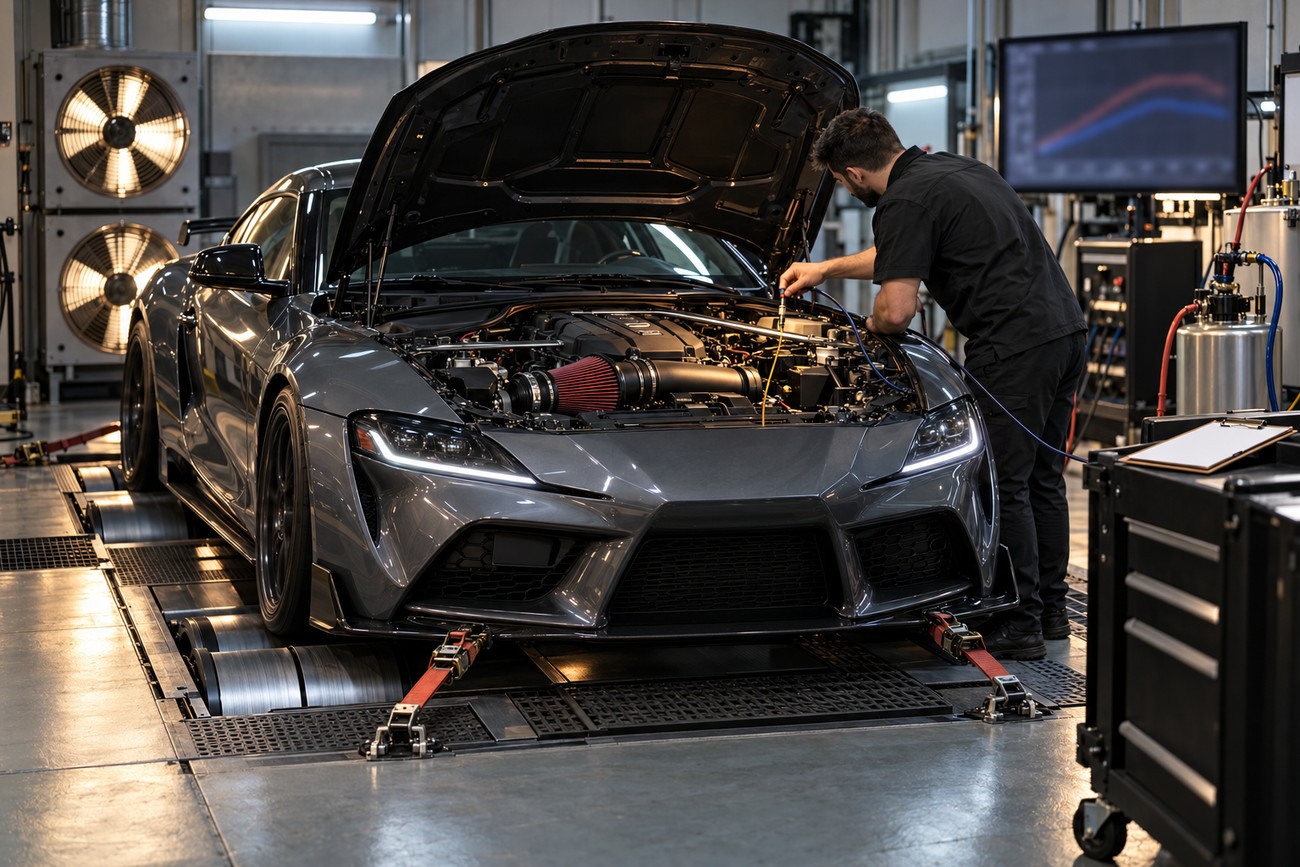
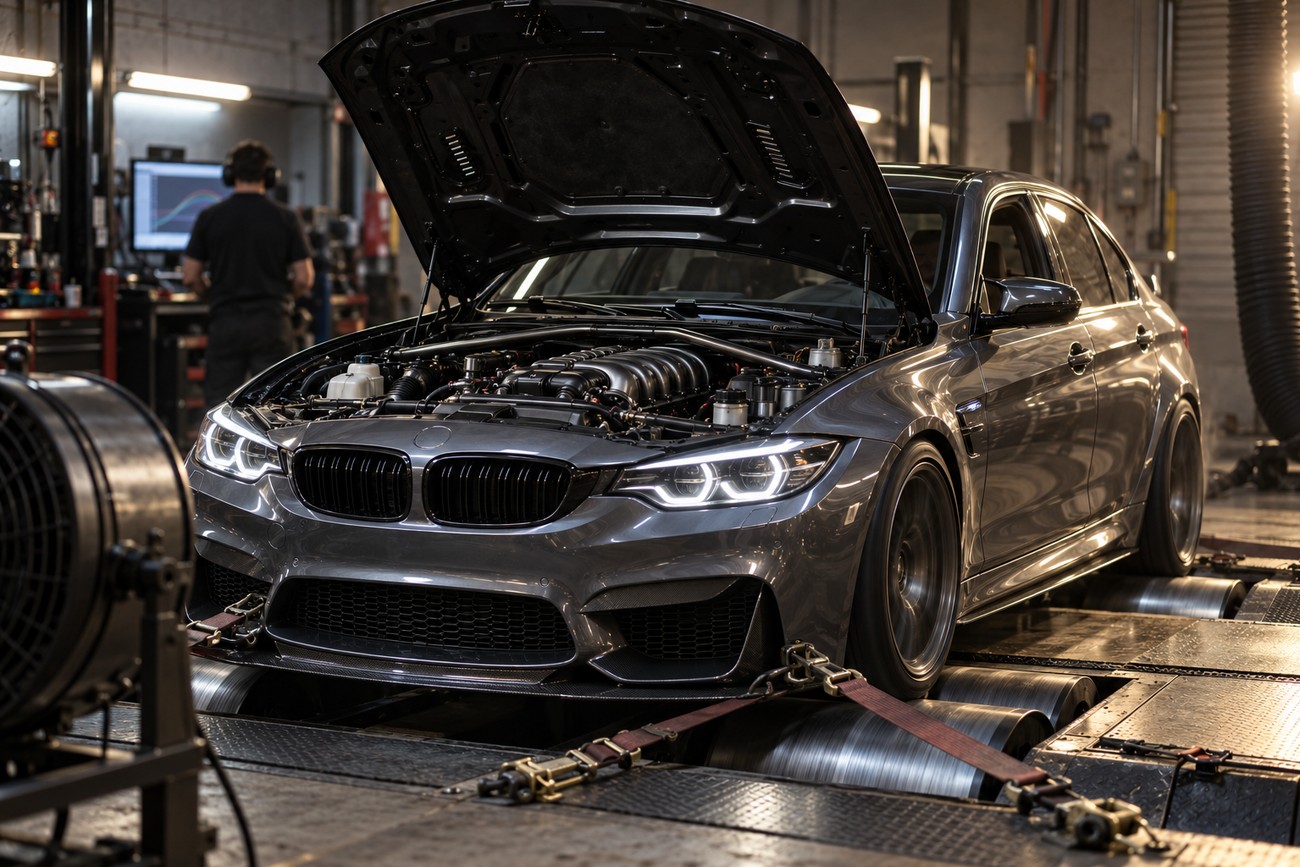
A credible before-and-after test starts with a controlled baseline. Use the same fuel, the same dyno and correction procedure, comparable engine temperature, and the same load settings. Keep the vehicle configuration unchanged apart from the intake, and allow the ECU to reach a comparable learning state before collecting the final data.
Run 3–5 baseline pulls and 3–5 post-installation pulls, then average the results. Record peak power, torque, and the shape of the curves instead of keeping only the best number. Intake air temperature and barometric pressure should be logged alongside the dyno data because weather and heat soak can distort a simple before-and-after comparison.
Require averaged runs with IAT and barometric pressure logged together. A single post-installation pull can mistake cooler weather, a different heat-soak state, or changing test conditions for intake power.
Review the test for consistency before accepting the result. If the runs vary widely, investigate fan placement, engine temperature, tire condition, ECU learning, fuel supply, and heat buildup. A small average difference that repeats across comparable pulls is more persuasive than a large difference between two isolated runs.
Road testing can add useful context when it is repeatable. Use the same route, fuel level, tire pressures, gear, launch method, and weather as closely as possible. Compare full-throttle acceleration where the intake is expected to matter, while remembering that a city commute at partial throttle may show little change even when the dyno result is valid.
A kit is worth considering when it demonstrates repeatable improvement, manages heat effectively, preserves drivability, and addresses a clear restriction in the factory system. A stock airbox may remain the better choice when it supplies sealed, cool air with adequate flow and stronger protection from water and debris. Noise and appearance can still justify a purchase, but they should be treated as ownership preferences rather than proof of horsepower.
Before buying, ask for evidence that matches the claimed result: comparable dyno conditions, averaged runs, temperature data, and a graph covering the full tested range. A product page that shows only a peak number offers too little information to judge whether the gain will survive real installation and daily use.
Frequently asked questions
Cold-air-intake decisions depend on the complete installation and the way the vehicle is used. These answers focus on ownership trade-offs and evidence that can help separate useful hardware from a louder replacement filter.
What is the downside of a cold air intake?
The main downsides are heat exposure, possible water exposure, extra noise, sensor or drivability problems, and additional maintenance. An exposed or poorly shielded filter can draw hot under-hood air after traffic, while a low-mounted inlet may be more vulnerable to water. The exact risk depends on the vehicle’s intake location and the quality of the installation.
A factory airbox is often the smarter choice when it supplies sealed outside air, protects the filter well, and provides adequate flow for the engine’s demand. A replacement system should also preserve compatible sensor readings and stable throttle response. If it adds noise without repeatable power or improves airflow only under ideal conditions, the trade-off may favor the original system.
How can I tell whether an intake kit is genuinely restrictive?
Look for pressure-drop data across the intake at a defined airflow or engine load, along with repeatable logs from the vehicle. Useful evidence includes consistent IAT behavior, stable mass-airflow sensor readings, and comparisons against the sealed factory system under the same conditions. Filter size and advertised horsepower do not establish restriction by themselves.
Check whether the kit preserves sensor compatibility, avoids sharp transitions, and maintains a sensible inlet path. A dyno graph showing a repeatable improvement across a useful rev range is stronger evidence than a single peak claim. If the supplier provides no test method, no baseline, and no environmental data, treat the advertised gain as unverified.
How should I test a cold air intake before and after installation?
Use the same fuel, dyno, correction method, engine temperature, and load settings for both tests. Run several baseline and post-installation pulls, then compare the averages rather than selecting the best result. Log intake air temperature, barometric pressure, torque, and the full power curves to account for weather and heat soak.
Repeatable road testing can provide additional context, but use the same route, gear, tire pressures, fuel level, and weather as closely as possible. A small improvement that appears consistently across comparable tests is more credible than a large difference between isolated runs.