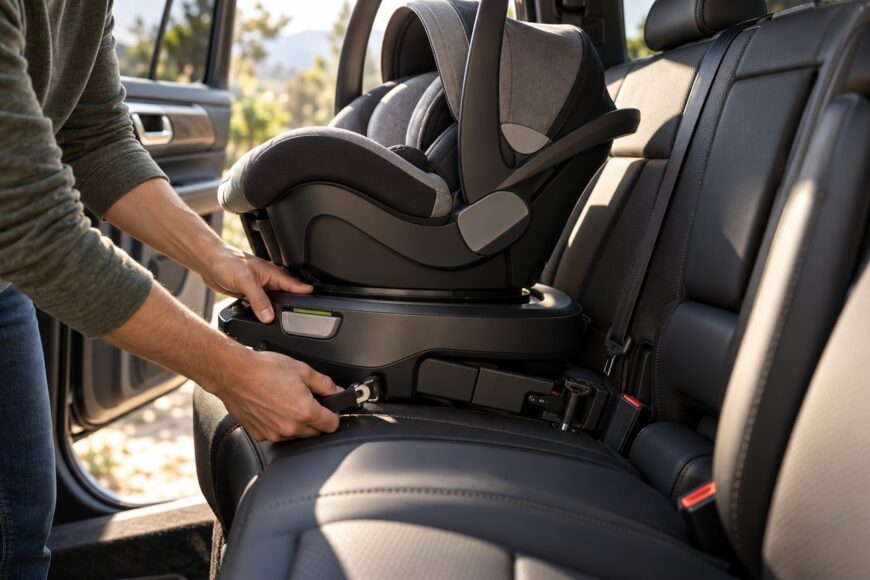
An accessory may promise an easier child seat installation, then leave the buckle trapped against plastic or add another connection to check. A base that clicks into place can still be wrong for the seat, the vehicle, or the position where you plan to use it.
Start with the approved combination: the exact child seat and accessory models, your vehicle, and the chosen seating position. Each part has a specific job. Understanding that job helps you decide whether an accessory solves a real fit problem or simply makes the installation more complicated.
- What counts as a child seat installation accessory?
- Installation accessories: what each part can and cannot fix
- Check compatibility before buying a base or adapter
- Top tethers and support legs: where they must connect
- When the seat will not fit or tighten properly
- The hidden costs of an easier-looking installation
- Frequently asked questions
- How do I assess a second-hand child seat base?
- How should I clean a base or lower-anchor connectors?
- What are car seat accessories?
- What are the car seat attachments called?
What counts as a child seat installation accessory?
A detachable base stays in the vehicle while a compatible child seat is removed. A rotating base may also let you turn the seat for access, within the uses allowed by its instructions. Bases and adapters may be approved only with specified child seat models; a matching-looking connection is insufficient evidence of approval.
Other parts may be built into the child seat or its approved base. Lower-anchor connectors attach to designated vehicle anchors. ISOFIX and LATCH are region-specific lower-anchor systems; neither term guarantees that a particular base fits every child seat or vehicle.
A top tether, support leg, and belt-routing features have different jobs. The tether limits forward rotation of a forward-facing seat, while a support leg bears on an approved point of the vehicle floor. Belt guides direct the vehicle belt along the seat maker’s specified route. These parts are not interchangeable ways to secure a seat.
Seat protectors, separate belt guides, and aftermarket adapters deserve particular caution. Check whether the child seat and vehicle makers permit the product in that installation. An accessory that changes the belt route, anchorage geometry, or instructed recline may interfere with the fit it claims to improve.
Installation accessories: what each part can and cannot fix
Use each component for its approved purpose; none makes an incompatible seat or seating position suitable.
| Component | Purpose and check | Cannot fix |
|---|---|---|
| Approved base | Secures a specified seat; check the seat, base, vehicle, and position approvals. | An incompatible child seat. |
| Lower-anchor connectors | Attach to designated anchors; check both manuals for the permitted method. | A required top tether or poor recline. |
| Top tether | Limits forward rotation; attach only to an approved vehicle tether anchor. | A missing approved anchor. |
| Support leg | Reduces rotation; check the vehicle-approved floor contact point. | An unapproved storage-compartment lid. |
| Unapproved add-ons | No established role in that installation; seek model-specific permission first. | Short belts, loose fit, or unsuitable anchorage. |
Check compatibility before buying a base or adapter
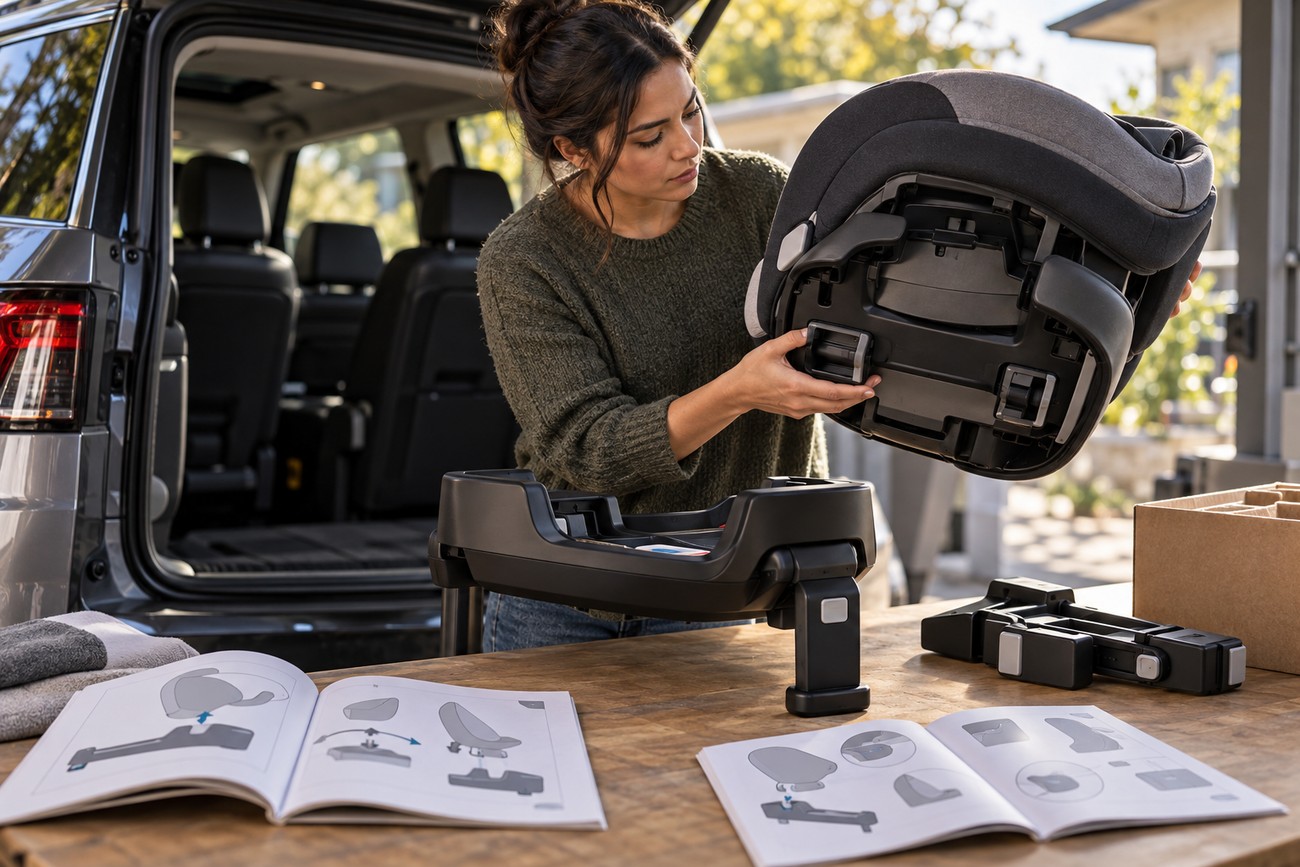
Write down the exact model of the child seat and the proposed base or adapter, including the version where the maker distinguishes between versions. Read their applicable instructions together. A base sold alongside a seat, or a connector that appears to latch, is not proof that those particular models are approved as a pair.
Next, check the manufacturer’s vehicle fit information, where provided, and the vehicle manual. Marketplace claims of “universal” fit may be broader than manufacturer model approvals and vehicle fit lists. Confirm the chosen seating position rather than stopping at the vehicle name; an outer rear seat and the center seat may have different anchors, cushion shapes, floor structures, or permitted installation methods.
Check how the approved combination is installed in that position. A visible set of lower anchors does not necessarily mean that every child seat can use them there, and a support leg needs a vehicle-approved floor contact point. If the instructions disagree or leave a position unclear, ask the child seat and vehicle manufacturers before ordering an accessory to bridge the gap.
Finally, check any child-size limits and operating rules for that configuration. Permitted use of a rotating base in a rotated position, including any restrictions tied to the child’s size, is model- and market-specific. Use the applicable manual rather than assuming that every position in which the base can physically turn is approved for travel.
Top tethers and support legs: where they must connect
Lower anchors secure the seat or base to designated points in the vehicle. On a forward-facing seat, a top tether limits forward rotation; use it when the child seat instructions require it, attached only to an approved vehicle tether anchor. Lower anchors do not replace a required tether, even if the seat feels firm when you pull it.
Tether anchors can be difficult to spot or may be absent from a proposed seating position. Use the vehicle manual to identify the anchor and its location; nearby cargo hooks, head restraints, and other convenient-looking fittings are not substitutes. If you cannot identify an approved anchor required for that installation, choose another approved seating position or installation option rather than improvising a connection.
A support leg performs a different rotation-control job by bearing on the vehicle floor. It may rest only on a vehicle-approved contact point. Storage-compartment lids, raised floor sections, and other floor features require specific approval, even when they seem solid under hand pressure.
Read the base or seat instructions alongside the vehicle’s guidance for that exact position. They may specify where the leg may stand or rule out its use there. A mat, board, or other makeshift reinforcement cannot create approval for a floor point that the vehicle maker has not cleared.
When the seat will not fit or tighten properly
A short vehicle belt, a buckle pressed against the seat’s plastic shell, or too little room beside another passenger can prevent a correct installation. First confirm that you are using the approved belt route and the permitted seating position. Do not add an extender, spacer, or adapter, or reroute the belt to make it reach unless the applicable instructions explicitly allow that solution.
If the seat seems loose, check movement at the belt path using the seat maker’s stated test. Confirm that the belt is secured as instructed, or that the lower-anchor connectors are attached and tightened as directed. Pulling on the top of the shell alone can make a properly installed seat appear loose because that edge may move differently from the attachment point.
Where both methods are approved, a vehicle-belt installation can fit better than lower anchors in a particular position. Use a vehicle belt, lower anchors, or a combination only as permitted by the child seat and vehicle instructions. Adding both methods without permission can change how the seat is held rather than cure looseness.
An infant seat that will not reach its instructed recline needs another approved installation solution, not an extra cushion or an altered belt route. Its recline angle matters for breathing as well as comfort. Check any adjustment method specified by the seat maker; if the correct angle remains out of reach, try another approved position or seek model-specific guidance.
The hidden costs of an easier-looking installation
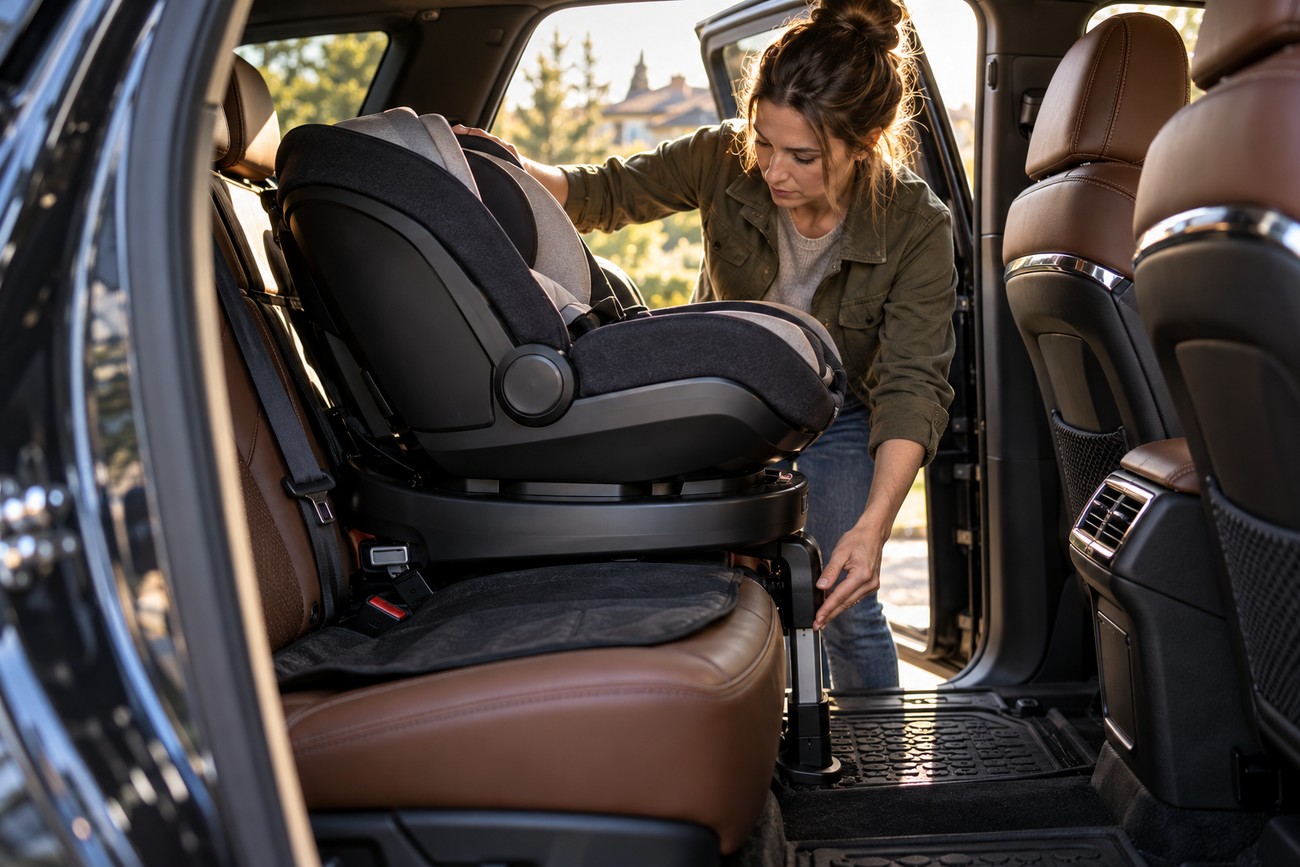
A rotating base may make access easier while adding weight, bulk, and another step to verify before travel. Check that the seat locks in its approved travel position each time. Also consider door clearance, the child’s room to climb in, and whether moving the system between vehicles would require repeating several model-specific checks.
Contact with upholstery and the vehicle floor matters, but cosmetic protection is a separate question from an approved installation. A protector that changes the seat’s grip or position may affect the fit. Check both makers’ instructions before placing material beneath a seat or base, particularly where the vehicle has seat-heating or ventilation features.
Likewise, a support leg can leave a mark without being incorrectly installed, while a cushioned-looking floor can be unsuitable for it. Appearance and a firm feel alone do not establish approval. Check the leg’s permitted contact point and the full installation instructions rather than judging the result by how little the assembly moves when pushed.
Plan for the accessory’s service life as well as its everyday use. After a crash, follow the manufacturer’s replacement instructions for the seat, base, and accessories, even if no damage is visible. Keep the model details and instructions accessible so you can identify every component covered by that guidance.
Frequently asked questions
These purchase and care checks concern the accessory itself. Keep its model information and instructions with the child seat records so the details remain available when you need them.
How do I assess a second-hand child seat base?
Identify the exact model from intact labels, obtain its complete instructions, and check its recall status through the manufacturer or relevant local authority. Ask for a reliable account of its history, including any crash involvement and whether parts have been replaced. If you cannot establish what the base is or how it has been used, you cannot confidently apply its approval and replacement instructions.
How should I clean a base or lower-anchor connectors?
Follow the product’s cleaning instructions, especially for buckles, connector mechanisms, and indicators. Remove debris only by an approved method, and let cleaned parts dry as directed before use. Do not apply lubricant or dismantle a connector unless the manufacturer specifically authorizes it; either action could affect its operation.
What are car seat accessories?
They are separate products used with a child seat, such as an approved detachable base, rotating base, or model-specific adapter. Some products sold in the same category, including upholstery protectors, do not help secure the seat. Check the product’s stated purpose and approval before treating it as part of the installation.
What are the car seat attachments called?
Common names include lower-anchor connectors, called ISOFIX or LATCH connectors in different regions, and the top tether and its hook. A seat or base may also have a support leg or a vehicle-belt locking feature. Use the names and diagrams in your particular manuals when checking a connection, since similar-looking parts can have different roles.