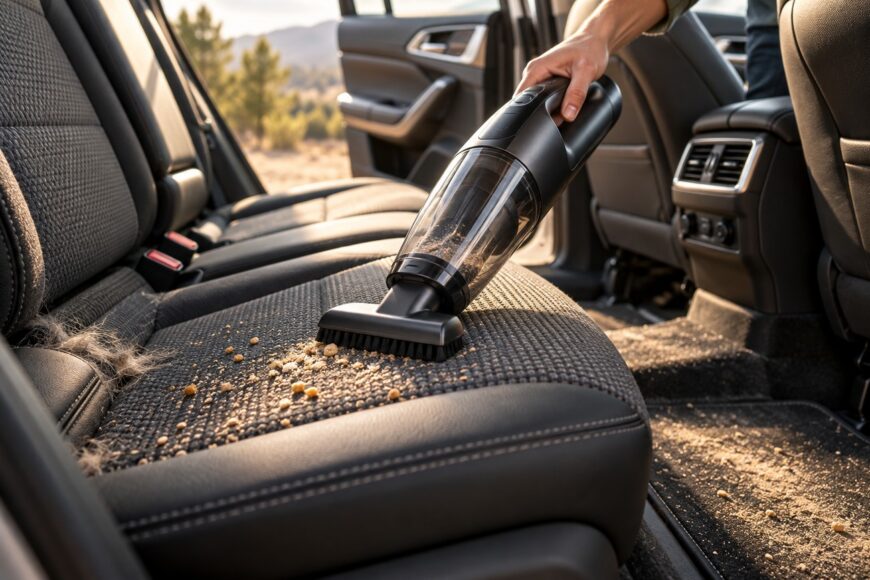
A few crumbs beside the seat can defeat a small vacuum if its nozzle cannot reach them. Sand caught in a floor mat is harder still. For a quick cleanup, useful attachments and a machine you can grab easily matter as much as its advertised suction.
The right choice depends on where you park and what lands in your car. A cordless unit may suit a parking space without an outlet; a larger vacuum may make more sense if gritty mats and pet hair are routine. Start with the mess you need to lift, then consider how easily you can reach it.
- Start with the mess you actually need to remove
- Cordless, car-outlet, or mains-powered: which fits your setup?
- Look past watts and advertised suction
- Check whether the tools can reach the dirt
- Will it stay convenient through the whole cleanup?
- Keep quick cleanups quick—and know when to switch tools
- Frequently asked questions
- What kind of vacuum do auto detailers use?
- What is the best vacuum to clean your car with?
- What is the best vacuum cleaner for car cleaning?
Start with the mess you actually need to remove
Loose crumbs on a seat, dust on a console, and grit on a smooth floor mat are reasonable jobs for a compact car vacuum. These are the spills worth tackling while they are still small. If the vacuum lives somewhere easy to reach, a short pass can keep loose debris from spreading through the cabin.
Sand worked into carpet pile is a different test. A light handheld may collect the grains on top while leaving the rest embedded, especially if its filter is already dirty. For heavily soiled mats, plan on a larger vacuum or a dedicated clean rather than expecting a quick-touch-up tool to do the whole job.
Pet hair clings to fabric, so a plain nozzle can struggle even when the vacuum picks up crumbs well. Debris beside a seat presents another problem: the machine may have enough suction, yet its opening never gets close to the dirt. Think about the surfaces and tight spots in your own car before comparing specifications.
A compact model earns its place by making frequent maintenance realistic. It need not replace a thorough carpet clean to be useful; clearing fresh crumbs and loose dust regularly also leaves less debris for a later deep clean.
Cordless, car-outlet, or mains-powered: which fits your setup?
Check the power source where you park, then picture reaching the rear seats and trunk from there. The three options make different demands on your routine.
| Option | Best use | Access needed | Main compromise |
|---|---|---|---|
| Cordless | Quick passes around the cabin | A charged battery and a place to recharge | Limited runtime; charging takes time |
| Car-outlet | Touch-ups where a vehicle socket is available | A suitable socket and cable that reaches the work | Cable routing and performance vary by model |
| Mains-powered | Heavier cleaning near an outlet | An accessible mains outlet and adequate cord reach | Less freedom to move around a parked car |
Look past watts and advertised suction
Watts describe electrical input, not how much dirt a vacuum removes from a seat or mat. The often-cited ranges of 60–80 W for maintenance and 100–160 W for more thorough cleaning are informal marketing and review heuristics, not standardized performance thresholds. They cannot tell you whether a nozzle will lift sand from your carpet.
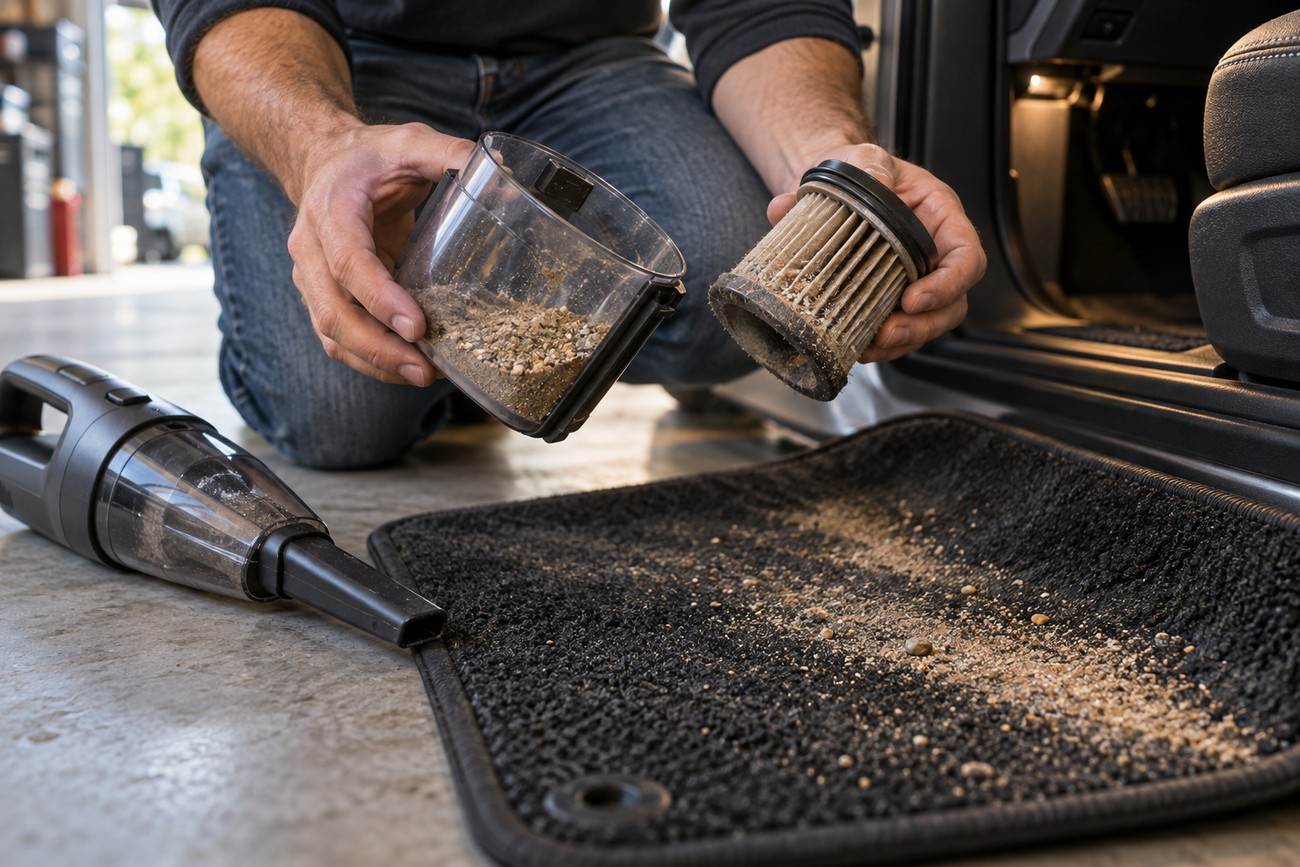
Airflow, the fit of the attachments, housing seals, and filter condition all affect pickup. A vacuum that works well with an empty bin may become frustrating as dust collects on the filter. Look for reviews that test the machine after some use, rather than showing only its first pass over loose crumbs.
Advertised suction in pascals is another clue with limits. Figures from different models are not reliably comparable unless the test conditions match. A high number measured at an opening says little about how a wide attachment handles pet hair on fabric or how a narrow one lifts grit beside a seat.
Give the most weight to credible demonstrations on debris and surfaces that resemble yours. Check whether crumbs disappear in one controlled pass, whether sand remains in mat fibers, and whether hair needs repeated brushing. Those observations are more useful for a quick-clean purchase than a specification in isolation.
Check whether the tools can reach the dirt
A slim crevice tool belongs near the top of the list for car use. It should fit beside the seat and along console seams without forcing you to press the vacuum body against trim. A narrow opening is useful only if you can guide it over the debris.
Under-seat access depends on the shape of the whole attachment. Check its length and angle as well as its width, particularly if the space beneath your front seats is shallow. A flexible extension or a suitably angled nozzle may reach an area that a straight, rigid tool cannot.
A tool can look narrow enough to slide under a seat yet leave dirt behind if its angle holds the nozzle opening above the carpet. Check whether the opening can sit against the surface you want to clean.
For fabric seats and pet hair, look for an upholstery brush that can loosen hair while the vacuum collects it. A suitable motorized brush can help on some fabrics, but check its size and surface guidance before assuming it will work on every seat or mat.
Extra attachments have little value if they are awkward to swap or cannot reach your problem spots. A short set of tools that covers seat gaps, floor edges, and upholstery is often more useful than a crowded box of poorly shaped nozzles.
Will it stay convenient through the whole cleanup?
Check cordless runtime on the power setting you expect to use. Some compact models have tested at around 11 minutes, which can be limiting if you intend to cover the entire cabin and trunk. At least 12–15 minutes of usable runtime is a practical quick-clean shopping target, not a guarantee that every vehicle can be finished on one charge.
Charging time matters if the vacuum is likely to be left uncharged after a spill. So does one-handed comfort: a unit that feels manageable in an open room can strain your wrist when you hold it at an angle beside a seat. If possible, assess the grip with the attachment you would actually use.
For a corded model, trace the cable route from the outlet to the far side of the car and into the trunk. At least 4 m is a common practical recommendation, not a universal requirement; outlet position matters more than the number alone. A car-outlet model also needs a suitable vehicle socket and enough reach without the cable catching on seats.
A small vacuum is easier to keep ready, but its bin may need emptying partway through a cleanup. Check whether you can remove the bin and filter without spilling collected dust into the cabin. The best storage spot is one that lets you grab the vacuum easily while keeping it secure when you drive.
Keep quick cleanups quick—and know when to switch tools
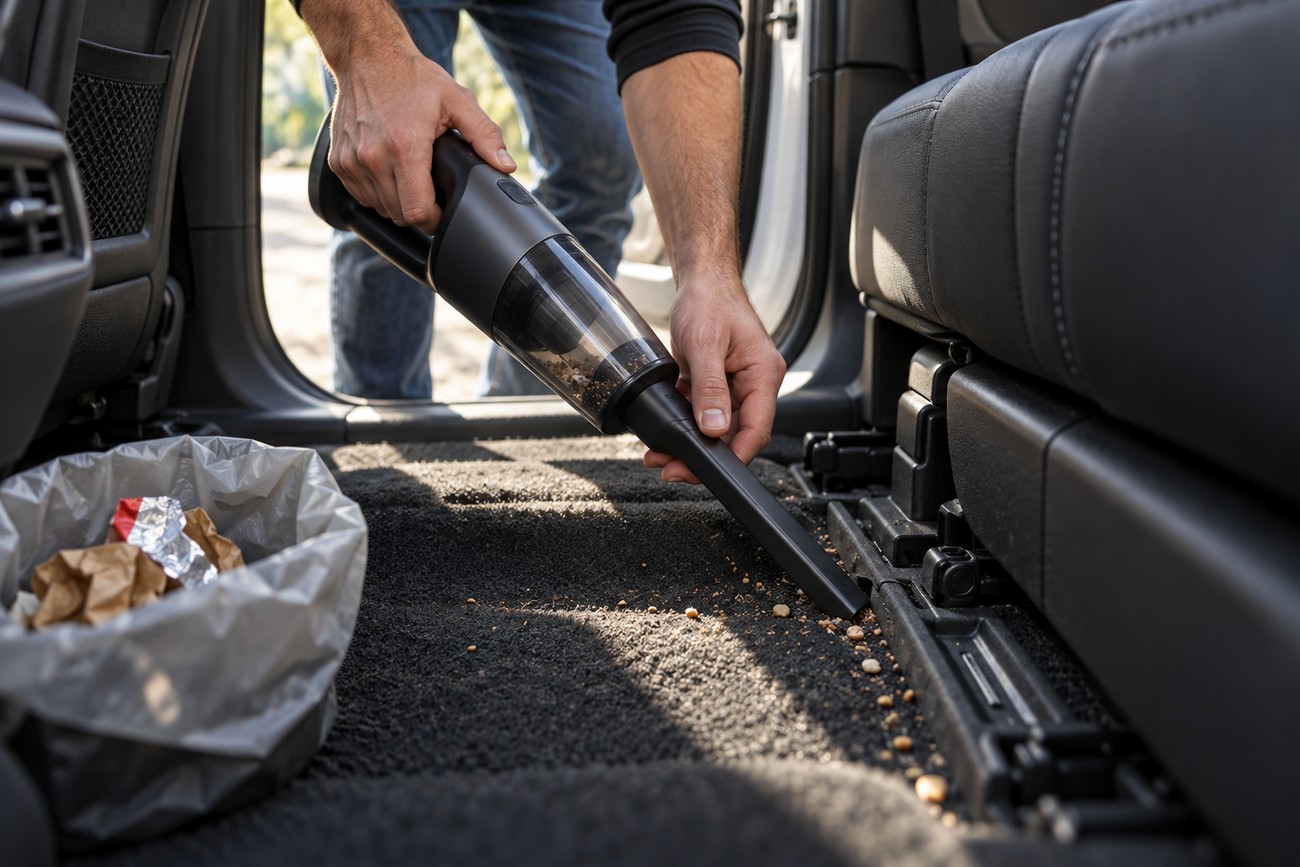
Pick up large wrappers or other objects that could block the inlet before switching on the vacuum. Start with exposed seats and floor areas, then use the crevice tool along edges and seams. This leaves the fiddly spots for a focused pass instead of turning a small spill into a tour of the entire car.
Empty the bin before it is packed full, and check the filter when pickup starts to fade. A full bin or clogged filter can make a capable vacuum feel weak, particularly on sand and crumbs. Follow the maker’s instructions for cleaning and fully drying any washable filter before putting it back.
A filter label alone does not prove that fine dust will stay contained. The fit of the bin, housing seals, and condition of the filter all affect the dust path. If emptying the machine releases a cloud of dust, do it outside the cabin and inspect whether the bin and filter are seated correctly.
Stop treating a quick cleanup as a deep clean when repeated passes leave sand embedded in the carpet or mats remain heavily soiled. A larger vacuum and more deliberate cleaning will be more effective there. Keep the compact unit for fresh messes and accessible dirt, where its small size pays off.
Frequently asked questions
What kind of vacuum do auto detailers use?
Auto detailers commonly use larger workshop wet/dry or commercial vacuums with specialist attachments. Their equipment is suited to extended cleaning and a wide range of vehicle conditions, but it needs storage, a power source, and time to set up. A compact vacuum can be a better purchase for someone who wants to remove fresh crumbs between deeper cleans.
What is the best vacuum to clean your car with?
For routine small messes, choose a vacuum you can keep ready and use comfortably in the spaces you clean most. If you mainly clean beside seats, confirm that its crevice tool fits there; if your mats often hold ground-in sand, access to a larger vacuum may matter more than owning a compact one. For a liquid spill, use only equipment whose instructions explicitly permit wet pickup—never assume a dry-only vacuum can handle it.
What is the best vacuum cleaner for car cleaning?
For a full-car clean, the best option is one that can handle your hardest surface and reach your parking space. Mains-powered equipment may be practical near an accessible outlet; a cordless unit is easier to use away from one, within its runtime. If you choose a car-outlet vacuum, check its cable reach and performance separately from mains-powered models. It draws power from the vehicle electrical system, so consult the vehicle and vacuum instructions before using it with the engine off.