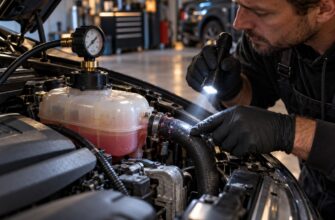
Adding oil between services is frustrating, especially when the driveway stays dry. A clean parking space does not prove the oil is staying inside the engine. It may escape through a small external seep, enter the intake through the crankcase ventilation system or turbocharger, or burn in the cylinders.
Start by measuring the loss rather than accepting “normal consumption” or approving major engine work on a guess. Record the oil added and the distance driven under consistent conditions. Then check accessible causes, including the oil level, specification, leaks, PCV system, intake, and turbo-related components, before drawing conclusions about internal engine wear.
- Confirm How Much Oil Is Disappearing
- Where the Oil Goes When You Cannot See a Leak
- Oil-Loss Clues by Driving Condition
- Check Accessible Causes Before Approving Major Engine Work
- What Can Stop Oil Consumption—and What Only Hides It
- When “Within Spec” Still Deserves Attention
- Frequently asked questions
- How should I document oil use for a dealer or warranty claim?
- How do I stop an engine from burning oil?
- Why is my engine losing oil if there is no leak?
- Why does my engine burn oil when I drive?
Confirm How Much Oil Is Disappearing
Check the oil on level ground, allowing the engine to sit for the same amount of time after shutdown each time. Use the same dipstick procedure and read the level at eye height. Checking once on a slope, once immediately after a hot shutdown, and once after an overnight rest can create a misleading trend.
Record the date, odometer reading, oil level, and amount added. Compare the oil added with the distance driven, using consistent level-check conditions. This record is also useful if a dealer needs to perform a formal oil-consumption test.
The change from the vehicle’s previous behavior matters. A sudden increase is more concerning than a stable, moderate rate, even when the measured rate falls within a manufacturer’s stated allowance. A car that previously needed no top-ups deserves investigation when it begins requiring regular additions.
Some manufacturers’ service policies allow consumption approaching 0.5–1.0 L per 1,000 km; this is not a universal normal rate or proof of engine health. An owner may reasonably investigate a new rate of 0.2–0.5 L per 1,000 km, particularly if the engine previously needed no top-ups, even where a manufacturer’s allowance is higher.
Where the Oil Goes When You Cannot See a Leak
Oil can escape through an external leak, enter the intake through crankcase ventilation or turbo-related faults, or burn in the cylinders. A small seep at a valve cover, timing cover, seal, or other joint may spread across the engine or burn on a hot surface without forming a visible puddle.
A faulty PCV/CCV system can carry excess oil into the intake without leaving an external puddle. A blocked oil separator, failed valve, or damaged diaphragm can upset crankcase pressure and increase the amount of oil drawn into the intake. The result may look like unexplained consumption even when the engine’s external surfaces appear dry.
Oil in intake plumbing is a direction for testing, not a verdict on the turbocharger. PCV operation, the oil separator, charge-air plumbing, shaft condition, and other fault evidence should be assessed before an expensive component is replaced.
Stuck or worn oil-control rings reduce control of oil on cylinder walls. Oil-control problems can develop before an obvious loss of compression, so normal-looking compression results do not always rule out an oil-consumption problem. Valve-stem seals and guides can also allow oil into the combustion chamber, particularly after the vehicle has been parked for a long period.
Moderate oil burning may produce no obvious exhaust smoke. Catalytic converters can make light consumption difficult to see, and smoke may appear only under particular operating conditions. No puddle and no visible blue smoke therefore narrow the clues without confirming a specific failed component.
Oil-Loss Clues by Driving Condition
The timing of smoke or oil loss can help determine the next inspection. Each pattern below is a clue rather than proof, and several faults can produce similar symptoms.
| Observation | Plausible causes | Useful next check |
|---|---|---|
| Oil disappears faster during sustained highway driving | Higher engine speed and temperature may increase oil passing the rings, through the PCV system, or through turbo-related components | Measure consumption over a documented distance, inspect the PCV system and intake, and check for external seepage |
| Blue smoke appears after startup following a long rest | Valve-stem seal or guide issues are possible; oil may have entered the combustion chamber while parked | Confirm that the smoke is blue oil smoke rather than ordinary cold-start condensation, then use targeted engine testing |
| Smoke or consumption increases after prolonged idling | Oil may be drawn past valve seals or through the crankcase ventilation path, although the observation is not diagnostic | Inspect intake plumbing, PCV operation, and smoke behavior during controlled testing |
| Consumption changes after an oil service | Incorrect specification, unsuitable viscosity, overfilling, an oil filter issue, a leak, or loosened deposits may be involved | Verify the required oil specification, fill level, and filter installation, and inspect the engine and underbody for leaks |
| Oil is lost without a puddle or obvious smoke | Internal burning, PCV/CCV carryover, turbo-related oil entry, or a small leak may be responsible | Inspect the intake and crankcase ventilation system, check for seepage, and continue a controlled consumption record |
Blue smoke is different from the light white vapor commonly seen during cold starts in damp conditions. Smoke with a blue tint, an oily smell, or a repeatable connection with startup or acceleration is more useful diagnostically, but its timing alone cannot identify the failed part.
Check Accessible Causes Before Approving Major Engine Work
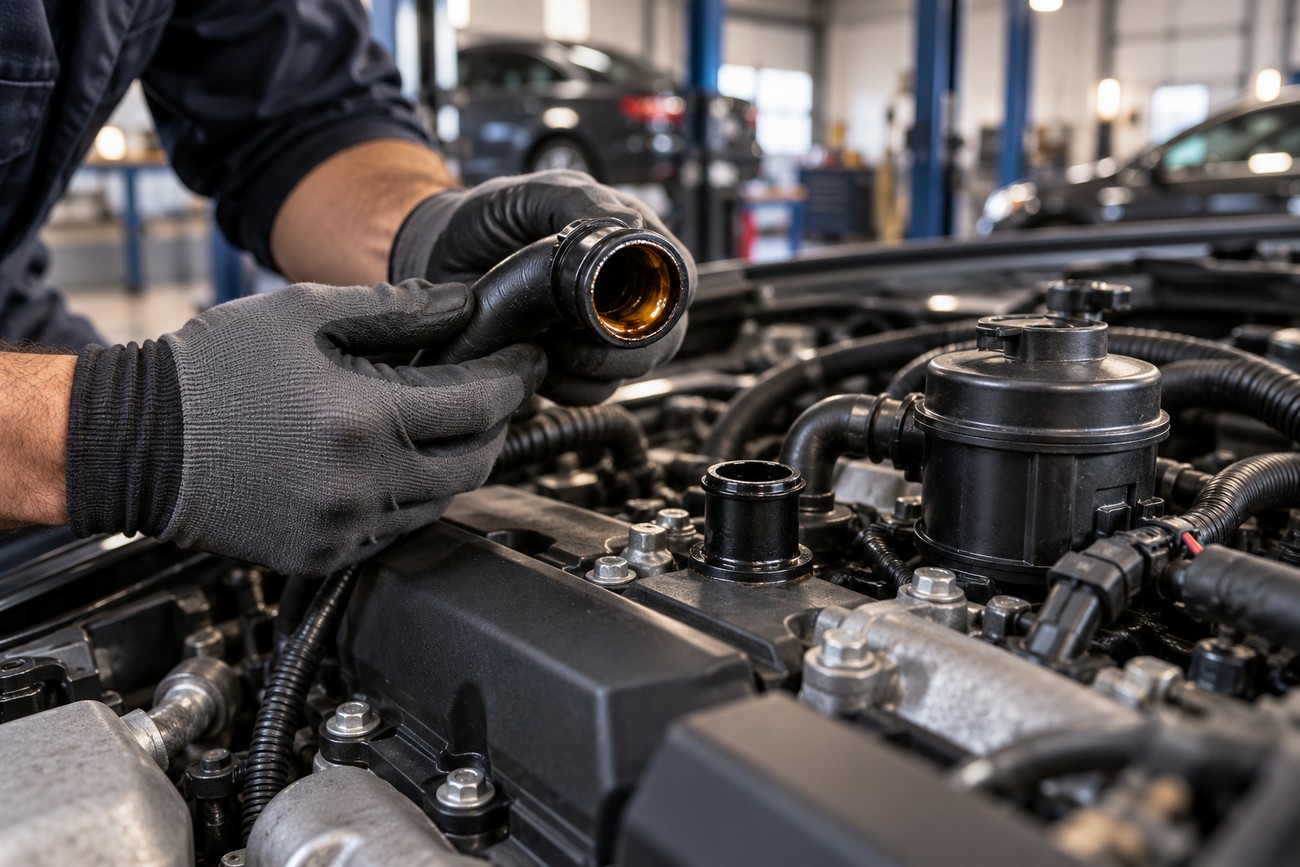
Begin with the basics: confirm the oil level and specification, then inspect the engine, filter area, drain plug, seals, and underbody for seepage. A small leak may leave a film rather than a puddle, so cleaning the area and rechecking after driving can make the source easier to locate.
Next, assess the PCV/CCV system and inspect the intake for excessive oil, residue patterns, and a restricted or damaged oil separator. The amount and location of oil matter, but oil found in intake plumbing alone does not establish that the turbo or engine requires replacement.
On a turbocharged engine, inspect the turbo-related oil paths, charge-air pipes, intercooler, intake, and exhaust side as appropriate. A whistle may indicate an air leak, turbo wear, or another issue, but it is not a diagnosis by itself. Turbo-related faults are one possible oil path, not a conclusion based only on noise or a light oil film.
If these checks do not explain the loss, a mechanic may use a controlled consumption test, compression testing, leak-down testing, borescope inspection, or other checks suited to the engine. Stuck or worn oil-control rings can cause consumption before an obvious loss of compression. Test results should be interpreted together rather than used as a single pass-or-fail answer.
What Can Stop Oil Consumption—and What Only Hides It
The effective repair depends on the verified path of oil loss. External seepage requires repairing the leaking joint or seal; a ventilation fault requires correcting the PCV/CCV system; and a proven turbo-related fault requires the appropriate turbo or oil-path repair. Internal wear may require engine repair when testing confirms damaged or worn components.
Use the vehicle’s required oil specification for top-ups and check compatibility before mixing products. Thicker oil may change consumption temporarily, but it does not repair worn parts or a faulty PCV system. Using a viscosity outside the required range can also affect cold-start lubrication, oil pressure, and emissions-system operation.
Additives and carbon-removal treatments can sometimes change symptoms when deposits contribute to ring sticking. Temporary improvement after carbon removal does not establish that underlying wear has been resolved. If consumption returns, the measured trend remains more useful evidence than the short-term result.
When “Within Spec” Still Deserves Attention

A manufacturer’s allowance is usually a service-policy threshold used for assessment or warranty decisions. It is not a universal normal rate and does not prove that the engine is healthy. Some manufacturers’ service policies allow consumption approaching 0.5–1.0 L per 1,000 km, but the acceptable figure depends on the vehicle, engine, operating conditions, and published procedure.
An owner may reasonably investigate a new rate of 0.2–0.5 L per 1,000 km, especially if the engine previously needed no top-ups. A sudden increase is more concerning than a stable, moderate rate because it can indicate a developing leak, ventilation fault, turbo-related problem, or internal wear.
Check the level promptly if it is falling rapidly, blue smoke persists, or the engine develops new noise or roughness. If the oil-pressure warning appears, stop the engine as soon as it is safe to do so. Restore a low oil level with the required specification, but do not continue driving if the level is insufficient or the oil-pressure warning remains on; continued operation may cause substantial engine damage.
Frequently asked questions
A consistent oil-consumption record helps you and a mechanic assess what has changed. The location of any oil residue and the conditions under which consumption increases can guide the next check. These answers explain how to document the loss and why a dry driveway does not rule out a problem.
How should I document oil use for a dealer or warranty claim?
Keep dated oil-level readings, mileage, the amount added, and receipts for every top-up. Record the conditions used for each measurement, including whether the vehicle was level and how long the engine rested before checking.
Ask the dealer to follow the vehicle manufacturer’s specified consumption-test procedure. A consistent record helps distinguish a new change from an inaccurate dipstick reading and gives the dealer evidence to compare with the vehicle’s service policy.
How do I stop an engine from burning oil?
Address the confirmed cause rather than treating the symptom alone. That may mean repairing a leak, correcting the PCV/CCV system, addressing a proven turbo-related fault, or repairing worn internal components.
Thicker oil, additives, or carbon-removal treatments may alter consumption temporarily. They should not replace testing, and the vehicle’s required oil specification should guide every top-up and service.
Why is my engine losing oil if there is no leak?
Oil may be entering the intake through the crankcase ventilation system or turbo-related components, or it may be burning in the cylinders. A small external seep can also spread or burn without leaving a puddle.
Oil around a spark plug, in the intake, or on an engine surface is a clue, not a diagnosis of internal engine wear. The location, quantity, consumption trend, and supporting test results must be considered together.
Why does my engine burn oil when I drive?
Consumption can become more noticeable under sustained load or at higher engine speed as heat and pressure increase. Highway driving may therefore reveal a problem that is less obvious on short urban trips.
Document the difference between driving conditions, then inspect the oil level, PCV system, intake, turbo-related components, and external sealing surfaces. The driving pattern suggests where to look next, but it does not identify the failed component by itself.