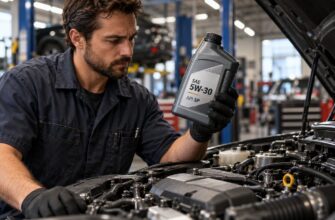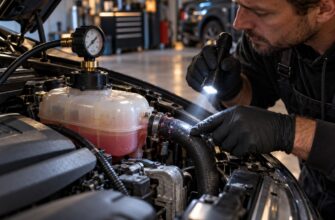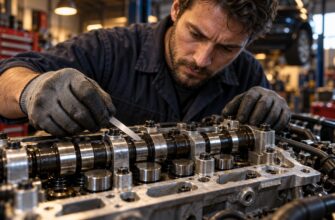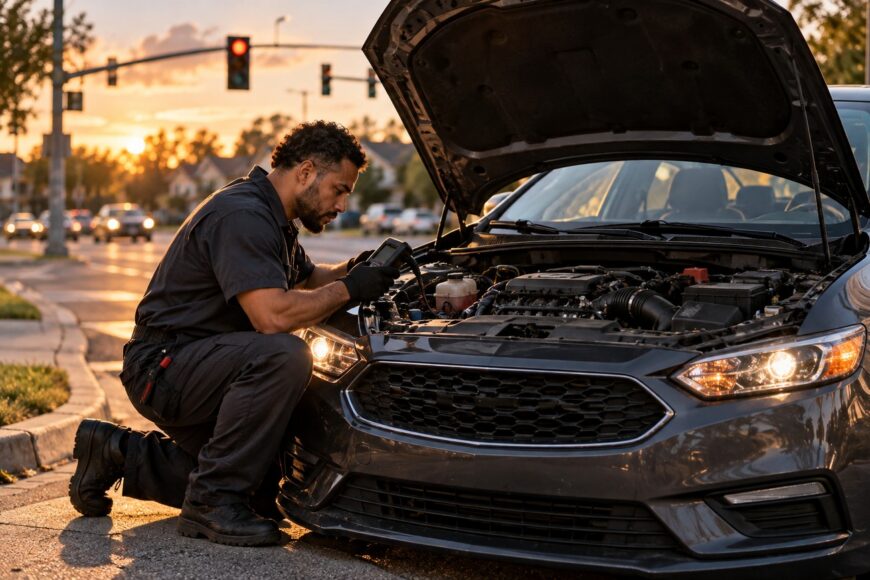
The engine dies at a stoplight, then restarts easily a few seconds later. Sometimes the Check Engine light stays off, which makes the fault harder to interpret. A stall during idle can arise from an intake leak, insufficient fuel, an ignition misfire, incorrect sensor data, a restricted exhaust, or excessive load from an accessory.
The symptom alone does not identify the failed part. The useful evidence is the condition in which the engine stalls: cold start, warm idle, braking, gear selection, air-conditioning use, steering load, or an immediate restart. Measured fuel pressure, smoke testing, live data, and electrical checks usually provide more direction than replacing the most obvious component.
- What the Stalling Pattern Tells You
- Air Leaks, the Throttle, and Idle Control
- Fuel Delivery and Ignition Faults
- Sensors, Exhaust, and Mechanical Causes
- A Diagnostic Sequence That Avoids Parts Swapping
- Common Diagnostic Mistakes and Myths
- Frequently asked questions
- Why does my car stall when the air conditioner is turned on or the steering is loaded?
- Why is my engine stalling while idling?
- What sensor can cause stalling?
- What could be the reasons why my car stalls but won’t start?
What the Stalling Pattern Tells You
The timing of the stall helps set the testing order. A cold-start problem can point toward temperature input, mixture control, ignition, or an air leak that becomes less influential as the engine warms. A stall only after warm-up may involve fuel delivery, closed-loop corrections, idle control, or a component that fails with heat.
Watch what happens during deceleration and braking. If the engine dies as you come to a stop, the idle-control system may be unable to catch the falling RPM, while a brake-booster leak can introduce unmetered air when the pedal is applied. A stall when selecting Drive or Reverse adds transmission load; a stall with the air conditioner or steering load suggests that the engine is not receiving the expected idle-up correction, or that an accessory is dragging excessively.
An immediate restart does not make the fault harmless or insignificant. An intermittent vacuum leak, idle-control failure, fuel-pressure problem, or unstable sensor signal can allow a restart while remaining capable of another stall moments later. Record whether the engine cranks at normal speed, whether it starts only with throttle input, and whether the symptom changes with temperature.
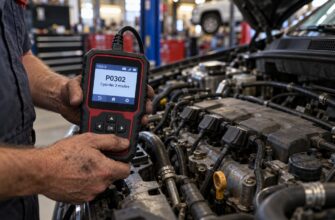
A missing warning light is also weak evidence. Live misfire activity can be visible before a confirmed Check Engine code or warning light appears. Pending or not-yet-confirmed codes and freeze-frame information may preserve useful evidence before a fault becomes a confirmed code, so scan the vehicle before clearing anything.
Air Leaks, the Throttle, and Idle Control
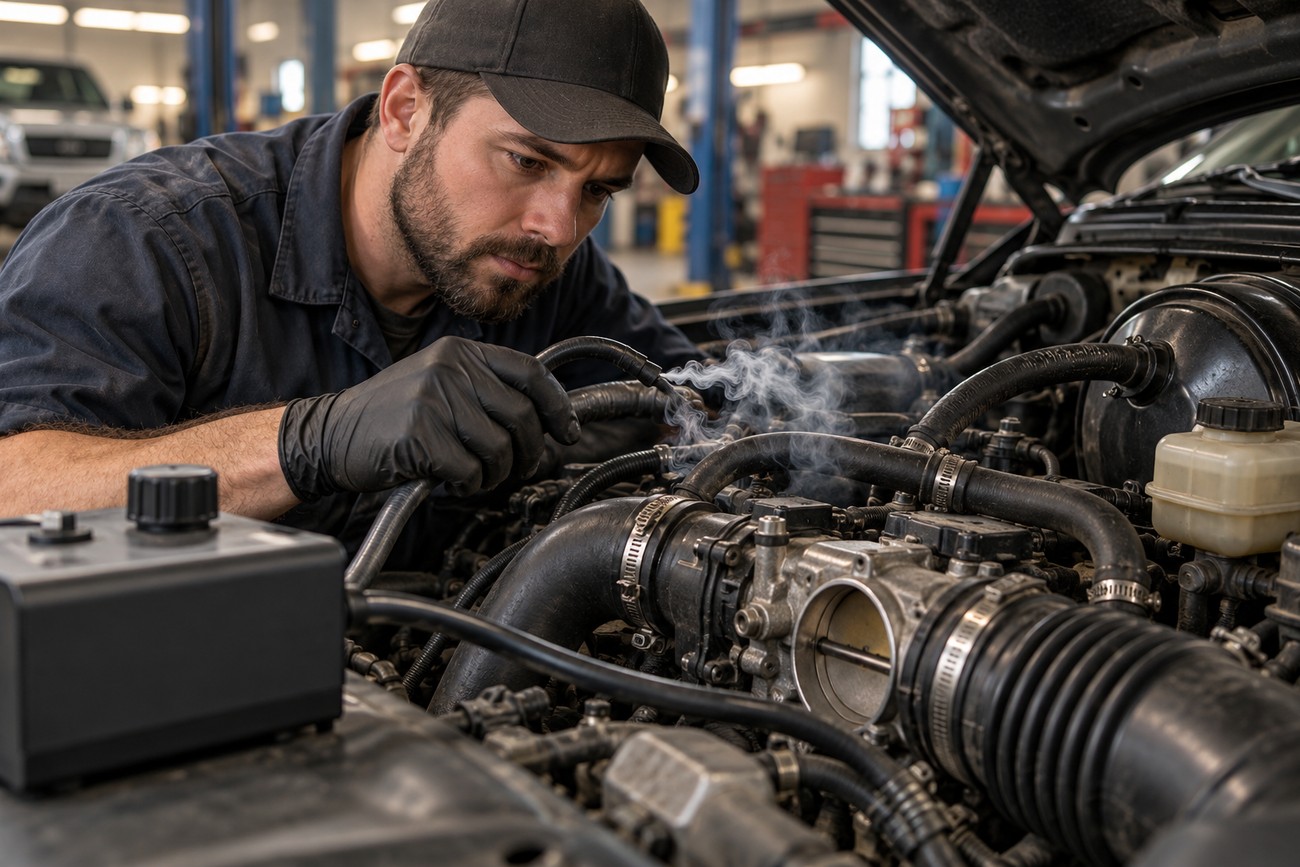
With the throttle nearly closed, the engine has little airflow margin. Unmetered air entering through a cracked vacuum hose, PCV connection, intake gasket, or brake-booster circuit can lean the mixture at idle and cause rough running, fluctuating RPM, or stalling. The same leak may be less obvious at raised RPM, which is why a vehicle can drive reasonably while dying at a stop.
Begin with a careful visual inspection of hoses, clamps, PCV plumbing, and the intake tract. A smoke machine is a practical method for locating intake, vacuum, PCV, or brake-booster leaks. Listen for hissing, but do not treat the absence of a sound as proof that the system is sealed; small or hidden leaks can require smoke testing.
Deposits around the throttle plate can reduce the available bypass airflow and disturb idle control. Cleaning may help when contamination is confirmed, but it is not a substitute for checking leaks, mixture data, and throttle operation. After throttle cleaning or battery replacement, some vehicles require a vehicle-specific idle or throttle adaptation procedure; there is no universal sequence.
On systems equipped with a separate IAC valve, the valve meters bypass air when the throttle is closed. Sticking or contamination can prevent the engine from catching the idle as loads change. Modern electronic-throttle systems may not use a separate IAC, so buying one based on a generic symptom can lead to the wrong repair.
Fuel Delivery and Ignition Faults
Fuel starvation and ignition failure can both look like a basic idle problem. Low fuel pressure may result from the pump, filter, regulator, wiring, or electrical supply. Measure fuel pressure against the specification for the specific engine; do not infer adequate pressure from pump noise or from the fact that the pump runs.
Check pump power and ground before approving a pump replacement. A weak supply, poor ground, restricted filter, or failing regulator can produce the same symptom as a worn pump. Pressure should also be observed under the conditions that trigger the stall, because a system can appear acceptable during a brief static check and fail as demand or temperature changes.
Ignition faults and injector problems deserve equal attention. Worn plugs, a failing coil, injector problems, or a wiring fault can create misfires severe enough to stop the engine, even without an immediately illuminated Check Engine light. Live misfire counters, fuel trims, and the operating conditions are more informative than automatically replacing plugs or coils.
Mixture direction matters. An air leak tends to support a lean condition, while injector or regulator faults can create an overly rich condition. Both may produce unstable idle, poor restarting, or an engine that dies when the throttle closes, so the symptom should be matched with fuel-trim and exhaust evidence rather than guessed from the sound alone.
Sensors, Exhaust, and Mechanical Causes

MAF, MAP, TPS, and coolant-temperature inputs influence the air, fuel, and idle decisions made by the engine controller. A MAF, MAP, TPS, or temperature-sensor code does not automatically prove that the sensor itself has failed. Check the reading for plausibility, then verify wiring integrity, power, ground, connector condition, and live-data behavior.
Disconnecting the MAF can sometimes make the engine run better because the controller switches to a fallback strategy. That temporary improvement does not, by itself, prove a defective MAF. It may simply hide an intake leak, incorrect airflow measurement, or another condition that the fallback strategy handles differently.
A MAP reading near atmospheric pressure with the ignition on and the engine off is only a plausibility check; exact readings vary with altitude and weather. Similar caution applies to throttle position and coolant temperature: a value can be electrically present yet implausible for the engine’s actual condition. Compare readings with cold-start behavior, warm operation, and other sensors rather than judging one number in isolation.
Electronic data can look reasonable when the cause is mechanical. A restricted exhaust, low compression, incorrect valve timing, or a mechanically seized accessory can cause stalling independently of an electronic sensor fault. A seized alternator pulley or excessive load from another accessory can disrupt idle and imitate a fuel or air problem, especially when the symptom appears after warm-up or when electrical demand changes.
A Diagnostic Sequence That Avoids Parts Swapping
Start by documenting the event. Note engine temperature, outside conditions, RPM, gear position, braking, steering input, air-conditioning status, electrical load, and whether the engine restarts immediately. Scan before clearing codes, and save freeze-frame data, pending codes, live fuel trims, coolant temperature, RPM, and misfire counters.
Next, inspect the basics: battery terminals, grounds, connectors, intake hoses, PCV plumbing, and visible belt or accessory damage. Check system voltage and grounds under load, because a connector that looks clean can lose voltage when current demand rises or vibration changes its contact. A short live-data recording during the exact stall event can reveal a signal drop or load response that a stored code cannot show.
Capture the moment of the stall rather than trusting a visually clean connector or one stored code. A brief recording during braking, air-conditioning engagement, or gear selection often shows whether RPM, airflow, fuel correction, voltage, or misfire activity changed first.
Test the intake system before condemning sensors or idle components. Use a smoke machine where appropriate, then compare fuel correction at idle and at raised RPM. If fuel correction is substantially greater at idle than at raised RPM, a vacuum-leak hypothesis becomes stronger, though the comparison is not conclusive by itself.
Measure fuel pressure against the engine’s specified value and verify pump power and ground. Check ignition performance and misfire data, then consider compression, valve timing, exhaust restriction, and accessory drag if the electronic tests do not explain the stall. With ignition on and the engine off, MAP near atmospheric pressure is only a plausibility check; exact readings vary with altitude and weather.
Do not assume that battery replacement or throttle cleaning completed the repair. Idle or throttle adaptation is vehicle-specific and must follow the manufacturer’s procedure. There is no universal fuel-pressure value or universal idle-relearn sequence, so model and engine information is essential before applying a test or procedure.
Common Diagnostic Mistakes and Myths
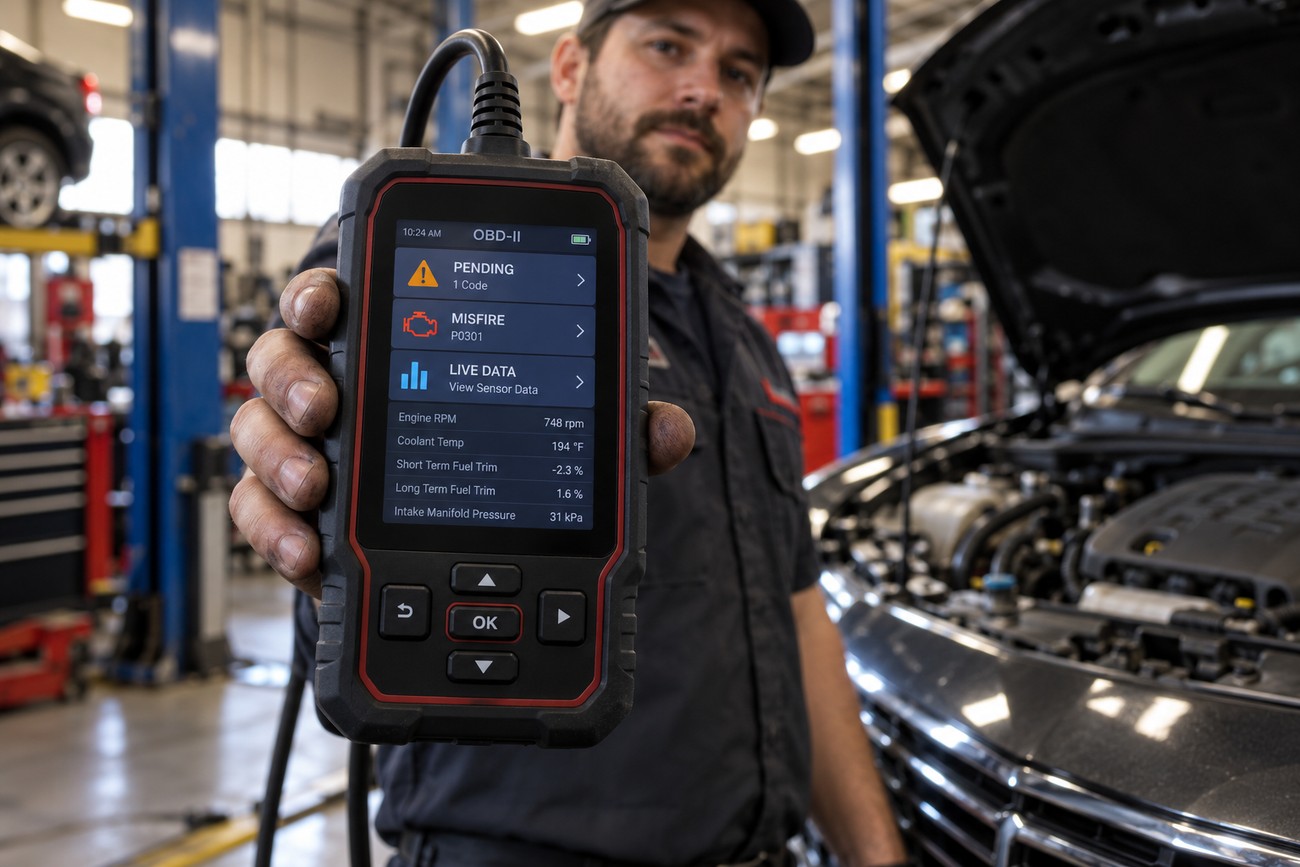
“The Check Engine light is off, so there is no fault” is unsafe reasoning. Live misfire or fuel data may appear before a confirmed code, and pending codes can preserve evidence that disappears after the codes are cleared. Save the scan results and operating conditions before disconnecting the battery or resetting the controller.
A single sensor code should not trigger an automatic sensor replacement. Wiring, power, ground, an air leak, or an incorrect system condition can create the code or produce an implausible reading. The same caution applies to IAC valves, throttle bodies, fuel pumps, plugs, and coils: test the related system first.
MAF sensors also require careful handling. Use only a cleaner intended for the component, do not touch the sensing element, and check the signal and wiring when possible. A free code scan generally does not include fuel-pressure measurement, smoke testing, or oscilloscope testing, so it is an entry point for diagnosis rather than a complete diagnosis.
The claim that a dirty throttle causes 90% of idle stalls is not supported by the provided official evidence and must not be used as a general rule. Professional testing is justified when the engine stalls in traffic, the fault is intermittent, fuel pressure or electrical supply is uncertain, or mechanical causes remain possible. Safe diagnosis is cheaper than repeated parts replacement and reduces the chance of creating a second fault.
Frequently asked questions
The questions below address common stalling patterns and the checks that help distinguish them. The conditions surrounding the stall remain more useful than the symptom alone. Preserve scan data and operating conditions before replacing parts or clearing codes.
Why does my car stall when the air conditioner is turned on or the steering is loaded?
The engine controller should raise airflow or idle speed when the air conditioner engages or steering load increases. A stall under that load can indicate failed idle-up control, a dirty or incorrectly adapted throttle, excessive compressor or alternator drag, belt problems, or power-steering load where applicable.
Reproduce the symptom only while stationary, with the parking brake applied and adequate ventilation. Record RPM, system voltage, belt noise, and the exact moment of the load change. This controlled observation helps separate a load-response problem from a sensor fault without disconnecting parts at random.
Why is my engine stalling while idling?
Idle stalling means the engine cannot maintain combustion or airflow at low speed under its current conditions. The useful next step is to compare the event with cold and warm operation, braking, gear selection, and accessory use, then preserve live data before clearing codes.
If the engine shakes before stopping, prioritize misfire and mixture evidence. If RPM falls cleanly when a load is added, evaluate idle-up response and accessory drag. If it restarts instantly, the fault may still be intermittent; easy restarting does not confirm that the engine is safe to drive.
What sensor can cause stalling?
MAF, MAP, throttle-position, and coolant-temperature sensors can contribute to stalling when their signals are incorrect or implausible. Crankshaft and camshaft position signals can also affect engine operation, especially when the engine stops suddenly or loses synchronization.
A sensor code identifies a circuit or implausible result, not automatically a failed sensor. Compare the signal with engine conditions and verify power, ground, wiring, and connector behavior before replacement. A brief signal interruption under vibration or heat may require a recording or electrical test to find.
What could be the reasons why my car stalls but won’t start?
A no-start after stalling can result from loss of fuel pressure, ignition or injector control, engine-speed signal, compression, or electrical power. The first checks should establish whether the engine cranks normally, whether fuel pressure meets specification, and whether the scan tool sees engine RPM while cranking.
A hot-only no-start deserves attention to components that fail with temperature, while a sudden stall with no restart may justify checking timing and mechanical condition sooner. Avoid repeated cranking if fuel, wiring, or belt damage is suspected, and arrange testing if the vehicle stops in an unsafe location.