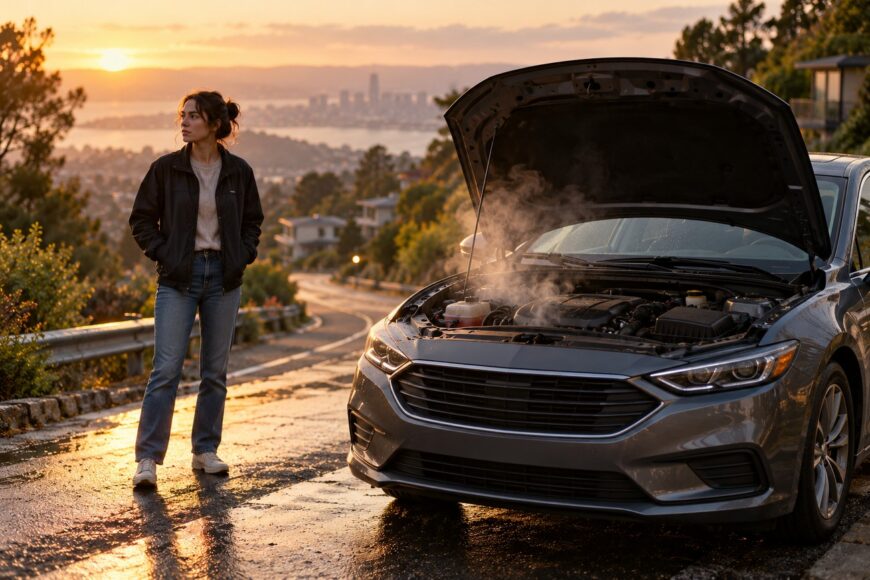
The temperature rises in traffic or on a long climb, and you have to decide quickly whether to stop, add coolant, or keep moving. The same warning can result from a leaking hose, a failed fan, trapped air, a restricted radiator, or a fault that produces excessive heat inside the engine.
A temporary fall in temperature does not prove that the problem is repaired. Reduce the load and make a safe roadside decision first; diagnosis and a lasting repair come afterward.
- What to do when the engine starts overheating
- Overheating symptoms and the faults they suggest
- The 10 common causes of engine overheating
- Find the fault before buying parts
- Fix the cause, then verify the cooling system
- Why an apparently normal gauge can miss a heat problem
- Shortcuts that turn one overheating episode into another
- Frequently asked questions
- How long should I wait before opening the coolant reservoir?
- Why does the cooling fan keep running after I turn off the engine?
- What should I tell the repair shop about an overheating episode?
What to do when the engine starts overheating
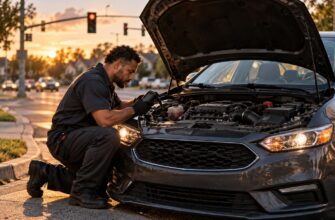
Reduce engine load as soon as the temperature begins to rise. Switch off the air conditioning, avoid hard acceleration, and use the lowest practical load while you look for a safe place to stop. Do not continue toward home simply because the warning briefly disappears.
If the warning is severe, steam appears, or coolant may have been lost, stop safely and shut the engine off. Advice to leave the engine idling for circulation applies only to some less severe situations and is not a blanket rule. A damaged pump, empty system, or rapidly rising temperature can make continued operation dangerous.
The heater can temporarily draw off some engine heat, which may help you reach a safe stopping point. It does not fix the cause. Once stopped, keep people away from steam and hot coolant, and arrange recovery if the coolant level or the cause is uncertain.
Never open a hot pressurized coolant cap. Escaping coolant or steam can cause serious burns. Check the vehicle manual for the correct inspection and recovery procedure, and wait until the system has cooled before checking the level.
Overheating symptoms and the faults they suggest
The driving pattern can narrow the investigation, but symptoms do not establish a diagnosis. Use the following table to decide what should be checked safely after the engine and cooling system have cooled.
| Condition or symptom | Plausible faults | Next safe check |
|---|---|---|
| Temperature rises in traffic or at low speed | Fan or fan-control failure, poor airflow, external radiator restriction, low coolant | After cooling, inspect for debris and check whether the fan operates according to the vehicle’s control strategy. Do not reach near a fan that may start automatically. |
| Temperature rises on climbs, while towing, or in hot conditions | Excessive heat load, restricted radiator, weak pump, low coolant, or an underlying engine fault | Reduce load and stop if the warning becomes severe. Have coolant flow, heat rejection, and engine operation tested under the relevant conditions. |
| Engine overheats after a thermostat or pump replacement | Trapped air, incorrect installation, wrong part, poor circulation, or an unresolved leak | Check the vehicle-specific bleeding procedure, coolant level, leaks, and circulation before buying another part. |
| Coolant level repeatedly falls with no visible puddle | Small external leak, coolant entering the engine, combustion-gas intrusion, or evaporation from a hot leak | Inspect for residue and pressure-test the system. Test for combustion gases in the coolant when appropriate. |
| Radiator remains relatively cool while the engine overheats | Stuck-closed thermostat, poor circulation, trapped air, or a restriction | Do not treat the cool radiator as proof of one fault. Check thermostat behavior, circulation, and air removal after the system cools. |
| Temperature warning appears with steam or a strong coolant smell | Major leak, low coolant, failed pump, or loss of system pressure | Stop safely and shut the engine off. Do not open the cap while hot; arrange inspection or recovery. |
The 10 common causes of engine overheating
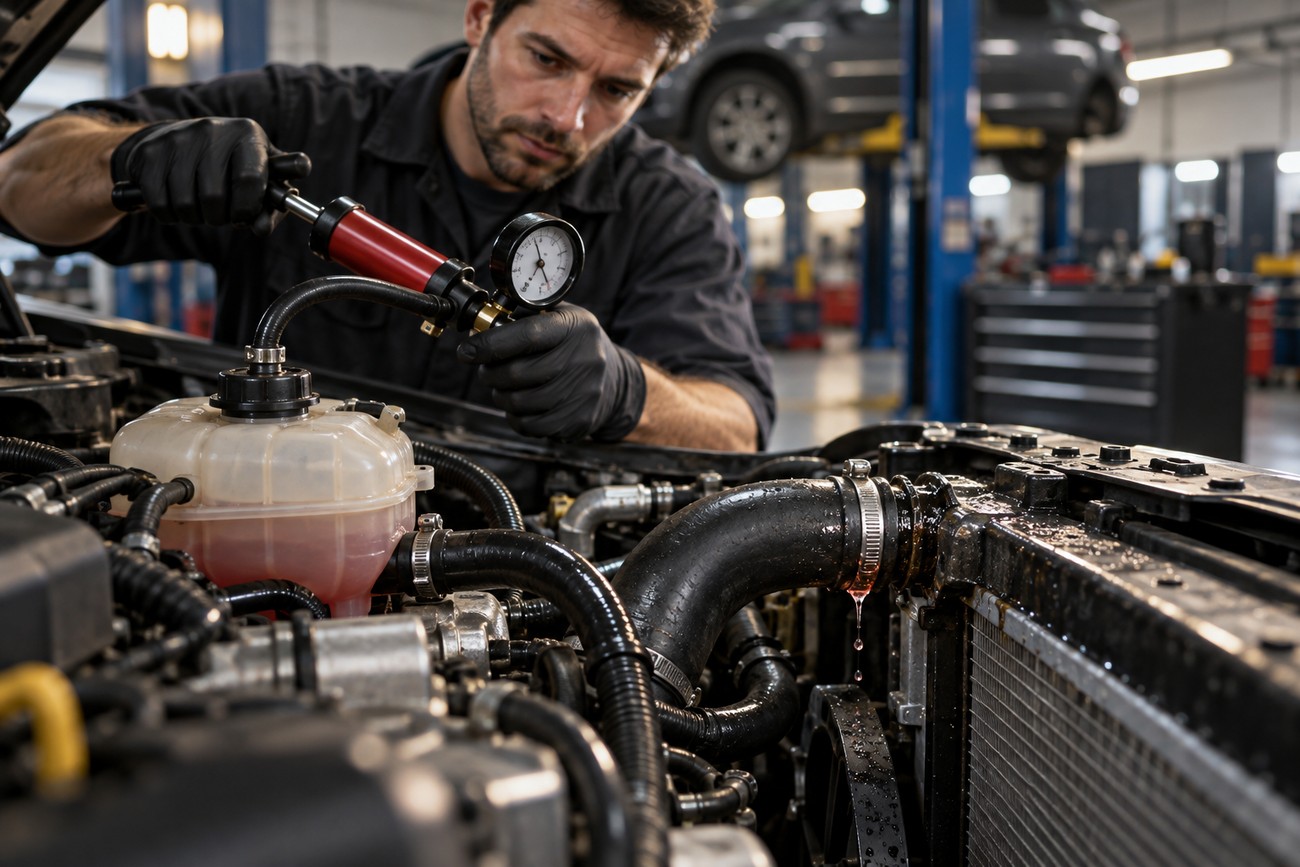
Coolant leaks reduce the amount of liquid available to carry heat away. The source may be a hose, radiator, pump seal, gasket, or connection, and a small leak can become serious under pressure. Trapped air has a similar effect: it interrupts circulation and can create local overheating despite a seemingly adequate coolant level.
A stuck-closed thermostat restricts flow to the radiator, so the engine can overheat while the radiator remains relatively cool. A weak water pump can also reduce circulation, particularly under load, although noise, leakage, or a damaged impeller may be needed to confirm the fault. A faulty pressure cap can lower the system’s pressure and allow coolant to boil or escape earlier than intended.
Fan or fan-control failure is especially important in traffic, where natural airflow is limited. Radiator airflow restriction from dirt, insects, or bent fins reduces heat rejection from the outside. Internal restrictions, whether in the radiator or in coolant passages, reduce flow and can create hot areas that a basic level check will not reveal.
Combustion-gas intrusion from a head-gasket fault or related engine damage can pressurize the cooling system, displace coolant, and worsen overheating. It may also explain recurring coolant loss without an obvious puddle. Finally, heat load can exceed available cooling during long climbs, towing, or hot-weather operation; a marginal component may show its weakness only under those conditions.
These causes affect different parts of the system: coolant quantity, circulation, pressure, or heat rejection. The same temperature warning can therefore require a leak test, airflow check, circulation test, or engine-combustion test rather than one automatic replacement.
Find the fault before buying parts
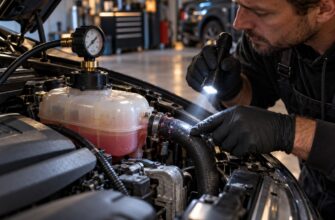
Begin only after the engine and cooling system have cooled. Check the coolant level using the vehicle’s specified procedure, then look for dried residue around hoses, the radiator, the pump area, the thermostat housing, and the pressure cap. A clean engine bay does not rule out a leak because coolant can evaporate or be carried away by airflow.
A technician may check fan operation and its controls, thermostat behavior, coolant circulation, system pressure, and the possibility of trapped air. If coolant keeps disappearing without an external trace, a pressure test and a combustion-gas test can help distinguish a hidden leak from combustion-gas intrusion.
This is particularly important when the radiator stays relatively cool while the engine overheats. A stuck-closed thermostat can produce that pattern, but trapped air, poor circulation, or incorrect installation can produce similar results. Replacing a sensor or thermostat without testing may leave the actual fault untouched.
Fix the cause, then verify the cooling system
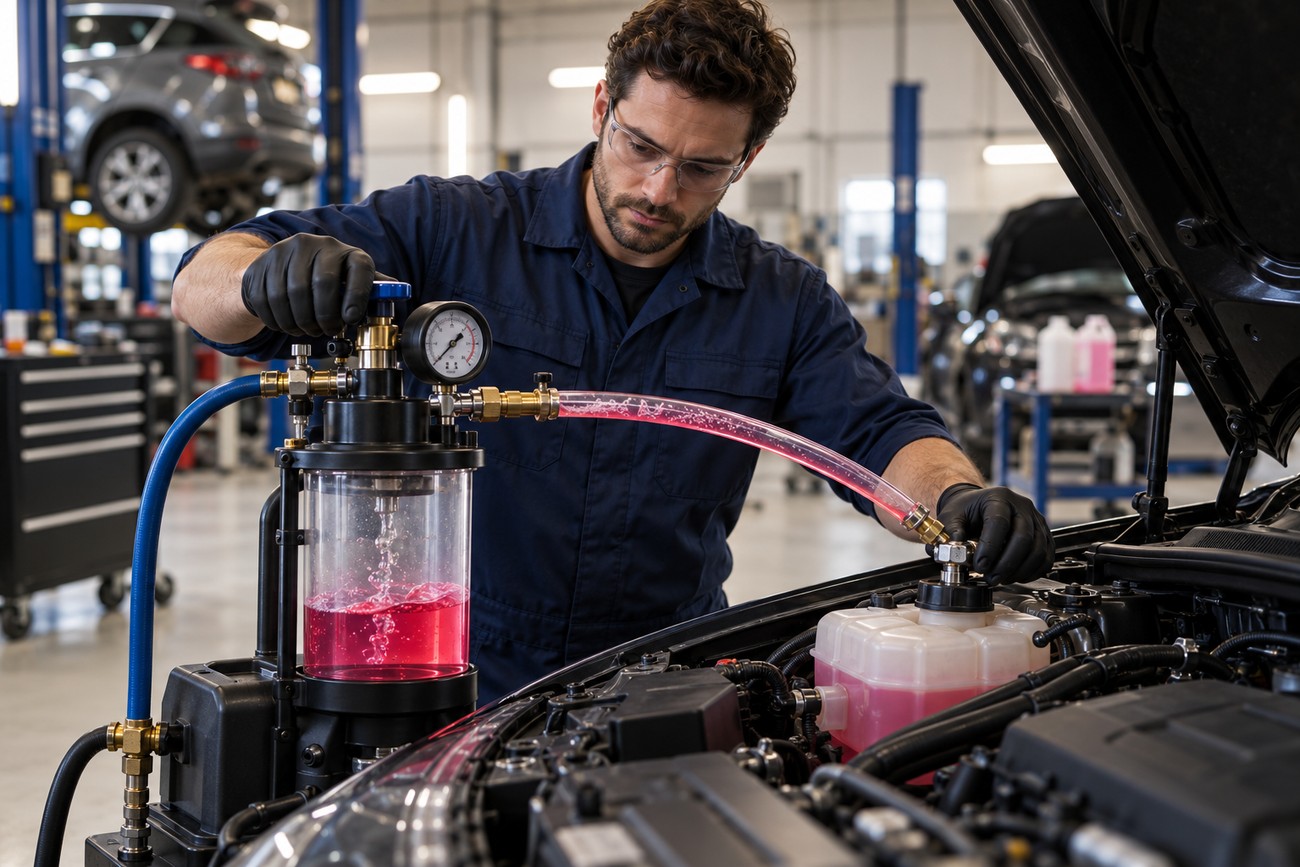
A confirmed leak requires the failed hose, radiator, seal, gasket, or connection to be repaired correctly. Fan and fan-control faults require restoring the intended electrical and mechanical operation, while a failed pump, thermostat, or pressure cap should be replaced with a suitable part. A restricted radiator or coolant passage may require cleaning or replacement rather than a stronger fan.
Refill the system with coolant that meets the vehicle specification. Follow the specified procedure for mixing, filling, and bleeding air; trapped air after cooling-system work can cause local overheating despite an apparently correct level. The reservoir level should be rechecked according to the manufacturer’s instructions, at the specified coolant temperature.
An emergency top-up can restore coolant temporarily, but replacing lost coolant without finding the source does not permanently fix recurring overheating. Water used for an emergency may also be unsuitable for long-term operation because it does not provide the required corrosion and freeze protection. Correct the mixture as soon as practical under the vehicle’s service procedure.
After repair, check for renewed loss and confirm stable operation under the conditions that originally triggered the problem, such as traffic, a climb, or towing. A heater may temporarily draw off heat during an incident, but it cannot verify the repair or compensate for an unresolved mechanical fault.
Why an apparently normal gauge can miss a heat problem
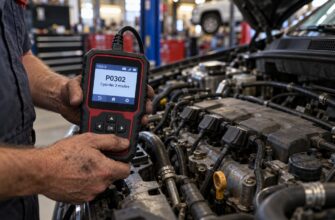
The dashboard gauge usually represents coolant temperature at one sensor location, not the temperature of every cylinder, valve, piston, or combustion-chamber surface. Some dashboard gauges smooth temperature changes, so a displayed normal reading can conceal short-lived or localized extremes. Interpret scan-tool readings against vehicle-specific specifications rather than one universal cutoff.
Trapped air can leave the sensor surrounded by coolant while another part of the cylinder head has poor contact with liquid. That can create a local hot spot even when the reservoir level looks adequate. Scan data can help identify a trend, but an OBD reading alone does not prove that damage has occurred.
Detonation, incorrect ignition timing, and a lean mixture can raise component temperatures without an obvious coolant-gauge warning. A heavily contaminated combustion chamber may also change heat transfer and combustion behavior. These faults require engine-performance and combustion diagnosis alongside cooling-system checks.
Treat the gauge, warning lamp, scan data, operating conditions, and physical evidence as separate pieces of information. A normal display should not override steam, coolant loss, unusual combustion noise, or a temperature rise under load.
Shortcuts that turn one overheating episode into another
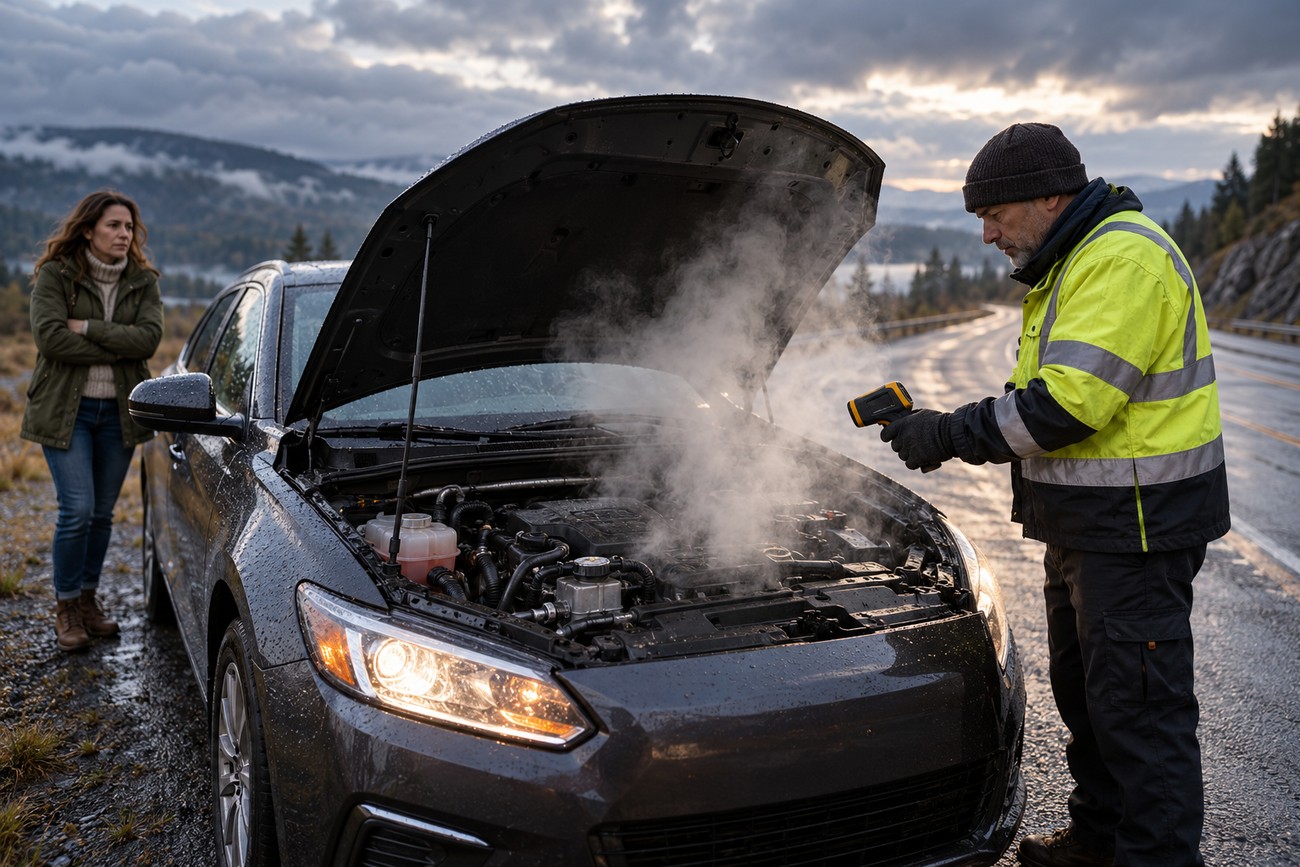
Driving on after a serious warning can turn a repairable cooling fault into cylinder-head or engine damage. A brief return to normal temperature is not proof that the system is safe. If steam appears, coolant may be lost, or the warning is severe, stop safely and shut the engine off.
A top-up treats the missing coolant, not the reason it disappeared. Recurring coolant loss without a visible puddle still requires investigation for hidden leaks and combustion gases. Do not open a hot pressurized cap while checking the problem; escaping coolant or steam can cause burns.
Replacing a thermostat, sensor, or fan without testing can waste parts and leave trapped air, a weak pump, a wiring fault, or a restricted radiator unresolved. Coolant quality also matters: unsuitable or degraded coolant can contribute to corrosion and deposits that restrict heat transfer.
Radiator fins clogged with debris reduce airflow, while aggressive pressure-washing can bend the fins and make airflow worse. Claims that a cooling system is maintenance-free should be checked against the vehicle’s actual service schedule. Coolant replacement, inspection, and radiator cleaning depend on the specification and operating conditions; there is no universal service interval.
Frequently asked questions
Questions may remain after the engine has cooled. The answers below cover opening the coolant reservoir, fan operation after shutdown, and what to tell a repair shop. Follow the vehicle-specific procedure when inspecting the system.
How long should I wait before opening the coolant reservoir?
Do not rely on a fixed number of minutes. Wait until the engine and the reservoir are fully cooled, there is no steam or hissing, and the vehicle manual’s opening procedure allows inspection. If the system remains pressurized or the engine is still hot, keep the cap closed.
Some vehicles use a pressurized reservoir, while others have a separate radiator cap and expansion tank. Follow the vehicle-specific instructions, and use a cloth and protective gloves only when the procedure permits inspection of a cool system.
Why does the cooling fan keep running after I turn off the engine?
Many vehicles run the fan after shutdown to remove residual heat, and this can be normal when the engine or under-hood area is hot. Keep your hands, clothing, and tools away because the fan may start without warning.
Persistent operation, unusual noise, battery discharge, or a fan that runs when the engine is cold can indicate a control, relay, sensor, or wiring fault. The correct test depends on the vehicle’s fan strategy and should be checked before disconnecting components.
What should I tell the repair shop about an overheating episode?
Give the shop the driving conditions and sequence of events: traffic, a climb, towing, ambient heat, warning lights, gauge movement, steam, smells, and any visible coolant loss. Mention whether the engine was shut down immediately, whether it restarted, and whether the temperature changed after the vehicle stopped.
Also report recent thermostat, pump, radiator, coolant, or engine work, including any emergency water top-up. This information helps the technician check installation and bleeding procedures, reproduce the operating condition, and choose leak, circulation, fan, or combustion-gas tests more efficiently.