An intermittent shake or a brief loss of power can make an ignition coil seem like the obvious purchase, especially when a misfire code names one cylinder. Before buying parts, decide whether the car is safe to drive. A flashing Check Engine light or an engine that runs badly calls for a safe stop and assistance.
If the symptom is mild and intermittent, preserve the clues before they disappear. Note whether it happens at idle, in damp weather, after warm-up, or during acceleration. A code can point you toward a cylinder, but testing must establish why combustion is failing.
- Recognize a misfire—and know when to stop driving
- What P0300 and cylinder-specific codes actually tell you
- Start with the conditions, then run the simplest checks
- Test ignition, fuel, air, and compression without guessing
- Use the symptom pattern when basic checks pass
- Choose the repair—and confirm the misfire is gone
- Frequently asked questions
- What should I ask for when booking a misfire diagnosis?
- How do I know if it’s an engine misfire?
- How do you fix a misfire in an engine quickly?
- Will an OBD2 scanner tell which cylinder is misfiring?
Recognize a misfire—and know when to stop driving
A misfire occurs when combustion in a cylinder fails or contributes less power than expected. You may notice a rough idle, hesitation, reduced power, or increased fuel use. Those symptoms help describe the problem, but none identifies its cause; other engine faults can feel similar.
An occasional stumble deserves investigation, particularly if it returns under the same conditions. Record when it happens and whether the Check Engine light comes on. Avoid treating a smoother drive home as proof that the fault has cleared.
Severe shaking, substantial power loss, or a flashing Check Engine light changes the priority. A flashing light can warn of a serious active misfire. Continuing misfires can send unburned fuel into the catalytic converter, where it can cause overheating and damage.
Stop safely and arrange assistance if the light flashes or the engine runs badly. Do not continue driving to see whether it clears. If the symptom is occasional and the light is steady, arrange a diagnosis promptly and follow the vehicle manufacturer’s guidance.
What P0300 and cylinder-specific codes actually tell you
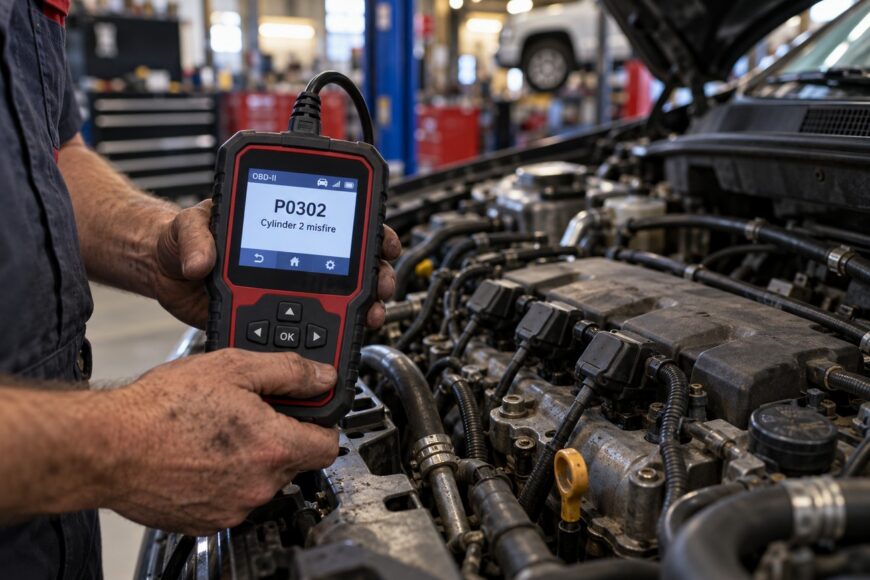
P0300 indicates random or multiple misfires; P0301–P0308 identify the affected cylinder by the final digit. A P0302, for example, directs attention to cylinder two. It does not say that cylinder two needs a coil: ignition, fuel delivery, an intake air leak, wiring, or compression could be involved.
Many engine computers infer misfires from changes in crankshaft rotational speed. The computer detects an uneven contribution to engine rotation rather than directly observing a spark or measuring the condition of a plug. A misfire code therefore records an event or affected cylinder, not a failed component.
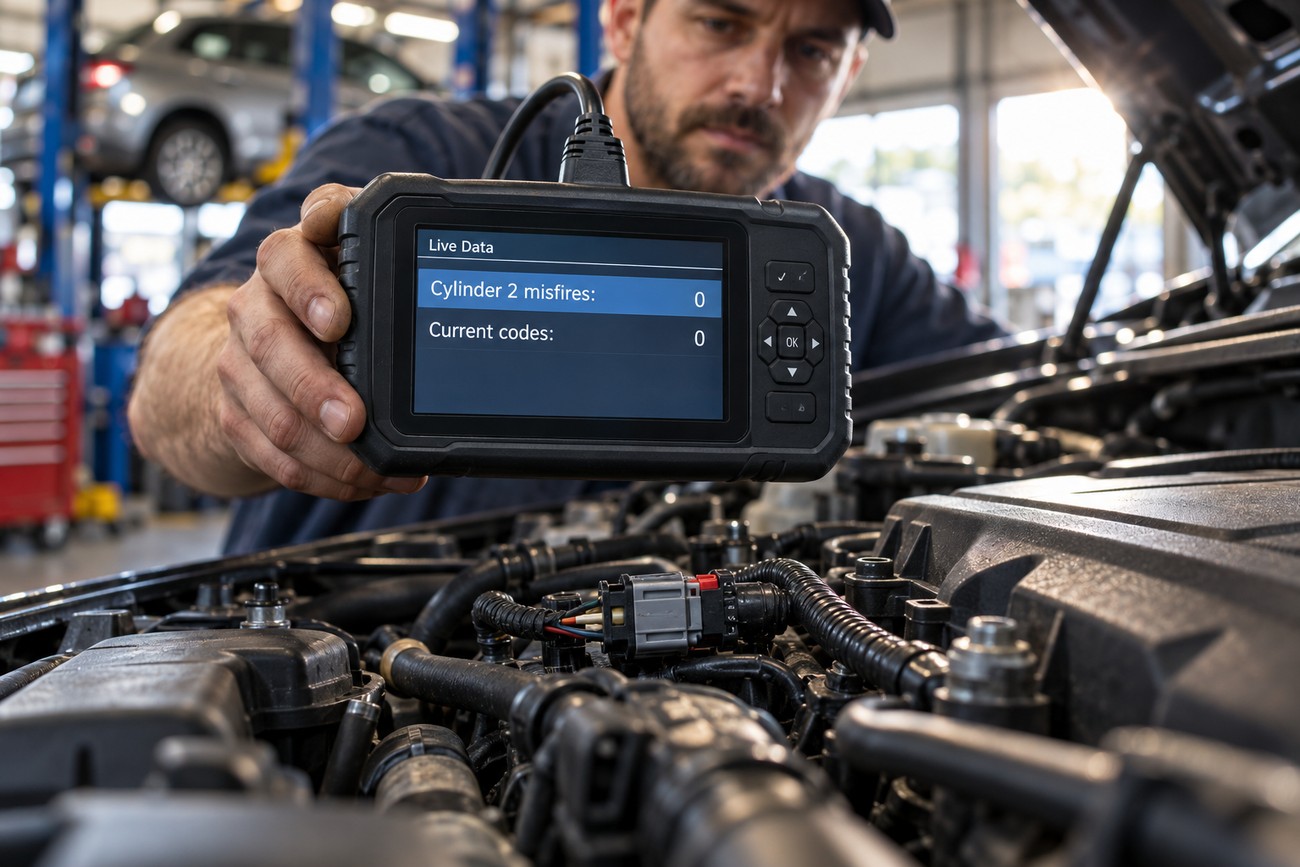
Read stored and pending codes together, then save any freeze-frame information before clearing anything. Freeze-frame data may show engine speed, load, and temperature when a code was set. If your scanner displays misfire counters, they can help show which cylinder is accumulating events as conditions change.
Detection also depends on operating conditions. A rare stumble in a narrow speed or load range may leave no clear code, even when you can feel it. An empty scan is a reason to document and reproduce the symptom carefully, not to dismiss it.
Start with the conditions, then run the simplest checks

Begin by recording all codes, pending codes, and available freeze-frame data. Note whether the fault appears cold, hot, at idle, in rain, or under load. Erasing a code removes useful evidence and does not repair the fault.
With the engine off and cool, look for loose coil connectors, damaged wiring, oil or water in plug wells, and disconnected intake hoses. A plug removed for inspection may reveal damage or contamination, though its appearance alone rarely settles the diagnosis. Check the battery, grounds, and charging condition as appropriate; unstable voltage can complicate engine operation and test results.
Use available misfire counters to decide where to focus next. A count rising on one cylinder suggests targeted cylinder checks; counts spread across cylinders may call for broader air, fuel, electrical, or mechanical checks. Compare those readings with the conditions in your notes rather than relying on a single snapshot.
Keep hands, tools, and clothing away from moving parts and high-voltage ignition components. Tests that require access near a running engine, fuel connections, or ignition circuits are best left to someone with the equipment and procedure for that vehicle.
Test ignition, fuel, air, and compression without guessing
For a cylinder-specific fault, an accessible plug or coil can sometimes be swapped with one from another cylinder, following the vehicle’s service procedure. If the misfire follows the part, that is a strong clue, not absolute proof of the root cause. Recheck codes and counters under comparable conditions before drawing a conclusion.
Oil or moisture in a plug well can affect the replacement component too. Inspect the well and the coil connector before ordering a coil on the strength of a swap result.
If ignition checks do not explain the fault, assess fuel delivery with an appropriate injector test rather than assuming an injector is dead because its cylinder misfires. Intake, vacuum-hose, or PCV leaks can upset the mixture and resemble an ignition problem. Wiring and connectors also deserve testing when a fault comes and goes.
Compression testing can reveal that a cylinder has a mechanical problem, but it may not establish the cause by itself. A leak-down test and further inspection can help narrow a low reading to a valve, piston sealing, or another mechanical issue. Each result should determine the next test; a P030x code alone cannot choose the repair.
Use the symptom pattern when basic checks pass
The conditions in which a misfire appears help prioritize tests, but they do not prove a particular cause. A symptom strongest at idle may put an intake or PCV air leak high on the list. Fuel-trim readings and a suitable leak test can help assess that possibility before more ignition parts are fitted.
Damp-weather trouble makes moisture-sensitive plug wells and electrical connections worth inspecting. A fault that starts only after warm-up may prompt checks of ignition components, wiring, and fuel delivery while the symptom is present. A normal cold test cannot rule out a failure that appears hot.
Acceleration places different demands on the engine than idling. A weak ignition component or partially restricted injector may appear adequate at idle yet misfire under load. That is why an engine can run smoothly in the workshop and still hesitate on the road.
Turbocharged or direct-injection engines may likewise pass stationary checks but misfire under boost. Reproducing that condition requires safe, suitable testing; a hard acceleration run on a public road is not a substitute. Give the technician the speed, temperature, and load pattern so the next test matches the complaint.
Choose the repair—and confirm the misfire is gone
Repair the fault supported by testing. A P030x code alone does not justify a new coil, a full set of plugs, or a fuel treatment. If a connector is damaged, an air leak is measured, or a mechanical defect is found, the repair should address that finding.
Specialist testing makes sense when the affected cylinder changes, basic checks disagree, or the misfire appears only under load. A workshop may need equipment or a controlled road test to capture the event safely. Ask for the results that support a proposed repair before parts are fitted.
Afterward, revisit the conditions that originally triggered the misfire. Check for returning codes and, where available, misfire counts while the engine operates in that same range. A smooth idle cannot confirm a repair for a fault that occurred only during acceleration.
Clearing the code is sometimes part of the final check, but it is not the repair. If the symptom or counts return, preserve the new information and continue diagnosis instead of repeatedly resetting the light.
Frequently asked questions
A useful misfire diagnosis begins with the symptom as well as the code. These answers can help you describe the problem, understand a scanner result, and agree on a sensible next step with a workshop.
What should I ask for when booking a misfire diagnosis?
Tell the shop which codes you have seen and when the shake or power loss occurs, including temperature, weather, idle versus acceleration, and any recent work. Mention a flashing Check Engine light immediately. Ask whether the diagnostic quote covers reproducing an intermittent fault, reviewing available misfire data, and reporting test results before parts are fitted. Also ask how the shop will contact you if the fault does not appear during the initial inspection.
How do I know if it’s an engine misfire?
A repeating stumble, uneven idle, or hesitation can suggest a misfire, especially if a P0300–P0308 code or misfire counter accompanies it. The feeling alone is not conclusive: a transmission problem or another engine fault may mimic lost power. Note whether the disturbance tracks engine speed and have the symptom and scan data checked together. If the engine runs badly or the Check Engine light flashes, stop safely and arrange assistance.
How do you fix a misfire in an engine quickly?
The quickest reliable route is to preserve the code and the conditions that trigger it, then test the most likely cause. A visibly loose connector may be straightforward to correct; a fault present only under load can take longer to confirm. Avoid buying a coil solely because a P030x code names its cylinder. If the light flashes or the engine runs badly, stop safely rather than trying a quick fix at the roadside.
Will an OBD2 scanner tell which cylinder is misfiring?
It can if the engine computer records a cylinder-specific code: P0301–P0308 identify the affected cylinder by the final digit. P0300 indicates random or multiple misfires instead. Some scanners also display pending codes, freeze-frame data, or misfire counters, which can make an intermittent complaint easier to investigate. Scanner coverage varies, and a rare or borderline event may produce no clear code. Even a cylinder-specific result cannot identify the part that needs replacement.