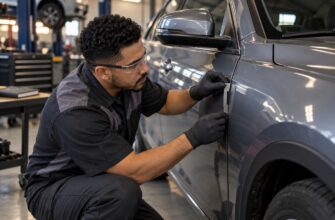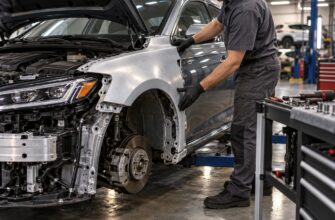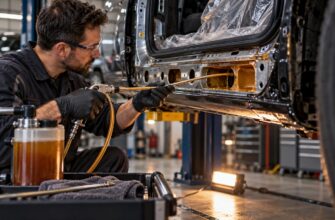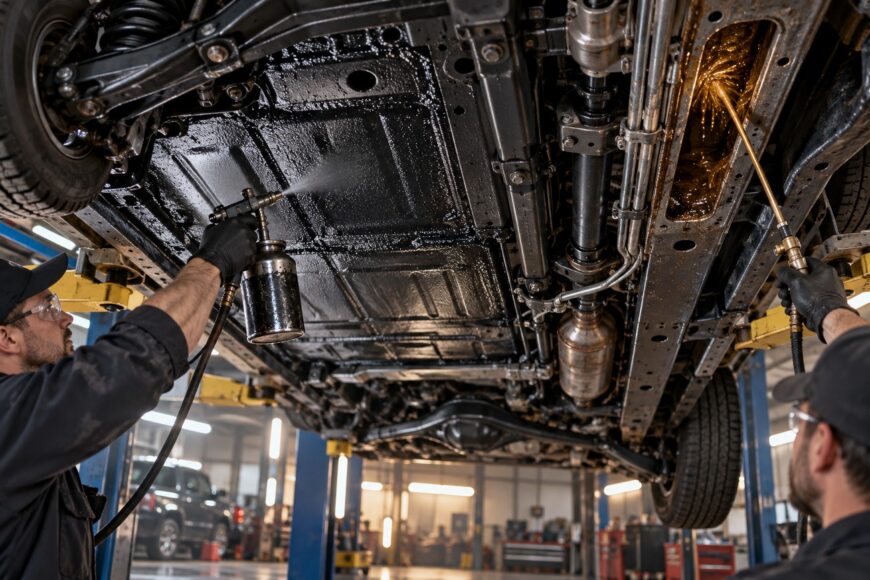
A tough underbody coating resists water, road salt, and stone impact, while an oil or lanolin spray reaches seams, frame sections, and hidden cavities that a thick film may miss. The two methods protect different surfaces in different ways, so the better choice depends on access, preparation, climate, and how regularly you inspect and renew the treatment.
Undercoating can provide a durable barrier on sound, exposed metal, yet a poorly prepared surface can leave corrosion growing unseen beneath it. Oil treatment is more forgiving around seams and existing surface oxidation, although its film can wash away, collect dirt, and require repeated application. Neither system repairs weakened metal, failed welds, or damaged fasteners.
- What Undercoating and Oil Spray Actually Do
- Undercoating vs. Oil Spray: The Practical Trade-Off
- Preparation Determines Whether the Protection Works
- Where Each Method Fails in Real-World Use
- How Climate, Vehicle Condition, and Use Change the Best Choice
- When a Combination of Oil and Undercoating Makes Sense
- How to Judge Product Claims and Plan Maintenance
- A Safer Decision Checklist: Which Rustproofing Should You Choose?
- Frequently asked questions
- What kind of rustproofing is best for a vehicle that already has surface rust?
- How can I tell whether an oil-spray treatment needs to be renewed?
- What is better, undercoating or rustproofing?
- What kind of rustproofing is best?
What Undercoating and Oil Spray Actually Do
Elastomeric or bitumen-rubber undercoating forms a relatively thick barrier over prepared areas of the underbody. Its main jobs are to reduce contact with water and salt and to absorb some stone impact before the underlying metal is damaged. The film works best on clean, dry, degreased surfaces that are free of loose rust, subject to the product’s instructions.
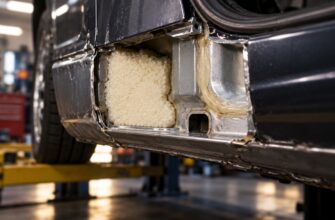
Oil and lanolin rustproofing work through a different mechanism. They create a moisture-displacing film that can flow into seams, gaps, frame sections, fastener interfaces, and hidden cavities. This makes a penetrating treatment useful where access is limited and where a rigid coating would bridge over an opening rather than reach the metal inside it.
Each system also has a characteristic failure mode. A coating can detach from contaminated, damp, or rusty metal and conceal corrosion beneath the detached area. An oil film can migrate, wash away, remain tacky, and collect road dirt. Oil also cannot prevent electrochemical corrosion where salt solution remains trapped against the metal.
Rustproofing is a corrosion-control measure, not structural repair. Neither a barrier coating nor an oil film restores thinned metal, failed welds, or damaged fasteners. Any area with structural loss, cracking, or unsafe attachment points needs proper inspection and repair before protective products are considered.
Undercoating vs. Oil Spray: The Practical Trade-Off
The practical choice becomes clearer when the two methods are compared by the work they can actually perform. Undercoating offers stronger resistance to direct stone impact on exposed, prepared surfaces. Oil spray generally provides better access to concealed spaces and accepts more complicated shapes, although it demands a maintenance cycle.
| Factor | Undercoating | Oil or lanolin spray |
|---|---|---|
| Protection mechanism | Thicker elastomeric or bitumen-rubber barrier against water, salt, and impact | Moisture-displacing film that creeps into seams and cavities |
| Coverage | Strong on open, accessible surfaces | Effective around seams, gaps, frame sections, and hidden cavities |
| Preparation | Requires clean, dry, degreased metal without loose rust | Still requires salt removal and complete drying; surface cleaning remains important |
| Stone-impact resistance | Generally better when correctly bonded and cured | Limited; the film can be displaced by impact and washing |
| Corrosion visibility | Thick or detached areas can hide new corrosion | Metal remains easier to inspect, though dirt can obscure the film |
| Cleanliness | Usually cleaner after curing, depending on the product | Can remain tacky and collect dust and grit |
| Reapplication | Depends on product, damage, and inspection; damaged areas need attention | Usually after 1–2 years, often annually where road salt is heavy |
| Best use | Prepared exposed areas subject to water and stone impact | Seams, cavities, frame interiors, and difficult-to-reach surfaces |
Coverage is a major dividing line. A spray wand can reach inside a boxed frame or along a folded seam, while a thick coating may cover only the visible face. Conversely, an oil film offers little protection against repeated gravel strikes on a frequently driven vehicle. Access, exposure, and the quality of the existing surface therefore matter as much as the product category.
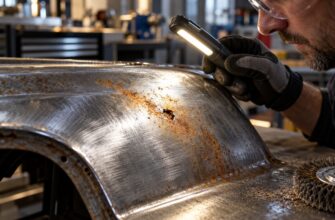
Inspection also pulls the decision in opposite directions. A smooth coating may look reassuring while hiding a blister or detached edge that needs investigation. Oil leaves more visual clues, but a dirty, wet film can make small defects difficult to see. In either case, the owner needs planned inspections rather than judging performance from appearance alone.
Oil or lanolin treatment commonly needs renewal after 1–2 years and often annually in heavily salted areas. That schedule is affected by washing, mileage, storage, climate, and how much of the film is exposed to spray from the tires. A coating may last longer in a particular location, yet marketing claims should not replace checks for cracking, peeling, impact damage, and corrosion at the edges.
Preparation Determines Whether the Protection Works

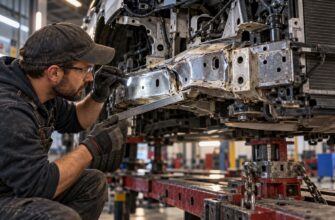
Preparation starts with inspection, not spraying. Raise or support the vehicle safely, identify existing corrosion, and check the floor pan, subframes, brake lines, fuel-system components, fasteners, seams, wheel arches, and drain paths. A treatment applied before the condition of the metal is understood can make future inspection harder.
Road salt must be washed away before oil treatment, and the vehicle must dry completely. Oil displaces moisture in a seam, but it does not remove salt residue or the electrolyte created when salt remains wet against metal. Applying oil over a salty film can preserve the contaminant in the same area that needs protection.
Undercoating requires a clean, dry, degreased surface without loose rust, in accordance with the specific product instructions. Loose scale, flaking coating, mud, and oily contamination weaken adhesion. Surface cleaning does not turn severely corroded metal into sound metal, so thin sections and damaged joints still require repair or replacement.
Visible floor-pan coverage is a poor measure of complete protection. Moving or removing plastic shields and wheel-arch liners exposes the pockets where salt and water collect, while cavity drains must be checked before any product is applied.
Plastic shields and wheel-arch liners may need to be removed or moved to reach concealed areas. The same applies to frame openings and rocker-panel cavities where practical access is available. Drains and rocker-panel ventilation must remain open, because blocking them can retain water and create a more persistent corrosion problem.
Keep brakes, the engine, transmission, and hot exhaust components clear of undercoating. Oil must also be controlled around these areas because it can run onto friction surfaces, hot parts, or the floor. Masking, controlled spray pressure, suitable access equipment, and adequate curing time reduce the risk of turning a corrosion treatment into a safety or maintenance problem.
Where Each Method Fails in Real-World Use
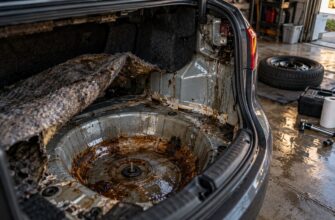
The most serious undercoating failure begins with a weak foundation. If loose rust, moisture, salt, or grease remains underneath, the film may bond only around the contamination. Once water enters through a chip or detached edge, corrosion can continue beneath the covering while the defect becomes harder to see.
A detached coating also changes the inspection task. The visible surface may remain intact while the metal underneath loses thickness. Peeling edges, swollen sections, cracking, and hollow-sounding areas deserve attention before more material is added. Recoating a failing layer can bury the evidence and increase the amount that must later be removed.
Oil spray has a different set of drawbacks. Excess material can run onto the floor, migrate toward hot exhaust parts, or reach brake components if application is careless. The film may also remain tacky and gather abrasive dirt, especially in wheel-arch areas. That does not automatically make the treatment unsuitable, but it means application control and later cleaning matter.
Incomplete access defeats both methods. Treating only the visible underside leaves the reverse side of panels, pockets behind plastic shields, seams, and internal cavities exposed. A vehicle can appear freshly treated while the areas receiving the most salt spray have never been reached.
Some products are marketed as long-term protection, while practical experience commonly reports washing, degradation, and the need for annual or two-year renewal. This difference can reflect exposure and maintenance rather than a simple product defect. The sensible response is to inspect the actual film, remove loose or heavily contaminated material, and renew only after the surface is suitable.
How Climate, Vehicle Condition, and Use Change the Best Choice
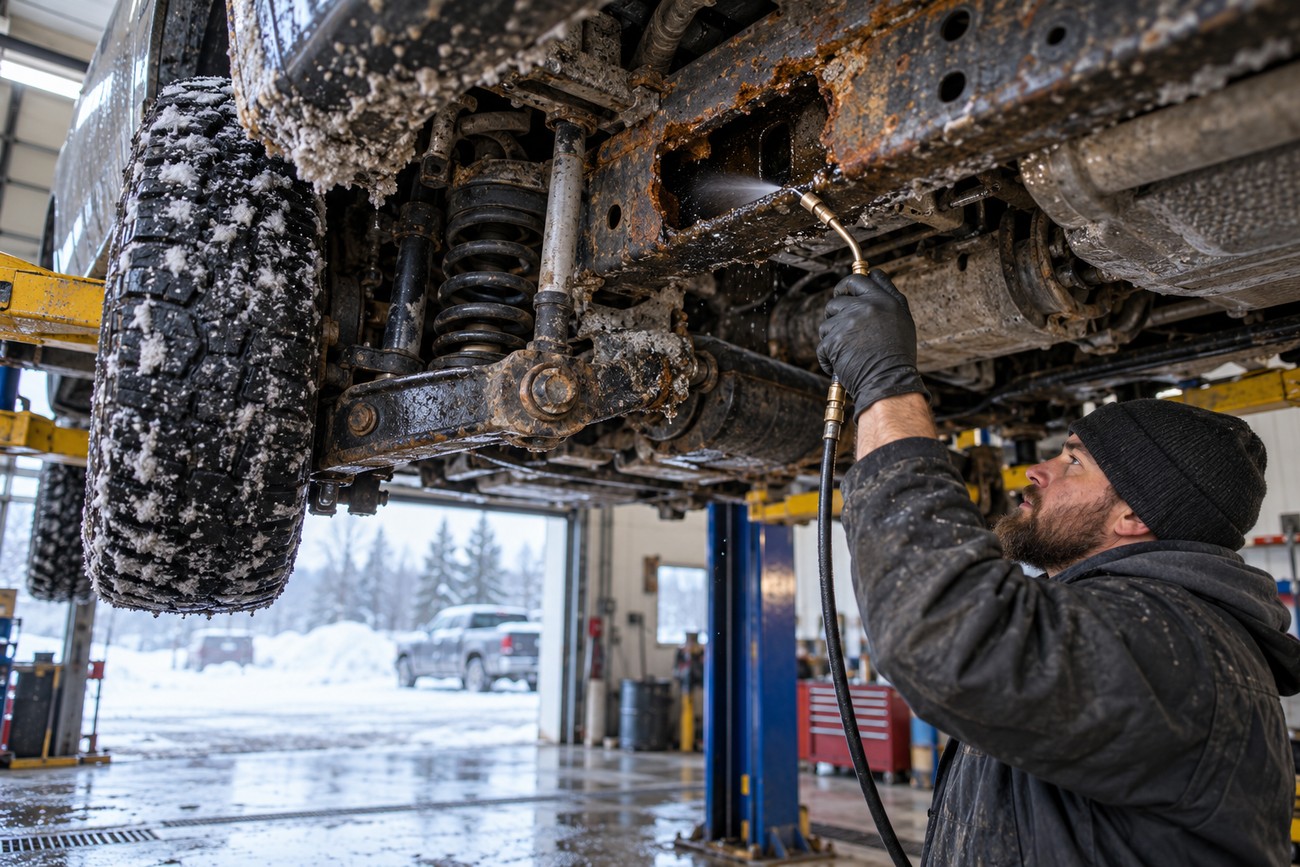
A daily driver in a road-salt climate faces repeated wetting, drying, contamination, and washing. Salt-heavy conditions increase the importance of regular renewal and inspection, especially around seams, suspension mounting points, wheel arches, and frame sections. An oil treatment may be useful in cavities, but its condition should be checked before and after the salt season.
A previously rusted or difficult-to-clean vehicle is a poor candidate for blindly sealing active corrosion beneath a rigid coating. Light surface oxidation on accessible, sound metal can be prepared according to the product instructions. Loose, scaling, deeply pitted, or structurally significant corrosion requires a more careful assessment before any protective layer is chosen.
Gravel roads and rough surfaces favor a sound, properly prepared barrier on exposed areas because stone impact can damage thin protective films and painted surfaces. That benefit does not extend automatically to hidden cavities, where a penetrating oil or lanolin product can provide more useful coverage. The two exposure zones may need different treatments.
A vehicle that appears free of rust does not prove that one method is superior. Climate, washing, storage, mileage, impact, starting condition, and access to hidden areas all influence the result. A well-maintained car stored dry may need a different approach from a high-mileage vehicle parked outdoors in a salt-heavy region.
When a Combination of Oil and Undercoating Makes Sense
A combination treatment can work when each material has a defined job. Penetrating oil or lanolin can be used in seams, cavities, and frame interiors, while an impact-resistant coating is reserved for clean, dry, properly prepared exposed areas. This approach follows the shape and exposure of the vehicle instead of treating every surface as though it had the same needs.
Compatibility must be checked before one product is layered over another. Some undercoating materials do not tolerate oils, greases, or solvents well, and an oily surface can prevent reliable bonding. Follow the product instructions for cleaning, flash-off, curing, and acceptable substrates rather than assuming that two products are compatible because both are sold for corrosion control.
Combination treatment is also a poor reason to build up layers indefinitely. Old dirty film, loose rust, and detached coating should be removed from the relevant area before new material is applied. A thicker stack of contaminated products can make inspection harder and leave the underlying problem untouched.
After treatment, the system still needs periodic inspection. Check cavity openings, coating edges, stone chips, drain paths, and areas exposed to tire spray. Renewal should respond to the condition of the film and the vehicle’s exposure, rather than becoming an automatic exercise in adding another layer over the old one.
How to Judge Product Claims and Plan Maintenance
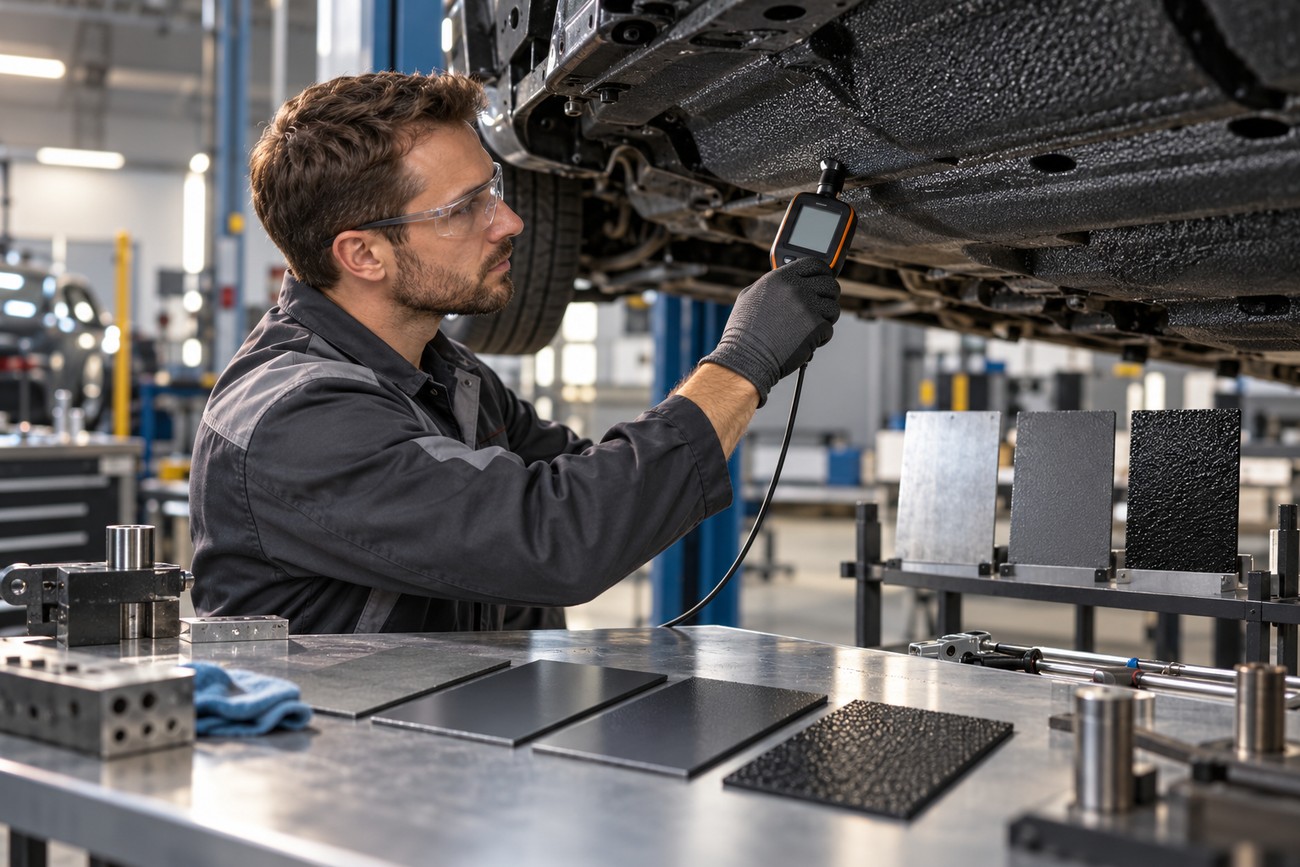
Technical figures are useful only when their conditions remain attached to them. A Sika example specifies approximately 500 micrometers of dry thickness for a particular general anti-corrosion application. That is a product-specific application parameter, not a universal undercoating requirement.
A specific epoxy product may claim 1,000 hours of salt-spray resistance at 150 micrometers. The result belongs to that product, thickness, substrate, preparation, and test method. It cannot be converted directly into a promised service life on a vehicle exposed to chips, dirt, freezing, vibration, washing, and standing salt solution.
ISO or PN-EN salt-spray chamber tests standardize comparison in controlled conditions. They do not reproduce the complete combination of road chips, accumulated dirt, freeze-thaw cycles, drainage problems, and road vibration. Use test data to understand the material’s tested behavior, then judge the vehicle application through preparation quality and inspection.
A sensible maintenance plan records where the vehicle is used, when it is washed, and which areas show film loss or impact damage. Inspect before renewal, especially after the salt season or extensive gravel use. Undercoating must not be applied to brake components, the engine, the transmission, or hot exhaust parts, and the product label remains the controlling safety instruction.
A Safer Decision Checklist: Which Rustproofing Should You Choose?
Choose a penetrating oil or lanolin treatment when cavity access, seams, frame interiors, and uncertain surface condition dominate the decision. It can reach areas a thick coating cannot, provided the vehicle is washed, dried, and safely masked. Plan for renewal because the moisture-displacing film can be displaced or washed away.
Choose undercoating for clean, dry, properly prepared exposed metal that needs resistance to water, salt, and stone impact. Confirm that loose rust and contamination have been removed and that the product is suitable for the substrate. A rigid film is a poor answer to active scaling corrosion or damaged structure.
Use both methods only when the surfaces and products are compatible. Keep penetrating material in suitable cavities and seams, and place impact-resistant coating on prepared open areas. Do not block drains or rocker-panel vents, and keep all protective products away from brakes, hot exhaust, the engine, and the transmission.
- Inspect for structural damage before choosing a coating.
- Wash away salt and dry the vehicle completely.
- Move plastic shields and liners to check concealed pockets.
- Remove loose rust, detached coating, and dirty old film where required.
- Check product compatibility before applying one material over another.
- Schedule renewal and inspection according to exposure, condition, and use.
Frequently asked questions
The right answer depends on the condition of the metal and the areas that need protection. These practical distinctions help avoid choosing a treatment by product name alone.
What kind of rustproofing is best for a vehicle that already has surface rust?
First distinguish light surface oxidation from loose, scaling, or structurally significant rust. Light oxidation on sound, accessible metal can often be cleaned and prepared for a compatible coating, while loose scale or active corrosion needs removal and inspection before any rigid film is applied. A penetrating oil or lanolin treatment is usually more suitable for seams and cavities where cleaning and coating access are limited.
If the metal is deeply pitted, thin, cracked, or affected around a weld or fastener, rustproofing alone is insufficient. Repair the affected structure first, then protect the sound surrounding metal.
How can I tell whether an oil-spray treatment needs to be renewed?
Inspect exposed metal, seams, cavity openings, and areas receiving tire spray. Renewal is more likely to be needed where the film has washed away, become cracked or heavily dirty, or left bare metal visible. Increased exposure to a new salt season is another reason to inspect earlier rather than relying only on a calendar.
Before reapplying, remove excessive dirt and loose old film where it interferes with inspection or adhesion. Repeatedly adding oil over a contaminated layer can conceal defects and create a thicker mess without improving coverage.
What is better, undercoating or rustproofing?
Undercoating is better for impact resistance on properly prepared exposed surfaces, while oil or lanolin rustproofing is better for penetrating seams and hidden cavities. The better method is the one that matches the vehicle’s surface condition, access, climate, salt exposure, and maintenance routine.
What kind of rustproofing is best?
The best rustproofing is a compatible system applied to correctly prepared metal and followed by inspection. Many vehicles benefit from targeted use: penetrating material in cavities and seams, with a suitable barrier on clean exposed areas that face stone impact. No product can compensate for trapped salt, blocked drainage, concealed active corrosion, or neglected renewal.