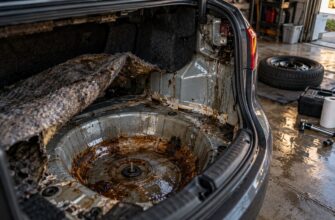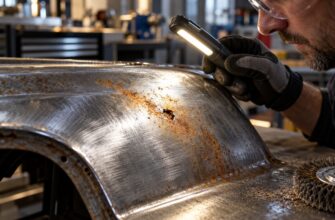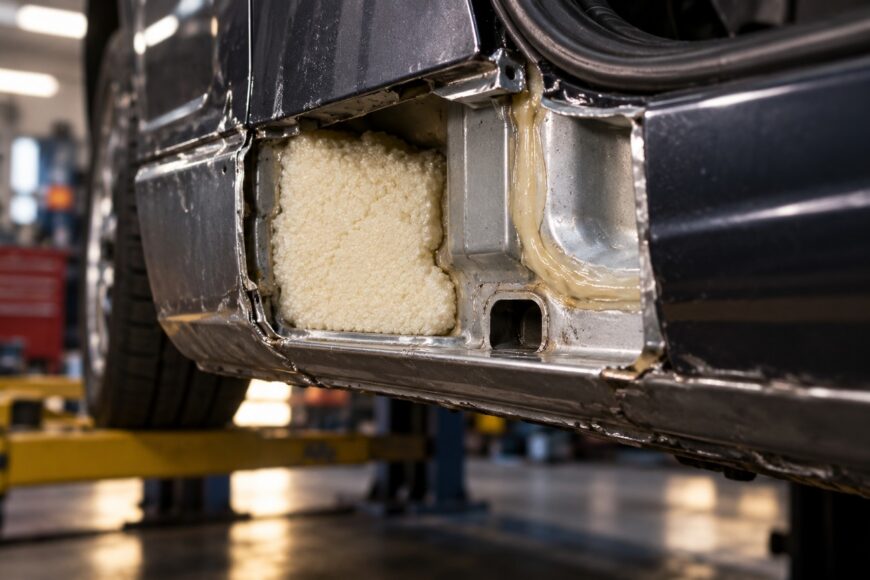
Filling body cavities with closed-cell foam can sound like a simple way to block water, heat loss, and road noise. The foam has low water absorption in bulk, fills irregular spaces, and can reduce movement from large, lightly supported panels.
The same layer can hide corrosion, obstruct drainage, and turn later inspection or repair into destructive work. Its result depends less on maximum thickness than on substrate preparation, adhesion, coverage, and the cavity’s original function. Used selectively, foam can solve a narrow thermal or vibration problem; used indiscriminately, it can preserve a bad repair under a hard-to-remove skin.
- What Closed-Cell Foam Actually Does Inside a Car Body
- Rust Protection: Water Resistance Is Not Corrosion Protection
- Noise and Vibration: Where Foam Helps—and Where It Disappoints
- Closed-Cell Foam, Cavity Wax, and Acoustic Treatments: What Each One Is For
- The Installation Errors That Turn Foam Into a Rust Risk
- When the Treatment Makes Sense—and When It Is Better Avoided
- Frequently asked questions
- What should I do if foam has already been installed over suspected rust?
- How can I test a foam product before filling an entire body cavity?
What Closed-Cell Foam Actually Does Inside a Car Body
Closed-cell foam contains largely separate cells, so water does not move through its mass as easily as it does through open-cell material. It generally has lower water absorption and vapor permeability than open-cell foam, which explains its popularity for automotive cavities and thermal barriers. Common comparative industry figures cite about 5% moisture absorption for closed-cell systems versus about 15% for open-cell systems, although these are not universal test standards.
That property is often misunderstood as complete waterproofing. Moisture can remain at the foam–metal interface, especially where the steel was damp, contaminated, or uneven. Water can also enter through cuts, seams, edges, poor adhesion, and imperfect coverage, then remain concealed inside the cavity.
Foam changes the cavity’s physical behavior as well as its moisture behavior. By reducing the air volume and supporting parts of a panel, it may damp some vibration and reduce a narrow band of panel-related noise. The result depends on where the foam is placed, how completely it contacts the structure, and which panel is generating the sound.
Closed-cell foam is also used for thermal insulation and weight-conscious construction. That benefit can be clear around a hot or cold boundary even where tire and wheel-arch noise barely changes. A foam layer should therefore be specified for a defined cavity and purpose, rather than treated as a universal body treatment.
Rust Protection: Water Resistance Is Not Corrosion Protection
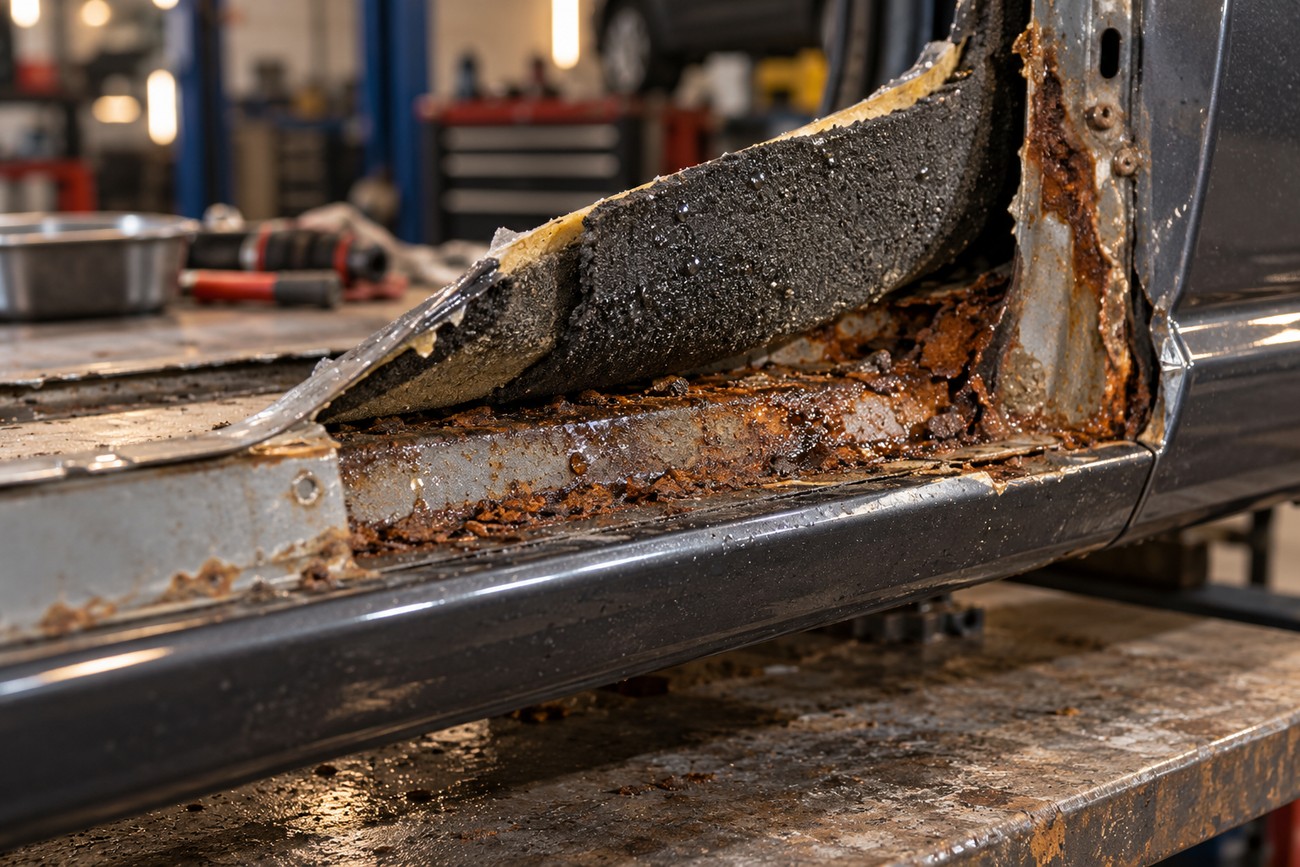
Closed-cell foam is not a standard anticorrosion coating and does not automatically prevent rust. The metal should be dry, clean, degreased, and free of active corrosion before application. Any dirt, salt, failed coating, or dampness left underneath becomes part of a hidden interface that is difficult to inspect later.
Even a well-adhered foam layer cannot correct corrosion that already exists. If moisture reaches an edge or damaged area, the foam may hold it against the metal for a long period while the outside still looks sound. This is why low bulk water absorption does not remove the need to inspect seams, flanges, welds, and drainage routes.
Cavity wax is treated as the corrosion-control layer; foam is a separate filler. The metal and its drainage must be verified first, because a strongly bonded foam layer can make a poor substrate harder to diagnose.
Manufacturers of body-repair materials recommend a dedicated cavity wax after suitable welding and painting work. 3M identifies Cavity Wax Plus for internal panels, welds, flanges, and box sections, and recommends up to three coats for complete coverage. Those are claims for the wax product, not evidence that closed-cell foam provides the same protection.
ASTM B117 and SAE J2334 testing cited for 3M Cavity Wax Plus applies to that cavity-wax product, not to closed-cell foam. Keeping this distinction clear prevents a common error: transferring corrosion-test claims from a protective coating to a filler that may conceal the surface.
Noise and Vibration: Where Foam Helps—and Where It Disappoints
Foam can help when a cavity allows a panel to flex or resonate. Filling part of that space may reduce air volume, support the panel, and damp some vibration. This is a localized effect, so it is usually more noticeable in a specific trim panel or hollow section than across the entire cabin.
Road noise has several paths: tire contact, wheel arches, suspension mounts, airborne transmission, and structure-borne vibration. Foam placed in one body cavity cannot reliably address all of them. A common result is better thermal insulation while tire or road noise changes little.
Open-cell systems are generally more sound-absorbing, while closed-cell systems are more strongly associated with moisture resistance, thermal insulation, and structural stiffness. That does not make open-cell material suitable for a wet cavity; it means acoustic treatment must match the sound path and moisture exposure.
Coverage quality also matters more than advertised thickness. Gaps, unsupported edges, and untreated vibration paths can leave the dominant noise mechanism unchanged. Measure the goal in practical terms—panel buzz, cavity resonance, or airborne absorption—before choosing foam.
Closed-Cell Foam, Cavity Wax, and Acoustic Treatments: What Each One Is For
These materials solve different problems. Selecting by the word “insulation” alone can leave corrosion protection, drainage, or service access unresolved.
| Material | Primary purpose | Moisture behavior | Corrosion role | Acoustic behavior | Serviceability and main risk |
|---|---|---|---|---|---|
| Closed-cell foam | Cavity filling, thermal insulation, and some vibration control | Low absorption in the foam mass; moisture can remain at interfaces and enter through defects | Not a dedicated anticorrosion coating | May damp panel movement and reduce cavity air volume; results are location-dependent | Can hide rust, block access, and complicate removal |
| Cavity wax | Protection of internal panels, welds, flanges, and box sections | Forms a protective coating; coverage and preparation remain critical | Dedicated corrosion-protection layer | Little direct sound absorption | Must be applied to suitable surfaces and renewed or checked as required |
| Open-cell acoustic material | Absorption of airborne sound in suitable dry locations | Generally more vulnerable to moisture than closed-cell material | Not a corrosion coating | Generally stronger for absorption than closed-cell foam | Requires moisture control and adequate space |
The Installation Errors That Turn Foam Into a Rust Risk
The most serious mistake is applying foam over wet, dirty, or actively corroded metal. Corrosion can continue beneath an apparently sealed layer, particularly where salt or moisture is already present. Mixed surfaces—bare steel, primer, seam sealer, old paint, and plastic—also require an adhesion check because the foam may bond strongly to one area and release from another.
Water paths must remain open. Factory drains, inspection openings, vent paths, and serviceable cavities should not be filled without a specific reason. Blocking a drain can redirect water into a floor section or retain it behind the foam, creating the exact concealed moisture condition the treatment was meant to avoid.
Expansion is another control problem. In a narrow cavity, uneven growth can leave voids in one area and put pressure on trim, panels, or wiring in another. Overfilling makes removal harder and may distort thin sheet metal. A small trial area can reveal whether the product expands predictably and cures without persistent odor.
Heat and fire limits are product-specific. One cited source reports degradation of some polyurethane properties above about 250°F (120°C) or below about -75°F (-60°C), but those figures should not be treated as universal ratings. Flammability ratings also differ from one polyurethane grade to another, so check the fire-performance data for the exact product; the product datasheet governs, especially near exhaust components, heaters, wiring, or other heat sources.
UV exposure and incomplete curing can create additional problems where the foam is not fully enclosed. Keep inspection points and repair zones accessible, and allow the manufacturer’s specified cure and ventilation conditions. A hidden smell, soft core, or weak bond is a reason to stop and investigate, not to cover the area with another layer.
When the Treatment Makes Sense—and When It Is Better Avoided
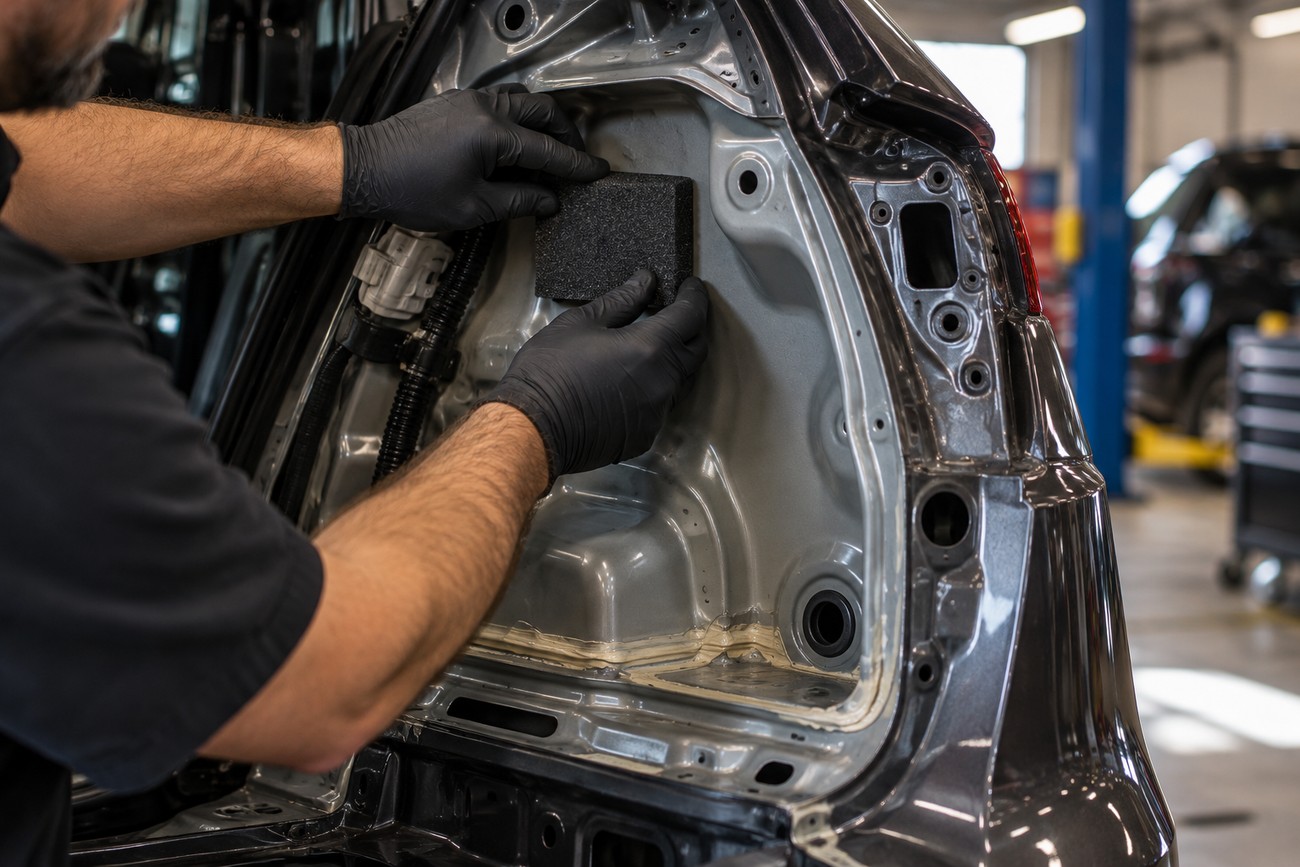
A targeted application can make sense in a clean, dry, non-service-critical cavity where drainage is preserved and the objective is thermal control or limited vibration damping. The actual metal, primer, seam sealer, and existing coatings must be compatible with the product. A smaller controlled treatment is safer than filling every hollow section.
Avoid filling unknown or rusty cavities, areas that require regular inspection, and sections likely to be cut during future body repair. Foam can conceal rust, cracks, and weld problems, then make cutting, extraction, inspection, and restoration substantially more difficult. Preserving access often has greater long-term value than adding material.
The key decision is not maximum foam thickness. It is whether edges, drainage routes, condensation-prone areas, and service points are controlled. If those conditions cannot be verified, cavity wax and a reversible acoustic treatment may be more appropriate than permanent filling.
- Inspect the cavity and identify drains, wiring, inspection points, and repair seams.
- Clean and repair the metal, then apply separate corrosion protection where required.
- Confirm that drainage remains functional and that the intended service area is still accessible.
- Test adhesion, expansion, curing, odor, and removal on a small area using the actual coating stack.
- Fill only the approved zone, leaving edges and functional openings controlled.
Frequently asked questions
Existing foam and uncertain substrates require a more cautious approach than a new, documented installation. The first objective is to restore visibility and control before adding material.
What should I do if foam has already been installed over suspected rust?
Stop adding foam and identify the affected zone. Remove enough material to expose the metal, including edges where water may have entered, then assess the steel, welds, and nearby drains. If corrosion is active, remove the damaged material and restore the surface and dedicated corrosion protection before deciding whether the cavity should be refilled.
Do not simply inject new foam into gaps around the old layer. That can enlarge the hidden area without confirming the condition of the substrate. If removal risks damaging wiring or thin sheet metal, controlled access and staged inspection are safer than forceful extraction.
How can I test a foam product before filling an entire body cavity?
Use a small test area on the actual metal, primer, seam sealer, or old coating stack. Check adhesion after curing, expansion direction, cure time, odor, and whether the foam leaves drains and inspection points clear. The test should also show how difficult removal will be if the result is unsuitable.
Allow the test to reach the product’s stated cure condition before judging it. Check nearby heat exposure and fire requirements against the datasheet, then inspect the boundary for gaps or moisture traps. A controlled trial cannot replace full preparation, but it can expose incompatibility before the entire cavity becomes inaccessible.