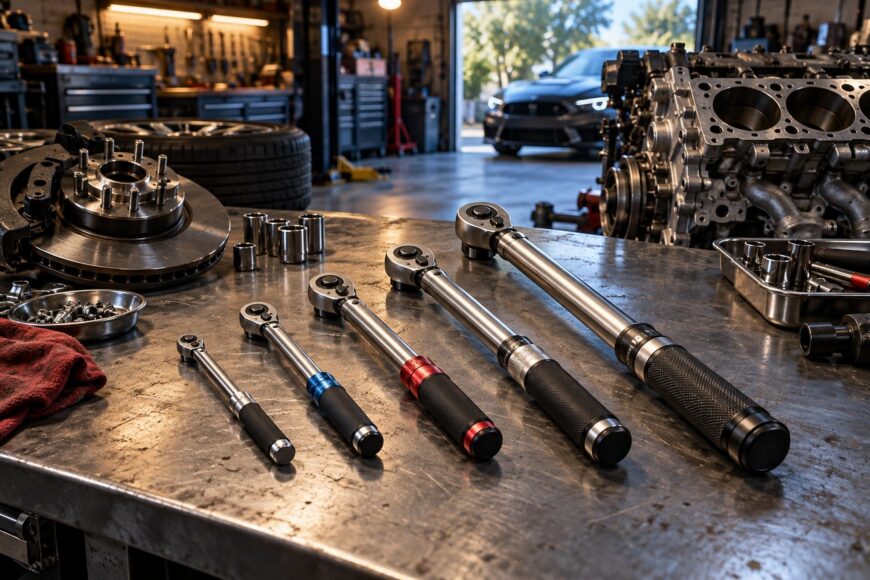
Buying a torque wrench for a home garage is a choice between two imperfect paths. One oversize universal wrench appears economical, yet it often performs poorly near the low end of its scale. Several specialized tools cover more jobs with greater confidence, although they cost more and take additional space in the toolbox.
The practical answer starts with the work you actually do: spark plugs and small covers, engine-bay fasteners, wheel nuts, or larger suspension and driveline hardware. Drive size matters alongside torque range. A 1/4-inch or 3/8-inch wrench suits small fasteners, while a 1/2-inch tool is usually the practical choice for wheels and many general passenger-car jobs.
Advertised accuracy is only one part of the decision. Click feel, scale visibility, adjustment control, calibration support, storage, and repeatability determine whether you can apply the specified torque consistently. The five selections below therefore represent useful tool profiles; where the supplied product information does not identify a current, documented model, the specification is marked unavailable rather than guessed.
- How We Chose the Five Picks
- The Five Best Torque Wrenches for Home Mechanics
- Pick 1: Best Small-Torque Wrench
- Pick 2: Best Mid-Range 3/8-Inch Wrench
- Pick 3: Best All-Around 1/2-Inch Wrench
- Pick 4: Best High-Range Wrench
- Pick 5: Best Value or Feature-Rich Alternative
- Five Picks Compared by Range, Drive Size, and Garage Use
- Which Torque Range and Drive Size Do You Actually Need?
- Buying Details That Matter More Than the Brand
- Common Torque-Wrench Mistakes and Hidden Trade-Offs
- How to Use, Check, and Store a Click Torque Wrench
- Frequently asked questions
- How often should a home torque wrench be calibrated?
- How do I torque left-hand-threaded fasteners?
- Who makes the best mechanic torque wrenches?
How We Chose the Five Picks
Click torque wrenches remain the main practical choice for a home garage because they give a mechanical release signal without requiring batteries or a display. The useful range is the first filter. A tool that covers the required torque in the middle of its scale is generally easier to set and trust than one forced to work close to its minimum or maximum.
Drive size was considered together with the range. Small-drive tools are easier to use on compact fasteners and fit crowded engine bays, while a 1/2-inch drive accepts the sockets commonly used for wheel nuts and larger automotive hardware. A large head can obstruct access, and a small drive can be a poor match for high-load work even when an adapter makes the socket fit.
Readability and feedback received equal weight. A clear scale, a locking adjustment, and a distinct first click matter in a dim or dirty garage. Common user complaints include vague or overly stiff clicks, slippery handles, poor scale visibility, and coarse adjustment. These are practical failures because they make the operator uncertain about when to stop.
Accuracy figures were treated as manufacturer or seller claims unless independent calibration evidence was available. About ±4% is claimed for some household models, but independent calibration evidence is not always available. Model-specific specifications, warranty terms, and calibration facilities must be checked against current manufacturer documentation rather than inferred from marketing language.
The Five Best Torque Wrenches for Home Mechanics
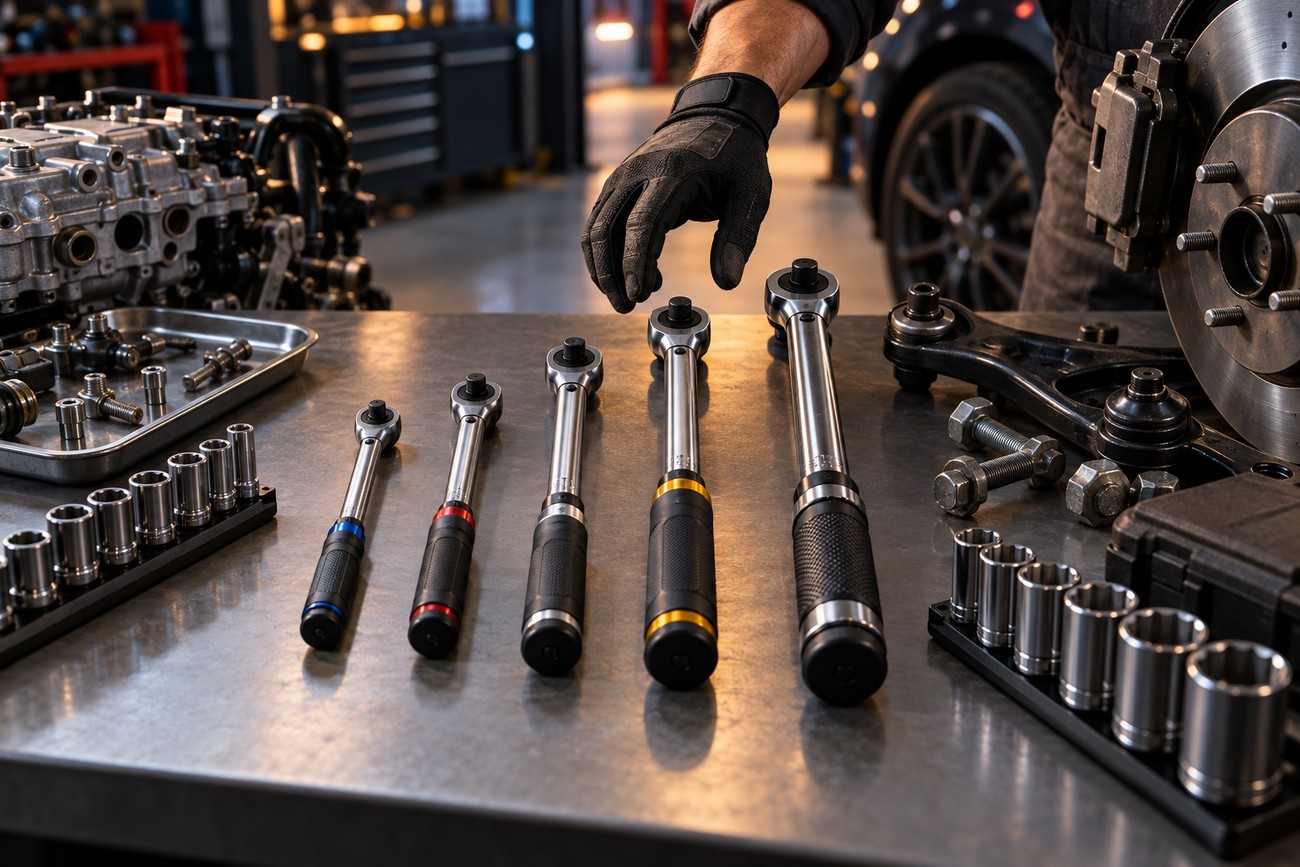
The five picks cover different home-mechanic needs instead of ranking five nearly identical tools. The categories follow three practical bands: up to 20–30 N·m, approximately 20–110 N·m, and approximately 100–350 N·m. Because the supplied research does not name five current products with verifiable documentation, each pick is presented as a buying profile, with unverified model-specific data clearly identified.
Pick 1: Best Small-Torque Wrench
The best small-torque wrench is a compact click tool with a 1/4-inch or 3/8-inch drive and a useful range up to 20–30 N·m. This category suits spark plugs, small covers, clamps, sensors, light brackets, and other fasteners where a large 1/2-inch wrench feels awkward. The supplied brief does not identify a specific verified model, so a current product should be selected only after checking its manufacturer range and calibration documentation.
A dedicated low-range wrench gives you a better chance of reading the setting accurately and feeling the release at the required value. A large universal tool may list a low minimum, yet its click can become difficult to distinguish there, particularly with gloves, background noise, or a crowded engine bay. The smaller head also improves access around covers and brackets.
Look for a fine, legible scale, a positive adjustment lock, and a click that releases cleanly without excessive travel. A short handle is useful in confined spaces, although it reduces leverage and can make a high setting physically inappropriate. The buyer who mainly works on wheel nuts should skip this category as a sole wrench; it is a companion tool for low-torque work.
Pick 2: Best Mid-Range 3/8-Inch Wrench
The mid-range 3/8-inch pick should sit comfortably around 20–110 N·m rather than advertise a wide total range that is useful only at its center. This is the practical band for many engine-bay, chassis, brake, and interior structural fasteners. No specific verified model is named in the supplied material, so the model’s stated range, drive, and service provisions require confirmation before purchase.
Scale visibility is especially important in this category because settings can change frequently during a repair. A well-marked primary scale with a manageable adjustment collar reduces reading errors when the handle is oily or the lighting is poor. The click should be distinct enough to feel through a controlled pull, with no need to guess whether a soft mechanical movement was the release.
A 3/8-inch head is a useful compromise for access and socket availability. It can reach many fasteners that are too small or crowded for a 1/2-inch tool, while offering more general utility than the smallest 1/4-inch format. Skip this pick if your work is almost entirely wheel service or high-load suspension hardware; a 1/2-inch tool will be a better primary wrench for those jobs.
Pick 3: Best All-Around 1/2-Inch Wrench
The most useful general garage profile is a 1/2-inch click wrench with a range around 28–210 N·m. This configuration is commonly used for wheel nuts and many passenger-car jobs, and it accepts the sockets already found in many automotive tool sets. The provided evidence does not identify a specific model that can be verified here, so current documentation should confirm the exact range, accuracy claim, warranty, and calibration route.
Its appeal is coverage. One tool can handle many wheel specifications, larger engine fasteners, and routine chassis work without the bulk of a high-range commercial wrench. The limitation is equally important: a range around 28–210 N·m does not make the tool equally suitable at every point on the scale. Low-torque fasteners remain better served by a smaller wrench.
Choose a model with a readable handle, a secure setting lock, and a head that does not obstruct the socket in tight wheel wells. Ratcheting can save time, but the ratchet mechanism should not be confused with a license to apply sudden force. A buyer who needs regular work approaching 350 N·m should skip this as the only tool and add a high-range wrench instead.
Pick 4: Best High-Range Wrench
The high-range pick is a long 1/2-inch wrench intended for larger fasteners and work approaching the 100–350 N·m category. It can be appropriate for heavy suspension, hub, axle, and driveline applications when the vehicle specification calls for that level of torque. The supplied research does not provide a verified model name or current specification, so length, range, and calibration details must be checked directly.
Length supplies leverage, which helps achieve high torque with a controlled pull. It also makes the tool harder to store and less pleasant in a confined engine bay. A long handle can strike bodywork or neighboring components, and its weight can encourage an operator to swing instead of pull smoothly.
High-range tools are poor substitutes for small-torque wrenches. Their lower scale area may be difficult to set, and their click may be less convincing near the minimum. Buy this profile only when the vehicle work genuinely includes high torque; otherwise, the space and cost are better spent on a low-range and a mid-range tool.
Pick 5: Best Value or Feature-Rich Alternative
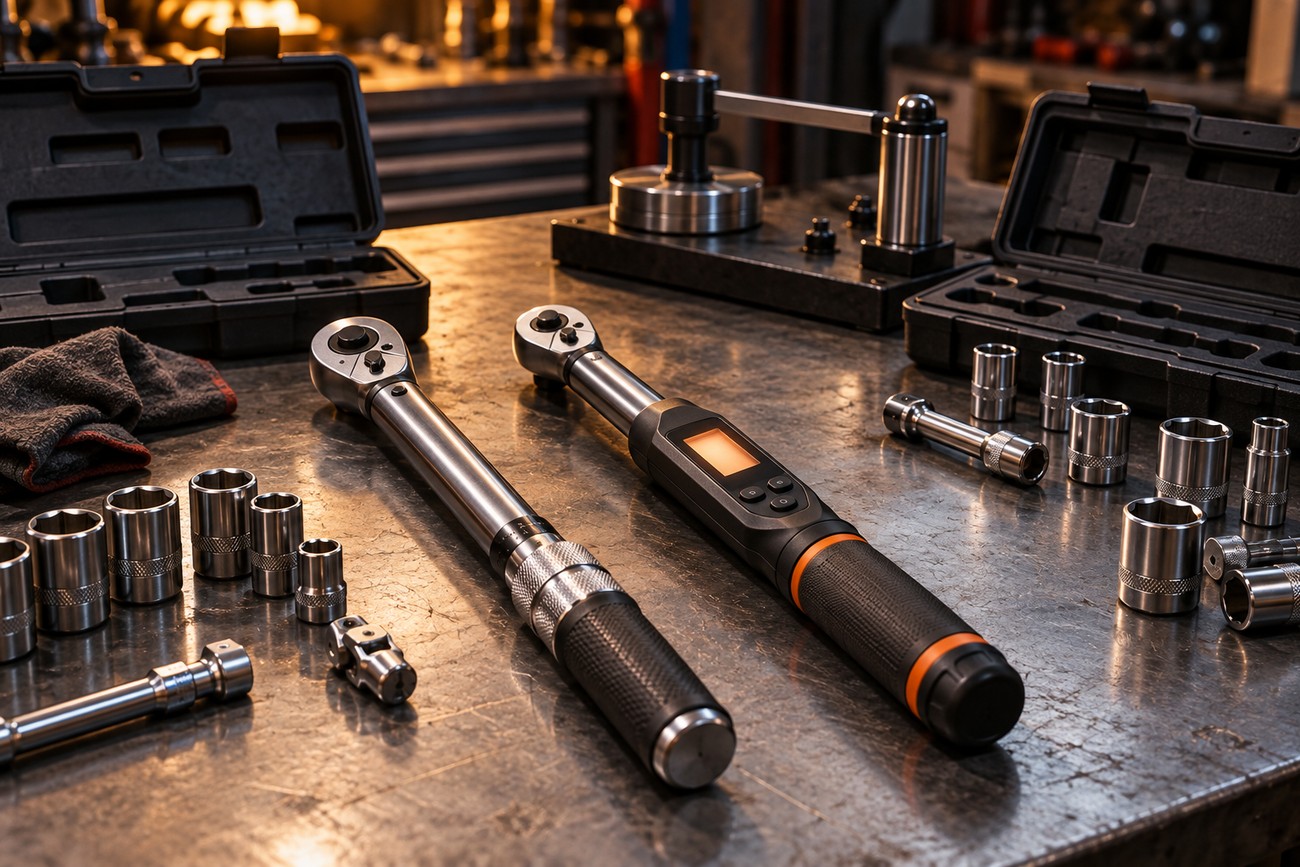
The value pick may be a budget click wrench or an electronically assisted model, provided its specifications, usability, and support can be documented. The supplied brief does not identify a current verified product for this category. A low purchase price is meaningful only if the tool has a usable range, readable adjustment, stable feedback, and a realistic path to calibration or service.
Budget models may claim accuracy near ±4%, while independent verification may be unavailable. Electronic models can add a display, audible alert, visual signal, or stored settings, yet they also introduce batteries, electronic controls, and environmental concerns. For home use, stable repeatability and readable adjustment can matter more than a claimed 2% accuracy figure.
Compare the alternative with a conventional click wrench on the points that affect daily use: can you see the setting, feel or hear the completion signal, and reset the tool reliably? The buyer who works in a wet, dirty, or poorly lit garage should favor dependable mechanical feedback over features that are difficult to notice. Skip a feature-rich model if its support and calibration arrangements are vague.
Five Picks Compared by Range, Drive Size, and Garage Use
The table compares the five buying profiles rather than inventing model-specific specifications. “Unavailable” means the supplied evidence does not verify the detail; it is not a claim that no product in the category offers it.
| Pick | Verified drive size | Stated working range | Torque type | Accuracy claim | Calibration information | Support | Best use | Key limitation |
|---|---|---|---|---|---|---|---|---|
| Best Small-Torque Wrench | 1/4-inch or 3/8-inch category; model unavailable | Up to 20–30 N·m | Click torque wrench | Unavailable for a verified model | Must be checked in current documentation | Model-specific support unavailable | Spark plugs, small covers, clamps, and light fasteners | Unsuitable as the only wrench for wheels and high-load work |
| Best Mid-Range 3/8-Inch Wrench | 3/8-inch category; model unavailable | Approximately 20–110 N·m | Click torque wrench | Claim must be verified by model | Independent evidence unavailable in the supplied brief | Model-specific support unavailable | Engine-bay and common chassis fasteners | Limited usefulness for very high torque |
| Best All-Around 1/2-Inch Wrench | 1/2-inch category; model unavailable | Around 28–210 N·m | Click torque wrench | Claim must be verified by model | Check calibration route before purchase | Model-specific support unavailable | Wheel nuts and general passenger-car work | Compromise near the low and high ends |
| Best High-Range Wrench | 1/2-inch category; model unavailable | Approximately 100–350 N·m | Click torque wrench | Claim must be verified by model | Check service and calibration documentation | Model-specific support unavailable | Large suspension, axle, and driveline fasteners | Too large and insensitive for small-torque work |
| Best Value or Feature-Rich Alternative | Model-dependent; unverified | Model-dependent | Click or electronic; model-dependent | Some budget models claim near ±4%; independent evidence may be unavailable | Must be documented by the manufacturer | Evaluate warranty and service response | Buyers balancing price, feedback, and features | Low price or extra features do not prove repeatability |
Which Torque Range and Drive Size Do You Actually Need?
Start with the torque specifications in the service information for the vehicles you maintain. Home automotive work commonly falls into three useful bands: up to 20–30 N·m for small fasteners, approximately 20–110 N·m for many engine-bay and chassis jobs, and approximately 100–350 N·m for larger hardware. These bands overlap because the correct choice depends on access, fastener size, and how close the required value sits to the tool’s limits.
A 1/4-inch or 3/8-inch drive is generally better suited to small fasteners and low torque. The smaller format fits spark plugs, covers, clamps, and sensors without bringing a large head into a confined space. A 3/8-inch mid-range wrench often provides a useful balance for engine and chassis work, while a 1/4-inch model is easier to control at the lowest settings.
A 1/2-inch drive is usually practical for wheel nuts and many general garage jobs. A range around 28–210 N·m is a common all-around configuration for passenger-car work. It should still be treated as a compromise: using it at the bottom of the scale can be less repeatable than using a dedicated low-range tool, and it does not cover high-torque jobs approaching 350 N·m.
Many experienced users therefore keep at least two wrenches: one low-range tool and one medium-to-high-range tool. This arrangement costs more than a single universal wrench, but each tool can be used in a more useful part of its scale. Adapters may allow a socket to fit a different drive, yet they do not turn a poorly matched range into a suitable one.
Long extensions and unusual adapter geometry deserve separate attention. Their effect depends on how the added length changes the line of force and on whether the tool is being pulled in line with the handle. A straight extension generally presents a different situation from an offset adapter, so follow the manufacturer’s guidance and avoid assuming every accessory is torque-neutral.
Buying Details That Matter More Than the Brand
A click wrench should release with a clear, repeatable signal at the selected setting. “Clear” does not necessarily mean loud; in a noisy garage, a tactile release that you can feel through a controlled pull may be more useful than a faint sound. Reports of vague, overly stiff, or delayed clicks matter because the operator may continue pulling after the target has already been reached.
The handle needs enough grip without becoming bulky. Oily hands, gloves, and poor lighting expose weaknesses that are easy to miss in a product photograph. Check whether the scale remains visible while the handle is held in a natural position, whether the adjustment collar moves in controlled increments, and whether the lock prevents accidental changes during use.
Head size and direction control affect access. Ratcheting can reduce the need to lift and reposition the wrench, but the specific head mechanism should be checked for durability and smooth switching. Reversibility for left- and right-hand threads varies by model; verify how the direction is selected and whether the manufacturer permits torque application in both directions.
Socket compatibility is another basic check. A 1/2-inch wrench does not accept a 3/8-inch socket without the correct adapter, and an adapter can affect the delivered torque depending on its geometry. A case that protects the adjustment mechanism and keeps the tool from rolling under a bench is useful because storage affects long-term repeatability.
Calibration information separates a serious purchase from a persuasive listing. Some consumer products claim about ±4% accuracy, but that claim may not be supported by independent calibration evidence. Brand reputation alone is insufficient; look for documented service, a stated calibration process, understandable warranty handling, and a range that matches your work.
Common Torque-Wrench Mistakes and Hidden Trade-Offs
The first mistake is asking one universal wrench to handle every torque value. A large tool used near its minimum can have a less convincing click and a harder-to-read setting, while a small tool cannot safely or comfortably cover high-load fasteners. The result is reduced confidence exactly where repeatability matters most.
A separate low-range wrench is easier to trust near small settings because its mechanism, scale, and handle are designed around that work instead of being stretched across a much wider range.
Working at the extreme ends of a scale is another avoidable compromise. The advertised range tells you where adjustment is possible, not that every point is equally convenient or predictable. Place the required value in the useful middle area whenever the tool and specification allow it, and select another range when the required torque sits too close to a limit.
After the first clear click, stop. Adding a subjective extra turn defeats the purpose of the calibrated release and can substantially increase clamp load. This is especially easy to do when the click is muted by a noisy workshop or when the operator expects the fastener to feel tighter.
Torque specifications also assume a particular thread condition. The same numerical setting can produce different clamp results on dry and lubricated threads because friction changes. Follow the vehicle or component instructions for cleaning, lubrication, thread compounds, and tightening sequence instead of applying a lubricant by habit.
Adapters and extensions are often treated as neutral accessories, but their influence depends on geometry, length, and the direction of the applied force. A long or offset arrangement can change the effective torque at the fastener. If a tool has been overloaded while loosening a seized bolt, treat the event as a reason for inspection and calibration rather than assuming the mechanism recovered on its own.
How to Use, Check, and Store a Click Torque Wrench
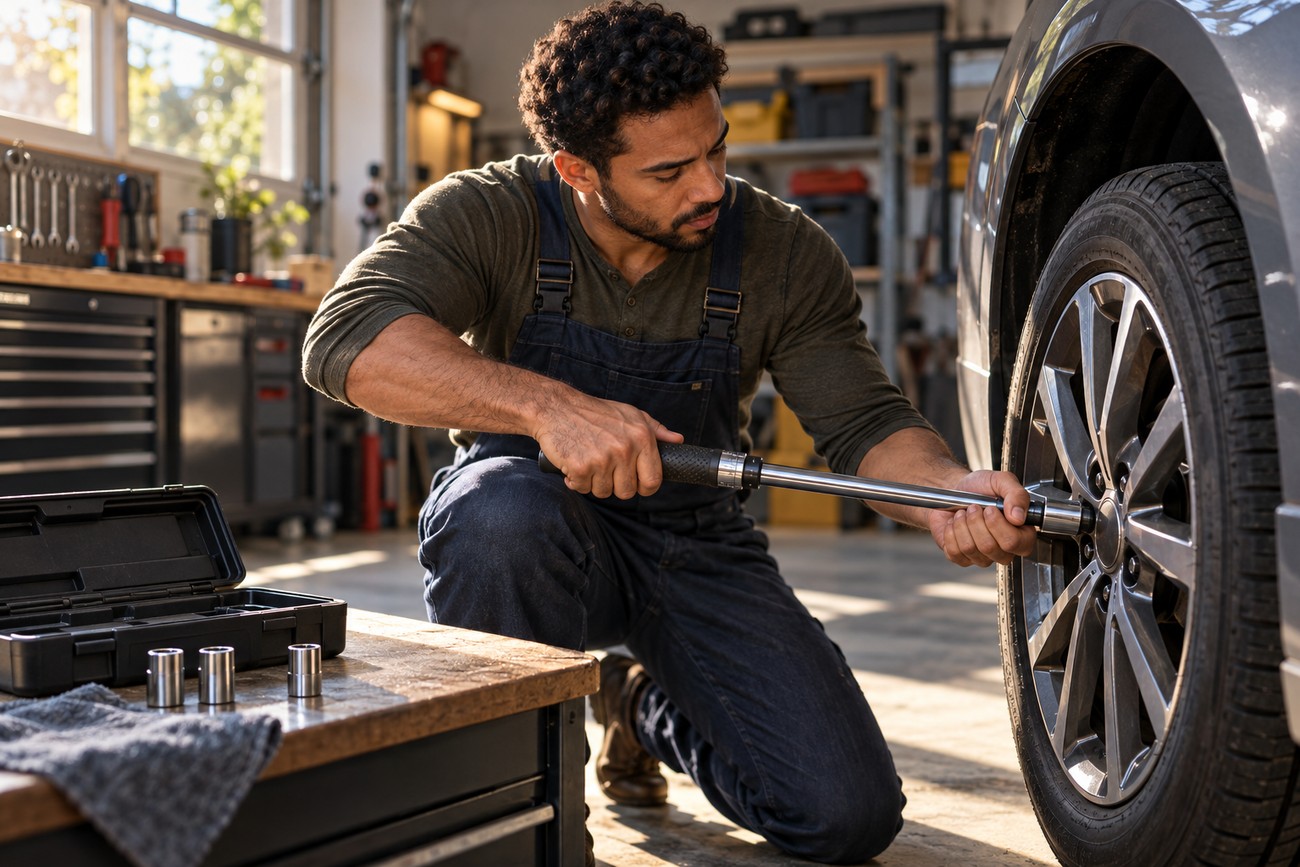
Begin with the vehicle or component specification and confirm the thread condition. Identify whether the value applies to a dry, clean, lubricated, or specially treated thread, and note any required tightening sequence. Select a socket that fits the fastener fully, then verify the wrench’s drive size and direction before setting the value.
Set the torque within the useful part of the wrench’s range, avoiding the extreme ends when another tool is available. Lock the adjustment so it cannot move while the handle is being positioned. Keep the pull as straight and smooth as the access allows; jerking the handle introduces operator variation and makes the release harder to interpret.
Stop at the first clear click. Do not reset the tool and pull again merely to make the fastener feel more secure, and do not add a final turn by judgment. For a sequence of fasteners, follow the specified pattern and repeat the same technique so that each position receives comparable treatment.
After the job, inspect the setting, head, socket interface, and handle for damage or contamination. A click wrench should be backed off after use rather than left at its maximum value. This is intended to reduce long-term spring stress according to common maintenance practice and makes the tool ready for its next setting.
Calibration is a maintenance issue, not a badge reserved for professional tools. Regular calibration and careful storage support repeatability regardless of brand. Seek service after a drop, overload, suspected misuse, or a noticeable change in click feel; a tool that suddenly becomes vague, stiff, or inconsistent deserves attention before it is trusted on critical fasteners.
Frequently asked questions
How often should a home torque wrench be calibrated?
There is no single interval suitable for every home mechanic. Follow the manufacturer’s service guidance, then shorten the interval when the wrench is used frequently, transported often, exposed to dirt or moisture, or subjected to an overload. A tool used occasionally for wheel work has a different maintenance burden from one used repeatedly during engine or chassis repairs.
Arrange calibration after a drop, an attempt to loosen a seized fastener, or any suspected overload. A changed click sound, unusual stiffness, inconsistent release, or visible damage is a warning sign even if the tool has seen little use. Storage with the setting backed off supports repeatability, but it does not replace calibration when the mechanism has been shocked or its behavior has changed.
How do I torque left-hand-threaded fasteners?
First verify that the specific wrench can apply torque in the required direction. Some click wrenches reverse for socket operation but are specified for torque measurement in only one direction; others support both directions. Check the manufacturer’s instructions and the head’s switching mechanism before purchase rather than assuming a reversible ratchet provides full bidirectional capability.
Use the torque value and tightening procedure supplied by the vehicle or component instructions. The wrench does not determine whether a left-hand thread requires a different specification. Keep the pull aligned with the handle, confirm the socket is fully seated, and stop at the first clear click in the permitted direction.
Who makes the best mechanic torque wrenches?
No brand is automatically best for every home mechanic. Evaluate manufacturers by documented calibration procedures, service availability, warranty handling, repeatability information, readable design, and the range and drive size required for your work. A well-supported tool that fits the job can be a better purchase than a prestigious name with a poorly matched range.
Check whether the accuracy figure is a manufacturer claim or supported by independent calibration evidence. Also inspect the storage instructions, adjustment lock, click behavior, and replacement or repair arrangements. Brand reputation helps with support expectations, but calibration, storage, range selection, and careful handling determine how reliably the wrench performs over time.