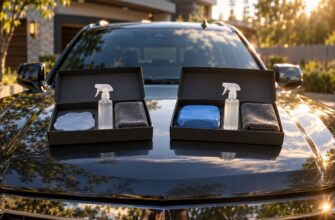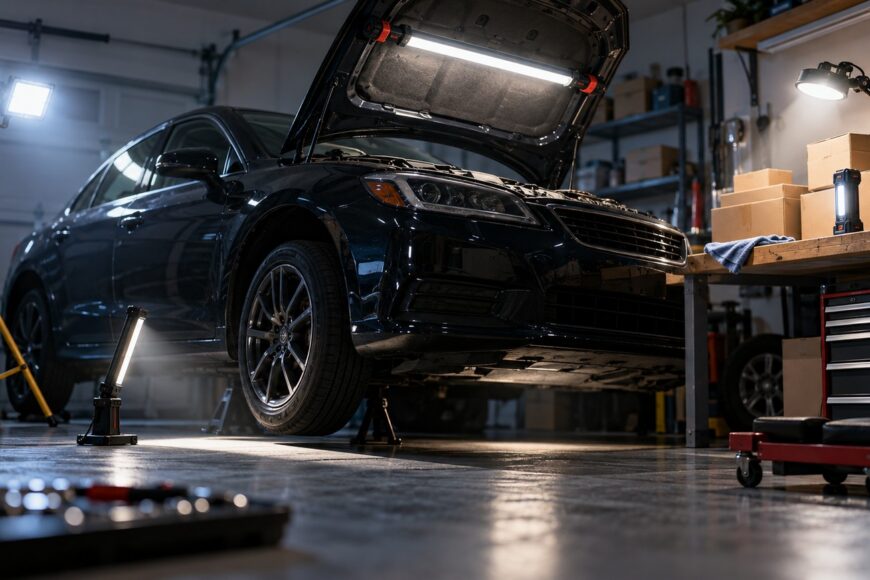
A high-lumen work light can still leave the area under a vehicle in shadow, throw hard reflections across the hood, and become tiring during a long repair. A narrow beam may look impressive on the box while illuminating only one central spot.
The practical choice is between fixed general lighting, portable task lighting, or a combination of both. Beam distribution, CRI, color temperature, flicker, cooling, mounting, and IP protection matter as much as the headline lumen figure. The five options below represent different garage jobs rather than five identical high-output lamps.
- What makes an LED work light good for a garage?
- The 5 best LED work lights for garages
- Best overall: a broad-beam portable work light
- Best under-hood light: a long, slim stick light
- Best fixed option: a linear garage LED
- Best for detailing: a high-CRI inspection light
- Best rugged choice: a protected flood or tripod light
- Five garage lights compared at a glance
- Why a bright garage light can still work badly
- How to set up garage lighting without glare
- Buying and safety checklist
- Frequently asked questions
- How can I check an LED work light for flicker without special equipment?
- What should I do if a garage LED light overheats but still works?
- What is Top Hat in Canvas?
- Where is T. O. P big Bang now?
What makes an LED work light good for a garage?
Start with illumination at the work surface, not with watts alone. A comfortable target is 300–500 lux in the work zone and 200–300 lux across the rest of the garage. A typical workbench or vehicle area needs about 3000–6000 lumens, depending on the room size, wall color, floor color, and how evenly the light is distributed.
Beam shape determines whether those lumens are useful. A broad, softened beam covers the floor, sides of the vehicle, and nearby tools, while a 20–30° beam can produce a bright central patch with dim edges. Several moderate sources usually create fewer hard shadows than one intense floodlight aimed from a single point.
Color quality affects inspection work. CRI ≥80 is the minimum sensible target for routine garage tasks, while CRI ≥90 is preferable for painting and detailing. A 4000–5000K color temperature is a practical compromise: it shows surface defects clearly without the harsh appearance that some high-cool-white lamps produce. Warm 3000K light can make paint look more forgiving than it really is.
Check the driver and housing as carefully as the LED board. LEDs and their drivers still produce meaningful heat, so the fixture needs ventilation and clearance around its heat sink. Flicker may be absent from the product description even when it appears on a phone camera or causes discomfort after extended work. IP44–IP54 is often sufficient for a closed garage; IP65 or higher suits wet, open, or very dusty work. Fixed installations also need secure mounting and certified wiring.
The 5 best LED work lights for garages
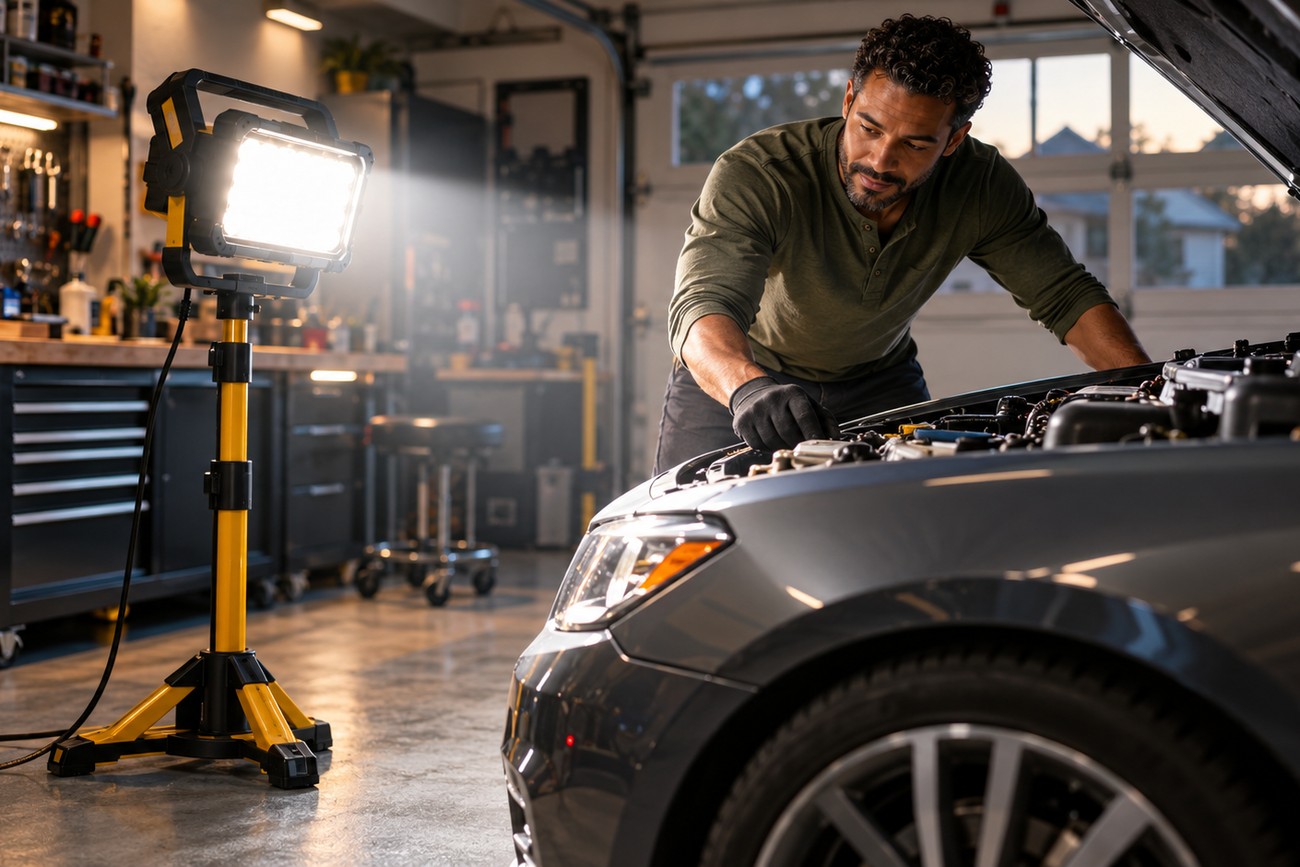
These five choices are practical light types for different garage tasks. Because no manufacturer specifications were supplied for particular retail models, unverified figures are marked that way rather than guessed.
Best overall: a broad-beam portable work light
A broad-beam portable light is the most flexible choice for a garage that already has basic ceiling lighting. It can sit beside a wheel, point into an engine bay, or illuminate a workbench without forcing you to stand directly in front of the beam. The useful target for a vehicle work area is about 3000–6000 lumens, provided the output is spread evenly.
Look for a frosted or diffused face, a stable tilting stand, and a mounting system that does not loosen when the lamp is repositioned. A broad beam is generally more useful for general work than a narrow 20–30° beam. The exact wattage, CRI, color temperature, IP rating, and runtime are unverified for this category, so confirm them on the individual product page.
This light works best as the mobile layer of a two-part setup. Place fixed lights above the vehicle for background illumination, then use the portable unit to fill shadows around the wheel arches, engine bay, and workbench. It should supplement, rather than replace, the garage’s main lighting.
Best under-hood light: a long, slim stick light
A long stick-style light reaches spaces where a square floodlight cannot. Its narrow body can sit along the hood line, sill, or subframe and spread light along the length of the engine bay. That reduces the gaps and deep shadows common with a single lamp held at one end.
The mounting method matters more than a high lumen claim. A strong hook, protected magnetic ends, or a secure clamp makes the lamp useful when both hands are occupied. Battery-powered models may run for only 1–2 hours, depending on output and battery design, so check whether the battery is replaceable and whether charging interrupts the job.
Use the stick light for under-hood, under-car, and wheel-area work, then return it to a charger rather than treating it as the main garage light. Confirm drop resistance and protection against workshop dirt separately; a vague “rugged” label does not confirm a tested impact rating or a particular IP level.
Best fixed option: a linear garage LED
A linear garage LED is the strongest foundation for regular vehicle work. Several evenly spaced ceiling or wall fixtures cover the vehicle’s length and reduce the hard shadows created by one intense point source. Linear housings are also common in 230V markets, while 120V markets commonly use separate work-light products in the 30–60W and approximately 3000–6000 lumen range.
Install fixed lighting with secure hardware and certified wiring. Leave the ventilation openings clear, especially when a fixture is mounted close to a ceiling or enclosed by a homemade cover. IP44–IP54 is often sufficient for an enclosed garage; exposed wash areas, open-sided workspaces, and unusually dusty locations may justify IP65 or higher.
Quality LED fixtures commonly claim 25,000–50,000 hours when operated with proper cooling and ventilation. Treat that as a conditional service-life claim, not a guarantee. A poorly ventilated driver can age early even when the lamp still appears bright.
Best for detailing: a high-CRI inspection light
A high-CRI inspection light earns its place during paint correction, detailing, and final inspection. CRI ≥90 is preferred for paintwork because it helps reveal changes in color, scratches, orange peel, and uneven correction. Brightness alone cannot compensate for weak color rendering.
Neutral 4000–5000K light generally makes surface defects easier to see than warm 3000K light, which can visually soften flaws. A frosted diffuser can reduce reflections from metal and clear coat, although the softened output may require more total light to produce the same measured illumination.
Use this type close to the panel and move it across the surface instead of staring into it from a shallow angle. A product with unverified CRI, flicker performance, or diffuse quality should be tested before being trusted for color-critical work. It is an inspection tool, not automatically a suitable replacement for broad ceiling lighting.
Best rugged choice: a protected flood or tripod light
A protected flood or tripod light suits damp garages, dusty work, and occasional outdoor jobs. IP65 or higher is justified for wet, open, or especially dusty working conditions, but the rating should be stated clearly and understood: it does not make every part of the stand, switch, plug, or extension connection weatherproof.
Powerful compact LED housings can run hot and need effective heat dissipation. Inspect the metal housing, rear heat sink, cable entry, stand lock, and bracket before buying. A stable tripod is safer than a loose swivel bracket when the lamp must remain aimed at a vehicle for a long repair.
A stated 25,000–50,000-hour life depends on normal operating temperature and ventilation. “Indestructible” or “impact-resistant” wording is weaker than a defined test rating and a warranty. Check whether the lens, driver, bracket, or power cable can be replaced; missing parts can make a damaged lamp uneconomical to repair.
Five garage lights compared at a glance
The table separates confirmed category-level guidance from specifications that must be verified for a particular retail model. Do not rank these options by lumens alone.
| Option | Intended use | Output and wattage | Beam and glare | Color and CRI | IP rating | Power and mounting | Runtime | Main compromise |
|---|---|---|---|---|---|---|---|---|
| Broad-beam portable work light | General task lighting | Target 3000–6000 lumens; wattage unverified | Broad beam; diffuse preferred | Verify 4000–5000K and CRI ≥80 | Verify; IP44–IP54 often suits a closed garage | Mains or battery; stand or bracket | Battery runtime unverified | Needs re-aiming and charging if cordless |
| Long slim stick light | Under hood and under car | Unverified | Long, narrow coverage for tight spaces | Verify color temperature and CRI | Verify | Battery; hook, clamp, or protected magnet | May be only 1–2 hours | Limited as general lighting |
| Linear garage LED | Fixed ceiling or wall lighting | Common output varies; verify model | Wide, even coverage | Verify 4000–5000K and CRI ≥80 | IP44–IP54 often sufficient indoors | Mains; fixed hardware and certified wiring | Not applicable | Less flexible after installation |
| High-CRI inspection light | Detailing and paint inspection | Unverified | Controlled beam; matte diffuse preferred | Prefer CRI ≥90 and 4000–5000K | Verify | Mains or battery; hand-held or stand | Battery runtime unverified | Costs more for inspection quality |
| Protected flood or tripod light | Dusty, damp, or outdoor work | 30–60W and approximately 3000–6000 lumens are common in 120V markets; verify model | Flood beam; glare depends on lens | Verify CRI and color temperature | IP65 or higher for demanding conditions | Mains; tripod or heavy bracket | Not applicable | Can run hot and cast hard shadows |
Why a bright garage light can still work badly
A 20–30° beam may illuminate only the center of the vehicle while leaving the sides, floor, and suspension in dim light. Reflections from a hood or polished tool can also be brighter than the defect you are trying to inspect. Moving the light farther away or using a diffuser often improves visibility more than adding another claimed lumen figure.
Budget LED fixtures may show PWM flicker, especially when dimmed or used in cold conditions. Some cheap lights begin flickering at −10°C and below, even though the problem is not obvious to the naked eye. Cold can also affect battery performance and driver behavior, so a lamp that works indoors may behave differently in an unheated garage.
A phone’s slow-motion video or camera preview can expose PWM flicker that looks steady to the eye, especially after dimming or in cold conditions. Dark bands or moving stripes are a warning to test another setting or fixture.
Heat is another hidden failure. Poor cooling can shorten LED and driver life even when the lamp does not immediately lose brightness. Check whether vents are blocked by dust, insulation, or a tight mounting surface, and avoid enclosing a high-output lamp in a box that traps hot air.
Loose brackets create their own safety problem: the beam drifts, the lamp falls, and repeated adjustment wears the mounting hardware. Impact-resistance claims do not guarantee survival after a fall. If replacement lenses, drivers, brackets, or cables are unavailable, the real ownership cost rises after a minor accident.
How to set up garage lighting without glare
Build the layout in layers. Use fixed ceiling or linear lights for the background and general illumination, then add portable directional lights for the engine bay, underside, wheel areas, and workbench. This combined fixed-and-portable setup reduces shadows around and under the vehicle without requiring one oversize floodlight.
Space fixed fixtures along the vehicle rather than placing every source directly above its center. Aim portable lights across the work surface or into a recess, not toward your eyes. Excessively bright point sources create glare and harsh shadows, particularly on metallic paint and glossy tools.
A matte diffuser is useful where reflections are a problem. It can make metal and clear coat easier to read, although it may require more total output for the same illumination. For defect inspection, use 4000–5000K; warm 3000K light can make scratches and paint texture appear less severe.
Magnets are convenient on steel bodywork, but they can scratch fresh paint or leave marks. Put protective film or a clean barrier between the magnet and the panel, and inspect the contact surface for grit before moving the lamp. Never rely on a magnetic mount alone above a person or a sensitive painted surface.
Buying and safety checklist
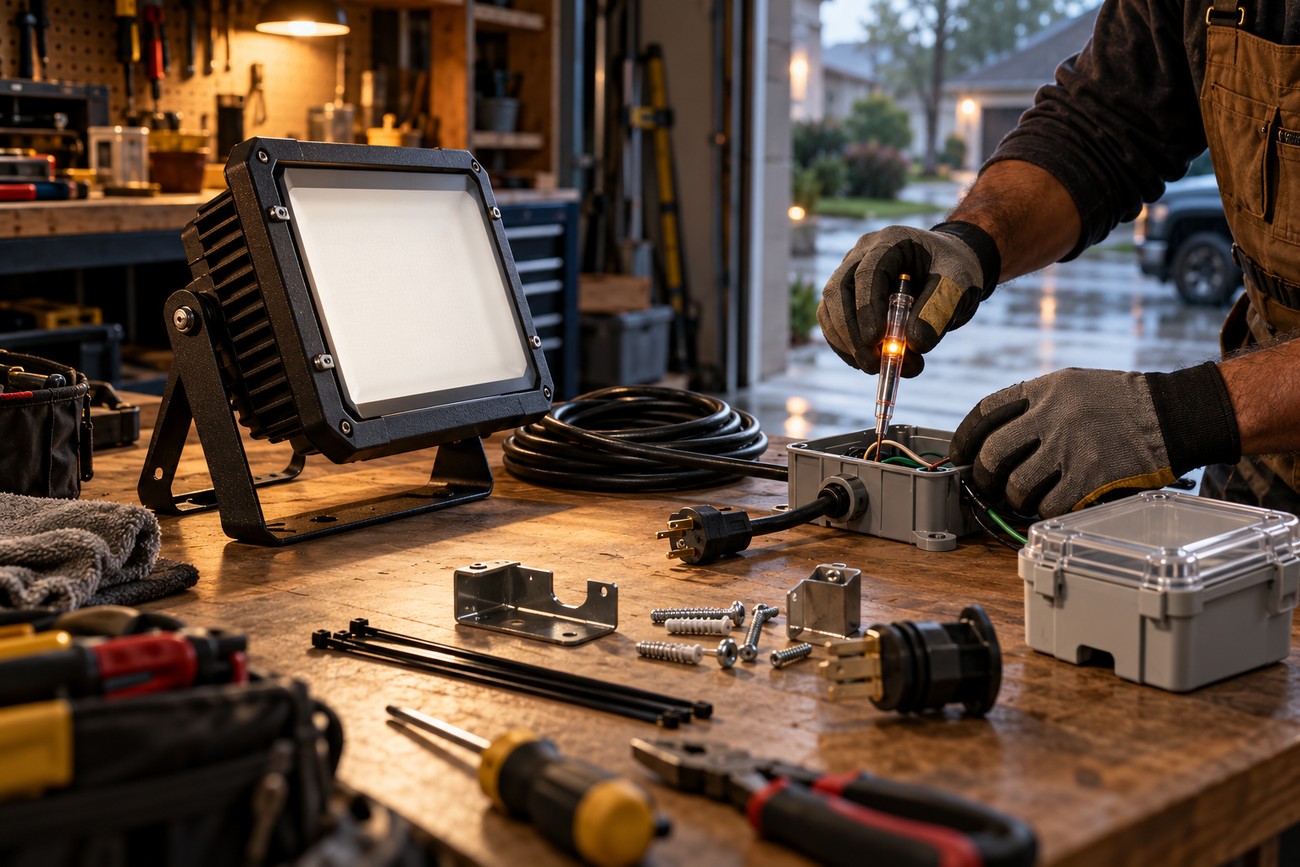
Confirm the electrical supply before ordering. The relevant supply contexts are 120V in the US and Canada and 230V in many European markets. A mains fixture must match the local voltage and use suitable wiring, plugs, and protection; fixed work should be installed with secure mounting and certified wiring.
Choose IP protection for the environment, not for marketing reassurance. IP65 is not automatically required in a dry enclosed garage; IP44–IP54 is often enough. IP65 or higher makes more sense for wet, open, or very dusty work, while the plug, switch, extension lead, and connection points still need appropriate protection.
Inspect cooling clearance, housing temperature, and flicker before committing to a permanent installation. LEDs still produce meaningful heat at the housing and driver, so ventilation matters. Use a phone camera to screen for banding, and test the lamp at its intended brightness rather than only at full power.
- Use a battery lamp as task lighting, not as the sole general light when its practical runtime may be only 1–2 hours.
- Check the stability of stands, hinges, hooks, clamps, and swivel brackets.
- Ask whether lenses, drivers, brackets, and cables are available as replacement parts.
- Verify CRI, color temperature, beam angle, and IP rating instead of accepting vague “daylight” or “weatherproof” wording.
- Keep heat sinks and ventilation openings clear of dust, stored items, and insulation.
Frequently asked questions
How can I check an LED work light for flicker without special equipment?
Open your phone camera and point it at the lamp while recording, then try slow motion if your phone offers it. Dark bands, moving stripes, or pulsing brightness suggest flicker that may be invisible in normal use. Repeat the check at lower brightness, because dimming can change the driver’s behavior.
This is a screening method, not a laboratory measurement. A clean-looking video does not prove that a fixture is flicker-free, but visible banding is a clear reason to avoid the setting or choose another light.
What should I do if a garage LED light overheats but still works?
Switch it off and let it cool before inspection. Check blocked vents, dust, tight mounting clearance, and any cover that traps hot air. If the housing remains unusually hot after those issues are corrected, inspect the driver area only if the fixture is designed to be serviced safely.
Do not ignore continuing heat because the lamp remains bright. Record the problem, check the warranty, and ask about a replacement driver or fixture. A lamp without service parts may be cheaper to replace than to keep operating in a degraded condition.
What is Top Hat in Canvas?
Top Hat is a separate teaching and student-engagement platform that can integrate with Canvas. In a connected course, instructors may use Top Hat for interactive questions and course activities while Canvas remains the learning-management system. The exact available features depend on the institution’s integration and account setup.
Where is T. O. P big Bang now?
T. O. P, also known as Choi Seung-hyundai, is no longer an active member of BIGBANG. He has publicly focused on individual creative work, including acting and art-related projects, while the group’s activities and his personal plans have changed over time. Current appearances should be checked against his latest official announcements.