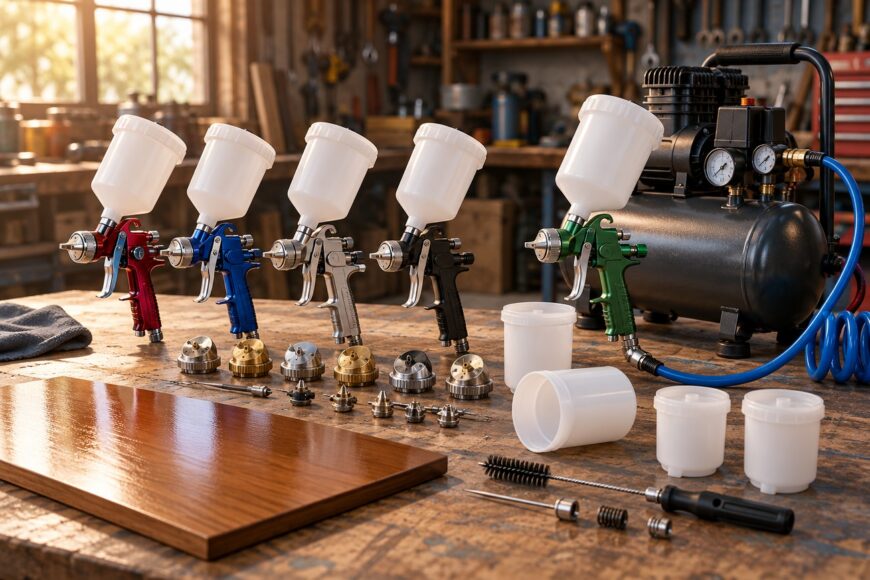
A spray gun can be well rated and still fail in your shop if the compressor cannot supply enough air. The result is a pulsing fan, weak atomization, dry spray, or uneven coverage, even when the pressure gauge appears to show the correct number.
Choosing an HVLP gun under $200 involves more than comparing wattage or review scores. You are balancing finish quality, material waste, working speed, cleanup, and the comfort of holding the tool. Compact turbine guns avoid compressor compatibility problems, while compressor-fed guns can be lighter but demand a suitable air supply.
The models below are budget compromises. They can work well for furniture, trim, cabinets, and occasional projects, but no sub-$200 gun should automatically be treated as equivalent to a professional turbine system or a well-matched shop spray setup.
- What to Know Before Buying an HVLP Spray Gun
- The Top 5 HVLP Spray Guns Under $200
- Comparison Table: Airflow, Nozzles, Capacity, and Best Use
- Will Your Compressor Actually Run It?
- Setup Mistakes That Cause Overspray, Spits, and Runs
- The Trade-Offs Cheap HVLP Listings Often Hide
- Which Under-$200 HVLP Gun Should You Choose?
- Frequently asked questions
- How often should I clean an HVLP spray gun?
- Which brand of spray gun is considered the best?
- What is the best budget HVLP spray gun?
- What are the top 5 spray paint guns?
What to Know Before Buying an HVLP Spray Gun
HVLP means High Volume Low Pressure. The system uses a large volume of air at relatively low pressure to atomize the coating, which can reduce overspray and material waste when the gun, coating, and technique are properly matched.
Air volume matters more than the pressure number printed on a product page. Typical true HVLP airflow is 8–20 cfm, while one profile source gives an HVLP air-volume range of 140–700 L/min. True HVLP operation may require a compressor of approximately 5 hp or more, although individual budget models sometimes claim compatibility with 2–3 hp compressors.
Those 2–3 hp claims are model-specific marketing, not a universal HVLP standard. A compressor may reach the advertised pressure while still failing to deliver enough air continuously. The pressure can then fall during a long pass, causing the fan to narrow or pulse.
Transfer efficiency is also a setup result. Practical transfer is often around 65% and can reach up to 80% with suitable settings. Nozzle size, viscosity, air pressure, material flow, spray distance, and hand speed all affect how much coating reaches the workpiece.
The Top 5 HVLP Spray Guns Under $200
This shortlist focuses on widely available consumer HVLP systems commonly sold below the $200 ceiling. Prices change by retailer, country, and bundle, so check the current listing before buying. The models are presented by use case rather than as a universal ranking.
HomeRight Finish Max is a practical choice for occasional furniture, cabinets, crafts, and trim. Its turbine is built into the gun, so it does not require a separate compressor, and its adjustable spray pattern makes it more adaptable than a single-nozzle detail sprayer. The compromise is modest production speed and a compact body that can become tiring during extended work.
Wagner Control Spray 250 suits small-to-medium DIY jobs such as shelves, doors, furniture, and outdoor projects. Its turbine layout is simple, and the adjustable spray pattern is useful when moving between narrow trim and broader panels. The main limitation is that the manufacturer’s consumer specifications do not provide a directly comparable compressor-style cfm requirement because the turbine is integrated.
Wagner FLEXiO 3500 is the stronger candidate for larger furniture pieces and longer DIY sessions among these compact consumer systems. Its remote turbine keeps some motor weight away from the hand and gives it more capacity than a small detail gun. It remains a consumer tool, however, and its higher output can create more cleanup and overspray if the material is too thin or the controls are opened too far.
VONFORN 700W and Scuddles HVLP kits are budget-oriented options for occasional projects where interchangeable nozzles and a larger cup matter more than long-term parts support. Both are typically sold with several nozzle sizes and broad adjustment controls, but airflow data, replacement-part availability, and durability information can be less complete than with established manufacturers. Their best use is light DIY work after careful test spraying, rather than continuous production.
- Best for small detail and furniture jobs: HomeRight Finish Max.
- Best for general occasional DIY work: Wagner Control Spray 250.
- Best for larger pieces and longer sessions: Wagner FLEXiO 3500.
- Best for low-cost experimentation with several nozzle sizes: VONFORN 700W or Scuddles HVLP.
Comparison Table: Airflow, Nozzles, Capacity, and Best Use
The table separates manufacturer-published details from information that is unclear or difficult to compare. Turbine guns do not use compressor airflow in the same way as compressor-fed spray guns, so an unavailable cfm figure does not mean the tool is unusable.
| Spray gun | Price status | Stated air consumption | Compressor guidance | Nozzle options | Cup capacity | Controls and layout | Best application |
|---|---|---|---|---|---|---|---|
| HomeRight Finish Max | Commonly listed below $200; verify current price | Not stated as compressor cfm | Integrated turbine; no separate compressor | Typically supplied with a 1.5 mm tip | Approximately 27 oz / 800 ml | Material-flow and spray-pattern adjustment; integrated turbine | Furniture, cabinets, trim, and occasional DIY work |
| Wagner Control Spray 250 | Commonly listed below $200; verify current price | Not stated as compressor cfm | Integrated turbine; no separate compressor | Manufacturer-specific nozzle; exact range should be checked for the bundle | Approximately 20 oz / 590 ml | Adjustable pattern and material flow; integrated turbine | Small and medium projects, doors, furniture, and outdoor coatings |
| Wagner FLEXiO 3500 | Some configurations are near the $200 ceiling; verify current price | Not stated as compressor cfm | Remote turbine; no separate compressor | Configuration-dependent; check the supplied nozzle | Configuration-dependent | Material and pattern controls; remote turbine layout | Larger furniture, cabinets, and longer DIY sessions |
| VONFORN 700W HVLP | Commonly listed below $200; verify current price | Manufacturer airflow data may be unclear | Integrated turbine; no separate compressor | Often supplied with approximately 1.0–2.5 mm options; verify the kit | Often approximately 1,000 ml; verify the listing | Material flow, pattern, and air controls; integrated turbine | Occasional furniture, crafts, and general DIY work |
| Scuddles HVLP kit | Commonly listed below $200; verify current price | Manufacturer airflow data may be unclear | Integrated turbine; no separate compressor | Often supplied with several tips, commonly around 1.0–2.5 mm | Often approximately 1,000 ml; verify the listing | Material flow, pattern, and air controls; integrated turbine | Low-cost projects and infrequent household use |
Many household HVLP guns use a 1.3–1.5 mm nozzle, a 600–700 ml cup, and approximately 2.0 bar working pressure. Those are useful reference points, not substitutes for the specifications of the individual model.
Weight and turbine layout affect comfort as much as the published power figure. A monoblock gun keeps the setup compact but places the motor in your hand. A remote turbine adds hose length but can reduce hand fatigue during cabinet or furniture work.
Will Your Compressor Actually Run It?
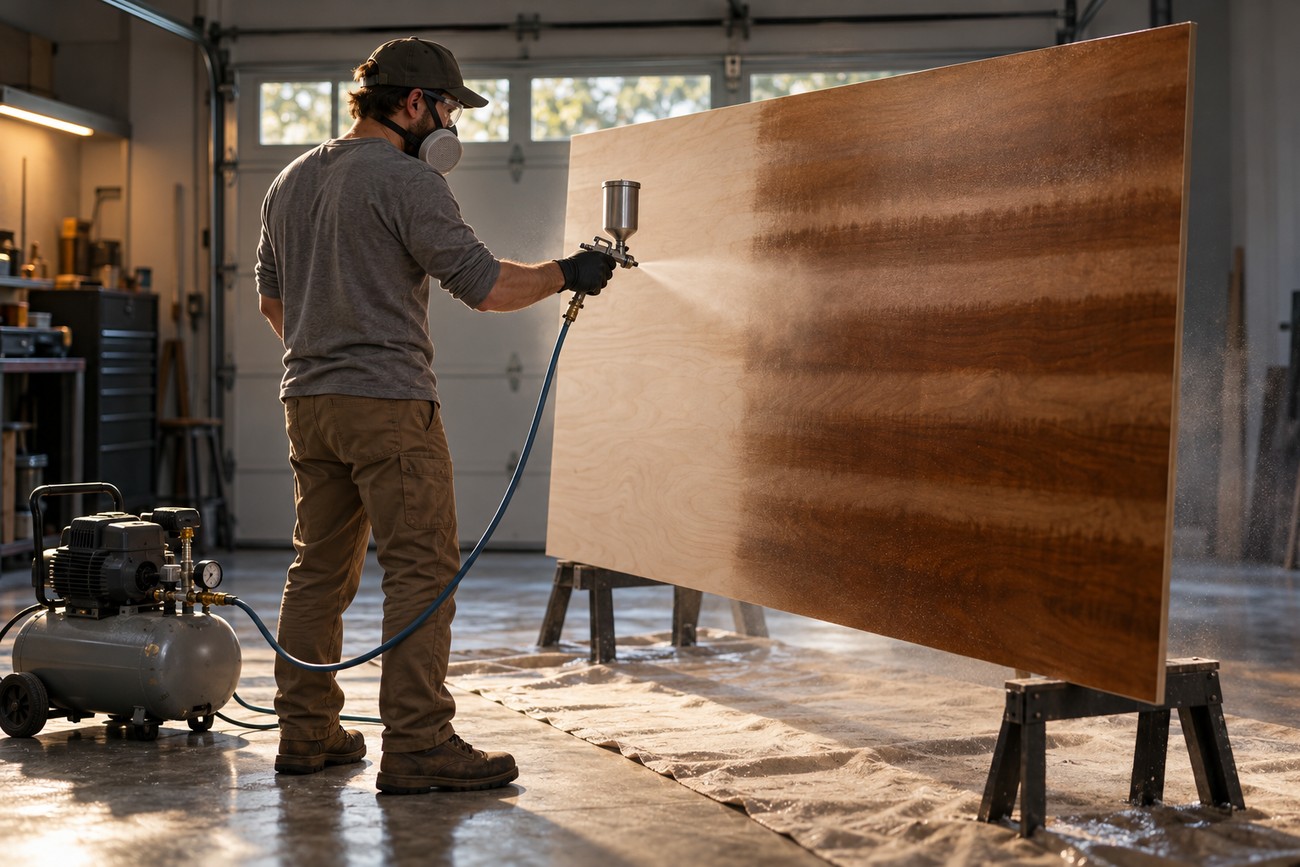
The most common compressor failure is insufficient sustained airflow. The gun may start with an acceptable fan, then lose atomization as the receiver pressure falls. The visible symptoms include a pulsing pattern, weak coverage, coarse texture, and a finish that changes halfway across the panel.
A pressure gauge tells you the pressure available at a particular moment. It does not prove that the compressor can deliver the required volume continuously. A true HVLP gun commonly uses 8–20 cfm, and one profile source associates true HVLP operation with approximately 5 hp or more.
Check delivered airflow while making a continuous pass, and watch whether the pressure drops as the compressor catches up. Peak psi on the tank label says little about how stable the spray will remain at the gun.
Compare the gun’s stated air consumption with the compressor’s delivered output, preferably at the pressure used for spraying rather than at the compressor’s maximum rating. Hose restrictions, regulators, filters, and couplers can reduce the air available at the gun.
Some inexpensive models advertise compatibility with 2–3 hp compressors. Treat that as a requirement for that particular design and coating, then test the gun under continuous spraying. If the fan pulses on a sample panel, reducing the pressure further will usually make atomization worse rather than solve the problem.
Setup Mistakes That Cause Overspray, Spits, and Runs
Filter the coating before it enters the cup, especially when using older paint, water-based finishes with dried skin, or material mixed in a dirty container. Thick material can cause clogs, spitting, and poor atomization without suitable thinning or filtration. Follow the coating manufacturer’s guidance because excessive thinning can reduce coverage and change the finish.
Nozzle choice must match the material. A 1.3–1.5 mm nozzle is common on household HVLP guns and works well for many thin-to-medium finishes, but it is not ideal for every primer, latex coating, or heavy protective product. A small nozzle can struggle with thick material, while an oversize nozzle can deliver too much material for a controlled finish.
Spray distance changes the result quickly. Too much distance lets droplets lose solvent or water before reaching the surface, creating dry, rough spray. Too little distance concentrates material and increases the risk of runs. Keep the gun moving before opening the material flow, release the trigger before stopping the stroke, and overlap passes consistently.
Test on cardboard or a sample panel before spraying the workpiece. Adjust one variable at a time: viscosity, air, material flow, or distance. Excessive fog, dry spray, drips, and clogs can indicate setup errors, although inexpensive guns may also have limits in atomization and fan stability.
The Trade-Offs Cheap HVLP Listings Often Hide
HVLP can use material efficiently, but the label alone does not guarantee savings. Poor viscosity, an oversize fan, excessive pressure, or slow hand movement can create a cloud of overspray and leave too little coating on the surface. Material savings depend on the complete setup and your technique.
Lower pressure is not automatically better. Too little pressure can produce poor atomization, spitting, and orange peel. The useful setting is the lowest pressure that still creates an even fan for the chosen material and nozzle.
HVLP is also slower than airless equipment on large surfaces. That slower pace can be worthwhile for cabinets, trim, and controlled furniture work, but it becomes frustrating when coating walls, fences, or large production batches. Budget guns may require frequent cleaning and may have shorter needle and nozzle life.
Noise claims need context. One model claims less than 50 dB(A), but a low-noise rating does not remove fatigue caused by a heavy monoblock body, a stiff hose, or awkward cable routing. A remote turbine is generally more comfortable for long work, while an integrated turbine is easier to store and deploy.
Which Under-$200 HVLP Gun Should You Choose?
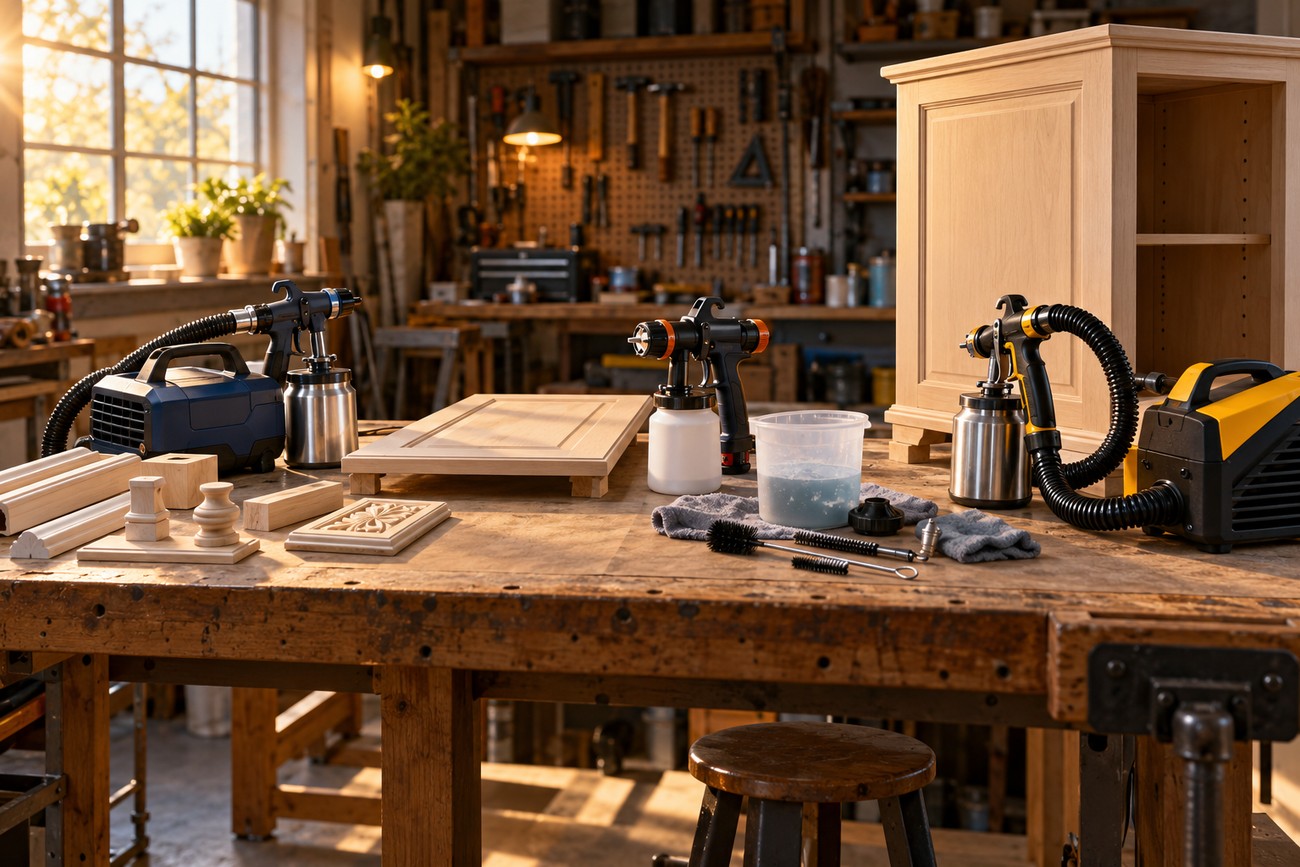
Choose the HomeRight Finish Max for small furniture, trim, crafts, and occasional touch-up work where compact storage matters. It is a sensible entry point when you want a turbine system without buying a separate compressor. Expect modest coverage speed and plan to clean it immediately after use.
Choose the Wagner Control Spray 250 for general DIY work and the FLEXiO 3500 when larger furniture or longer sessions justify a remote turbine. The remote layout is usually the more comfortable arrangement over time, while the compact Control Spray is easier to carry and set up for short jobs.
VONFORN and Scuddles are reasonable candidates when the purchase price and included nozzle assortment are the priority. Inspect the listing for replacement tips, seals, and clear cleaning instructions before ordering. A cheap kit becomes poor value if a worn nozzle or damaged seal cannot be replaced.
HVLP is strongest where control and material economy matter more than maximum speed. For large surfaces, an airless sprayer may be a better tool. For frequent finishing work, a more expensive turbine system can justify its cost through steadier atomization, better ergonomics, and stronger parts support; professional HVLP systems commonly start at approximately $100, while quality turbine systems can cost substantially more.
Frequently asked questions
The right answer depends on the coating, nozzle, compressor or turbine, and length of the work session. These practical checks help avoid treating one specification as a complete buying decision.
How often should I clean an HVLP spray gun?
Clean the fluid path whenever you change colors or coatings. Empty the cup, flush the gun with the correct cleaner, and spray the cleaner through the nozzle until it runs clear. Do not leave material sitting in the cup while you take a break.
At the end of the day, partially disassemble the air cap, nozzle, needle area, and cup seal as directed by the manufacturer. A full strip-down is usually unnecessary after every short pass, but dried coating around the needle or air cap will quickly affect the fan and can cause spitting.
Which brand of spray gun is considered the best?
No brand is universally best because turbine guns, compressor-fed guns, detail sprayers, and production equipment have different priorities. Evaluate the manufacturer’s published airflow information, nozzle availability, replacement seals and needles, cleaning instructions, and warranty support.
Parts access is especially important in the budget segment. A gun with slightly less impressive headline power can be the better purchase if you can replace a worn nozzle or seal instead of replacing the entire tool.
What is the best budget HVLP spray gun?
The best budget choice depends on the job. HomeRight Finish Max is a practical compact option for small furniture and trim, Wagner Control Spray 250 suits general DIY use, and Wagner FLEXiO 3500 is the more suitable layout for larger pieces and longer sessions.
Choose a multi-nozzle VONFORN or Scuddles kit only after confirming the included tips, cup size, cleaning method, and availability of replacement parts. The lowest purchase price matters less if the gun cannot atomize your coating or cannot be maintained.
What are the top 5 spray paint guns?
For an under-$200 HVLP shortlist, the five useful options are HomeRight Finish Max, Wagner Control Spray 250, Wagner FLEXiO 3500, VONFORN 700W, and a Scuddles HVLP kit. They cover compact detail work, general DIY projects, larger furniture, and low-cost experimentation.
They are not interchangeable. Check the coating viscosity, nozzle range, cup capacity, turbine layout, cleanup requirements, and current price before choosing. For large surfaces or high output, an airless sprayer may be more appropriate than any of these HVLP options.