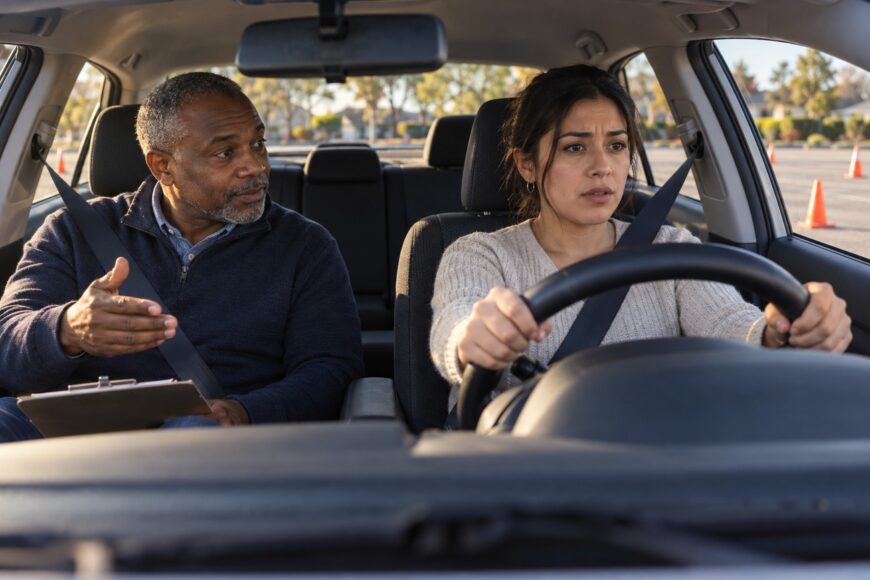
Teaching a teenager to drive requires two kinds of control at once: the control your teen is learning behind the wheel and the control you must maintain as a worried, sometimes frustrated passenger. A parent may need to watch traffic, give instructions, manage fear, and resist the urge to correct every small mistake. That divided attention makes the teaching role demanding, even when the route seems simple.
Passing a driving test or accumulating practice hours does not complete the job. The real goal is a structured transition from supervised practice to safer independent driving, with special attention to the first months after licensing. Good instruction builds judgment, repeatable habits, and the ability to manage distractions before a young driver faces those demands alone.
- Start With a Safety System, Not the Steering Wheel
- Prepare the Parent, Car, and First Lesson
- From Empty Lot to Highway: A Practice Progression
- Coach Without Overloading or Losing Your Temper
- Teach Defensive Driving and Distraction Discipline
- Plan the First Six Months of Independent Driving
- Frequently asked questions
- What are the Three C’s of driving?
- What should a parent never do when teaching a teenager to drive?
- How can a teen recover after becoming overwhelmed in traffic?
Start With a Safety System, Not the Steering Wheel
Begin by checking the rules that apply where your teen will drive. In the United States, permit age, passenger limits, curfew, supervision, phone rules, and licensing stages vary by state. Verify the current requirements with the relevant motor vehicle agency before setting practice plans or allowing independent trips.
Most state systems follow Graduated Driver Licensing, or GDL. The general progression is learner permit → provisional or restricted license → full license. CHOP identifies GDL as the most effective strategy for reducing teen crash risk because it introduces driving responsibilities gradually while limiting the conditions that create the greatest danger.
Build family rules around the legal requirements, then make them clear enough to follow on an ordinary weekday. Every occupant wears a seat belt on every trip. The phone stays silenced and out of reach, and driving stops when the teen is too tired, upset, or distracted to focus. Agree in writing on passengers, nighttime driving, weather, supervision, check-ins, and what happens after a rule is broken.
Parents remain part of the safety system after the permit is issued. CHOP reports that involved parents who set rules and support learning can reduce a teen’s crash risk by half. Before the first lesson, inspect the vehicle, adjust the seat and mirrors, confirm that warning lights are understood, and choose a car whose controls the teen can operate without stretching or guessing.
Prepare the Parent, Car, and First Lesson
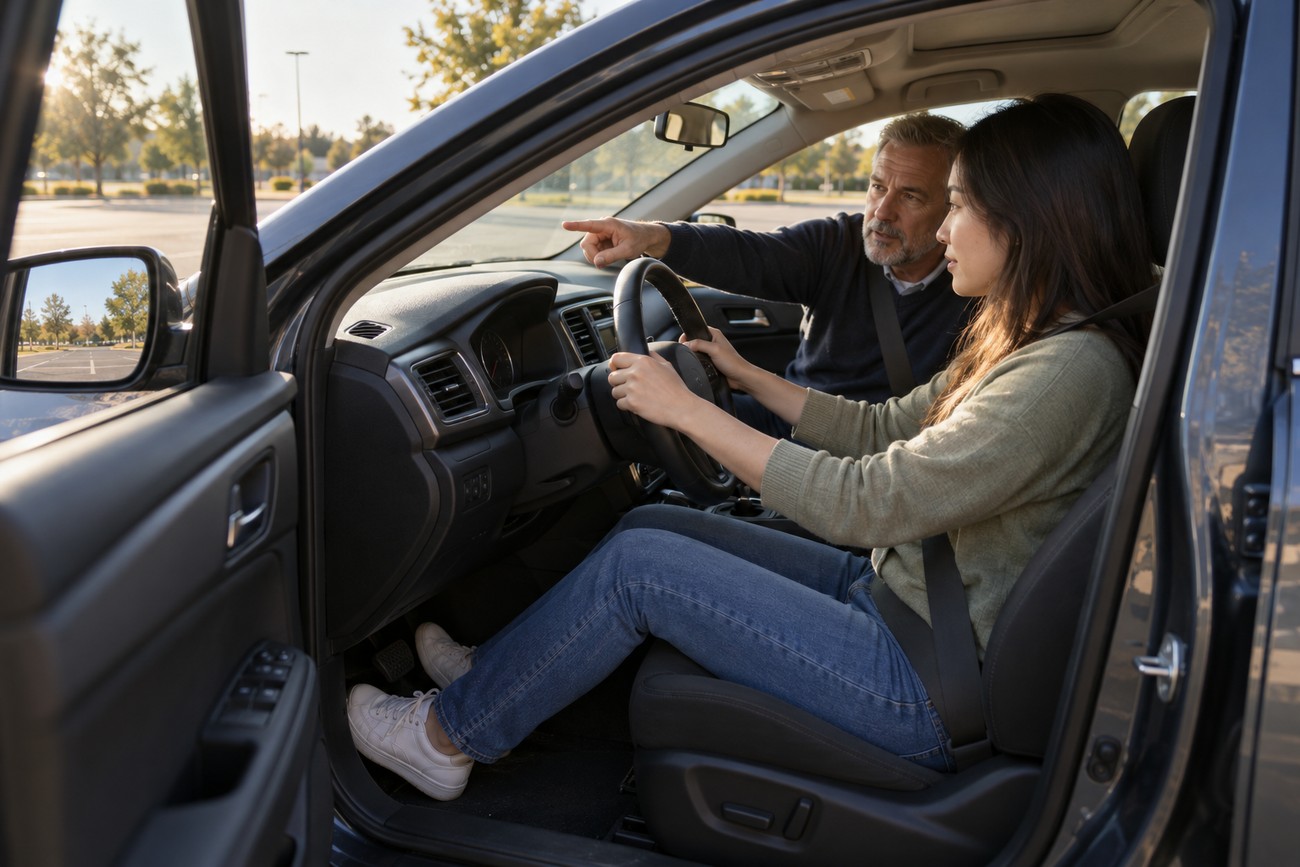
The first lesson should reduce cognitive load before the vehicle moves. Choose a familiar route or an empty area, remove unnecessary items from the cabin, and agree on a few short commands such as “ease off,” “check left,” and “slow.” Define one emergency phrase that means the teen must stop following normal coaching and respond immediately.
Seat position and mirrors deserve a quiet check before starting. The teen should be able to press the pedals comfortably, see the road without leaning, and reach the controls while keeping attention forward. Begin with one skill-specific objective, such as smooth braking or controlled turns, rather than combining parking, lane changes, busy intersections, and navigation in one session.
Parents should model the habits they expect: speed control, phone-free driving, calm responses, and consistent seat-belt use. A teenager often copies a parent’s driving manner more readily than a parent’s lecture. If you regularly speed, handle a phone at red lights, or react angrily to other drivers, those behaviors weaken every safety rule you state.
Give one anticipatory cue before a maneuver, then stay quiet long enough for the teen to process it. Stacked corrections can turn a manageable task into a panic response.
Arrange at least one session with a professional instructor if parent and teen repeatedly disagree about what “normal” performance looks like. A qualified instructor can help calibrate expectations and identify habits without the family history attached to every correction. Stop a lesson safely when either person is too tense to learn; a short, calm session produces more useful practice than a long argument in a moving car.
From Empty Lot to Highway: A Practice Progression
Move through driving environments gradually. Readiness depends on repeatable control and sound decisions, rather than a particular number of practice hours.
| Stage | Main goal | Suitable exercises | Readiness signals | When to step back |
|---|---|---|---|---|
| Empty parking area | Build basic vehicle control. | Starting, stopping, smooth acceleration, steering, wide turns, reversing, and parking within clear spaces. | The teen uses the pedals smoothly, keeps the vehicle controlled, and can stop without prompting. | Return here after jerky braking, pedal confusion, loss of steering control, or repeated missed instructions. |
| Quiet streets | Connect vehicle control with observation. | Right and left turns, stop signs, residential speeds, mirror checks, lane position, and scanning ahead. | The teen notices signs, pedestrians, parked vehicles, and intersections before reaching them. | Reduce difficulty if attention stays fixed on the car, turns are rushed, or the teen becomes visibly overwhelmed. |
| Moderate traffic | Practice decisions around other road users. | Following distance, lane changes, signal use, intersection judgment, and identifying escape space. | The teen maintains a safe gap, checks mirrors, anticipates other drivers, and makes decisions without constant prompting. | Return to quieter roads if traffic produces freezing, abrupt maneuvers, missed signals, or unsafe gaps. |
| Nighttime or rainy conditions | Adapt observation and speed to reduced visibility. | Short familiar routes, lighting changes, windshield management, slower turns, and extra following distance. | The teen reduces speed appropriately, uses lights and wipers correctly, and remains attentive to reflections and visibility. | End or postpone the session if visibility, fatigue, or emotional stress makes basic attention unreliable. |
| Highway driving | Manage speed, merging, lane discipline, and sustained attention. | Enter during a quiet period, practice one merge, hold a steady gap, scan far ahead, and exit deliberately. | The teen checks traffic early, matches speed safely, holds lane position, and can plan several seconds ahead. | Use lower-speed roads if merging, speed control, or prolonged concentration is inconsistent. |
Sending a beginner directly into dense traffic, onto a highway, or out at night is a common teaching mistake. Each new environment should be introduced when the previous one feels routine, while supervision remains active during the transition.
Coach Without Overloading or Losing Your Temper
Nervousness around other vehicles is a training problem that should be scaled gradually. Start with a route where traffic is present but manageable, then repeat it until the teen can observe, steer, and make decisions without freezing. Confidence grows from predictable exposure and successful repetition, rather than from being pushed suddenly into the hardest available conditions.
Use one coaching objective at a time. A session might focus on gentle braking, mirror use, or maintaining a following distance. Give a brief prompt before a maneuver—“check the mirror, then prepare to turn”—and save detailed discussion for a safe stopping place.
Jerky acceleration and braking often improve when the parent describes the desired action in advance. “Release the pedal gradually” is more useful than criticizing a hard stop after it happens. Correct urgent hazards while the vehicle is moving, but avoid correcting every minor issue at once; too many simultaneous instructions can cause the teen to lose track of the main task.
Use a calm, agreed vocabulary and plan a short debrief after parking. Discuss one success, one priority for improvement, and one exercise for the next lesson. If voices rise, the teen stops following directions, or the parent feels unable to coach safely, end the session at the nearest legal safe place and continue later.
Teach Defensive Driving and Distraction Discipline
Safe driving includes observation and prediction as much as steering and pedal control. Teach the teen to scan well ahead, check mirrors approximately every 5–8 seconds, and keep enough following distance to respond without panic. At intersections, look for pedestrians, cyclists, turning vehicles, and drivers who may fail to yield.
Lane changes should follow a repeatable sequence: identify a safe gap, check mirrors, check the blind spot, signal, and move smoothly when the space remains available. Discuss escape space before it is needed. A clear area beside the vehicle or ahead in traffic can provide an option if another driver drifts, stops suddenly, or enters the lane unexpectedly.
Phone use requires an absolute family rule. NHTSA reports a sixfold increase in crash risk when driving while talking on a phone and a 23-fold increase when texting while driving. Put the phone on do-not-disturb or in a location that cannot be reached from the driver’s seat; a passenger can handle navigation or messages.
Passengers, music, fatigue, and seat belts deserve the same attention as the phone. NHTSA recommends strict limits on teen nighttime driving, passengers, and phone use, with seat-belt use every trip. A rule stated once may be forgotten under social pressure, so enforce it consistently and pause the trip when the conditions are unsafe.
Plan the First Six Months of Independent Driving
A license marks the start of a demanding transition. An ACC study reports that young-driver crash risk is higher during the first six months after receiving a restricted license than during any other period of their lives. The teen may feel ready after passing the test, while independent driving introduces navigation, social pressure, fatigue, and unpredictable road users without a parent beside them.
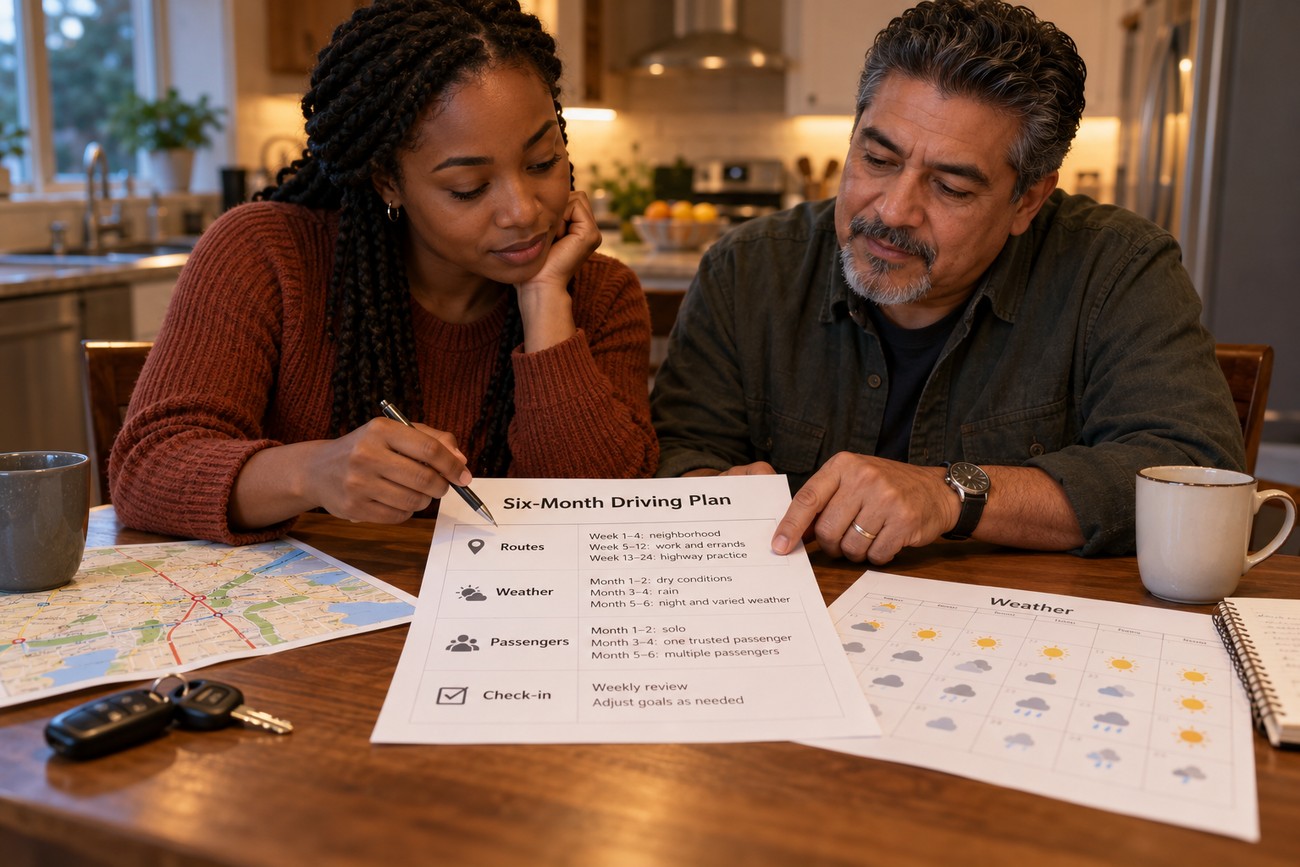
Create a written release plan for this period. Set initial routes, times of day, weather limits, passenger rules, check-in expectations, and a clear response to missed check-ins or unsafe choices. Confirm the local GDL restrictions, since limits on passengers, nighttime driving, phone use, and supervision may be stricter than a family expects.
Expand privileges one condition at a time after consistent performance. A teen who manages familiar daytime routes may later add a passenger, a longer trip, or a different time of day. Rain, night driving, highway travel, and unfamiliar destinations should each be treated as separate demands rather than automatic privileges granted with the license.
More practice hours alone do not guarantee safety. Structured scenarios, disciplined rules, and useful feedback matter more than simply accumulating time behind the wheel. Continue occasional check-ins, review near misses without humiliation, and require the teen to call for a safe ride when tired, impaired, distracted, or otherwise unable to drive responsibly.
Frequently asked questions
What are the Three C’s of driving?
The Three C’s are not a single official U. S. licensing standard. Online versions may use different words, so a family should define its own mnemonic in writing and use the same meaning during every lesson.
For example, a family might choose “check, communicate, control” to remind the driver to check the environment, communicate with signals and positioning, and control speed and space. The value comes from consistent use and observable actions, not from treating an internet version as law. State GDL rules and official driver manuals remain the authority.
What should a parent never do when teaching a teenager to drive?
Do not grab the wheel or shout unless immediate danger requires urgent intervention. Use the agreed emergency command, give the clearest necessary instruction, and help secure the vehicle in a legal safe place.
Once everyone is safe, wait until both people are calm before discussing what happened. A debrief should identify the hazard, the decision that was missed, and the next practice step. If the same conflict repeats, pause parent-led lessons and involve a professional instructor rather than turning every drive into a confrontation.
How can a teen recover after becoming overwhelmed in traffic?
The teen should signal early, move to a safe legal stopping place when possible, and pause. After stopping, identify the immediate hazard, take a moment to restore basic attention, and resume only when steering, observation, and decision-making feel manageable.
If attention does not return, call the parent or another approved adult for help. Continuing simply to avoid embarrassment can turn temporary overload into an unsafe maneuver. The next practice session should repeat a simpler route before the teen returns to the traffic condition that caused the problem.