Waking up to find your car gone is especially frustrating when it had a factory immobilizer, an alarm, or both. Those systems reduce risk, yet they do not make a vehicle untouchable. Modern theft is often a fast, targeted attack against a popular model with known weaknesses, rather than a dramatic break-in that gives neighbors time to react.
The practical goal is to add delay, uncertainty, visibility, and recovery options. That means combining sensible parking, disciplined key habits, a visible mechanical barrier, concealed electronic protection, and a tracker where appropriate. Each layer should be usable every day, because a device left switched off or abandoned after repeated false alarms provides little protection.
- Why Modern Car Theft Happens So Quickly
- Start With Parking and Everyday Habits
- Protect Keyless Cars From Relay Attacks
- Build a Layered Barrier: Mechanical and Electronic
- Secure the OBD Port and Install Devices Properly
- Make Your Security System Usable Every Day
- Frequently asked questions
- Which car is the hardest to steal in 2026?
- What should I check before buying an aftermarket immobilizer?
- What should I do immediately after my car is stolen?
Why Modern Car Theft Happens So Quickly
Popular vehicles attract organized attention because thieves can learn their access points, programming methods, and common owner habits in advance. A targeted model may be approached with a plan that takes advantage of its specific electronic architecture. This makes risk uneven: a method that works on one vehicle may be ineffective against another.
A factory immobilizer materially reduces theft risk. Widespread adoption was followed by a major decline in new-car thefts in England and Wales, but an immobilizer is not complete protection. It can still be bypassed if a criminal gains access to the vehicle’s electronic systems, obtains a programmed key, or removes the vehicle using another method.
The OBD-II port is a standard diagnostic connector, usually located beneath the dashboard. When access and protection are weak, it can be abused to program keys or bypass parts of factory security. A keyless relay attack uses a different weakness: criminals extend communication between a passive key and the vehicle so the car believes the key is nearby, allowing an eligible vehicle to unlock and start.
These methods explain why a car may disappear quickly without obvious glass damage or a prolonged alarm. The aim of each practical barrier is to increase time, noise, uncertainty, or the chance of detection. No single system guarantees prevention, and factory security should be treated as a foundation for additional layers rather than a complete answer.
Start With Parking and Everyday Habits
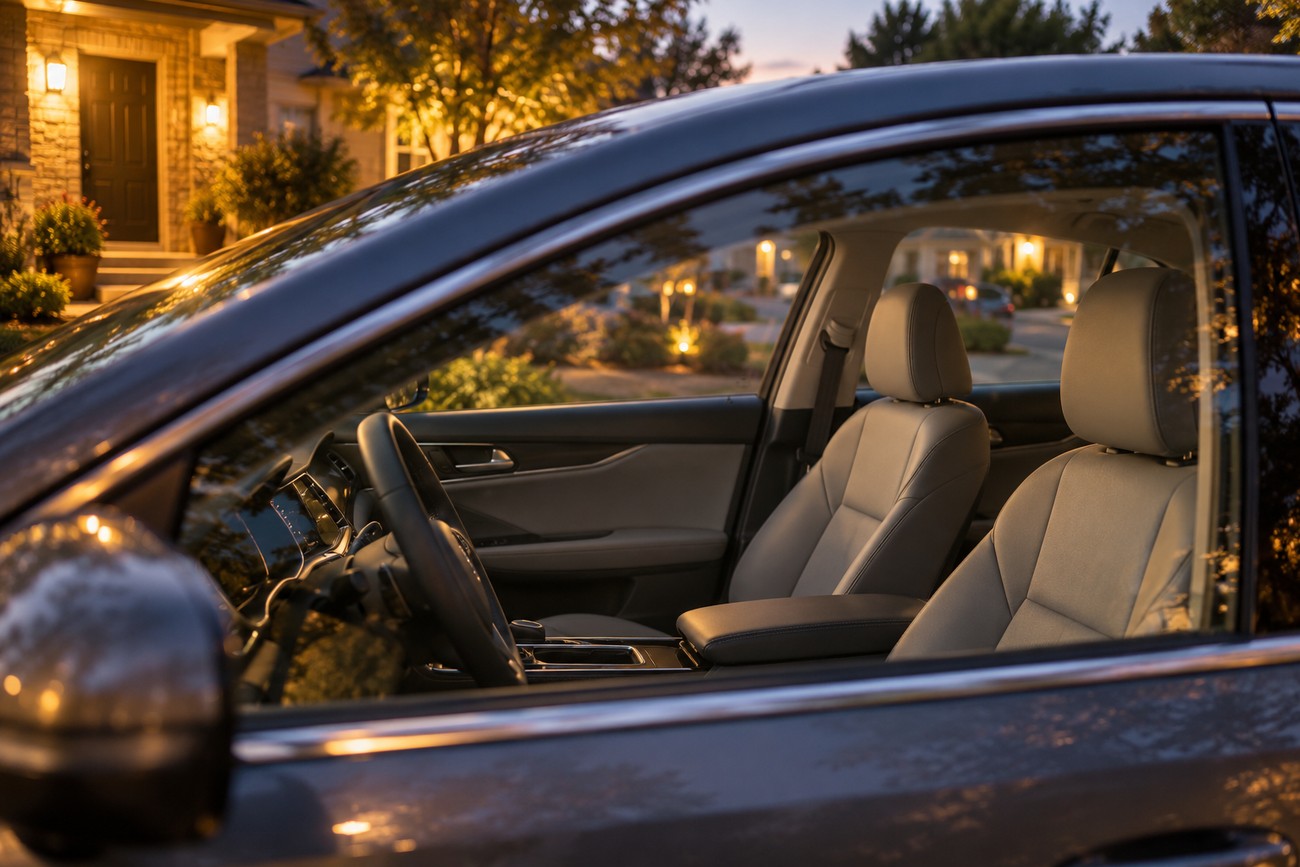
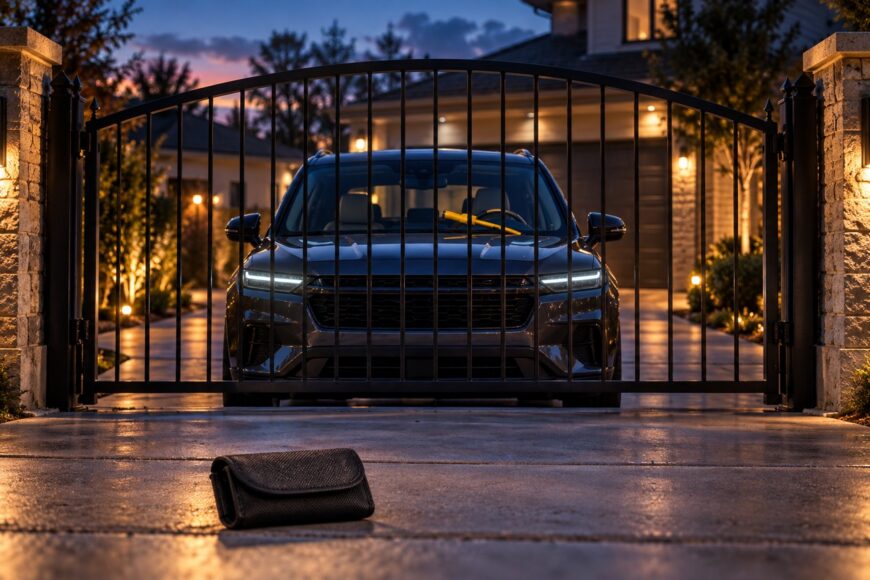
Parking choices change the opportunity available to a thief. A well-lit, visible, and occupied location exposes suspicious activity and makes a quiet attack harder to complete. At home, positioning the vehicle behind a locked gate or another car can add inconvenience, although it should not block your own ability to leave in an emergency.
Keep doors locked, windows closed, and the cabin free of bags, electronics, tools, and other visible valuables. A thief looking for property may break into a vehicle even when the vehicle itself is not the intended target. An empty interior reduces the immediate appeal of the car and can prevent a theft attempt from becoming a more serious incident.
Key storage matters most for vehicles with passive keyless access. Keep the key away from the front door, windows, and exterior walls, where a signal may be easier to reach from outside. A properly functioning signal-blocking pouch can add another relay barrier, but it must actually block the signal and be used consistently whenever the key is stored.
These habits work by reducing motivation, opportunity, or capability. They cannot address every threat, including an OBD attack or vehicle removal. Their value comes from supporting mechanical and electronic protection, especially when the vehicle is parked overnight in a place where a thief can observe routines.
Protect Keyless Cars From Relay Attacks
Passive keyless entry allows the vehicle to detect a nearby key and unlock when you touch the handle. In a relay attack, criminals use equipment to extend communication between the key inside your property and the vehicle outside. The car interprets the relayed signal as proof that the authorized key is nearby.
Store both primary and spare keys away from doors, windows, and exterior walls. A metal container or signal-blocking pouch may help, but test the chosen pouch with the vehicle before relying on it. If the vehicle still unlocks or starts while the key is inside the pouch, the barrier is ineffective and needs replacing.
Check the owner’s manual and vehicle settings for an option to disable passive entry or reduce its operating range. Some keys also have a sleep or motion-based setting, while others do not. Confirm that the car remains locked after you walk away, and check whether disabling passive entry affects remote start, convenience functions, or the way you normally secure the vehicle.
Relay protection addresses a specific vulnerability. It does not protect against a key being stolen, an OBD-II attack, forced entry, or removal by tow truck. Treat it as one part of a wider plan, and continue using locked doors, sensible parking, and additional barriers where the vehicle or local theft pattern justifies them.
Build a Layered Barrier: Mechanical and Electronic
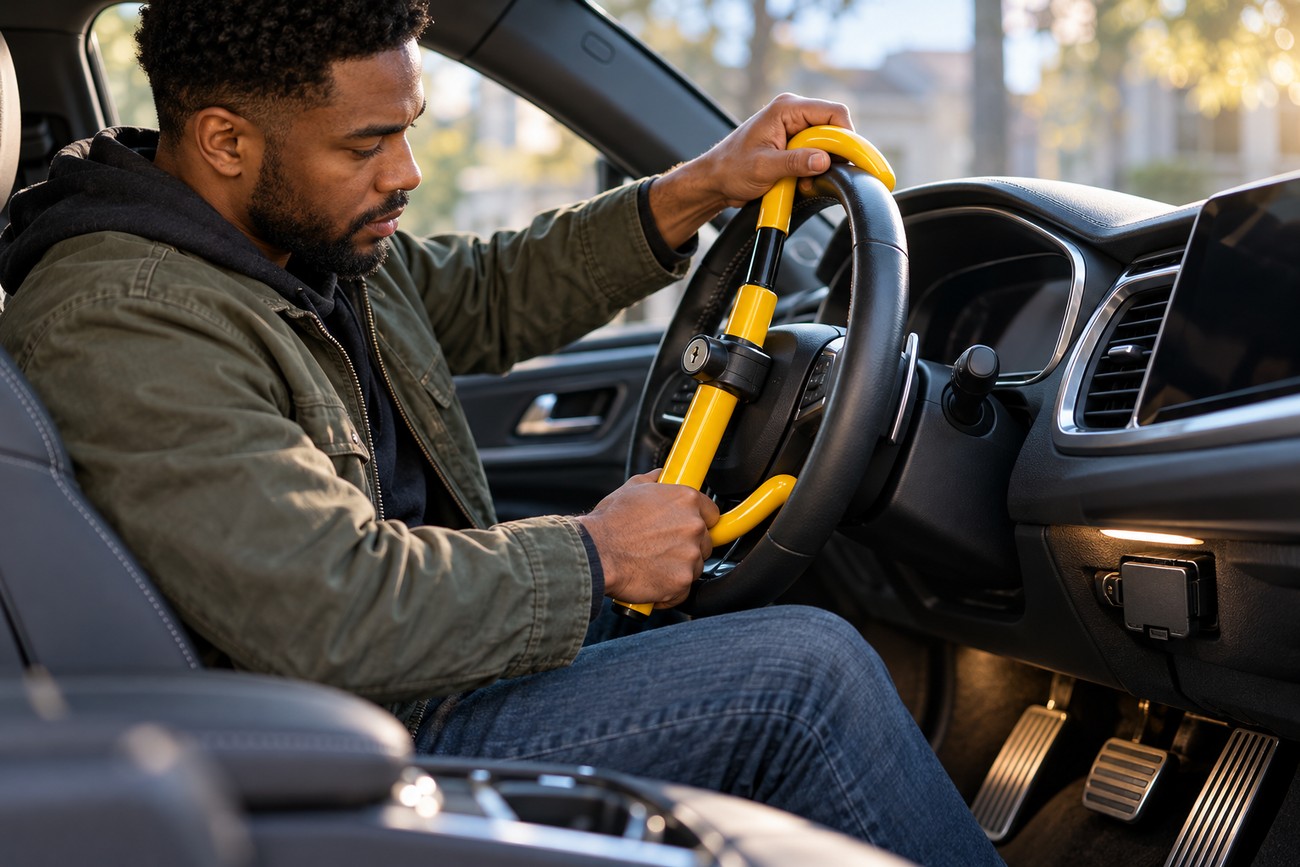
A steering-wheel or pedal lock provides a visible obstacle before a thief reaches the vehicle’s electronic systems. It does not make theft impossible, but it increases attack time and noise. That can make another vehicle seem more attractive, particularly when an unprotected car is parked nearby.
Choose a mechanical lock that you will actually fit every time you leave the vehicle. A device that is awkward to store, difficult to attach, or incompatible with your parking routine is likely to be left at home. Check that it does not interfere with airbags, pedals, steering controls, or safe vehicle operation.
A concealed immobilizer or kill switch adds a different layer by interrupting a critical starting or running function. For a high-risk model, this can be more useful than adding another visible siren. The strongest practical setup combines visible mechanical delay, concealed electronic protection, sensible parking, and disciplined key habits.
Installers favor a concealed immobilizer or kill switch with a controlled service override because a predictable cut-off point can be located quickly. The override should be reliable for the owner and service provider while remaining difficult for an outsider to identify.
Convenience determines whether this protection survives normal ownership. Test the system with the alarm, remote start, factory key, and any connected app before accepting the installation. Marketing may say that a device helps prevent theft, but most simple measures create delay rather than absolute protection.
Secure the OBD Port and Install Devices Properly
An exposed OBD-II port gives someone inside the cabin a direct route to vehicle diagnostics. Because the connector is standard, criminals may use it to program keys or attack parts of factory security when the port and surrounding systems are insufficiently protected. The precise risk depends on the vehicle, its software, and the access a thief obtains.
Ask a qualified installer whether an OBD lock, relocation, or other protection is suitable for your vehicle. The solution must preserve legitimate service access and should not create a new failure point. A concealed device is useful only when its wiring, mounting, and power connections are also difficult to identify and defeat.
Installation quality can undermine an otherwise good product. Weak wiring, predictable mounting, easy access to the power supply, or an obvious tracker location gives an attacker a practical route around the system. The installer should explain the safe service override, what happens if the vehicle battery is flat, and how the system interacts with factory controls.
A GPS or telematics tracker mainly supports recovery after theft. It does not itself stop the vehicle from being stolen, and it becomes less useful when it is obvious, easy to disable, dependent on a weak connection, or ignored after an alert. Concealed installation, dependable power and connectivity, and a clear response plan matter as much as the tracking hardware.
Make Your Security System Usable Every Day
Security equipment fails in practice when owners stop trusting it. A shock sensor that reacts to wind, passing traffic, or vehicle recovery can produce repeated false alarms. After enough false alerts, owners and bystanders may ignore the sound, and the system loses much of its practical value.
Test sensitivity after installation rather than accepting the default setting. Confirm that the alarm arms consistently, that notifications reach the correct phone, and that the vehicle still starts normally after sitting overnight. Check battery drain over ordinary use, especially if the vehicle has remote start, additional electronics, or long periods of inactivity.
Extra steps are acceptable only when they fit the way you use the car. If a system requires several confusing actions, conflicts with remote start, or regularly produces glitches, it may be bypassed or abandoned. A quieter system with concealed protection, reliable alerts, and a routine you follow is often more valuable than a louder system that owners disable.
Anti-theft equipment may affect insurance terms or discounts, but it does not remove premiums, deductibles, conditions, or exclusions. Check the relevant requirements before installation and keep records of the device, installer, and maintenance. If a claim becomes necessary, those details may help demonstrate how the vehicle was secured, subject to the policy wording.
Frequently asked questions
Vehicle theft risk varies by model, region, current criminal methods, and the quality of the vehicle’s security implementation. Factory security provides the foundation, while keyless design, OBD-II access, and additional protection affect the overall picture. The most suitable security approach also depends on reliable installation and everyday usability.
Review the vehicle’s security before buying aftermarket equipment, and consider how each device will work with the factory key, remote start, connected apps, and routine servicing. If theft occurs, act promptly, use the available tracking and account information, and avoid confronting suspected thieves.
Which car is the hardest to steal in 2026?
There is no permanent universal winner. Theft risk depends on the model, region, current criminal methods, and the condition of the vehicle’s security implementation. A sensible comparison should include current model-and-region theft data, factory immobilizer performance, keyless design, exposure of the OBD-II port, and the quality of available aftermarket options.
Security can also change during ownership as thieves adopt new tools or discover a weakness. Choose a vehicle with a strong factory foundation, then assess whether concealed additional protection can be installed without harming reliability or service access.
What should I check before buying an aftermarket immobilizer?
Check the installer’s competence, the device’s compatibility with your vehicle, remote start, factory keys, and other security systems. Ask where the unit will be mounted, how the wiring will be protected, how the service override works, and what happens if the vehicle battery, phone, app, or network connection fails.
Request clear warranty and support terms, including help after a failed installation or software update. A concealed installation with a controlled override is preferable to a visible device with predictable wiring. The system should add protection without creating unsafe starting behavior or leaving you unable to use the car during routine service.
What should I do immediately after my car is stolen?
Report the theft to the police promptly and obtain the report or reference details. Notify the insurer and provide the vehicle identification, keys, security information, and any requested records. Contact the tracking provider, follow its recovery procedure, and share live location information with police rather than approaching the vehicle yourself.
Secure connected accounts, remove unauthorized users, and report missing keys or digital access credentials. Preserve nearby camera footage, messages, tracker alerts, and location history before they are overwritten or deleted. Do not confront suspected thieves or attempt a personal recovery.