Children can lose interest within minutes of leaving home, then ask for a screen, argue over a toy, or become loud while the driver is trying to concentrate. A long drive becomes harder when every new activity requires an adult to turn around, retrieve a fallen piece, or negotiate another choice.
A calmer setup starts with a small rotation of safe, compact activities rather than a large pile of toys or one device used for the entire journey. The best plan gives each child something suited to their age, keeps loose items under control, and leaves room for audio, conversation, rest, and movement breaks. It also changes easily when the route, mood, or weather makes one activity unsuitable.
- Start With Safety and a Low-Stress Car Setup
- Build an Entertainment Menu Instead of Packing Everything
- Choose Activities That Match the Child and the Space
- Use Screen-Free Games That Survive a Long Drive
- Mix Audio, Screens, and Offline Activities
- Plan Breaks and Fix the Problems That Derail Trips
- Frequently asked questions
- What is the 3-3-3 rule for a road trip with kids?
- What is the hardest age to travel with kids?
- What are the best toys for toddlers on a road trip?
- How can I entertain a child who gets carsick?
Start With Safety and a Low-Stress Car Setup
Entertainment comes after correct restraint use. Children should be secured in a car seat or child restraint appropriate to their age, height, and weight, with the harness or belt positioned according to the restraint’s instructions. A game, toy, book, or device must not interfere with correct posture, positioning, or buckling.
Set up activities so the child can reach them without leaning out of position or asking the driver for help. A soft, contained activity bag or a small tray within the child’s safe reach can hold the current item. Loose toys should never be scattered around the seat, because small parts can fall under the seat, disappear, frustrate everyone, or distract the driver when someone tries to retrieve them.
Compact does not automatically mean suitable for a moving vehicle. Choose items that can be used while the child remains correctly restrained, and check whether a hard object could become uncomfortable or hazardous during sudden braking. Small figures, cards, and craft pieces need a lidded container, zip pouch, or tray with raised edges so they stay together.
Prepare the car’s surfaces before using materials that can leave marks. A washable mat, lap tray, or designated drawing board can protect upholstery and plastic from stickers, markers, or modeling materials. Keep wipes and a small waste bag nearby, and avoid giving messy supplies when the adult who would manage the cleanup is also responsible for driving.
Build an Entertainment Menu Instead of Packing Everything
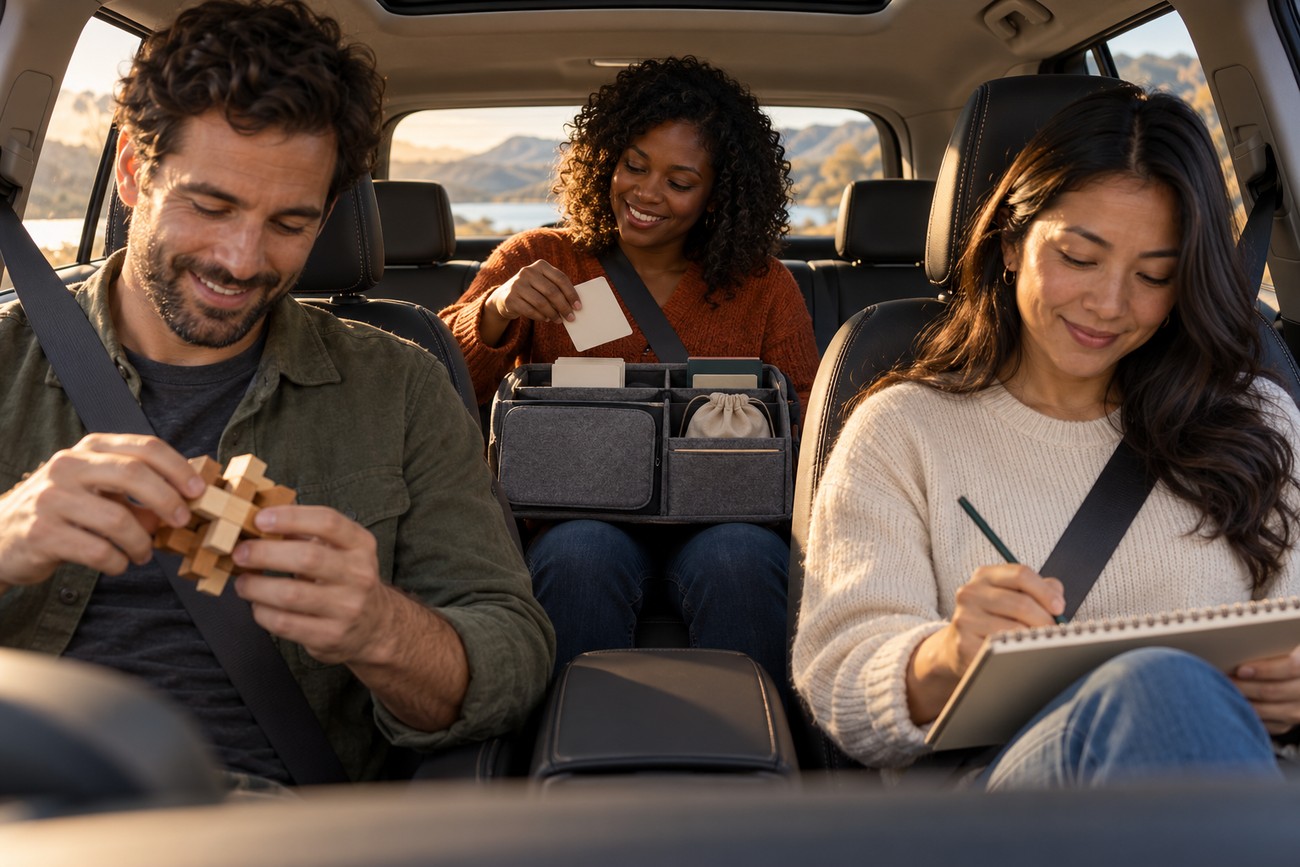
Children usually manage a small sequence better than an open bag full of possibilities. Prepare a few activities in advance and offer them one at a time, keeping the rest out of sight. This preserves novelty, reduces arguments over choice, and makes it easier to see which format is helping and which one should be retired.
For younger children, rotate activities about every 10–20 minutes, adjusting to the child’s attention and comfort. Older children may stay with one format somewhat longer, especially when they have some control over the choice. These are flexible guideposts rather than a strict timetable; a child who is absorbed in an audiobook does not need to be interrupted simply because the planned interval has ended.
A useful menu combines several kinds of engagement: one activity the child can manage alone, one adult-led game, an audio option, a quiet period, and a replacement for the screen if needed. For example, a toddler might move from a soft finger toy to a short song, then listen to a familiar story. A school-age child might alternate a word game, coloring, an audiobook chapter, and a snack or rest period.
Keep most supplies out of sight and hand over one activity only after the previous format has run its course. This helps novelty last longer and prevents the child from judging every option against a whole bag of alternatives.
Reserve one or two toys mainly for car trips if possible. A familiar object can feel special when it is unavailable during everyday play, while a favorite toy carried in the car every day may lose its appeal quickly. Keep the plan flexible enough to skip an activity, repeat a successful one, or move to quiet time before the child becomes overtired.
Choose Activities That Match the Child and the Space
Toddlers generally benefit from sensory and finger-based formats that are easy to grasp and simple to repeat. Soft textured toys, large-piece manipulative, lift-and-look books, and finger games can provide useful changes without demanding complicated instructions. The child still needs to remain correctly restrained, and any item with pieces should be used in a container that prevents them from spreading through the seat area.
School-age children can usually handle more language, observation, and simple rules. Verbal games, cards, coloring, stickers, magnetic boards, and small figures offer variety, provided the setup fits the available space. A lap tray or a stable drawing surface helps keep cards and art materials from sliding, while a small pouch can separate the current activity from the reserve supplies.
Older children often appreciate more autonomy. They may choose a podcast or audiobook, create a story, solve a logic puzzle, keep a travel journal, or take part in a category game. A conversation about the route, a family memory, or an imaginary scenario can last longer than a novelty toy and needs no storage space.
Games without props are often the most durable option on a long drive because they cannot break or get lost. They also work when the car is full, the tray is occupied, or a previous activity has fallen out of reach. Keep a short list of verbal games in mind so the child does not depend on a particular toy to remain engaged.
Use Screen-Free Games That Survive a Long Drive
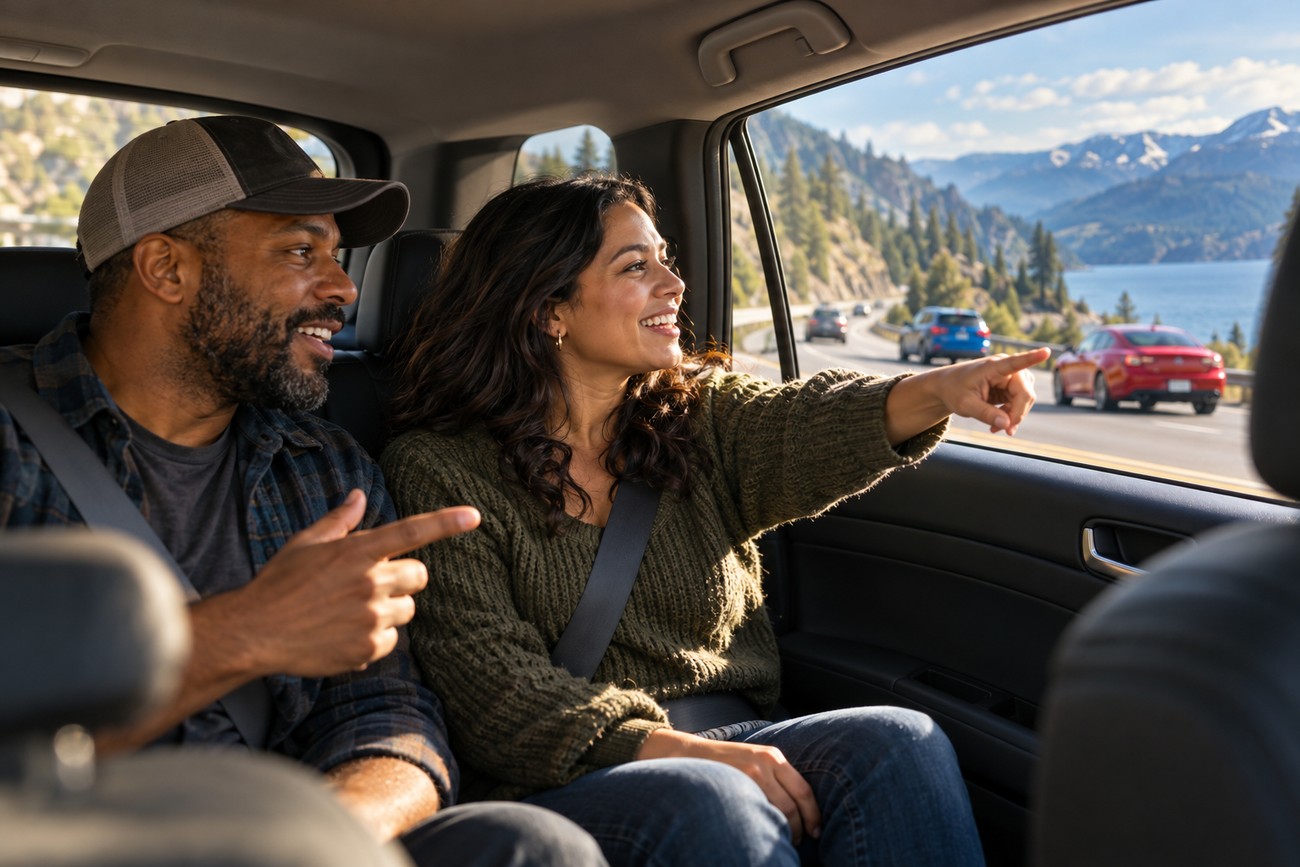
Observation games need little space and can suit several ages. Try counting cars of a chosen color, finding a particular type of vehicle, spotting signs or animals, or playing “I spy.” Younger children can search for one visible feature, while older children can keep a running tally or set a category for the family.
These games depend on the route and visibility. A varied daytime road may provide plenty to notice, while a monotonous highway, heavy traffic, poor weather, or nighttime driving can make observation tiring or impossible. Keep a verbal alternative ready so the game ends naturally rather than turning into pressure to keep looking.
Category games require no equipment: take turns naming foods, animals, places, or objects that begin with a chosen letter or belong to a shared group. Simple word games can be adapted for speech development, spelling practice, or family humor. Storytelling also scales well: one person starts with a sentence, and each participant adds a detail, character, or problem.
A memory prompt can add variety for children who enjoy recall. One parenting source suggests allowing a child 10 seconds to memorize several objects and then checking what they remember. Treat this as an optional technique, not a general standard; use familiar, manageable objects, and stop if the exercise feels like a test.
Some games can run with little adult input after the rules are explained, such as spotting colors or maintaining a category. Others need an adult leader to ask questions, track turns, or keep the story moving. Plan both types, since an adult-led game may be engaging early in the trip and exhausting after several hours.
Mix Audio, Screens, and Offline Activities
A screen can be useful, especially during a difficult stretch of road, but it works best as one component of a mixed plan. Tablets and phones may lose power, lose signal, or become an object of conflict when the child has had enough. Offline activities and audio give the family options when technology is unavailable or no longer helping.
Audiobooks are often one of the strongest long-duration screen-free choices for a car trip. A well-matched story can fill a substantial stretch without visual stimulation, and older children may listen independently with headphones or through the car’s audio system. Younger children may still need changes of activity, movement, snacks, conversation, or a short quiet period even when the story is holding their attention.
Watch for signs that a screen is worsening comfort. Some children experience more motion sickness when looking at a device, especially while reading, drawing, or playing a visually busy game. Switch to an audiobook, music, a spoken game, or simple conversation when the child feels unwell or begins to complain of headache, nausea, or visual discomfort.
Prepare digital content before leaving if the journey may pass through areas with weak signal. Charge devices in advance, carry the appropriate charging equipment, and keep at least one screen-free activity available without relying on an app or downloaded file. A mixed plan is more resilient because the journey does not depend on one battery, one connection, or one child’s tolerance for visual stimulation.
Plan Breaks and Fix the Problems That Derail Trips

Boredom often appears after a short period, even when the child started with enthusiasm. Toys can lose novelty, a quiet game can require more adult participation than expected, and a child who has been sitting too long may become restless or loud. Treat these changes as information about the plan rather than as a reason to keep adding more items.
On longer drives, practical guidance commonly suggests a stretch or movement stop about every 2–3 hours. Adapt that interval to the child, the road, and the journey’s conditions; younger children or children who are already uncomfortable may need a pause sooner. A brief walk, toilet stop, drink, and change of posture can reset the next part of the trip more effectively than handing over another toy.
Use stops to reset the activity menu. Put away items that have been handled, collect pieces from the floor, and offer one fresh option after the break. Giving everything at once can overwhelm a child and make each activity lose appeal quickly, while a small reset restores a sense of change without increasing the amount of luggage.
Build the plan around activities the child can manage with limited help. A game may sound quiet yet require an adult to lead every turn, answer every question, or retrieve every card. Balance those activities with audiobooks, simple observation, coloring on a contained surface, or a familiar toy that does not require constant intervention.
Mess is another common source of conflict. Stickers, markers, and modeling materials can leave marks on upholstery or plastic unless the surface and cleanup plan are prepared. Use them only when the child can handle the materials responsibly and the adult has a practical way to contain the result; otherwise, save them for a stop or the destination.
Keep a recovery option for the final part of the drive. This may be a calm audiobook, soft music, a familiar verbal game, or quiet looking out the window. The goal is to lower stimulation before fatigue turns into shouting, repeated requests, or behavior that pulls the driver’s attention away from the road.
Frequently asked questions
What is the 3-3-3 rule for a road trip with kids?
The 3-3-3 rule is an informal road-trip planning phrase, and its meaning can vary. It is best treated as a reminder to break a long journey into manageable portions, allow for regular pauses, and avoid planning the drive as one uninterrupted block.
It is not a universal child-travel or safety standard. Use the child’s age, restraint needs, comfort, toilet requirements, and behavior to decide when to stop. A family may need an earlier pause than the shorthand suggests, while a sleeping child may make a short continuation reasonable if the driver remains alert and the restraint is used correctly.
What is the hardest age to travel with kids?
There is no single hardest age because the source of difficulty changes with development and with the individual child. Younger children often need frequent physical and sensory changes, help with snacks and comfort, and close management of small items. Their limited ability to explain discomfort can make fatigue or nausea appear as sudden crying.
Older children may tolerate longer activities but resist boredom, limits, or shared family choices. They often benefit from more autonomy, advance information about the route, and activities that feel age-appropriate. A successful plan changes with the child: frequent short switches for a toddler, more independent options for a school-age child, and meaningful choice and audio for an older one.
What are the best toys for toddlers on a road trip?
Choose toddler travel toys that are quiet, washable, easy to grasp, free of loose tiny parts, and usable while the child remains correctly restrained. Simple sensory items, large-piece finger activities, soft books, and contained manipulative are easier to manage than kits with many pieces or complicated instructions.
Pack each item in a small tray, pouch, or bag that limits movement around the seat. Check that the toy does not encourage leaning, twisting, or reaching into an unsafe position. A short selection is easier to rotate, clean, and retrieve than a full collection, and a toy reserved mainly for car trips may retain its novelty longer.
How can I entertain a child who gets carsick?
Prioritize listening and conversation for a child who becomes carsick. Audiobooks, music, spoken storytelling, and simple verbal games reduce the need for close visual focus, while reading, drawing, and visually busy screen activities may make symptoms worse for some children.
Pause the activity as soon as the child feels unwell rather than insisting on finishing a game. Combine the change with an appropriate travel break, fresh air where suitable, water, and a chance to move and settle. Follow relevant medical advice for recurring or severe motion sickness, and keep the child correctly restrained throughout the journey.