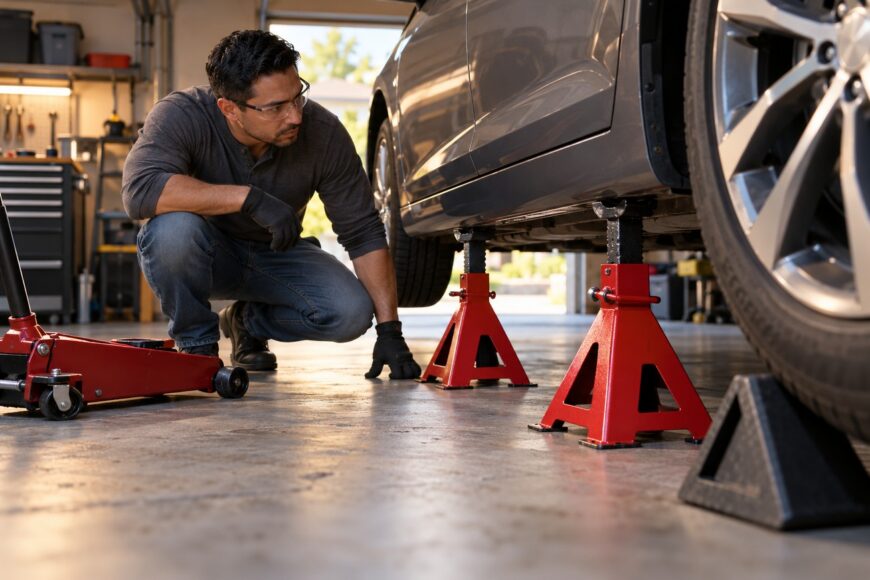
A hydraulic jack lifts a vehicle, but it is not designed to support one while someone works underneath. Hydraulic pressure can bleed away, a seal can fail, or the jack can shift. A car supported only by a jack can drop without warning.
Safe lifting is a stability problem as much as a lifting task. The floor, approved lift points, stand geometry, wheel chocks, vehicle load, and planned work all affect the result. Before the first lift, decide whether the equipment and vehicle can form a stable, manufacturer-approved setup. If they cannot, stop rather than improvise.
- Choose the Right Jack Stands and Inspect Every Tool
- Prepare the Vehicle and the Work Surface
- Find the Manufacturer’s Lift and Support Points
- Lift the Car and Set It Down on the Stands
- Work Under the Car Without Creating New Instability
- Troubleshoot Fit, Height, and Vehicle-Specific Problems
- Frequently asked questions
- What is the safest way to jack a car up?
- How long can I leave my car on jack stands?
- What should I do if a jack stand will not fit the specified support point?
Choose the Right Jack Stands and Inspect Every Tool
Choose a jack and a pair of jack stands that can support the vehicle and the intended load in their actual working configuration. The capacity marked on each stand is its rated working limit, not an automatic safety margin. Vehicle weight is distributed unevenly, so the load at one end or corner may differ substantially from the vehicle’s average weight.
Stability also depends on the stand’s base geometry, extension height, floor quality, and any side load applied during the repair. A large advertised ton rating cannot compensate for a narrow base, excessive height, poor contact, or a stand placed on an unsuitable surface. Each stand must be properly rated, correctly positioned, and fully engaged.
Inspect the jack and stands before every use. Look for cracks, bent metal, damaged welds, distorted bases, contaminated contact surfaces, and incomplete locking. On ratchet stands, check that the pawl engages the rack correctly and that there is no excessive play. On pin-type designs, confirm that the pin is fully inserted and retained.
Test the jack’s operation without a vehicle load. A jack that lowers slowly after storage, feels uneven, or shows hydraulic seepage should be removed from service until it has been assessed. Do not rely on a clean appearance or a rating label when the mechanism is damaged or its condition is uncertain. A hydraulic jack is for lifting, not for supporting a vehicle during work underneath.
Prepare the Vehicle and the Work Surface

Work on level, hard, stable ground. Slopes, loose soil, gravel, soft paving, and uneven asphalt can allow the jack or a stand to tilt, sink, or roll. A garage floor is useful only if it is sound and clear; debris beneath a stand can produce the same instability as a visibly poor surface.
Park with the engine off, select Park on an automatic transmission, or leave a manual transmission in gear. Apply the parking brake, then place wheel chocks against the wheels that will remain on the ground. The parking brake and transmission’s Park mode do not replace wheel chocks, especially when you lift one end of the vehicle.
Before lifting, remove loose cargo that could shift and plan where tools and removed parts will go. Slightly loosen the wheel nuts while the tires are still on the ground. Breaking seized fasteners after the vehicle is raised can require substantial force through a wrench or breaker bar, creating side loading and potentially moving the vehicle on its supports.
Keep people clear of the vehicle during lifting and lowering. Check that the jack can roll as its lifting arm rises, where applicable, without striking a wall, drain, tool, or other obstruction. If the vehicle begins to move, tilt, or make unusual noises, stop lifting or lowering, move clear, and reassess the setup from outside the danger area.
Find the Manufacturer’s Lift and Support Points
Read the owner’s manual or model-specific service information before positioning the jack. The manufacturer specifies permitted lifting points and support points, and the two are not always interchangeable. A lifting point may be designed for the jack’s contact shape, while a nearby structural area may be intended for a stand—or neither may be suitable for the other.
Use only designated points. Thin rocker metal, plastic trim, an oil pan, exhaust component, suspension arm, differential, or another part that looks strong may not tolerate a concentrated load. An incorrect point can bend the body, damage the suspension or underbody, or allow the vehicle to slip from the equipment.
Frame vehicles and unibody vehicles can require different support locations. On a frame vehicle, follow the specified frame or other approved locations rather than automatically placing stands under an axle. Independent suspension components also vary widely, so never treat a familiar-looking control arm or subframe as a universal support point.
Inspect the contact area before lifting. The stand saddle must sit on the designated reinforced area, with full, stable contact and no interference from plastic covers, brake lines, fuel lines, or wiring. If the approved point is inaccessible, identify compatible equipment before raising the vehicle; moving the stand to a nearby part is not a safe substitute.
Lift the Car and Set It Down on the Stands
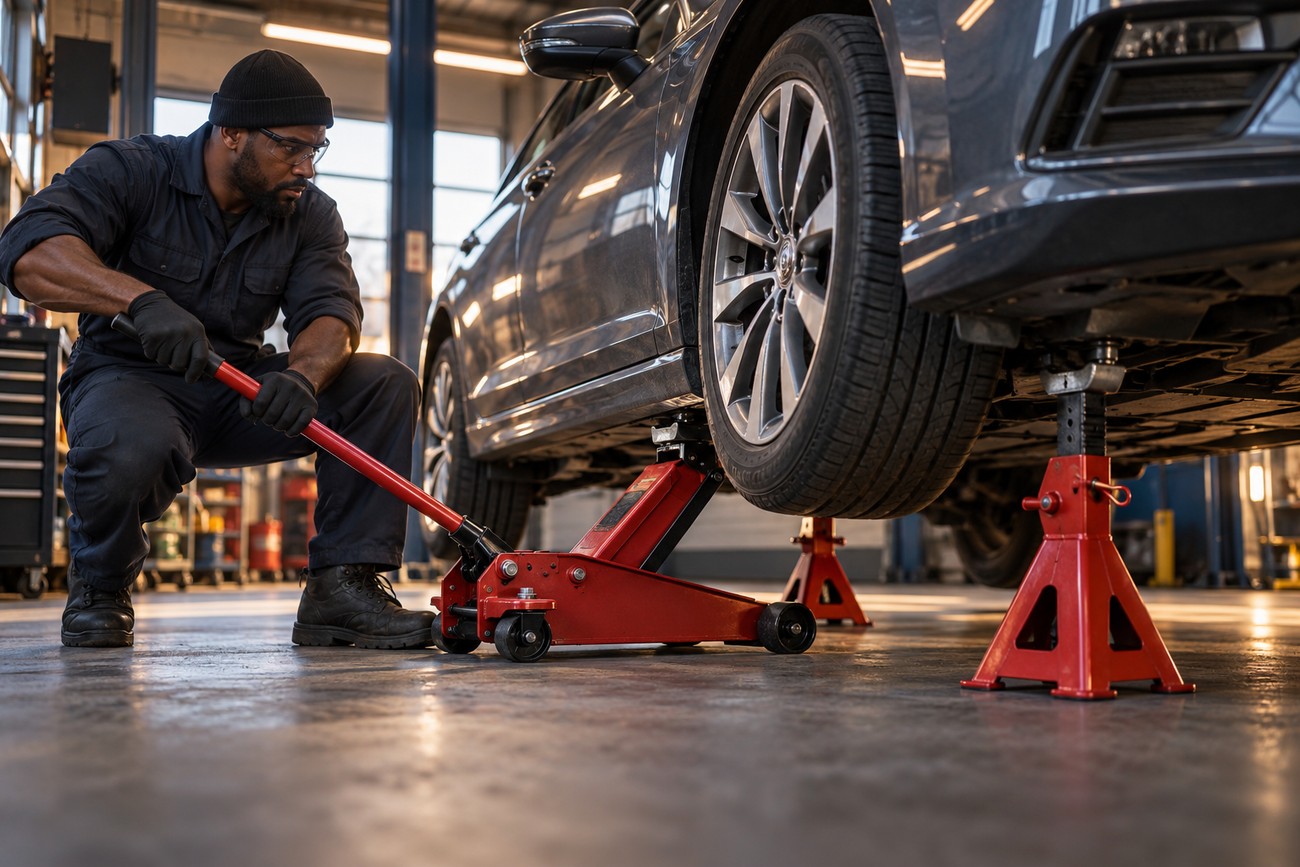
Position the jack squarely under the approved lifting point, with its wheels and base aligned as the manufacturer and jack instructions require. Raise the vehicle slowly and watch the contact between the lifting pad and the vehicle. Keep hands, feet, and tools away from pinch points, and stop immediately if the pad shifts, the vehicle leans, or the jack approaches an unstable angle.
Place a pair of stands at the approved support points for the raised end. Adjust each stand to a suitable height, then fully engage its locking mechanism. Both stands should have a stable base and flat, unobstructed contact with the vehicle. One stand is not an adequate replacement for a properly positioned pair.
Confirm the lock visually before transferring the load. A stand can appear upright while its pawl is only partly engaged or its pin is not fully seated; a slow load transfer exposes that mistake before anyone works underneath.
Lower the vehicle smoothly until its weight is carried by the stands. Do not drop the vehicle onto them. Once the jack has transferred the load, inspect each saddle and base again to ensure they remain flat and correctly positioned. The jack may remain nearby as auxiliary assistance, but it is not the primary support and must never be the sole support.
Apply only moderate, controlled force to check stability from a safe position. The vehicle should not rock, slide, or settle unexpectedly, and the stands should remain fully engaged. A sharp or forceful shake is unsafe because it creates the side load being tested for. If anything moves, raise the vehicle only enough to correct the setup, then repeat the complete placement and load-transfer check.
Work Under the Car Without Creating New Instability
A supported vehicle can become less stable as the repair changes its load. Removing a wheel, unloading a suspension component, shifting cargo, or changing the position of the steering can move the center of gravity. Engine, battery, fuel, and cargo placement already distribute weight unevenly before work begins.
Force applied to a fastener can be especially important. A long breaker bar or a seized suspension bolt may push the vehicle sideways or twist it on the stands. If a task requires substantial force, confirm that the stands are at the approved points, the wheels remaining on the ground are chocked, and the vehicle is not being loaded in a direction the setup cannot resist.
Use the lowest stand setting that provides the working clearance you need. Greater extension increases the overturning lever and is generally less stable than a lower setting. The highest available position is therefore not automatically the safest one, even when the stand’s rating appears sufficient.
If a wheel is removed, it may be placed beneath a suitable part of the vehicle as a secondary measure that can limit the consequences of a fall. It does not replace properly installed stands and should not be used as the main support. Keep the underside clear enough that you can leave the area quickly if the vehicle shifts.
Troubleshoot Fit, Height, and Vehicle-Specific Problems
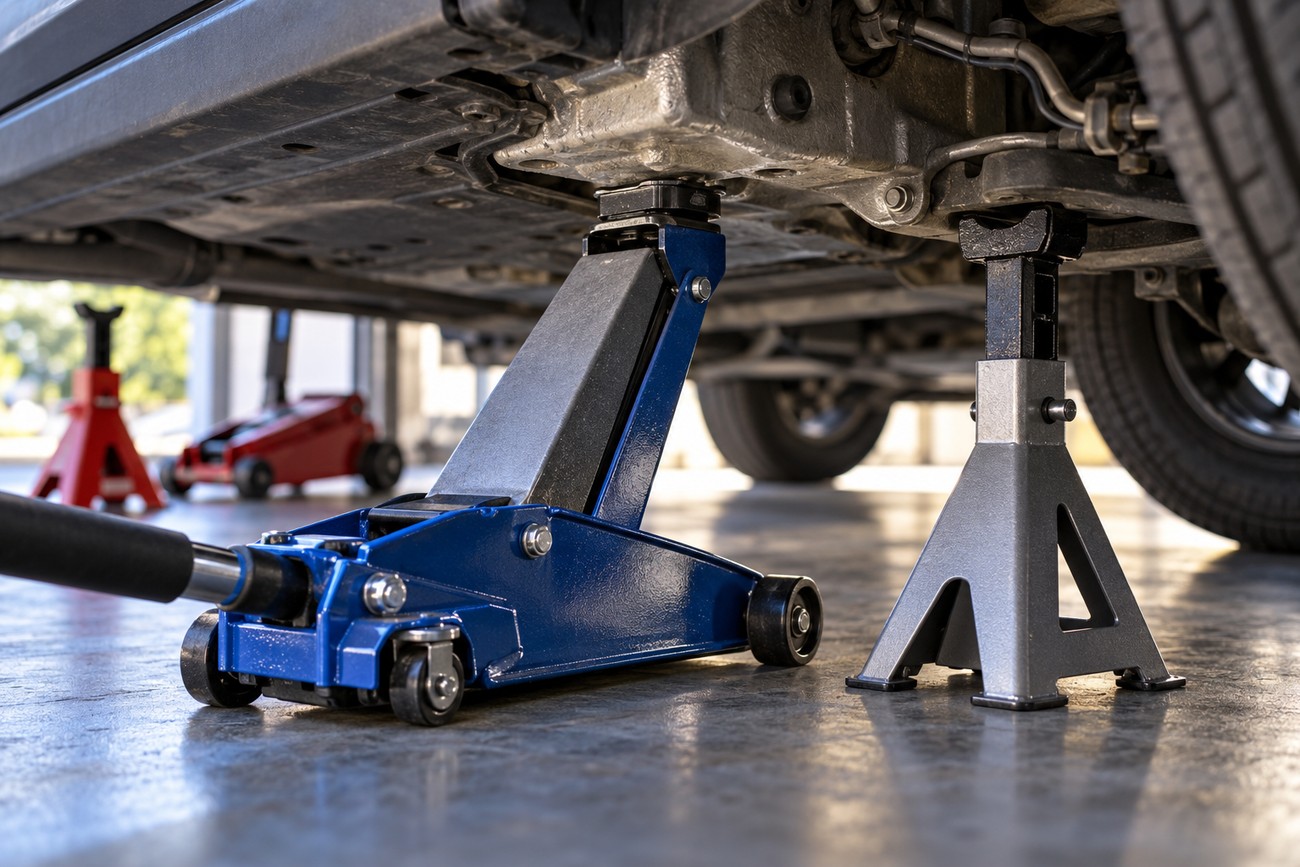
Equipment must suit the vehicle, not merely fit in the trunk. A low-profile jack may pass under the car but fail to reach the approved lifting point. A factory jack may reach that point yet lack enough height to place stands correctly. If the available jack cannot reach the approved point or provide the required height, stop and use compatible equipment rather than improvising.
The stand saddle must rest on the approved reinforced area. If it contacts a thin section, plastic cover, seam, or nearby line, the load may damage the vehicle or make the stand unstable. Do not force a saddle into a narrow space, stack materials beneath it, or move it to a part that merely appears stronger.
Rubber adapters and spacers can protect a rocker seam or help match a contact shape, but they also reduce available lifting height and may make the contact less stable. Use them only when they are suitable for the vehicle and stand, remain securely positioned, and still allow the manufacturer’s approved support area to carry the load.
Air suspension requires the manufacturer’s special lifting procedure. The required state may include a specified low or depressurized setting, and the correct sequence differs by vehicle. Follow the vehicle information before raising it; do not assume that normal suspension settings are safe for a lifted axle.
Never suspend an axle only through its shock absorbers. Shock absorbers are not general-purpose support members, and loading them in an unintended way can cause damage or a fall. If the suspension, frame, or support points are unclear, obtain model-specific instructions or use a qualified facility rather than guessing.
Frequently asked questions
These answers apply the same conservative principles to common decisions. Vehicle-specific instructions take priority whenever they differ from a general method.
What is the safest way to jack a car up?
Use a go/no-go sequence: confirm level, hard, stable ground; verify that the jack and each stand are properly rated and undamaged; locate the manufacturer’s lifting and support points; and check that the stand saddles and height fit those points. Chock the wheels that remain on the ground, loosen wheel nuts slightly while the vehicle is down, lift slowly, and lower the vehicle onto a pair of fully locked stands.
Stop if the equipment cannot reach the approved point, cannot provide the needed height, does not fit the reinforced support area, or makes the vehicle tilt or shift. Do not solve a fit problem with blocks, stacked materials, a nearby suspension part, or a single stand.
How long can I leave my car on jack stands?
There is no universal safe time limit. A vehicle may remain on correctly installed stands for an extended period when the ground, equipment, contact points, and surrounding conditions remain stable and undisturbed.
Keep the area protected from impacts, movement, and changing loads. Before resuming work, inspect the stand bases, locking mechanisms, saddles, and vehicle contact points again, and use only moderate, controlled force to confirm that nothing has shifted. Do not leave the vehicle supported only by a hydraulic jack.
What should I do if a jack stand will not fit the specified support point?
Stop the job and obtain vehicle-compatible, properly rated equipment that fits the approved support area. Do not move the stand to a nearby part, force the saddle into place, or stack wood, bricks, blocks, or spacers to solve the mismatch.
If an appropriate stand cannot be positioned with full, flat contact and a fully engaged lock, the vehicle is not ready to be supported. Use the manufacturer’s service information or a suitably equipped professional facility rather than creating an improvised support system.