Oil consumption, engine noise, or a daunting repair quote can leave you choosing between rebuilding the engine and giving up on the car. A full rebuild can keep an otherwise sound vehicle in service. It can also be an expensive answer to a fault that needed a smaller repair.
The decision rests on what has failed, whether the engine can be restored within specification, and what the finished job will cost. Mileage alone cannot answer those questions, and an advertised starting price rarely covers the whole job. Before committing, you need evidence of the fault and a comparison with the other ways to keep the car on the road.
- Know when to stop driving—and when symptoms mislead
- Confirm internal wear before authorizing a teardown
- When is an engine actually rebuildable?
- Price the entire rebuild, not the advertised labor
- Rebuild, replace, repair, or sell: the trade-offs
- What makes a rebuild last—and what to demand in writing
- Frequently asked questions
- What should I do if a rebuilt engine develops a problem under warranty?
- Which rebuild records should I keep when selling the car?
- How can I plan for the car being off the road?
Know when to stop driving—and when symptoms mislead
Metallic knocking, low oil pressure, or overheating calls for stopping the engine rather than continuing to drive. If it is safe to do so, pull over and switch it off, then arrange recovery. Driving farther can turn repairable wear into damage that makes a rebuild impractical.
Oil consumption, exhaust smoke, and reduced compression deserve attention, but none proves that the entire engine needs rebuilding. Oil may be escaping through an external leak or passing through a cylinder-head fault, a turbocharger, or a faulty crankcase ventilation system.
Likewise, high mileage or vehicle age is a prompt to investigate, not a rebuild criterion. A well-maintained older engine may have a limited fault, while a younger one may have suffered serious damage. Diagnose the condition you have rather than buying a repair based on the odometer.
Confirm internal wear before authorizing a teardown
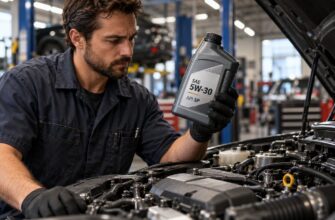
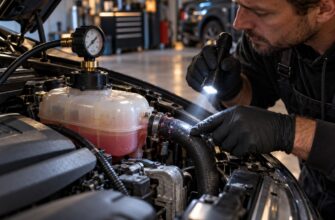
Start with checks that do not require dismantling the engine: look for oil leaks, confirm the oil level and condition, and inspect crankcase ventilation. The pattern of oil loss matters. Oil on the outside of the engine points the investigation somewhere different from oil entering the combustion chambers.
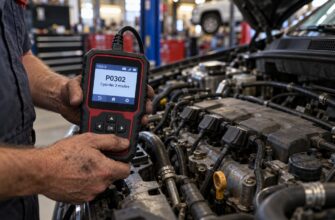
Next, measure compression across the cylinders and check oil pressure with an appropriate gauge. Cylinder inspection with a borescope, where access allows, may reveal scoring or other visible damage. These findings help establish whether internal wear is likely, but one low reading or image is not a complete rebuild verdict.
Investigate likely cylinder-head, valve-seal, and turbocharger faults alongside those results. If the evidence points to a head fault or blocked ventilation, a targeted repair may address oil consumption without opening the bottom end. Ask the shop to explain which findings support its recommendation and which alternatives it has ruled out.
Some answers only emerge after disassembly. Bore dimensions, bearing clearances, and the condition of major parts must be measured before the final machining and parts list can be set. Agree in advance that work pauses for your approval if teardown reveals a substantially different job.
When is an engine actually rebuildable?
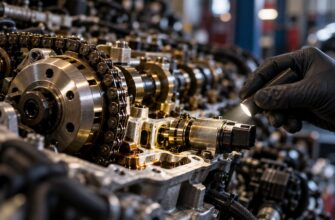
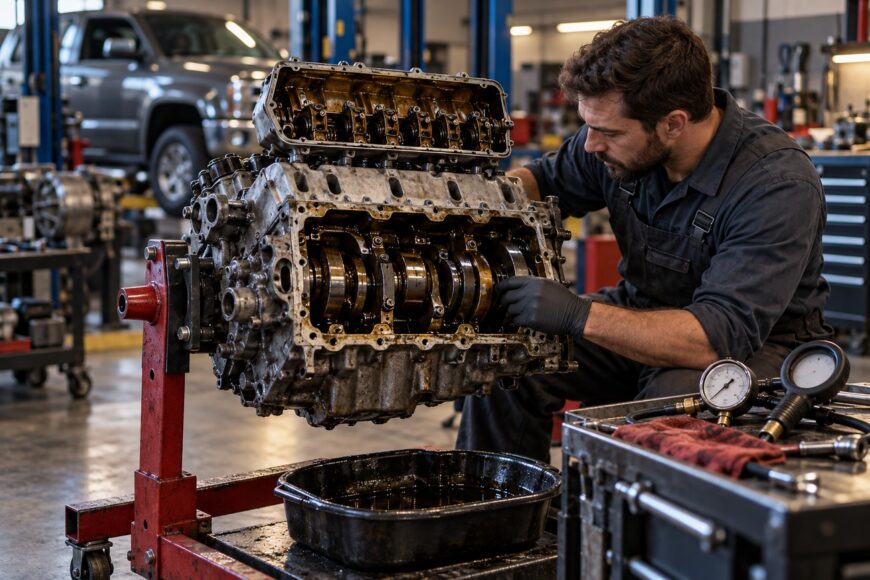
A full engine rebuild means disassembly, dimensional inspection, necessary machining, replacement of worn components, and controlled assembly. The aim is to restore working clearances and function within the engine’s specifications. A cylinder-head repair addresses a narrower fault; fitting rings and bearings alone does not establish that the whole engine has been rebuilt.
Wear can often be corrected when the block, cylinder head, and crankshaft remain suitable for the specified machining and parts. The machinist must measure the bores and other critical surfaces before choosing a repair. Visible wear alone cannot show whether a component will finish within tolerance.
Severe cracks or through-damage to major castings, or a crankshaft that cannot be restored within specification, can make replacement more practical. Even when repairs are technically possible, scarce parts or extensive machining may change the economic answer. Request the inspection findings before approving further work.
A completed rebuild does not automatically deliver new-engine durability. Its useful life depends on the condition of retained components, machining accuracy, parts quality, and assembly. Treat “rebuilt” as a description of documented work, not a promise that every part is new.
Price the entire rebuild, not the advertised labor
Ask for an estimate that separates engine removal and installation, machine-shop work, parts, and assembly. It should also identify plausible related repairs that require your approval, such as a damaged cooling-system component found while the engine is out. A labor-only starting price may exclude several of these substantial costs.
The first figure is provisional until teardown and dimensional inspection reveal what can be reused. Ask which charges are fixed, which depend on findings, and whether the shop will contact you before ordering extra parts or authorizing machining. That gives you a point at which to reconsider rather than discovering the revised total at collection.
As a screening heuristic, a total rebuild cost at or below roughly 40–50% of the vehicle’s market value may warrant consideration. It is neither a universal cutoff nor proof of value. The condition of the transmission, body, and cooling system, your ownership plans, and time without the car all affect what you can reasonably spend.
Compare that finished cost with the installed price of a used replacement engine, including any testing, ancillary parts, and available warranty. A seller’s claimed mileage does not verify internal condition. A cheaper unit can become the costly option if its history is uncertain and you must pay for installation twice.
Rebuild, replace, repair, or sell: the trade-offs
Match the option to the diagnosed fault, available parts, and how long you intend to keep the car. A documented original engine may also matter more in a rare or collectible vehicle.
| Option | When it fits | Main uncertainty or hidden cost | Evidence to request |
|---|---|---|---|
| Targeted repair | A confirmed leak, ventilation, turbocharger, or cylinder-head fault without evidence requiring a full rebuild. | Another fault may remain if diagnosis was incomplete. | Test results, repair scope, and a plan to verify the result. |
| Full rebuild | Measurable internal wear, rebuildable major parts, and a car worth keeping. The 40–50% cost-to-value guide is only an initial screen. | Teardown findings, parts availability, and machine-shop delays. | Measurements, itemized estimate, parts specification, and warranty terms. |
| Used replacement engine | A rebuild is impractical or a suitable unit has stronger cost and availability evidence. | Claimed mileage does not establish internal condition; installation may expose further costs. | Identification, test evidence, installed quote, and written warranty. |
| Sell or replace the car | Total repair spending no longer fits the vehicle’s condition or your plans. | The replacement vehicle has its own unknowns. | A realistic value for the current car and an inspection of any replacement. |
What makes a rebuild last—and what to demand in writing
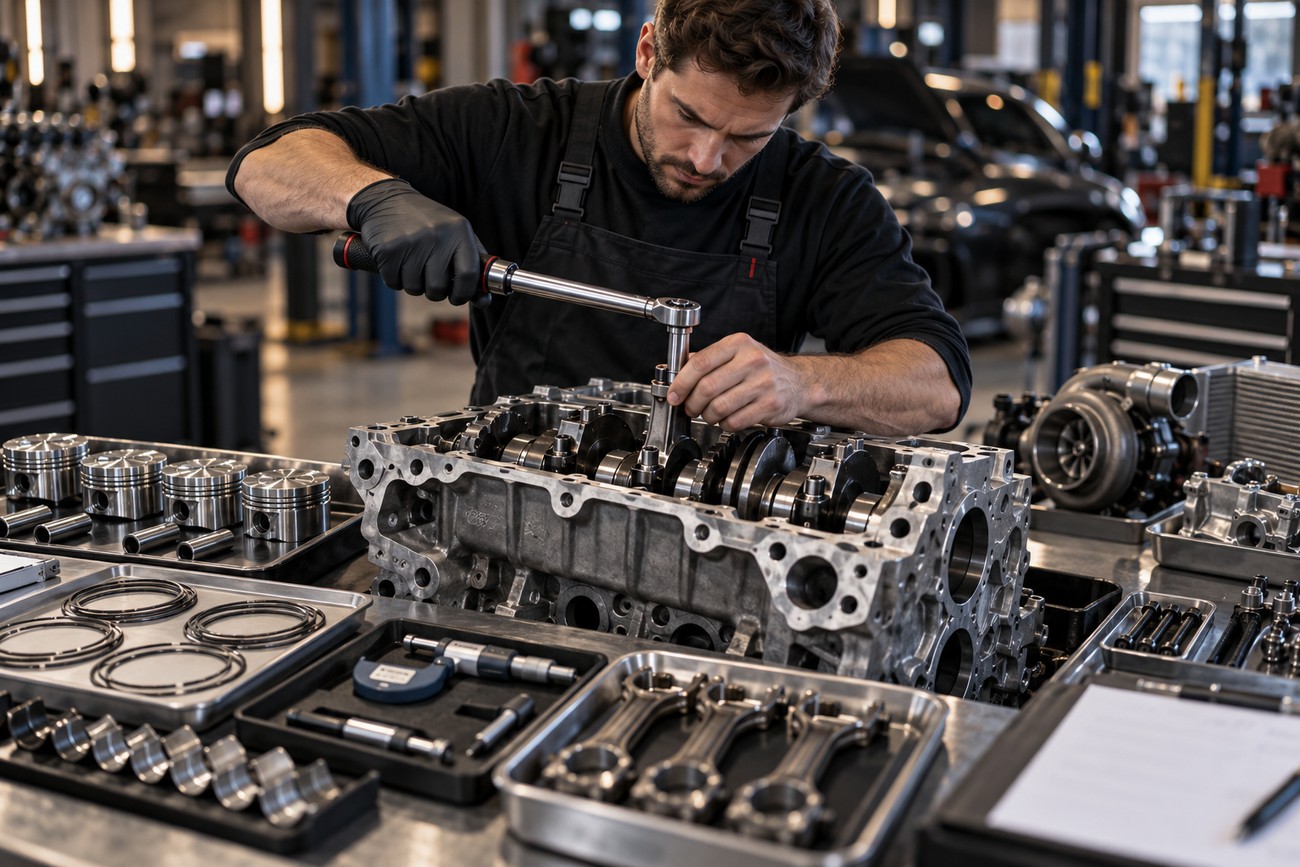
Predictable results depend on measured bore shape, correct clearances, suitable machining, appropriate parts, and careful assembly. New rings cannot compensate for a cylinder that remains out of specification. A rings-and-bearings refresh may have a place, but it should not be sold as a full rebuild without the inspection and work that description implies.
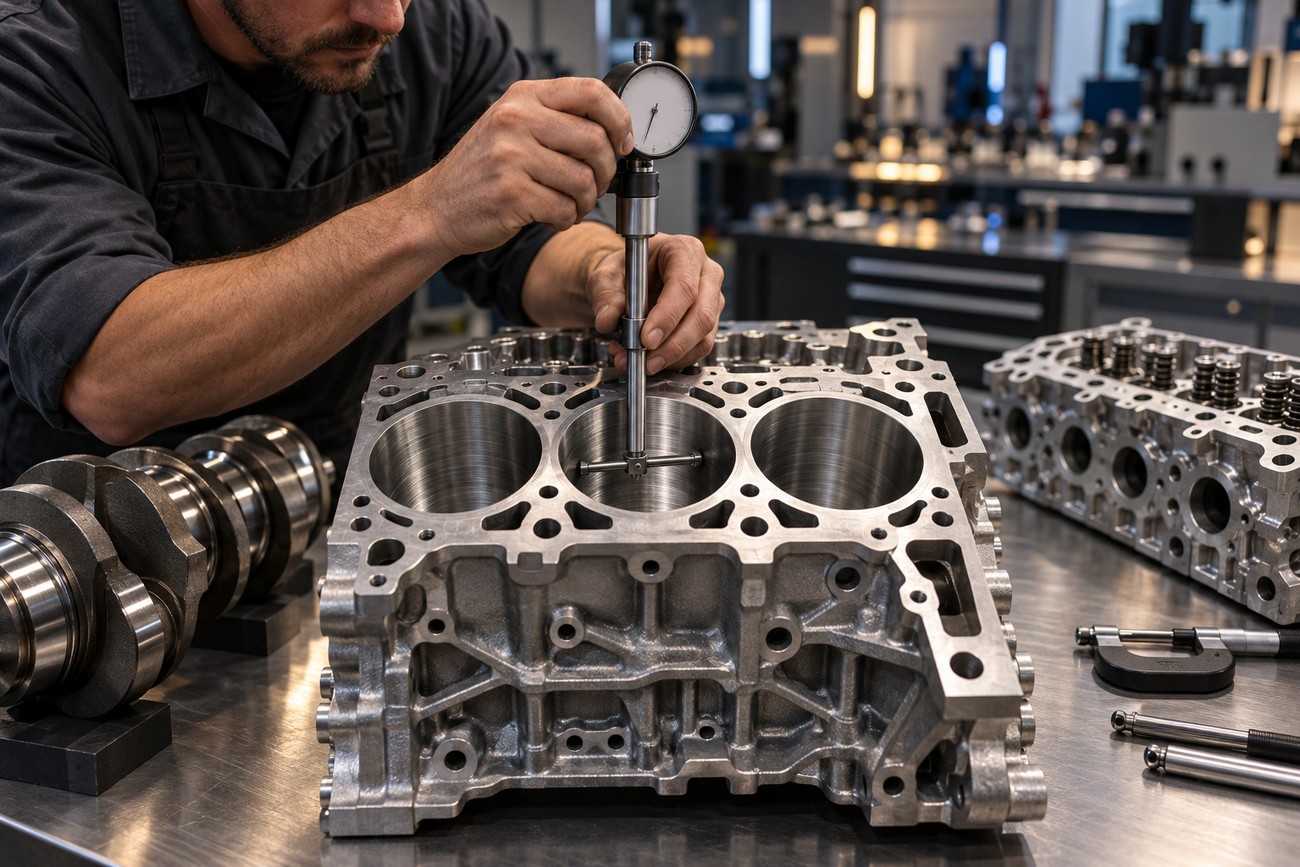
Bore taper and out-of-round measurements should be recorded before machining and piston sizes are chosen. Ordering parts from a visual inspection alone can leave the finished clearances wrong.
Complex turbocharged or direct-injection engines may demand engine-specific procedures, documentation, and tools. Ask who performs the machining, how dimensions are checked, and which parts are new, reconditioned, or retained. An itemized scope makes it easier to compare shops than a single promise to “rebuild the engine.”
Get the proposed work, measurement results, parts specification, and approval process in writing. Confirm how machine-shop capacity and parts availability affect scheduling; delays can occur after the engine is apart. The shop should also explain how it will check the assembled engine before handover.
Read the warranty before authorizing work. Coverage may be limited by time, mileage, and stated maintenance or operating conditions, so ask what happens if a fault appears and what records you must keep. After collection, follow the rebuilder’s written, engine-specific operating and maintenance instructions rather than assuming every rebuilt engine needs the same treatment.
Frequently asked questions
Once the repair is complete, good records and prompt communication help you deal with any problem that follows. These steps also make the work easier to explain to a future buyer.
What should I do if a rebuilt engine develops a problem under warranty?
Stop driving if continued use could worsen the damage, then document the symptoms, when they began, and the vehicle’s maintenance since the rebuild. Notify the rebuilder promptly using the contact method in your paperwork, and ask how it wants the car inspected or transported.
Keep invoices, receipts, and messages together. Before another shop dismantles the engine, obtain the rebuilder’s written findings or instructions where possible; an unauthorized teardown may complicate a claim under the stated warranty conditions.
Which rebuild records should I keep when selling the car?
Keep the itemized invoice, parts list, measurement and machining records, warranty paperwork, and subsequent maintenance receipts. Together, they show what was done and how the engine was cared for, rather than relying on the word “rebuilt” in a listing.
Give a buyer the documented scope, including any components that were retained or repaired separately. Clear records are particularly useful when the original engine is part of the car’s appeal, though they cannot guarantee its future condition.
How can I plan for the car being off the road?
Ask about machine-shop capacity, availability of likely parts, the point at which you must approve teardown findings, and when reassembly can be scheduled. A completion estimate made before inspection may change if machining or parts orders take longer than expected.
Arrange alternative transport with room for that uncertainty, and ask the shop for updates at defined decision points. This is especially important if the car is essential for work: a repair that fits your budget may still be difficult to manage without a practical plan for the downtime.