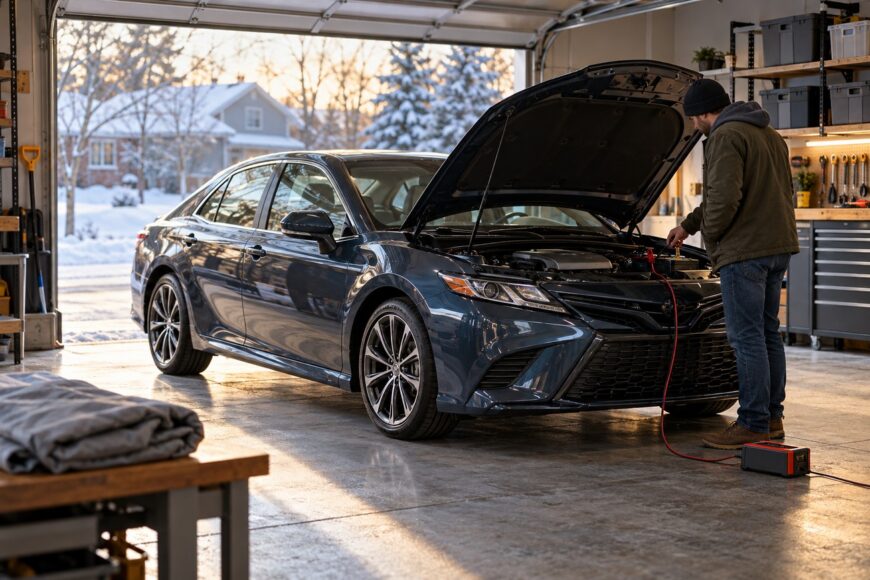
A car left unused through winter can emerge with a failed battery, damp interior, tire flat spots, corrosion, or wiring damaged by rodents. These problems often begin before the first cold day: a wet car goes under a cover, a weak battery is left connected, or food remains in the cabin.
Preparation depends on the vehicle and where it will sit. A battery maintainer and a disconnected negative terminal have different consequences; modern radial tires can usually stay on the car; and a full fuel tank makes sense only where the manufacturer supports that approach. For storage of about 60 days or more, make those choices deliberately, then work through the car from its parking place to its eventual restart.
- Start With the Storage Conditions and a Final Inspection
- Wash, Dry, and Protect the Car Before Covering It
- Prepare the Fuel, Fluids, and Engine Without Short Runs
- Choose the Right Battery Strategy
- Set the Tires and Park the Car Safely
- Control Moisture, Rodents, and the Spring Restart
- Frequently asked questions
- How long can a car sit without being driven?
- What is the $3,000 rule for cars?
- What to do before storing a car for winter?
Start With the Storage Conditions and a Final Inspection
Choose a dry, ventilated place with a hard, level surface. Keep the vehicle out of direct sunlight and away from stored oil or gasoline. A cover may protect the finish from dust, but it cannot make a damp or poorly ventilated garage suitable for storage.
A period of about 60 days or more calls for extended-storage planning. Prepare the fuel, battery, tires, and electrical systems separately rather than simply parking the car after its last drive. Check the owner’s manual first, especially if the vehicle has model-specific storage or battery procedures.
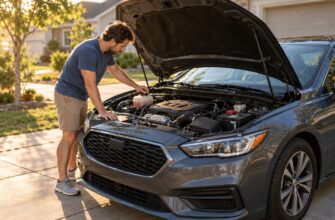
Inspect the car while a repair is still easy to arrange. Look for fluid leaks, damaged tires, worn belts or hoses, and dashboard warnings that appeared during the last drive. Record anything unresolved; a warning light found in spring is harder to distinguish from a problem that developed during storage.
Assess the surface and the air around the car, too. Standing water, persistent condensation, or dirt blowing under a cover calls for a better location or a change to the space itself. An outdoor cover does not replace dry storage, and contact with wet dirt can harm the paint.
Wash, Dry, and Protect the Car Before Covering It
Wash the body, wheel arches, and wheels thoroughly before storage. Road salt and brake dust left in seams or on metal surfaces can contribute to corrosion, while grit trapped beneath a moving cover can mark the finish. A quick rinse that leaves those deposits behind offers little protection.
Allow time for the car to dry beyond the visible panels. Dry the brakes after washing, and check door seals, drains, and places where water collects in body openings. Parking a freshly washed car immediately under a cover can trap moisture even when the paint looks clean.
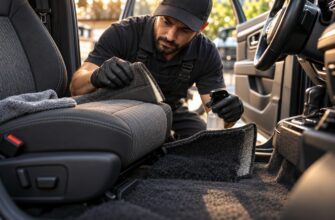
Clean the cabin and remove damp mats or other wet items. Check that drains are clear and that the interior has dried before closing the car for an extended period. This reduces the chance of returning to condensation, odors, or mold.
If you use a cover, choose one that is clean, fits securely, and allows ventilation. Put it on only after the vehicle is clean and dry. Avoid an airtight enclosure: it can hold moisture against the car, and it cannot compensate for a wet storage space.
Prepare the Fuel, Fluids, and Engine Without Short Runs
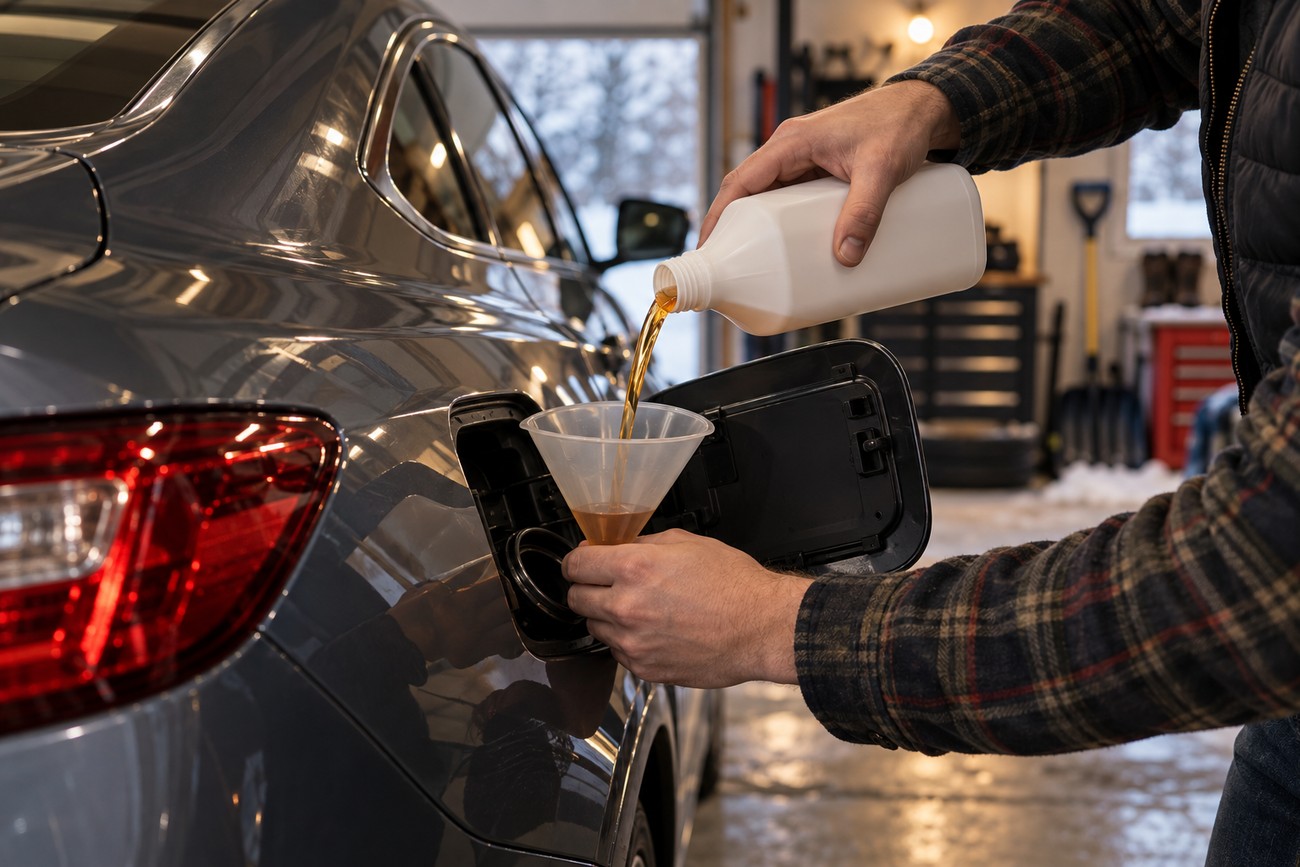
Follow the owner’s manual for fuel level and fluid procedures. Some manufacturers recommend a full tank of compatible, stabilized fuel; a full tank is not a universal requirement for every car. The relevant instructions depend on the vehicle and the fuel it uses.
If a stabilizer is specified or appropriate for your vehicle, confirm that it is compatible with the fuel and mix it before storage according to its directions. Adding it after the car has been parked leaves fuel elsewhere in the system untreated. Filling the tank alone also does not stop fuel from aging.
Check fluid levels and investigate leaks before parking. If service is due, consult the vehicle’s maintenance and storage instructions rather than assuming that a fluid change is always necessary. Keep a note of any outstanding work so it is addressed before the car returns to regular use.
A 5–10 minute start every few weeks is a poor substitute for driving. A short run can add condensation to the engine and exhaust without bringing the whole system through a proper operating cycle. If you cannot safely complete a normal drive, leave the engine off and follow the storage plan instead; never run it in an enclosed space.
Choose the Right Battery Strategy
A connected 12-volt battery may lose charge while the car sits, even with the ignition off. Plan to check it after the first 60 days, then every 30 days during extended storage. That interval is a practical service reference, not a promise that every battery will remain healthy until the first check.
A suitable maintenance charger can help preserve charge while keeping alarms, telematics, and vehicle memory powered. Use equipment with a maintenance mode matched to the battery type—lead-acid, AGM, EFB, or lithium—and follow the vehicle and charger instructions for connecting it. An ordinary charger without a suitable maintenance mode should not be left in its place.
Disconnecting the negative terminal limits the vehicle’s electrical draw, but the battery still self-discharges. Disconnection can also disable alarms, telematics, and other constant-power functions. It may reset the clock, multimedia settings, seat memory, and learned functions that need attention when power is restored.
Neither choice is universally best. A maintainer needs suitable equipment and a safe power supply; disconnection avoids dependence on that supply but sacrifices powered features. Confirm the manufacturer’s procedure before touching the terminal, particularly on vehicles with complex electrical systems.
Set the Tires and Park the Car Safely
Measure tire pressure when the tires are cold, record the readings, and set pressure according to the vehicle placard. The number on a tire’s sidewall is a maximum limit, not automatically the recommended operating pressure. Plan to check pressure monthly during extended storage and use the placard again when preparing to drive.
Modern radial tires can generally remain installed if they are correctly inflated and monitored. A temporary flat spot after a long stand may ease as the tire warms in use, but a persistent vibration deserves inspection. Removing the wheels is optional, not a routine requirement for every winter-stored car.
Wheel removal introduces its own work and risks. The vehicle needs supports approved for the job and stable placement on a hard surface; wheel removal may also affect tire-pressure monitoring, brake condition, and how the suspension is loaded. Check the vehicle guidance before choosing this route.
Clean and fully dry any tires stored separately. Store tires mounted on wheels horizontally, and tires without wheels vertically. Keep both away from sunlight, heat, ozone sources, chemicals, and outdoor exposure, even if a cover is available.
Control Moisture, Rodents, and the Spring Restart
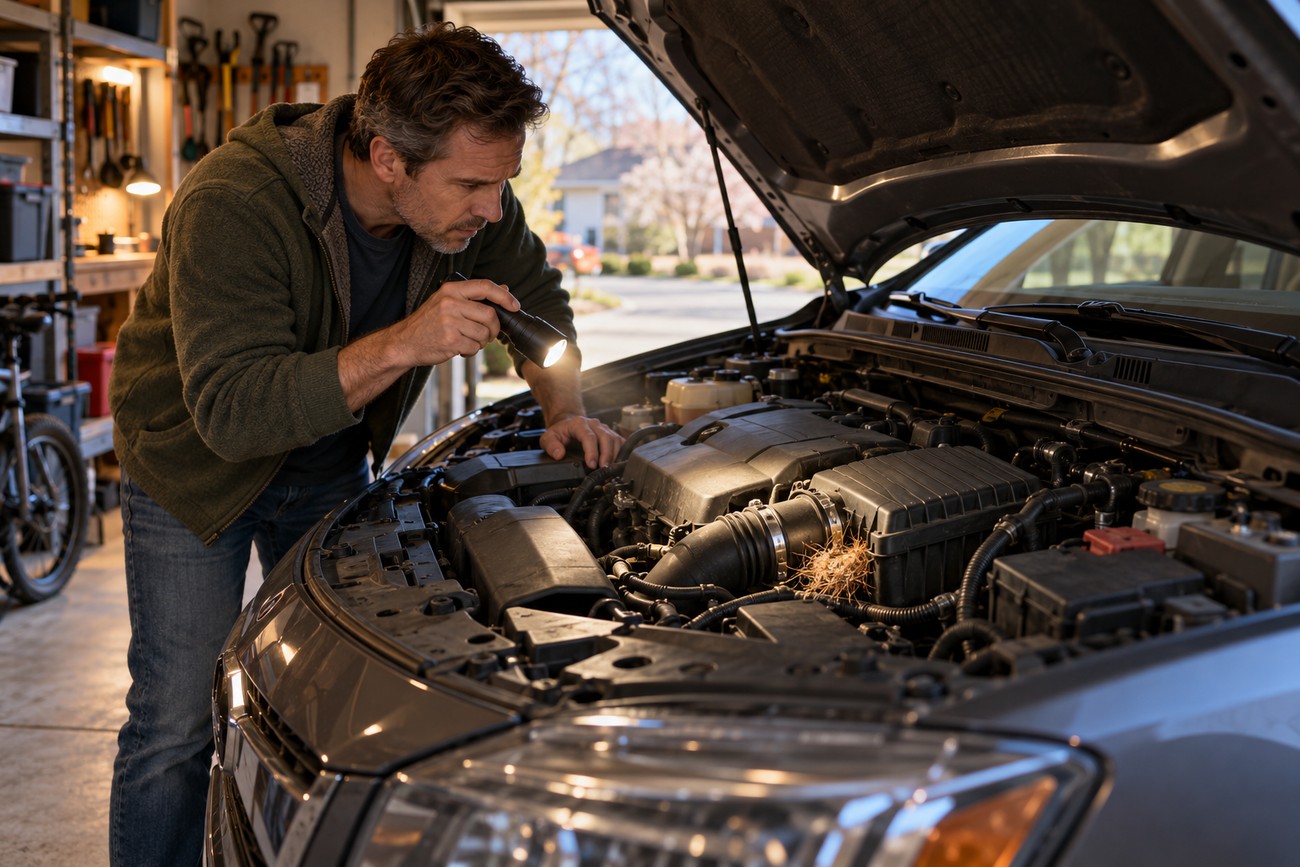
Remove food, packaging, and possible nesting material from the cabin and nearby storage area. Rodents can damage wiring, insulation, and air filters, so inspect accessible air intakes, the engine bay, and the exhaust before parking. Avoid sealing ventilation so tightly that moisture becomes trapped inside the car.
A covered vehicle can still develop a damp cabin if wet mats or blocked drains were overlooked. Check the interior during extended storage where access allows, along with the battery and tire pressure. A musty smell or fresh evidence of pests is a reason to investigate promptly rather than wait for spring.
Before restarting, inspect the air intake, filter, engine bay, wiring area, and exhaust for nests, chewed material, or blockages. Starting a vehicle with an obstructed intake or exhaust can be dangerous. Clear any problem safely and arrange a repair if wiring or other components have been damaged.
Reconnect the battery using the manufacturer’s procedure if it was disconnected, then check for leaks and confirm tire pressure against the vehicle placard. After starting, check for ABS warnings and verify that the power windows and alarm operate correctly. Follow the manufacturer’s procedure for steering-angle system initialization, which may require driving. Address persistent faults before returning the car to regular use.
Frequently asked questions
The answers below are planning guides. Your vehicle’s manual takes priority where it gives a specific storage, charging, or return-to-service procedure.
How long can a car sit without being driven?
There is no single safe maximum for every car. Battery condition, climate, storage conditions, and the vehicle’s electrical draw all affect what happens while it sits. About 60 days or more is a useful point at which to plan for extended storage, rather than a deadline at which a car necessarily develops a fault.
A car that happens to remain parked is different from one prepared for that period. The prepared car has a battery strategy, monitored tire pressure, an appropriate fuel plan, and a dry location. If an unprepared car has already sat through winter, inspect it before attempting to start or drive it.
What is the $3,000 rule for cars?
The “$3,000 rule” is an informal way of weighing a repair bill against a car’s value and the cost of replacing it. It is a budgeting heuristic, not a winter-storage procedure or a technical threshold for deciding whether a vehicle is safe to park or drive.
For a car with known faults, request a diagnosis before storage and decide whether to repair it now or budget for work before it returns to service. Leaving a leak or warning unexplained over winter does not resolve it, regardless of the car’s value.
What to do before storing a car for winter?
Start with the owner’s manual and a written record of the car’s condition. Note existing warnings, tire readings, battery arrangements, fuel treatment, and the date it was parked. Keep the manual and any maintainer instructions accessible to whoever will check the car during storage.
Arrange access for those checks before leaving the vehicle: a monthly tire-pressure check and battery attention are difficult if the car is parked too tightly to reach. Leave yourself enough room for a safe inspection of the engine bay and exhaust before the first spring start.