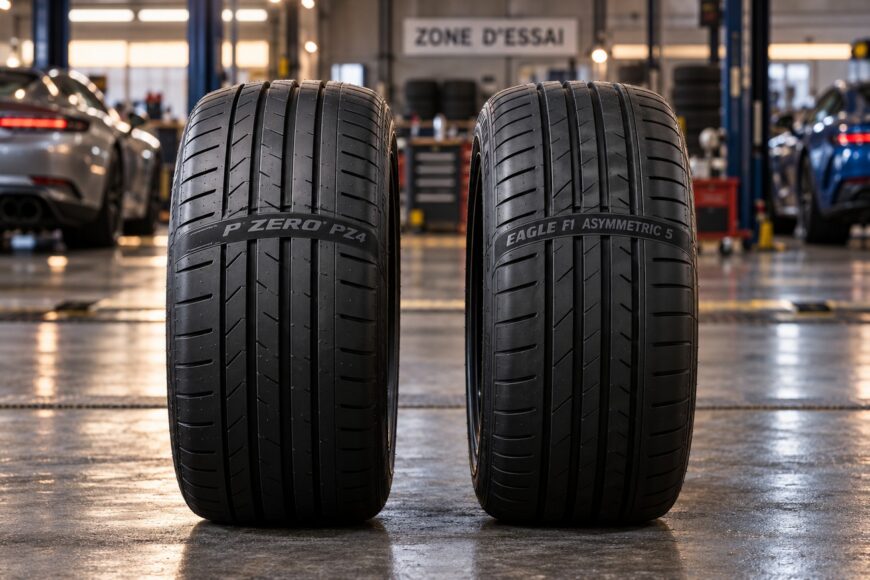
Choosing between Pirelli P Zero and Goodyear Eagle F1 Asymmetric usually comes down to a trade-off between sharper steering and high-speed composure on one side, and a more compliant ride with strong wet-road performance on the other. Both are UHP summer tire families designed for powerful cars and SUVs, so neither is a general-purpose touring tire.
The answer can change with the generation, size, load rating, and vehicle-specific construction. A P Zero PZ4 with an OEM marking may behave differently from an unmarked P Zero in the same nominal size, just as an Eagle F1 Asymmetric 3 result cannot automatically describe an Asymmetric 6. The useful comparison starts with the exact tire specification rather than the family name.
- First, make sure you are comparing the same tires
- P Zero vs Eagle F1 Asymmetric: the trade-offs at a glance
- Dry steering or wet braking: where the difference matters
- Comfort, noise, and wear after the first few months
- The buying mistakes that can outweigh a test result
- Which should you buy for your driving?
- Frequently asked questions
- Which is better: Goodyear Eagle F1 Asymmetric 6 or Pirelli P Zero PZ5?
- What is the average lifespan of a Goodyear Eagle F1 Asymmetric 6 tire?
First, make sure you are comparing the same tires
P Zero is a family that includes several generations and constructions, including the PZ4. Eagle F1 Asymmetric has also progressed through successive generations such as the Asymmetric 2, 3, and 5. These products share a performance category, but their tread compounds, carcasses, and development targets can differ.
Independent tests are meaningful only when the generation, size, vehicle, and specification are reasonably comparable. A result showing an Eagle F1 Asymmetric 3 braking well on wet asphalt cannot establish how an Asymmetric 5 or Asymmetric 6 will perform in another size. The same caution applies when a P Zero PZ4 is compared with an older Eagle F1 model.
OEM-marked P Zero versions add another layer of variation. Markings such as AO, MO, or N0 identify approval for a particular vehicle manufacturer, and the construction may be tuned for that vehicle’s steering, ride, or noise targets. An OEM marking is useful compatibility information, but it is not, by itself, a performance verdict.
The newer PZ5-versus-Asymmetric 6 question therefore needs a directly comparable test. Older-generation results can describe broad family tendencies, but they cannot establish a winner between those newer products. Check the exact size and specification before applying any test conclusion to your car.
P Zero vs Eagle F1 Asymmetric: the trade-offs at a glance
The table summarizes tendencies reported across older generations. They are family-level indications rather than universal results, and they should not be treated as a verdict on the newest generations.
| Criteria | Pirelli P Zero / PZ4 | Goodyear Eagle F1 Asymmetric |
|---|---|---|
| Dry steering | More often gives a precise response and a firm, controlled feel, especially in fast bends. | Can feel progressive and secure, though some drivers find the steering less immediate. |
| Wet braking and stability | Competitive, with results depending strongly on generation and size. | Asymmetric 3/5 more often favors wet braking and wet-road stability in the older tests discussed here. |
| High-speed composure | More often favors stability and consistency at sustained high speed. | Usually comfortable and secure, though some owners report a softer feel at very high speeds. |
| Ride feel | Firm and communicative; rough roads can make the ride less relaxed. | Often more compliant, with a softer carcass feel that can reduce steering sharpness. |
| Wear considerations | Shoulder wear and increasing noise are reported by some owners, especially with poor alignment or aggressive driving. | Service life varies widely; impact damage and sidewall vulnerability are reported by some owners. |
| Specification sensitivity | High: OEM-marked and unmarked versions can differ within the same nominal size. | High: generation, size, load rating, and vehicle setup still affect the result. |
Neither family has a dependable official tread-life figure. Owner-reported outcomes span roughly 20,000–50,000 km across different driving styles, roads, vehicle weights, and maintenance conditions. That range is neither an average nor a promise for a particular generation.
The broad distinction is response versus compliance. P Zero and PZ4 more often favor steering accuracy and high-speed composure, while Eagle F1 Asymmetric 3/5 more often favor wet braking and stability. A same-size comparison can narrow that difference considerably.
Dry steering or wet braking: where the difference matters
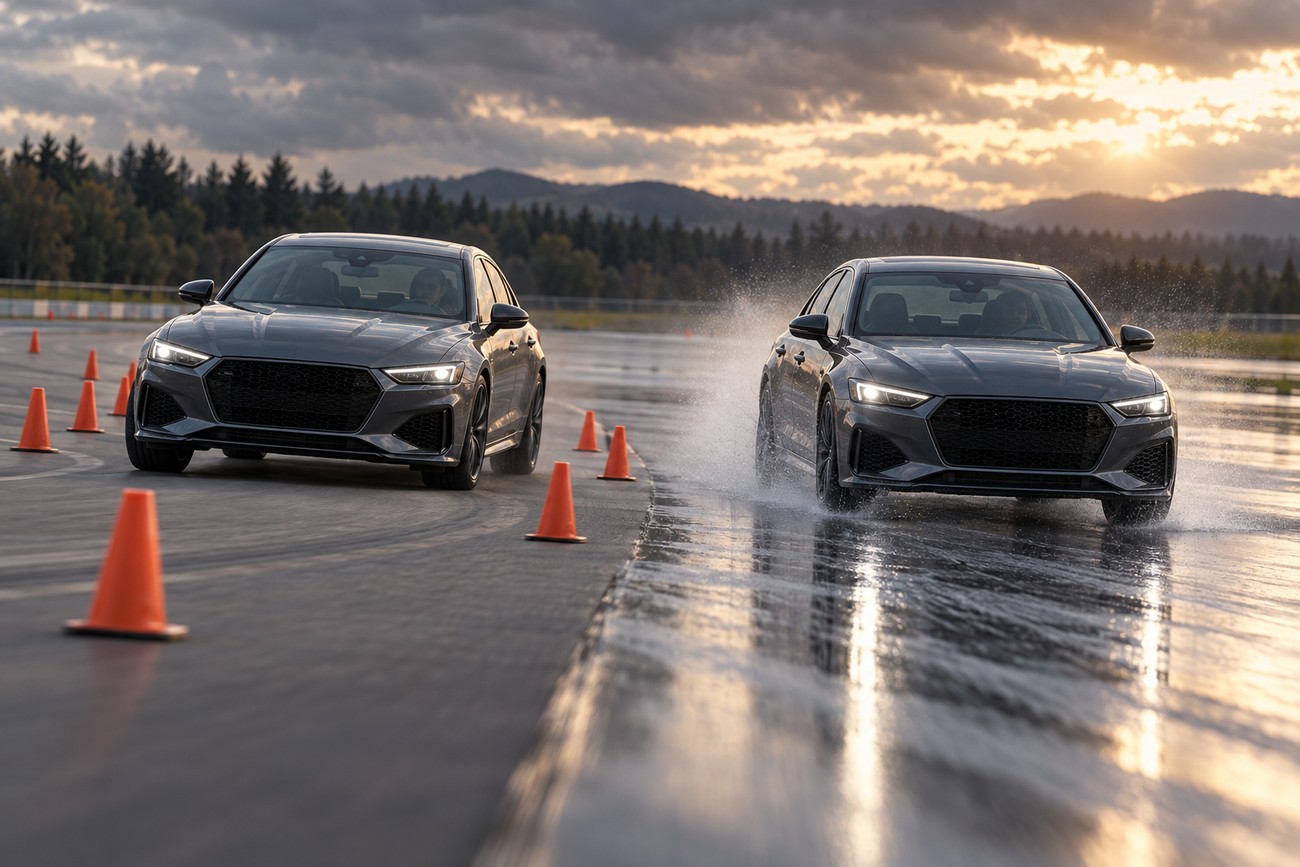
On dry roads, P Zero often suits a driver who notices steering delay and wants a firm connection between steering input and the front axle. Its stiffer-feeling response can help during rapid lane changes and fast highway travel. That sensation describes steering feedback and composure; it does not prove that the tire produces more measured grip in every dry test.
Eagle F1 Asymmetric 3/5 more often performs strongly in wet braking and wet-road stability in older-generation tests. That can matter during a damp commute, an emergency stop, or acceleration onto a wet road. The result remains dependent on tread depth, temperature, vehicle electronics, and the exact tire specification.
Wet conditions also vary considerably. A lightly damp surface, standing water, and cold rain test different parts of a tire’s design. Neither family has a universal wet- or dry-performance advantage, so a driver who mainly faces rain should look for a test using the same size and a comparable vehicle.
Cool weather is a separate concern for both products because they are summer tires. Performance can fall in cool conditions, with approximately 7–10 °C serving as a cautionary range rather than a precise grip cutoff. Cold, wet asphalt can expose the limits of either tire through reduced traction and longer braking distances, even when the tire performs well in warm-weather testing.
Comfort, noise, and wear after the first few months
P Zero commonly delivers a firm ride and clear steering when new, while Eagle F1 Asymmetric is often perceived as more compliant. Some drivers who move from P Zero to Eagle F1 Asymmetric describe the Goodyear’s steering as softer or less immediate. That is a subjective handling impression, and it can also reflect sidewall construction, wheel size, inflation pressure, and the vehicle’s suspension.
Some P Zero owners report rapid shoulder wear, particularly with aggressive driving or incorrect alignment. Others report increasing road noise as the tread ages, especially on coarse asphalt. These are owner complaints rather than established comparative defect rates, and uneven wear can also indicate an alignment or pressure problem.
EU-label external-noise figures for some sizes are around 70–73 dB. The exact value belongs to the specific tire specification, and the label measures external pass-by noise rather than cabin noise. It also says little about how noise may change after uneven wear.
Asymmetric owners report a wide range of service life, and some value its comfort over a long period of ordinary driving. Neither family has a reliable official lifespan figure. Rotation where permitted, correct pressure, proper alignment, and regular tread inspection are more useful for assessing tire condition than a generic mileage claim.
The buying mistakes that can outweigh a test result
Start with the vehicle manufacturer’s required size, load index, and speed rating. Many listed sizes in both families carry W or Y ratings, but the exact requirement belongs to the vehicle and tire specification. A quieter or softer replacement with an insufficient load index can overheat, wear quickly, or respond poorly on a heavy vehicle.
OEM marking deserves careful interpretation. A factory-approved P Zero may have a different construction from an unmarked replacement in the same nominal size, with the tuning aimed at a particular vehicle. It may prioritize ride or noise targets as well as handling, so the marking alone does not promise sharper steering.
Alignment and pressure can materially affect UHP tire wear. Excessive shoulder wear may point to camber, toe, underinflation, or driving style, while a worn center can suggest overinflation. Checking them can prevent a setup problem from being mistaken for a brand characteristic.
Rough roads create a different risk. Some Eagle F1 Asymmetric owners report bulges or sidewall impact damage, while P Zero users also report damage after severe impacts. These accounts do not establish comparative failure rates, but they do support a practical warning: a soft ride does not make a low-profile tire suitable for repeated pothole impacts.
Vehicle weight matters as well. A heavy SUV, a powerful all-wheel-drive car, or a vehicle carrying frequent loads needs the correct load index and a carcass suited to its use. A tire selected from comfort impressions alone may feel pleasant in town while lacking the steering support or impact margin you expect on a heavier vehicle.
Which should you buy for your driving?
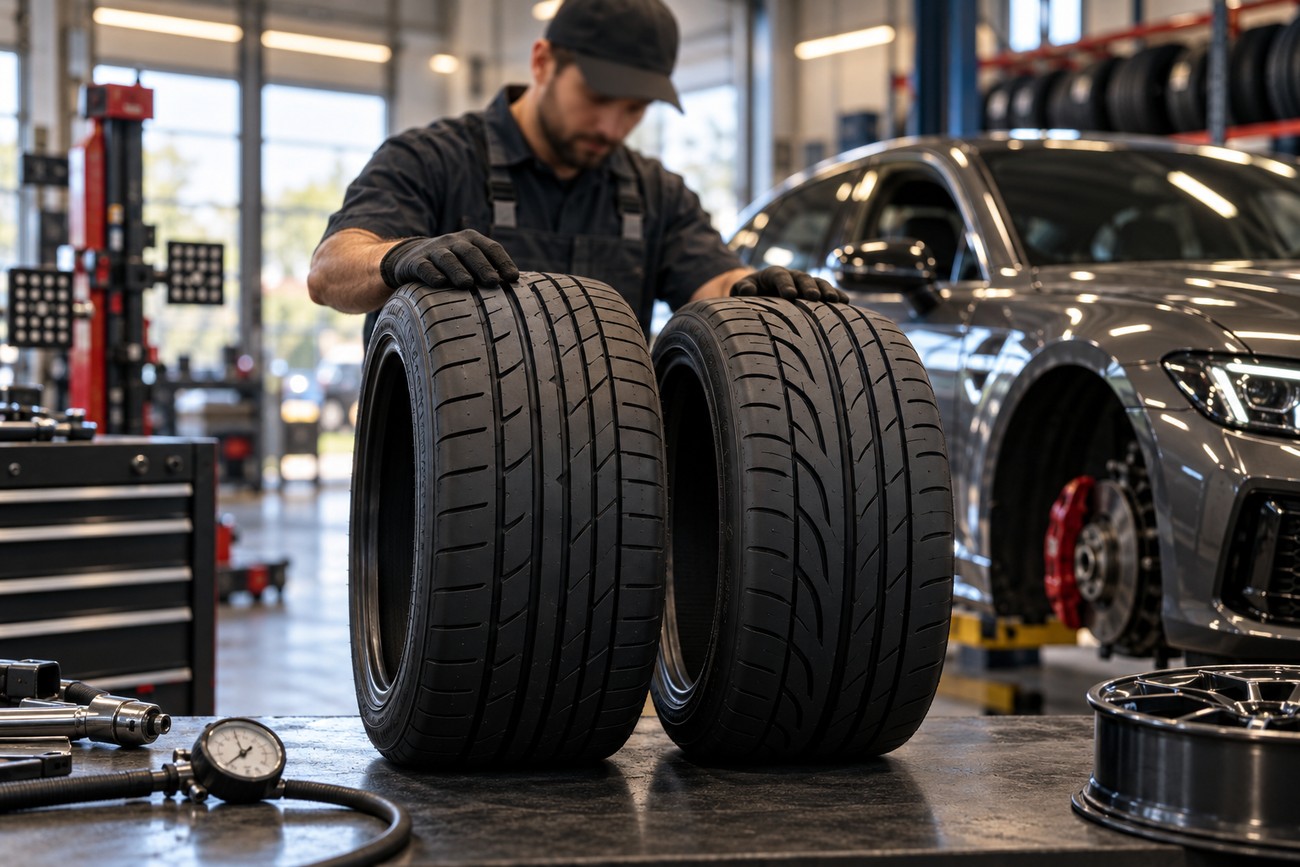
Choose P Zero or PZ4 when steering precision, fast-road stability, and a firm response are high priorities. It can suit drivers who spend substantial time on highways or enjoy accurate dry-road handling. Correct alignment and pressure are essential, particularly if the car has aggressive camber or the roads are rough.
Eagle F1 Asymmetric is a strong candidate for drivers who value wet-road confidence and a more compliant ride. The older Asymmetric 3/5 results more often favor wet braking and stability, while the softer carcass feel may suit urban driving. Drivers who expect very high-speed precision may prefer a firmer alternative, depending on the vehicle and exact specification.
Neither choice automatically solves the needs of a heavy vehicle or poor roads. Check the load index, inspect the sidewall design, and consider the impact environment before prioritizing ride comfort. If the car already has a factory-approved P Zero fitment, retaining that specification may preserve the vehicle’s intended balance, though it still does not guarantee the best result for every driver.
Shortlist the correct size, load index, speed rating, and OEM specification first, then use a same-size test of comparable generations where one is available. Family reputation is a useful starting point; exact evidence is the better final filter.
Frequently asked questions
The questions below focus on the newer Asymmetric 6 and PZ5. Results from older generations offer context, but they cannot settle a comparison between these two models. Likewise, mileage reported across a wider tire family is not an average for the Asymmetric 6.
Which is better: Goodyear Eagle F1 Asymmetric 6 or Pirelli P Zero PZ5?
There is no defensible universal winner without a directly comparable test. The comparison should use the same tire size, load and speed ratings, vehicle, test conditions, and specification, because older Eagle F1 Asymmetric and P Zero results cannot establish a PZ5-versus-Asymmetric 6 result.
Use the test outcome that matches your priority: wet braking and stability, steering response, noise, or rolling resistance. If no equivalent test exists, select the tire that matches the vehicle’s approved fitment and your road conditions rather than extending older family-level conclusions.
What is the average lifespan of a Goodyear Eagle F1 Asymmetric 6 tire?
A reliable generation-specific average or manufacturer lifespan guarantee is not available from the evidence discussed here. Owner reports across the wider families range roughly from 20,000 to 50,000 km under different conditions, but that span is not an average for this model.
Assess the actual set through tread depth, evenness of wear, visible damage, age, and wet-weather performance. Uneven shoulders or rapid wear should prompt an alignment and pressure check before you judge the tire’s durability.