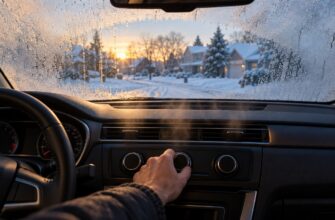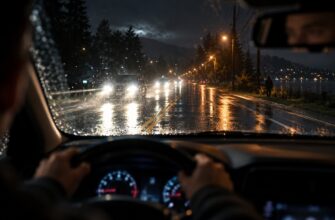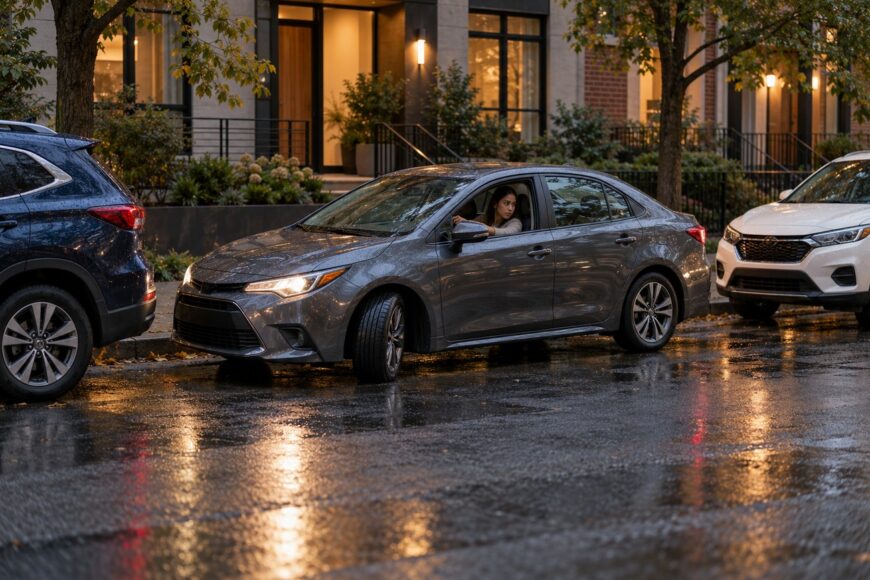
A tight parallel-parking space becomes harder when traffic is waiting behind you, visibility is poor, and another car is close enough to make every steering input feel risky. Rain, darkness, a dirty rear camera, or an uneven curb can remove the visual cues you expected to use. Pressure from drivers behind often makes people rush precisely when slow control matters most.
Parallel parking is a repeatable sequence of reference points and small corrections, rather than a test of instinct. You use the curb, neighboring vehicles, mirror lines, and the position of your rear wheel to judge the car’s path. A reliable skill usually takes practice; a promise that anyone can master it in ten minutes is not realistic.
- What Makes Parallel Parking Difficult—and What Good Looks Like
- Set Up the Car Before You Reverse
- A Repeatable Manual Parallel-Parking Sequence
- How to Correct a Tight or Uneven Parking Attempt
- Cameras, Sensors, and Automatic Parking: Useful but Limited
- Common Mistakes That Cause Scrapes and Bad Positioning
- Build the Skill in Real Traffic Without Panic
- Frequently asked questions
- What is the easiest way to parallel park a car for beginners?
- What are the 3 R’s of parallel parking?
- What is the 1-2-1 method of parallel parking?
- When should I stop using automatic parking and park manually?
What Makes Parallel Parking Difficult—and What Good Looks Like
Low-speed maneuvers still produce many minor contacts because the car changes direction in a confined space while the driver must monitor several edges at once. The brief cites approximately 10–15% of urban crashes as low-speed parking-related incidents in US/EU insurance and police data. Even a small steering error can bring a bumper, wheel, mirror, or door into contact with another vehicle.
Vehicle size and shape change the sight lines. A long hood, a high seating position, a wide rear quarter, or a small rear window can make the same parking space feel completely different. Rain, darkness, glare, snow, and poorly marked curbs further reduce the accuracy of visual judgments, while a queue of traffic can encourage hurried movements.
Parallel parking is included in driving tests in most countries, so exam guidance often gives drivers a useful framework. Common exam guidance allows approximately 30–50 cm of clearance from neighboring vehicles, although the exact assessment standard varies. Many local regulations require at least 30 cm from the curb and prohibit crossing parking lines; exact rules vary by jurisdiction.
A good finish leaves the vehicle legally positioned, clear of neighboring cars, reasonably close to the curb, and ready to leave without an awkward first move. It does not require one exact steering pattern for every car or street. The space, wheelbase, steering lock, curb shape, and surrounding traffic all affect the final adjustments.
Set Up the Car Before You Reverse
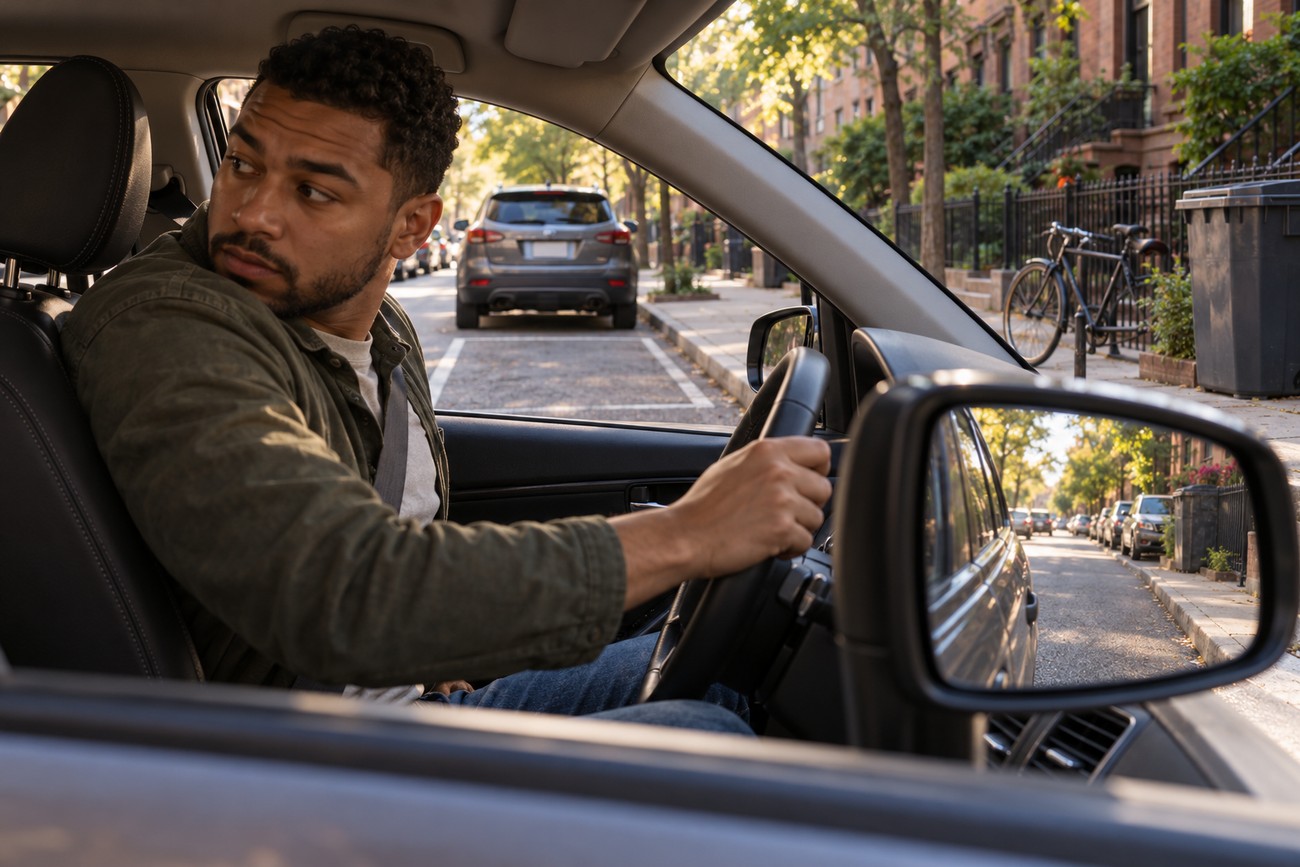
Read the space while approaching it. Check whether the vehicle ahead is parked straight, whether the curb continues evenly, and whether a post, bicycle, rubbish container, or pedestrian could affect the reversing path. Signal early, check mirrors and blind spots, and make sure traffic and pedestrians are clear before selecting reverse.
Adjust the seat and mirrors before the maneuver begins. Seat position and mirror adjustment can substantially change your perception of vehicle width, so a position that feels familiar on an open road may be unhelpful in a narrow street. Your mirrors should show the nearby vehicle sides and curb area without requiring you to lean or twist.
Defensive-driving and driving-school methods commonly use an entry angle of approximately 45 degrees. This angle gives the rear of the car room to enter while allowing the front end to swing away from the vehicle ahead. It is a useful starting point, not a rigid requirement for every car or parking space.
Choose a repeatable reference point for beginning the first steering input. Schools use different start markers, but they agree that a repeatable reference point is better than moving back by feel. The marker may relate to a mirror line, a neighboring car, or the rear-wheel position; learn how it looks from your normal driving position and adapt it to the vehicle you are driving.
A Repeatable Manual Parallel-Parking Sequence
Stop alongside the vehicle in front of the space with enough lateral clearance to begin reversing safely. Select reverse, scan all sides again, and release the brake gradually so the car moves at walking speed or slower. Turn into the space using your chosen reference, while checking the curb-side mirror and the front corner of your car.
As the rear of the vehicle clears the front car, begin bringing the steering back toward center. Watch the neighboring car, the curb, and the line of your mirrors together. The rear wheel is especially useful because it shows where the car is pivoting toward the curb, while the front end needs separate attention as it swings outward.
Once the front of your car has cleared the vehicle ahead, steer toward the curb to bring the rear into position. Keep the movement slow and stop if any reference becomes unclear. Finish centered in the space, with enough room for neighboring vehicles to open doors and leave safely.
One bumper point rarely describes the whole car’s path. A short set of rear-wheel, mirror-line, curb, and neighboring-car references remains useful across different vehicles because it shows both where the car is going and what may swing into danger.
Use controlled corrections rather than holding full steering lock through a long reverse. Micro-movements of approximately 10–20 cm are safer than long, uninterrupted reverses with full steering lock, especially when the curb is uneven or the space is tight. Before moving forward or changing direction, straighten or reset the steering wheel so the car does not suddenly cut across an adjacent vehicle or line.
How to Correct a Tight or Uneven Parking Attempt
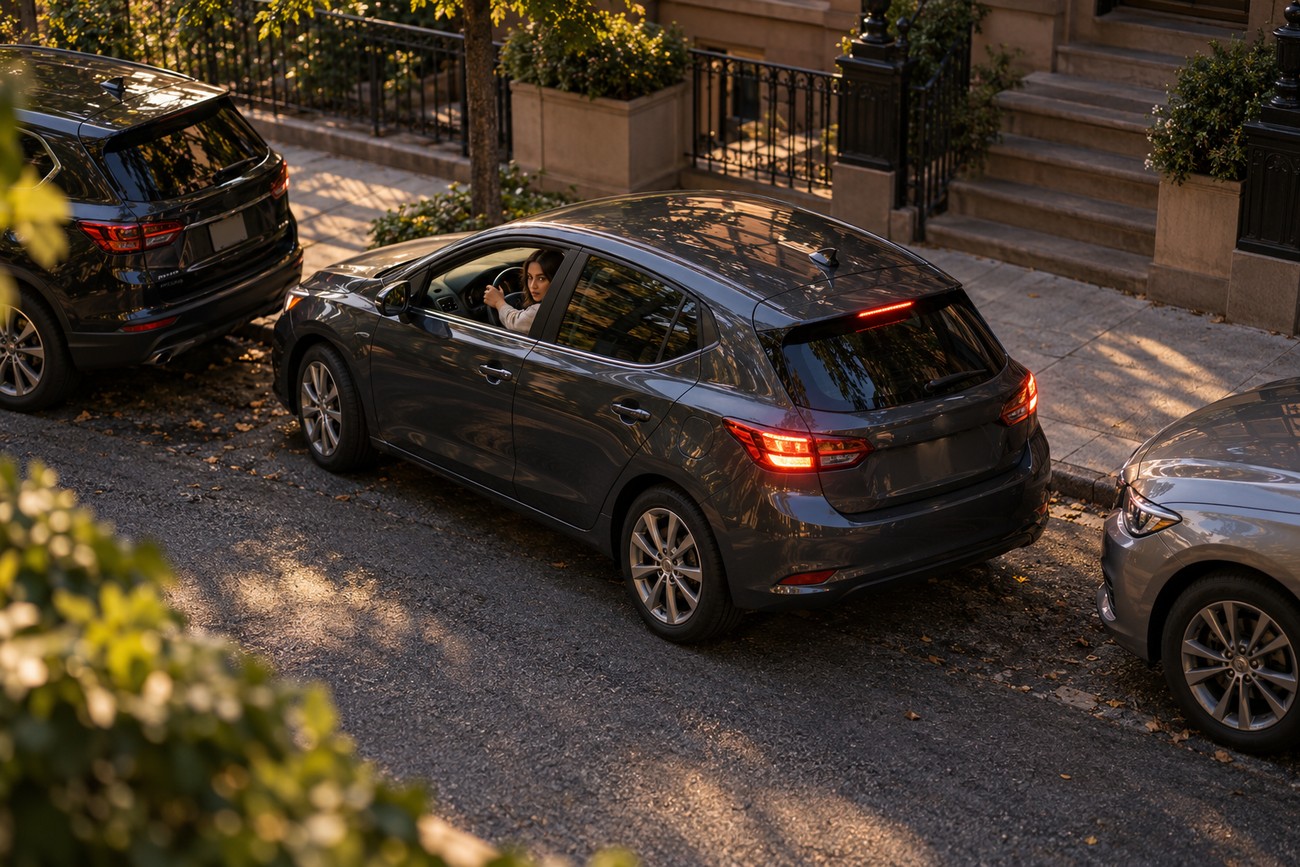
One or more corrections are normal, particularly in a short or irregular space. Trying to complete the maneuver in one movement is a common cause of poor alignment because the driver keeps following an increasingly inaccurate path. Stop, apply the brake, and reassess the front, rear, curb side, and traffic side before deciding what to do next.
If the car is too far from the curb, straighten the wheels before making a short reverse or forward adjustment. If the rear is too close, move forward slightly with the wheels reset, then change the angle gradually. Small 10–20 cm adjustments provide more control than a single long correction and make it easier to detect a changing gap.
A driver waiting behind you may sound impatient, but a horn does not improve visibility or shorten the car. Safety takes priority over completing the maneuver in one movement. If the space has become unsafe because of a pedestrian, cyclist, approaching vehicle, or unexpected obstacle, pause and let the situation clear.
Abandoning a bad space is also a valid decision. Pull out carefully, drive around the block if necessary, and choose a wider or better-lit space. Driving-school statistics in the brief suggest approximately 5–10 guided repetitions are commonly needed for stable performance without prompts, so an imperfect attempt is part of learning rather than evidence that you cannot park.
Cameras, Sensors, and Automatic Parking: Useful but Limited
Cameras and parking sensors are valuable aids when used with mirrors and direct observation. They are associated with a 30–50% reduction in contact probability, but they do not eliminate contact. The rear camera shows a limited field of view, while sensors may indicate distance without explaining the vehicle’s full side-to-side trajectory.
Inspect the equipment before relying on it. Cameras and sensors become less reliable when dirty, fogged, snowy, or iced, which often happens during the same weather that makes curb and line visibility difficult. Sensors may also miss very low or thin obstacles such as curbs, posts, bicycles, or small objects.
Automatic parking is designed around expected conditions and can struggle with narrow spaces, slopes, irregular curbs, rubbish, or vehicles parked at unusual angles. Consumer tests in the brief found automatic parking errors or aborted maneuvers in approximately 10–25% of cases, especially in narrow spaces. False alerts can be distracting, while a quiet sensor does not prove that every area is clear.
Take over manually when the system aborts a scan, the camera view is unclear, the space is irregular, or pedestrians and traffic change around the car. Stop first, select the appropriate gear only after checking all sides, and use the same slow, reference-based method as you would without assistance. Treat the system as an extra source of information, not as permission to stop looking.
Common Mistakes That Cause Scrapes and Bad Positioning
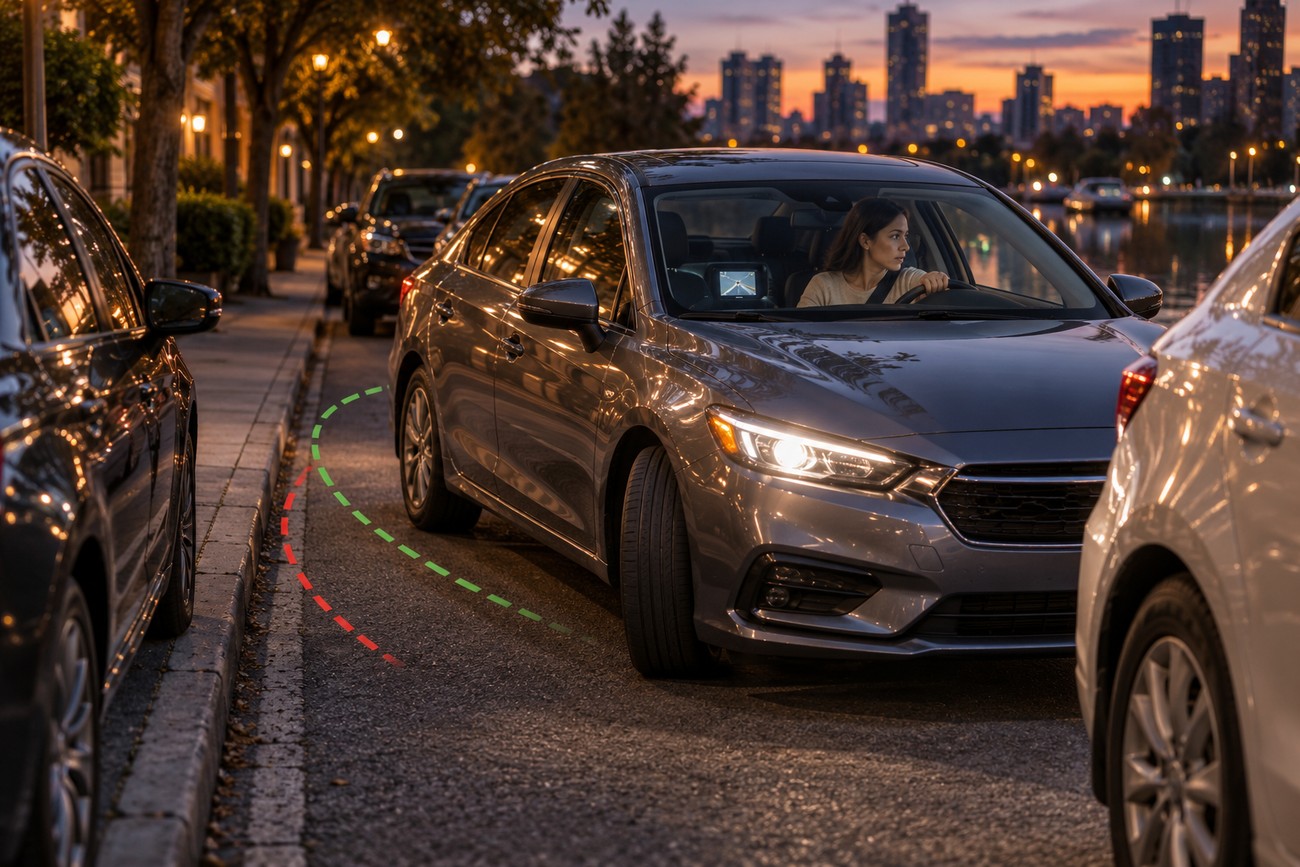
Turning too early can bring the rear wheel toward the curb before the front of the car has cleared the neighboring vehicle. Turning too late can leave the vehicle far from the curb or force a sharp correction in limited space. A shallow initial angle can create the same problem because the car enters without enough lateral movement.
Depending only on the rear camera reduces awareness of side clearances. Look at both mirrors, scan over your shoulder where appropriate, and monitor the front corner as it swings. The camera can help confirm the rear path, but it cannot replace a complete view of the vehicle’s surroundings.
Check the final position against the markings and the available exits. Parking beyond the markings can obstruct neighboring spaces or vehicle exits, even if the car appears clear of the curb. Leave the wheels straight before changing direction; a steering wheel left turned can make the vehicle cut unexpectedly into a neighboring car or traffic lane.
Instructional videos often show a straight curb, clear markings, plenty of space, and no one waiting behind. Real streets may contain crooked cars, trucks, rubbish, poor visibility, rain, darkness, uneven curbs, or ice. The correct response is to slow down, update the plan, and use more than one visual reference.
Build the Skill in Real Traffic Without Panic
Begin in a quiet, wide space where you can practice stopping and checking without pressure. Repeat the same reference sequence until you can describe what you are looking for before selecting reverse. Review the final position each time: distance from the curb, clearance from other vehicles, alignment within the markings, and the direction of the wheels.
Then vary one factor at a time. Practice with different vehicle sizes, shorter spaces, mild slopes, darkness, rain, and uneven surfaces. Most learners need approximately 5–10 repetitions with an instructor or equivalent guided practice for stable performance, so regular repetition is more useful than one long session followed by weeks without practice.
Use a calm verbal checklist before reversing: signal, mirrors, blind spots, pedestrians, space, reference point, and slow movement. If traffic builds behind you, keep the checklist and reduce speed rather than trying to satisfy the queue with a rushed maneuver. A driver who pauses safely is easier for others to predict.
Real streets sometimes require a change of plan. Parallel parking may need to be combined with diagonal parking or another approach when the curb, markings, traffic, or available space changes. A ten-minute promise is not a reliable expectation for a lasting skill; confidence comes from repeating the process under gradually less ideal conditions.
Frequently asked questions
Parallel parking becomes easier when you use repeatable reference points, slow movements, and deliberate checks. The questions below address beginner methods, common mnemonics, and the limits of automatic parking. If visibility or clearance becomes uncertain, stop and reassess before continuing.
What is the easiest way to parallel park a car for beginners?
The easiest starting point is a quiet, wide space with a clear curb, no nearby pedestrians, and enough room to correct without touching another vehicle. Before reversing, say a short checklist aloud: signal, mirrors, blind spots, space, reference point, slow speed, and stop if visibility changes.
Choose one vehicle and repeat the same reference sequence several times before changing cars or conditions. This builds a consistent visual memory without treating one bumper position as a universal rule. Move to ordinary urban streets only after you can stop, reassess, and correct calmly.
What are the 3 R’s of parallel parking?
The 3 R’s is a non-standard teaching mnemonic; instructors may assign different words to it. Some versions use terms related to position, reverse, and straighten, while others describe steering stages or observation checks. It should therefore be treated as a memory aid, not a universal technical standard.
Use the words only if they help you remember the actual checks: set up safely, reverse under control, observe the curb and surrounding vehicles, and reset the steering before changing direction. The vehicle’s size and steering range matter more than matching a particular instructor’s wording.
What is the 1-2-1 method of parallel parking?
The 1-2-1 method is an informal label for a staged parallel-parking sequence. Its exact steering interpretation varies between vehicles and instructors; “one,” “two,” and “one” may refer to steering stages, reference points, or movements rather than fixed turns of the wheel.
Use the label only alongside visible cues. Confirm the rear-wheel position, mirror line, curb, and neighboring-car clearance, then straighten the wheels before moving in the opposite direction. This prevents the mnemonic from overriding what the car is actually doing.
When should I stop using automatic parking and park manually?
Park manually when the system aborts its scan, the camera view is dirty or unclear, the space is narrow or irregular, the road slopes, or pedestrians and traffic are changing around the vehicle. A gap in the sensor display or an unexpected alert is a reason to stop and reassess, not to continue automatically.
Automatic parking remains fallible, with approximately 10–25% error or interruption rates in the cited consumer tests. Stop the vehicle, check all sides, and take over at walking speed using mirrors, direct observation, and small corrections. If the space still does not provide clear margins, leave it and choose another one.