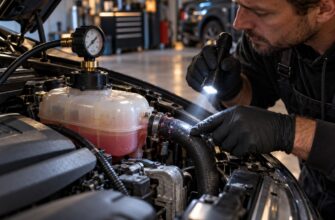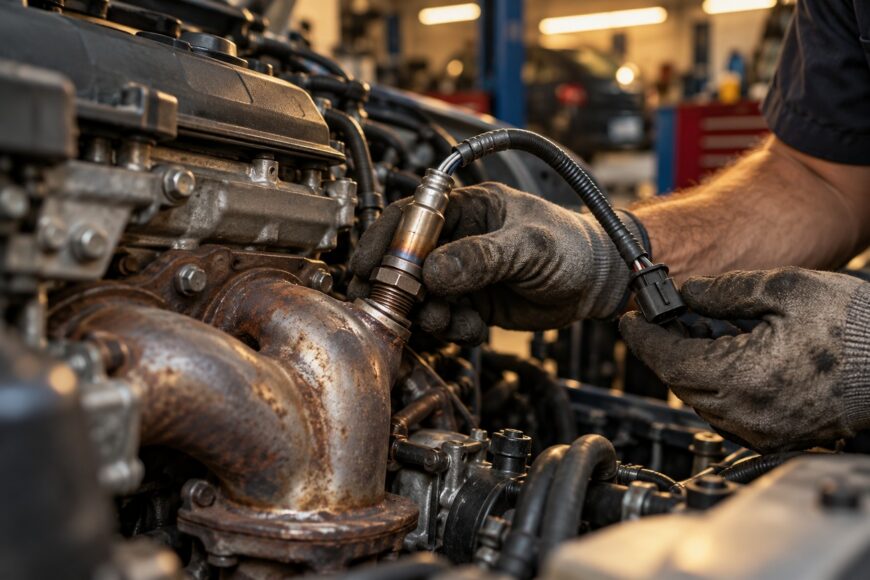
A rising fuel bill, weaker response, or a fuel smell from the exhaust can appear while the car still seems perfectly driveable. A degrading oxygen sensor is one possible cause, especially when its response becomes slow rather than stopping completely. The ECU may continue correcting the mixture, yet it receives delayed information and spends more time operating away from the most efficient target.
Replacing the sensor blindly wastes money when the real fault is an intake leak, wiring problem, injector issue, or exhaust leak. Ignoring a mixture fault wastes fuel and can overheat the catalytic converter. The useful approach is to confirm what the sensor is reporting, compare that information with fuel-trim and engine data, then verify the repair with repeatable fuel measurements.
- How an Oxygen Sensor Affects Fuel Economy
- Symptoms and the Real Fuel Economy Penalty
- How to Diagnose the Sensor Before Replacing It
- What Causes Oxygen Sensors to Fail Early?
- Mistakes That Keep Fuel Use High
- What to Check After Replacement
- Frequently asked questions
- Why is my car suddenly getting terrible gas mileage?
- When is poor fuel economy probably not caused by the oxygen sensor?
How an Oxygen Sensor Affects Fuel Economy
A gasoline engine needs an air-to-fuel ratio of approximately 14.7:1 for the stoichiometric target. At that point, the combustion mixture gives the catalytic converter a suitable balance of oxygen and fuel to control emissions efficiently. The oxygen sensor measures oxygen content in the exhaust and supplies feedback that helps the ECU keep the gasoline mixture near this target in closed loop.
The front oxygen sensor has the primary mixture-control role. A healthy narrowband sensor switches rapidly as the mixture moves slightly rich and slightly lean, allowing the ECU to add or remove fuel in small corrections. Its signal is commonly around 0.1–0.9 V, although the important diagnostic feature is fast, consistent response rather than a single voltage reading.
During cold starts, heavy acceleration, and some high-load conditions, the ECU deliberately uses open-loop calculations based on programmed maps and other sensors. If the oxygen sensor fails, most ECUs use a richer preset map in open loop. That strategy can provide a safety margin for the engine under uncertain conditions while increasing fuel consumption during ordinary driving.
The sensor is one part of a larger control system. Incorrect fuel pressure, restricted injectors, unmetered air, a leaking exhaust, poor coolant-temperature information, or an ECU fault can produce the same mixture symptoms. Fuel economy depends on the quality of the complete feedback system, so a sensor-related code identifies a direction for testing rather than proving that the sensor itself is defective.
Symptoms and the Real Fuel Economy Penalty
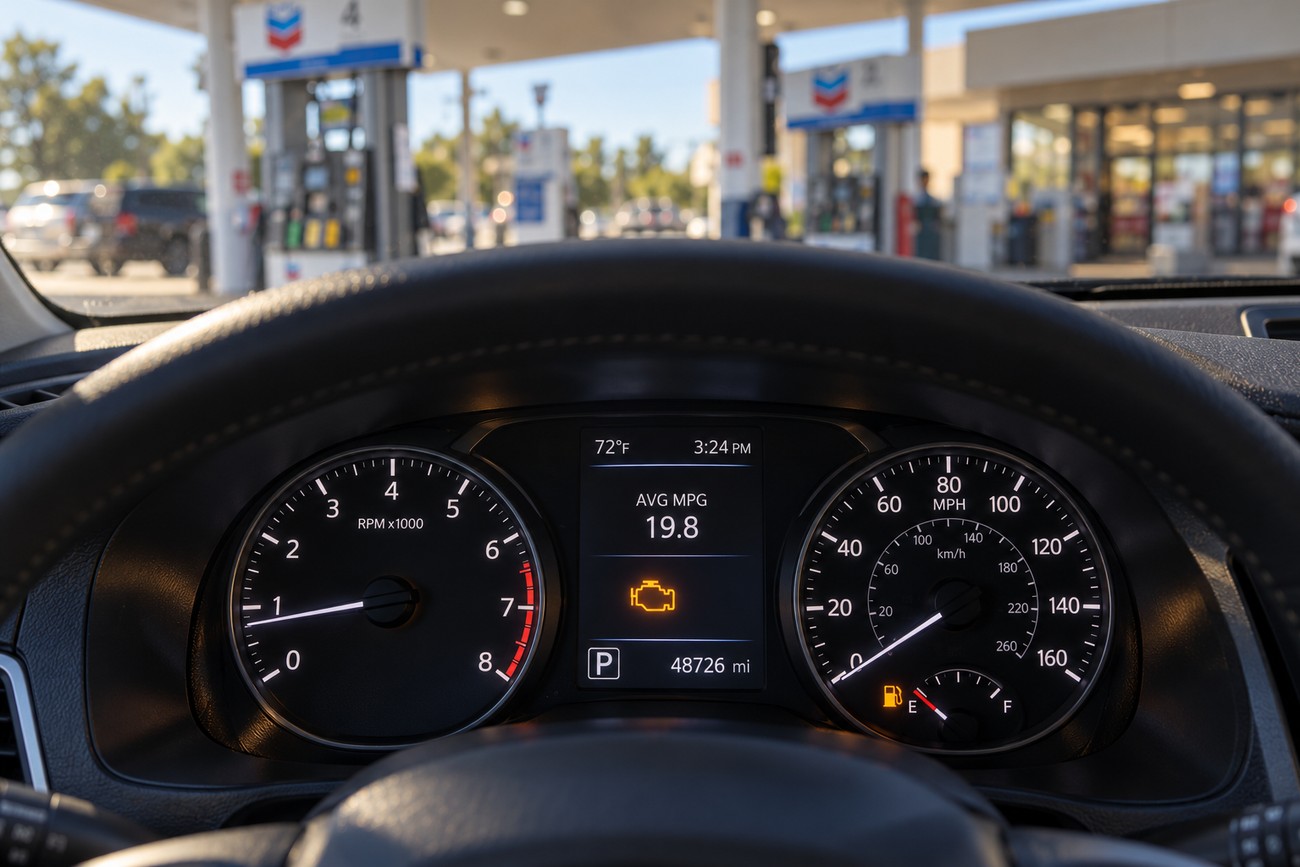
The most familiar sign is a sudden increase in fuel use: the vehicle needs refueling sooner, acceleration feels weaker, or the idle becomes unstable. A rich mixture may also produce a fuel smell, darker-than-usual exhaust, or a noticeable change in engine behavior. These symptoms become more meaningful when they appear together with a Check Engine light or a mixture-related fault code.
A failed oxygen sensor commonly causes fuel economy to fall by about 10–20% or more in real-world cases. Claims of a 50% increase from the oxygen sensor alone are usually exaggerated; a much larger change generally points to additional faults, such as a leaking injector, incorrect fuel pressure, severe air leakage, or a restricted catalytic converter.
Sensor degradation often starts with slow response. The sensor still produces a plausible signal, so the ECU may not immediately log a clear sensor failure. Delayed switching makes fuel corrections less precise, which can create a small but persistent increase in consumption before the warning light appears.
Normal drivability does not prove that the sensor is healthy. Modern ECUs can compensate for a gradual loss of accuracy, and many drivers adapt to weaker response without noticing the change. On turbocharged engines and engines with variable valve timing, the effect can be even harder to identify by feel because several control systems influence torque and fuel use at the same time.
How to Diagnose the Sensor Before Replacing It
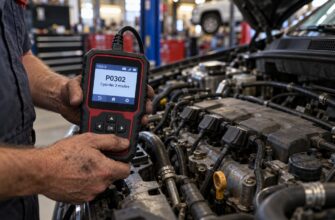
Start with a complete scan, including stored, pending, and manufacturer-specific codes. Check live data after the engine reaches operating temperature, then compare the front sensor’s switching behavior with short- and long-term fuel corrections. A narrowband sensor typically moves between approximately 0.1 and 0.9 V, and its response should be fast enough for the ECU to correct the mixture without long delays.
Electrical checks come next. Inspect the sensor connector, wiring near the exhaust, heater-circuit power and ground, and any damage caused by heat or contact with the road. Test for intake leaks, exhaust leaks ahead of the sensor, fuel-pressure problems, injector faults, and inaccurate coolant-temperature information. Each of these can make a good sensor appear to report an incorrect mixture.
Sensor switching speed becomes meaningful only beside fuel-trim behavior, wiring integrity, and leak checks. Condemning the sensor from one mixture code often replaces a symptom while leaving the cause in the engine.
The front sensor provides primary feedback for closed-loop mixture control. The rear sensor primarily monitors catalyst performance and does not directly control the mixture on most systems. A rear-sensor fault can still complicate diagnosis, expose a damaged catalyst, or influence the ECU’s monitoring strategy, so it should not automatically be treated as the cause of poor fuel economy.
Finally, assess the catalytic converter and ECU plausibility. A restricted converter can cause poor acceleration and increased fuel use, while an ECU or reference-voltage fault can distort sensor readings. The correct repair follows the evidence from signal behavior, fuel corrections, wiring, air and fuel tests, and exhaust condition.
What Causes Oxygen Sensors to Fail Early?
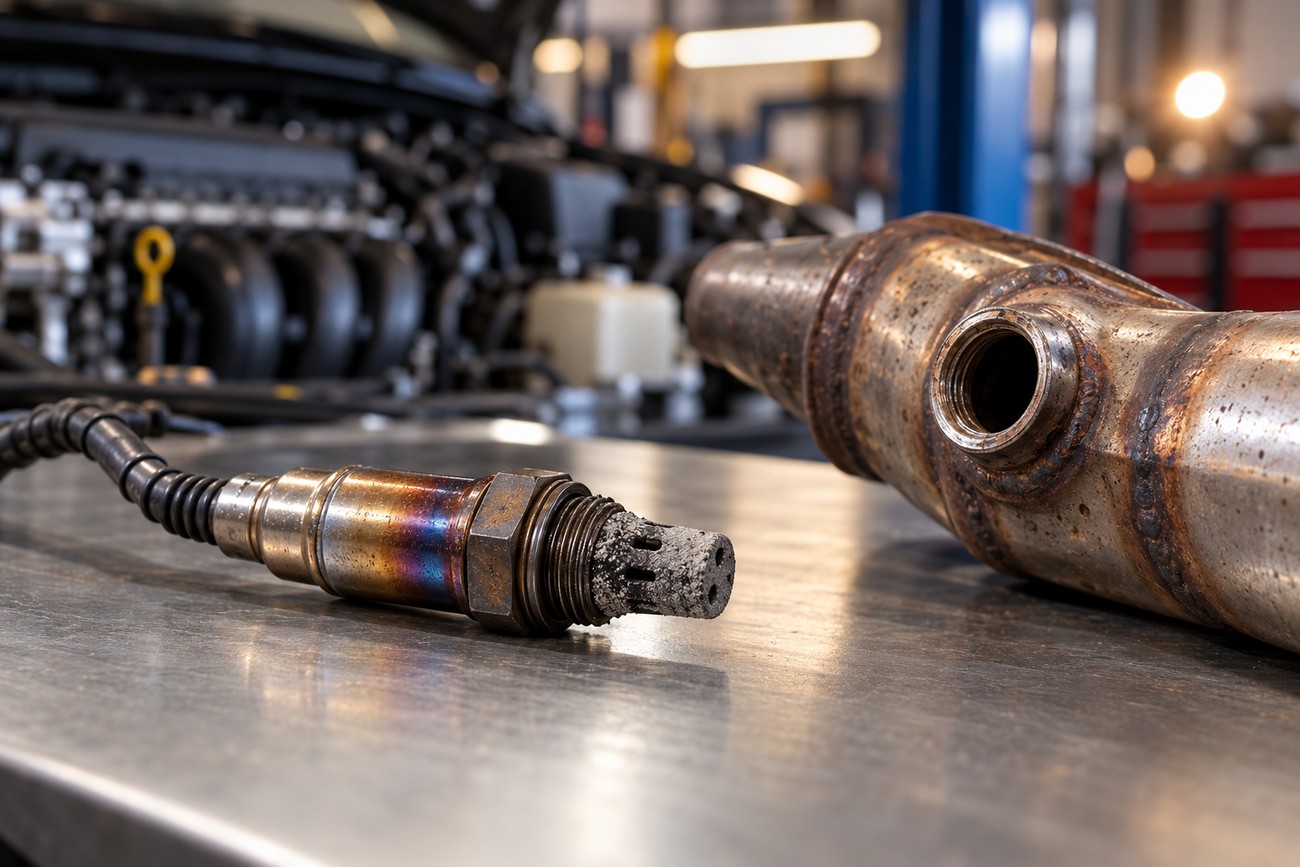
Oxygen sensors live in a harsh thermal environment. Repeated heat cycling, overheating, physical impact, and contamination can damage the sensing element or its heater. Lead in fuel is especially harmful, while oil ash from engine oil consumption and sustained rich running can coat the sensor and slow its response.
Short trips create an unfavorable thermal pattern because the exhaust may spend much of its time warming up rather than reaching a stable operating temperature. Poor cooling-system operation can also alter the exhaust temperature and mixture strategy. A sensor exposed to those conditions may age sooner than one used regularly at a steady operating temperature.
Real-world service-life claims often range from 20,000 to 80,000 km. Some manufacturers and service providers describe oxygen sensors as lasting for the vehicle’s service life. Neither statement creates a universal replacement interval: actual life depends on fuel quality, oil consumption, engine condition, heat exposure, and electrical integrity.
Repeated sensor failure deserves a cause investigation. Installing another sensor without correcting oil burning, rich running, contaminated fuel, damaged wiring, or an ECU fault can produce a temporary improvement followed by the same fuel-economy problem. A sensor is often the victim of an engine fault rather than its source.
Mistakes That Keep Fuel Use High
Ignoring the Check Engine light is the costliest common mistake. OBD systems are designed to monitor oxygen sensors and catalyst efficiency, and they usually illuminate the warning when a fault is detected. Driving for months with a mixture-related fault can allow excess fuel use to continue while unburned fuel overheats the catalytic converter.
Replacing the sensor without testing creates a second problem: the new part may show the same symptoms because the cause remains elsewhere. A mixture code can result from an intake leak, fuel-delivery fault, exhaust leak, wiring defect, or ECU issue. Testing before replacement is usually cheaper than repeatedly installing parts that cannot correct the original fault.
Cheap or incorrectly matched universal sensors can respond too slowly or have unstable long-term signal behavior. Connector compatibility alone does not guarantee the correct sensing characteristics. The replacement should match the vehicle’s application and wiring requirements, and the installation should keep the harness away from exhaust heat.
Disabling the sensor, programming the ECU to ignore it, or fitting an electronic workaround commonly leaves the engine using richer open-loop maps. That may remove a warning from the dashboard while increasing fuel use and catalyst risk. Dashboard fuel-economy displays also need careful interpretation: confirm any improvement with repeatable real-fuel measurements taken over comparable driving conditions.
What to Check After Replacement
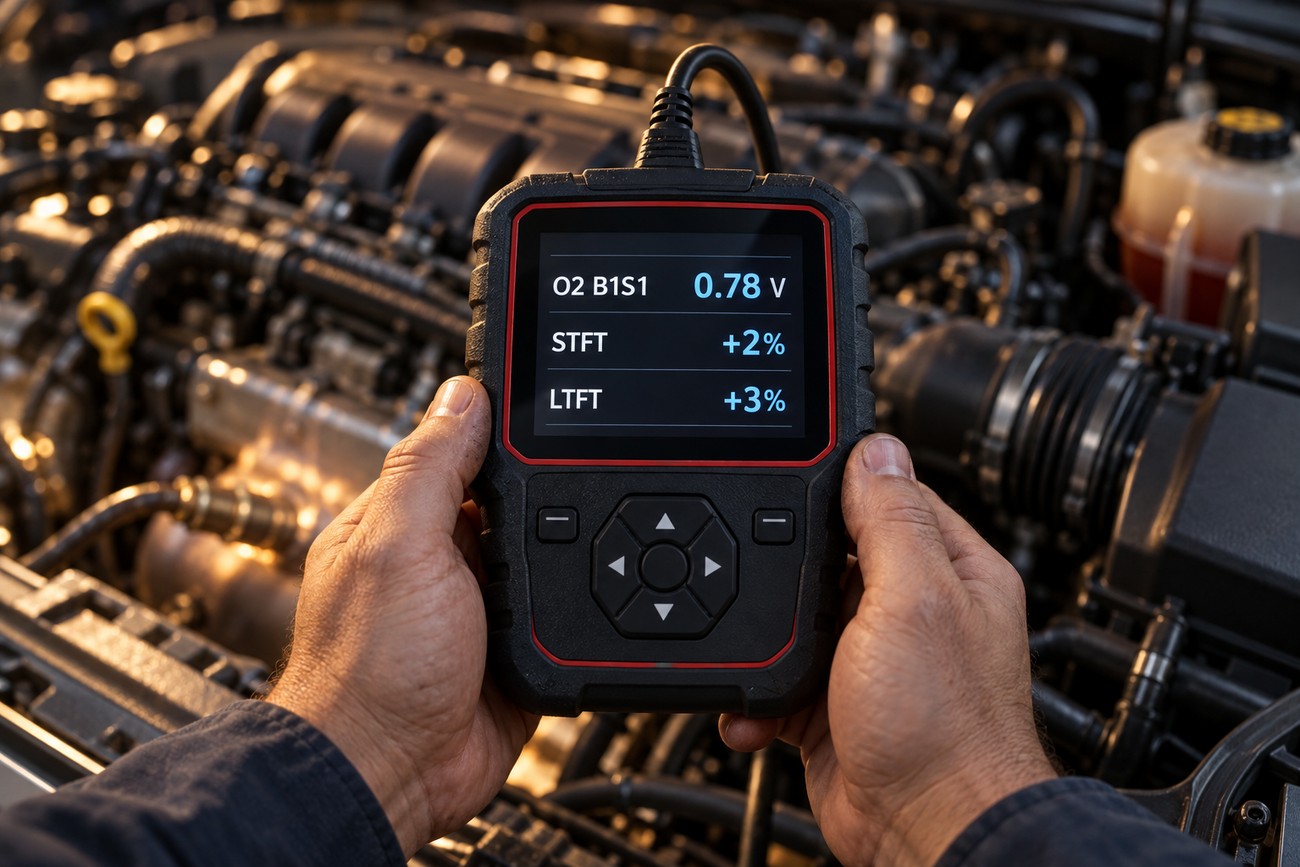
A repair is confirmed through evidence, not the disappearance of a warning light alone. Follow the vehicle’s procedure for clearing codes and completing any required drive cycle, then recheck fault status. Review sensor behavior, fuel-trim or mixture data, and heater operation after the engine reaches normal temperature.
Inspect the catalytic converter if the engine has been running rich. Excess fuel can overheat and melt the ceramic, restricting exhaust flow and increasing repair costs. A restricted converter can also make the vehicle feel weak after the original sensor fault has been corrected, creating the impression that the replacement failed.
Measure fuel use with the same method before and after the repair. Fill the tank consistently, record distance, and compare several similar trips rather than trusting an instantaneous or short-term dashboard estimate. Weather, traffic, cargo, tire pressure, and driving pattern can easily hide a modest improvement.
A replacement sensor can fail again if contamination, oil consumption, wiring damage, or rich running remains. Prevention therefore means prompt diagnosis of warning lights and mixture symptoms, together with correction of the condition that damaged the sensor. Automatic replacement at a fixed mileage is less reliable than condition-based testing.
Frequently asked questions
Fuel-economy changes can have several causes, and an oxygen sensor is only one part of the feedback system. Comparing the sensor’s signal with fuel-trim data helps separate it from intake, fuel, exhaust, brake, or tire problems. The checks below focus on deciding whether the sensor is actually responsible.
Why is my car suddenly getting terrible gas mileage?
Check the oxygen-sensor system, tire pressure, dragging brakes, fuel leaks, seasonal temperature changes, thermostat operation, and recent changes in driving pattern. A fuel leak or brake drag can waste fuel without producing a mixture code, while a thermostat that keeps the engine too cool can maintain an inefficient warm-up strategy.
Use a sensible order: confirm the fuel consumption with real refueling records, inspect for safety-related leaks, check tires and brake temperatures, scan for codes, and then review live engine data. A sudden, large change deserves broader testing because the oxygen sensor alone does not explain every fuel-economy loss.
When is poor fuel economy probably not caused by the oxygen sensor?
The sensor is less likely to be the main cause when its signal switches correctly and fuel corrections point to a separate fault. An injector problem, vacuum leak, incorrect fuel pressure, thermostat issue, low tire pressure, or dragging brake can make the ECU report a real mixture problem while the sensor is accurately describing it.
Sensor replacement is also unlikely to solve the issue when fuel use changed after a repair, tire change, cooling-system fault, or brake problem. A persistent rich-running condition should be investigated promptly because it can damage the catalytic converter as well as increase fuel cost. Clearing the warning light does not prove that the underlying fault has been fixed.