Choosing an oil filter means considering oil flow, valve calibration, filtration efficiency, and physical quality. The brand name or a small micron figure tells only part of the story. A filter must pass enough oil during cold starts and at high engine speed, hold contamination without collapsing into bypass, and seal reliably against the engine.
The practical failures are familiar: a leak appears after installation, oil pressure arrives late on a cold start, a diesel or turbocharged engine sounds noisy, or a low-quality housing deforms under pressure. These symptoms can arise from a poor gasket, incorrect valve design, weak media support, or a filter that was never catalog-matched to the engine.
Quality therefore belongs to the complete filter-and-engine system. A premium label cannot correct the wrong bypass setting, and the finest stated filtration rating is unhelpful if excessive restriction keeps oil flowing around the element.
- How Oil Filter Types Control Oil Flow
- Oil Filter Types and Quality: At-a-Glance Comparison
- What Separates a Quality Oil Filter from a Cheap One
- How to Match an Oil Filter to Your Engine
- Failure Symptoms and the Hidden Weak Points
- Replacement Intervals, Installation, and the OEM Debate
- Frequently asked questions
- What oil filter brand is considered the best?
- What oil filters should I stay away from?
How Oil Filter Types Control Oil Flow
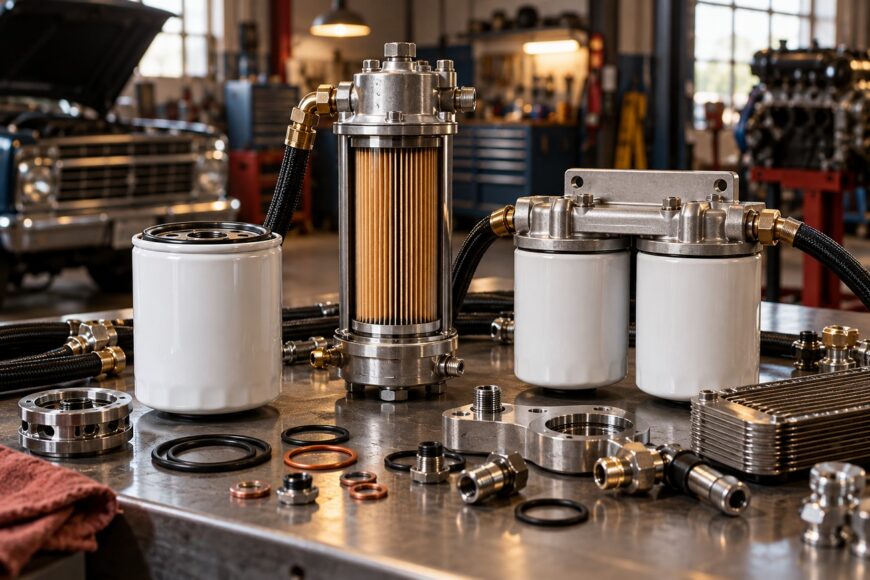
Full-flow filtration is the standard arrangement in passenger vehicles. All or nearly all oil delivered to the engine’s main lubrication circuit passes through the filter before reaching bearings, camshafts, turbocharger bearings, and other lubricated components. Because the filter sits directly in the supply path, it must balance particle removal with acceptable pressure drop.
A bypass filter works differently. It cleans a smaller portion of the oil at a time, often through finer media, while the engine continues receiving oil through the main lubrication circuit. This arrangement can provide very fine cleaning over repeated circulation, but a separate bypass filter cannot usually replace the full-flow filter in a conventional passenger-car system.
Dual or combo systems combine both functions. A full-flow stage protects the engine’s immediate oil supply, while a secondary bypass stage filters part of the oil more finely. Such systems are more common in specialized, heavy-duty, or modified applications than in ordinary factory passenger cars.
Nearly all production passenger-car engines use a full-flow filter with an integrated bypass valve. This valve is different from a bypass filter type: it is a safety route inside the full-flow filter that opens when the pressure difference across the filter becomes too high. The common opening range is 0.7–2.0 bar differential pressure, although the correct value is set by the engine or vehicle specification.
The bypass valve protects oil delivery when the element is restricted or the oil is cold and highly viscous. It also means that a filter marketed as “finer” is not automatically better. Excessive restriction can make the valve open more often, reducing the amount of oil that passes through the media.
An anti-drainback valve serves a separate purpose. It helps keep oil in the filter after the engine stops and is essential when the filter is mounted above the oil level or horizontally. A missing, stiff, leaking, or poorly shaped valve can contribute to delayed lubrication and noise during the next start.
Oil Filter Types and Quality: At-a-Glance Comparison
The table describes filtration-system types rather than ranking brands or individual filter quality. A well-made full-flow filter can be a better choice for a particular engine than an incorrectly selected bypass or combo arrangement.
| System type | Oil path | Purpose | Typical use | Strengths | Limitations |
|---|---|---|---|---|---|
| Full-flow | The engine’s normal oil supply passes through the filter element. | Remove contamination while maintaining oil delivery to the lubrication circuit. | Nearly all production passenger-car engines. | Simple, direct protection and immediate compatibility with the factory oil circuit. | Must balance filtration efficiency, dirt capacity, and pressure drop; restriction can activate the internal bypass valve. |
| Bypass | A smaller portion of oil is diverted through a finer secondary element. | Progressively clean the oil through repeated partial-flow circulation. | Specialized, heavy-duty, or supplementary filtration systems. | Can achieve fine filtration without placing the entire engine oil supply through restrictive media. | Does not normally provide the full-flow protection required by itself in a production passenger car. |
| Dual/combo | The main flow passes through a full-flow stage, with part of the oil also passing through a bypass stage. | Combine immediate full-flow protection with finer secondary cleaning. | Selected heavy-duty or specialized applications. | Provides two filtration functions within one system. | More complex, application-specific, and unsuitable for conversion without confirmed manufacturer approval. |
What Separates a Quality Oil Filter from a Cheap One
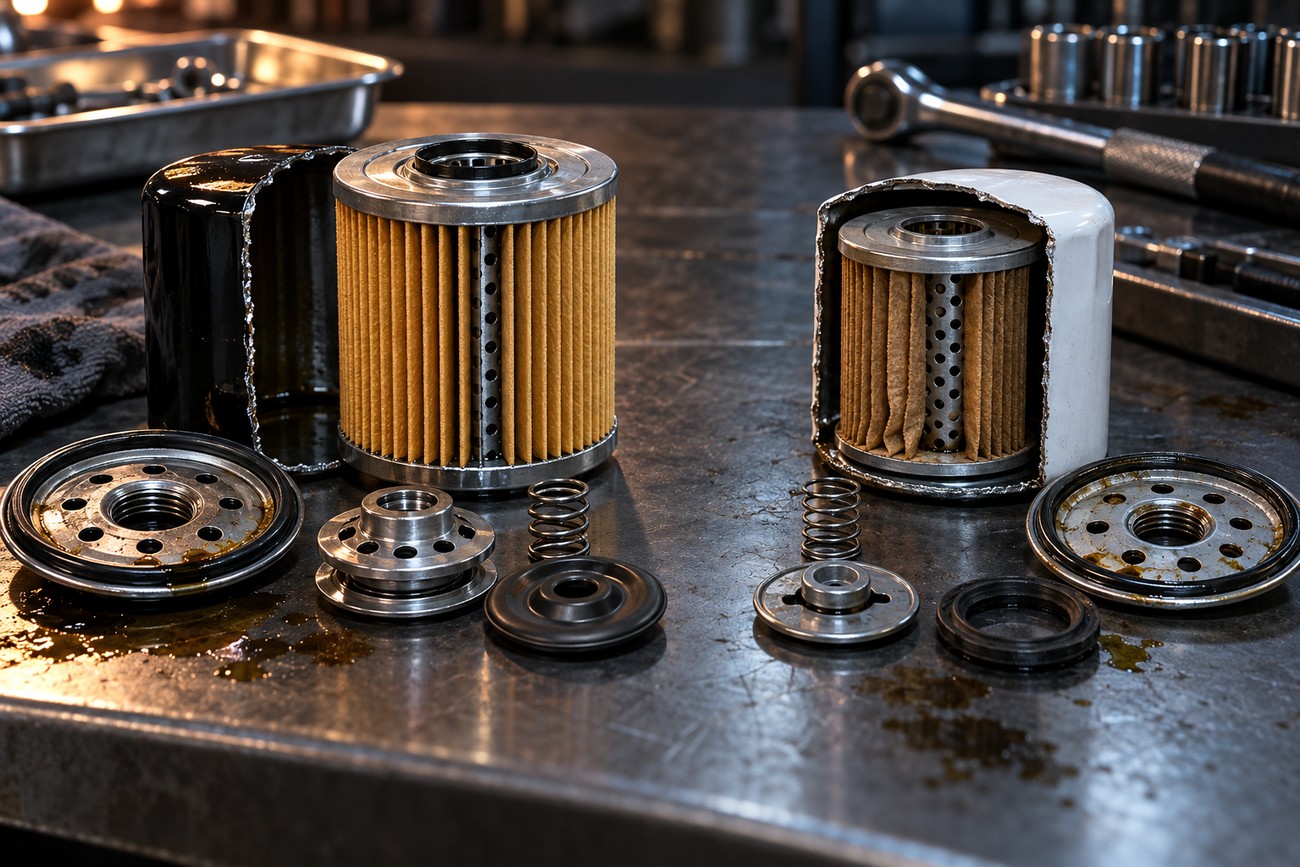
The filter element is the main point of difference. Basic filters commonly use cellulose media. Higher-grade filters may combine cellulose with synthetic materials such as glass fiber or polyester. The hybrid construction can provide lower pressure drop and longer service capacity at a similar level of filtration, although the result depends on the complete element design.
Published efficiency figures need careful reading. Quality automotive filters commonly claim 95–99% efficiency at 20–25 microns. Some premium product lines claim up to 99% at 15–20 microns, depending on the specific product line and test conditions. Those figures cannot be compared fairly if one manufacturer reports a different test method, particle concentration, flow rate, or efficiency definition.
Useful quality also depends on media area and dirt-holding capacity. A filter with more stable pleats can expose more media to the oil, reducing loading on each section. Cheap filters may use fewer pleats, a smaller element, or weak internal support, so the filter reaches high restriction sooner even if its initial paper appears acceptable.
Adhesive quality is easy to overlook because it is hidden inside the housing. The end caps must remain bonded, the pleats must stay supported, and the media must not deform under pressure or temperature changes. A failure in the adhesive or center tube can allow oil to bypass the element or leave the filter unable to maintain its designed shape.
Three references are particularly relevant when a manufacturer publishes test information: ISO 4548-12 for filtration efficiency, ISO 4548-1 for pressure drop and housing strength, and SAE J1858 for filter evaluation methodology. A label saying “high performance” provides little basis for comparison without a stated test method and a specific product application.
The housing and valves deserve the same scrutiny as the paper. A properly calibrated bypass valve, a flexible anti-drainback valve, sound threads, a reliable gasket, and a strong shell determine whether the stated media performance is available in actual use. The most expensive line is not automatically the strongest; a traceable mid-range product with consistent construction may perform better than a marketing-led premium line.
How to Match an Oil Filter to Your Engine
Start with the vehicle or engine catalog, then confirm the exact filter application. Thread and diameter alone do not establish compatibility. Two filters may screw onto the same mounting point while differing in bypass pressure, anti-drainback design, gasket dimensions, element length, internal volume, or dirt-holding capacity.
The bypass setting matters because different engines can require different pressure even when the external dimensions appear identical. A valve that opens too early can send a substantial share of oil around the element during cold operation or high flow. A valve that opens too late can increase restriction and delay adequate oil delivery.
Turbocharged engines place particular demands on rapid pressure build-up and stable valve operation at high oil flow. Diesel engines can also expose poor anti-drainback behavior through extended cold-start noise. If the filter is mounted horizontally or above the oil level, the catalog must confirm the correct anti-drainback arrangement rather than merely listing a matching thread.
Oil viscosity and operating conditions affect the filter’s workload. Cold climates and high-viscosity oil increase initial pressure drop, while dust, short trips, overheating, and heavy traffic load the element with contamination and fuel- or moisture-related deposits. In severe city use, a filter chosen for a clean, long-distance duty cycle may have less practical reserve than its packaging suggests.
When a generic aftermarket claim conflicts with the vehicle or engine manufacturer’s specification, follow the engine-specific specification. That instruction covers more than fitment: it reflects the intended valve calibration, sealing geometry, flow demand, and service conditions.
Failure Symptoms and the Hidden Weak Points
A leak after installation often begins with a simple physical defect. Poor crimping between the shell and end plate, a weak or damaged gasket, damaged threads, or an incorrectly seated seal can allow oil to escape. Overtightening can also distort the gasket, while insufficient tightening leaves the seal unable to maintain contact as the engine warms.
A pressure warning or noisy cold start points toward several possibilities. The oil level, viscosity, pressure sensor, mounting surface, and engine lubrication system should be checked before the filter is blamed. If those items are sound, a leaking anti-drainback valve, excessive restriction, or an incorrectly calibrated bypass valve becomes a reasonable suspect.
A diesel or turbocharged engine that becomes louder immediately after a filter change may be reacting to delayed oil retention or slow pressure build-up. That timing is useful diagnostic evidence, though it is not proof that the filter caused the fault. Comparing the installed part number with the catalog and checking whether the filter remains full after shutdown can narrow the diagnosis.
A filter that deforms or bursts under high load is a more serious warning. Low-quality housings may have thin material, weak seams, or poor resistance to pressure and low-temperature conditions. A faulty bypass valve or highly restrictive element can add to the load, especially when cold, although an engine-side pressure fault must also be considered.
Counterfeit filters create a separate risk. Packaging can imitate a familiar premium product while the filter contains thinner metal, less media, a poorly made valve, or an inferior gasket. Buy through a traceable source, compare the application data, and inspect the seal, threads, and body before installation. A suspicious box is a purchase warning, not a diagnosis of every failure that follows.
Replacement Intervals, Installation, and the OEM Debate

For passenger cars under normal operating conditions, a typical filter interval is approximately 10,000–15,000 km. Dusty roads, frequent short trips, overheating, heavy traffic, and similar severe conditions may justify reducing the interval to approximately 5,000–8,000 km. The correct interval still depends on the engine, oil, operating environment, and manufacturer’s maintenance plan.
Service books may specify oil-change intervals of 10,000–30,000 km. Many mechanics recommend replacing the filter at every oil change, even where the formal schedule permits a longer filter interval. That approach avoids carrying a loaded element into fresh oil service and removes uncertainty about how much contamination the filter has accumulated.
The manufacturer’s schedule remains the formal reference for the vehicle’s design intent and, where applicable, warranty requirements. A filter described as suitable for an extended interval does not create permission to exceed the vehicle’s oil-service schedule. Long-life claims may assume low-ash oil, clean operating conditions, and stable temperature control that do not match short-trip urban use.
Installation begins with the correct catalog part and a clean mounting surface. Lightly lubricate the gasket with clean engine oil, seat it squarely, and follow the filter maker’s instructions. Where specified, the common guidance is gasket contact followed by approximately three-quarters to one full hand turn. A wrench should be used only when the instructions call for it or removal requires one.
After starting the engine, check for leaks and confirm that the oil-pressure warning behaves normally. Recheck the oil level after the engine has been stopped briefly and the oil has returned to the sump. A filter that looks physically interchangeable can still have the wrong valve arrangement, so visual size and thread fit are insufficient checks.
Three common assumptions deserve caution. Finer filtration is useful only when pressure drop and bypass behavior remain correct. A premium filter does not automatically permit twice the service life. OEM packaging confirms the intended application, while a reputable aftermarket filter can meet or exceed an OEM product in some tests; neither category is automatically superior in every application.
Frequently asked questions
What oil filter brand is considered the best?
There is no universal best oil-filter brand independent of engine application. Compare the exact product line, a traceable supply chain, published testing, and a catalog match for the specific engine. A well-documented standard-range filter can be a safer purchase than a premium-labeled product with vague specifications.
Check whether the maker identifies filtration performance, pressure-drop or strength testing, valve design, and the intended vehicle application. Brand reputation helps with consistency and counterfeit control, but the part number and construction determine whether the filter is suitable for your engine.
What oil filters should I stay away from?
Avoid filters with counterfeit-looking packaging, missing application data, damaged seals or threads, untraceable sellers, or precise-sounding performance claims that provide no test method or specification details. A very low price is not proof of poor quality, but it warrants closer inspection of the source and product identity.
Also avoid a filter selected only by thread and diameter. If the catalog does not confirm bypass pressure, anti-drainback design, dimensions, and sealing geometry, the apparent fit is incomplete. Reject any filter whose housing, gasket, or threaded section shows damage before it reaches the engine.