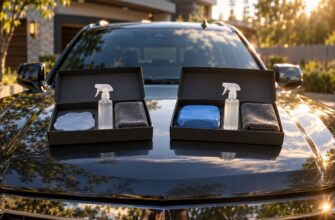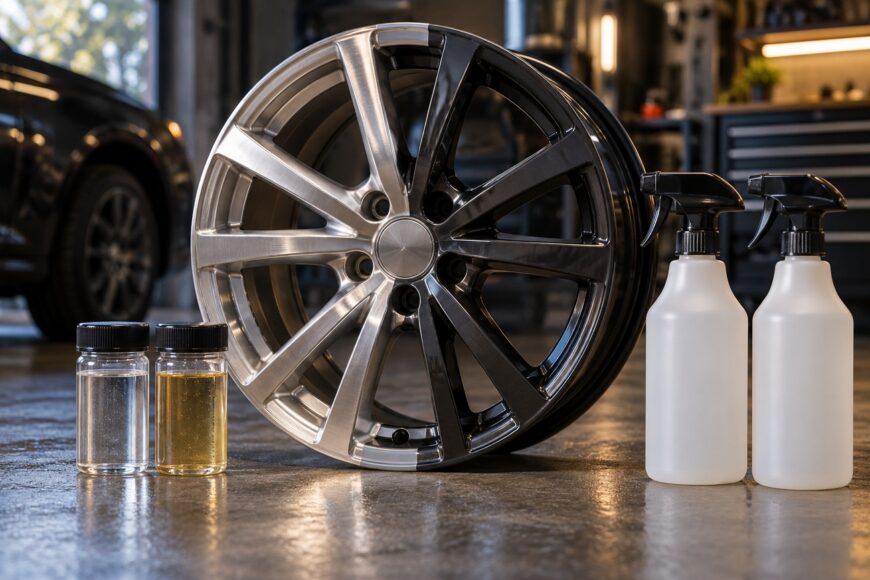
Choosing between Mothers and Adam’s often starts with two concerns: stubborn brake dust that survives a normal wash, and the fear of dulling or staining the wheel finish while trying to remove it. A brand-versus-brand verdict rarely settles that conflict because both companies sell more than one wheel-cleaning product.
The useful comparison begins with the exact bottle, the wheel’s finish, and the condition of the contamination. Painted, clear-coated, powder-coated, anodized, polished, and bare-metal wheels do not present the same level of risk. A sensible choice matches those factors first, then considers cleaning strength, brushing effort, odor, and product use.
- The First Difference Is the Product, Not the Logo
- Mothers vs Adam’s: A Label-Based Buying Comparison
- Brake Dust, Color Change, and What Actually Comes Clean
- Why Wheel Finish Matters More Than Brand
- The Application Mistakes Behind Spots and Disappointing Results
- Which Should You Buy for Your Wheels?
- Frequently asked questions
- What is the difference between Adam’s Wheel Cleaner and Adam’s Wheel & Tire Cleaner?
- What should I do if wheel cleaner dries on the wheel?
- Which wheel cleaner is better, Adam’s or Chemical Guys?
- Which wheel cleaner is better, Meguiar’s or Adam’s?
The First Difference Is the Product, Not the Logo
Both Mothers and Adam’s offer multiple wheel-cleaning products, so check the chemistry and permitted uses of the specific product. A product intended for routine wheel washing may behave differently from one designed to address heavier iron or brake-dust contamination. The brand name alone does not identify the formula.
Wheel-cleaning products may be pH-neutral, alkaline, or acidic. Acidic products pose greater risks to bare metal, polished surfaces, and sensitive finishes, while stronger chemistry can provide more cleaning power against difficult contamination. That trade-off makes the label’s warnings and approved surfaces more useful than a general reputation for either brand.
Read the current bottle for its intended task, finish restrictions, application method, and required rinsing. Avoid assuming that two products with similar names have identical chemistry, or that a product for wheels and tires has the same use case as a wheel-only cleaner.
A small test area is sensible when the finish is valuable, aged, repaired, or unfamiliar. Follow the product directions exactly, keep the surface cool, and stop if the finish changes appearance. This approach also accounts for regional or updated formulas that may make older reviews less reliable.
Mothers vs Adam’s: A Label-Based Buying Comparison
Use this checklist with the specific Mothers or Adam’s bottle in front of you. Where the current label is needed to settle compatibility or directions, the label takes priority over brand-wide assumptions.
| Buying question | Mothers | Adam’s |
|---|---|---|
| What task is it intended to handle? | Check the specific product for routine wheel cleaning, heavier contamination, or a combined wheel-and-tire use case. | Check the specific product for routine wheel cleaning, heavier contamination, or a combined wheel-and-tire use case. |
| Which wheel finishes are permitted? | Confirm the current label’s approved surfaces, including any restrictions for painted, clear-coated, powder-coated, anodized, polished, or bare-metal wheels. | Confirm the current label’s approved surfaces, including any restrictions for painted, clear-coated, powder-coated, anodized, polished, or bare-metal wheels. |
| What restrictions matter? | Look for warnings about heat, direct sun, sensitive finishes, exposed metal, and allowing the product to dry. | Look for warnings about heat, direct sun, sensitive finishes, exposed metal, and allowing the product to dry. |
| How should it be applied? | Follow the bottle’s instructions for wetting, coverage, dwell time, agitation, and rinsing. Do not infer a universal procedure from another Mothers product. | Follow the bottle’s instructions for wetting, coverage, dwell time, agitation, and rinsing. Do not infer a universal procedure from another Adam’s product. |
| Will a brush still be needed? | Possibly. Bonded brake dust and neglected residue often need a suitable soft brush, regardless of the label or brand. | Possibly. Bonded brake dust and neglected residue often need a suitable soft brush, regardless of the label or brand. |
| What is the main trade-off? | A stronger product may improve removal of heavy contamination while reducing the safety margin on sensitive finishes. | A stronger product may improve removal of heavy contamination while reducing the safety margin on sensitive finishes. |
Brake Dust, Color Change, and What Actually Comes Clean
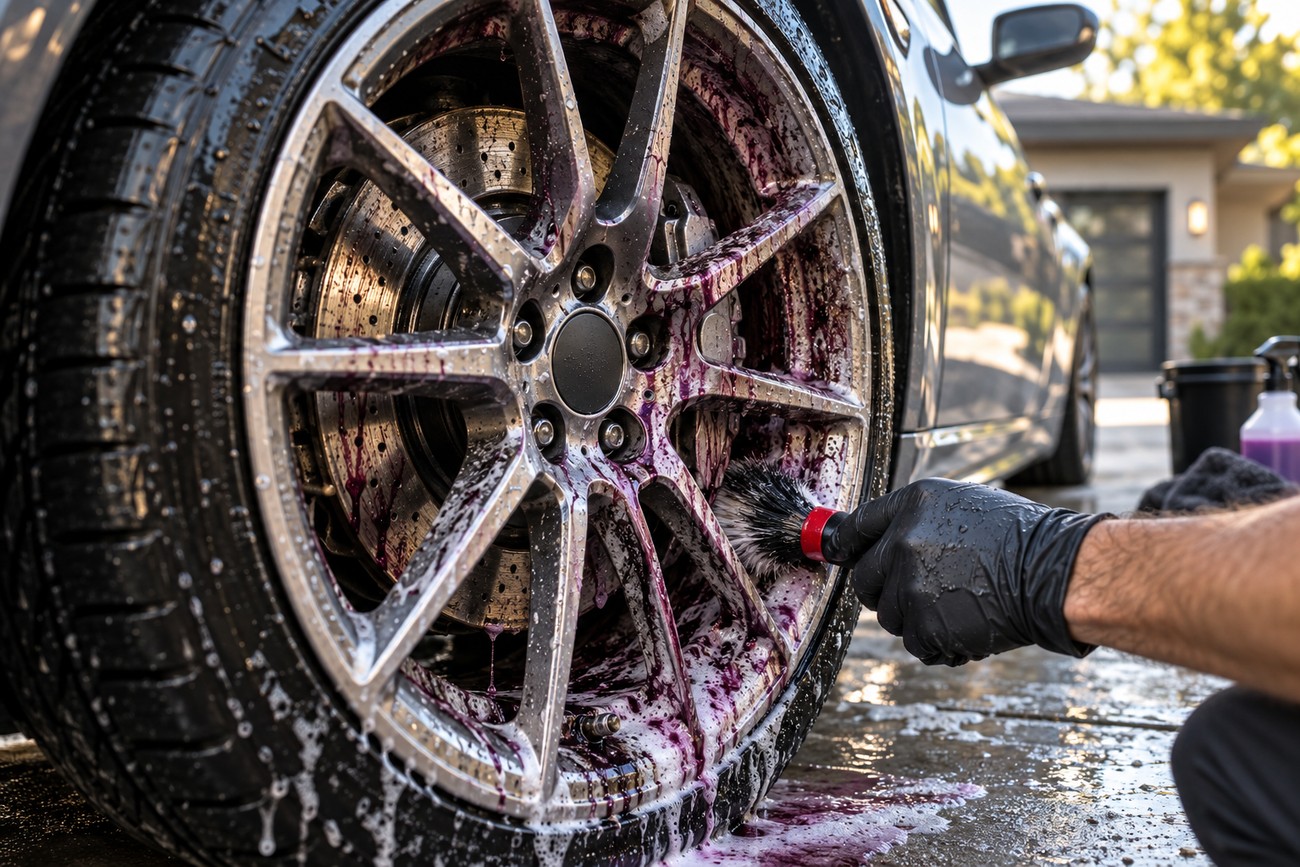
Fresh brake dust is generally easier to remove than older, bonded contamination. Regular cleaning helps prevent residue from building into a layer that needs repeated chemical treatment and mechanical assistance. A neglected wheel may therefore need a second pass or careful brushing even if the cleaner reacts visibly.
A color-change reaction indicates a reaction with contamination; it does not establish that all residue has been removed. The visual effect can show that the product is interacting with iron-containing material, while grime remains in corners, behind spokes, or on the inner barrel.
Use a suitable soft wheel brush when the label permits agitation and after the product has had the label-directed time to work. Light agitation can reach deposits that spraying alone misses, but aggressive brushing on a compromised finish can create a separate problem. Rinse, inspect the surface under good light, and repeat the appropriate process rather than automatically choosing a stronger formula.
Post-winter iron contamination may require a separate iron-decontamination step rather than ordinary wheel cleaning alone. Road salt residue, embedded iron, and general road film do not always respond to the same treatment, so a wheel that remains dull after washing may need a more targeted process.
Why Wheel Finish Matters More Than Brand
Painted and clear-coated wheels usually have a protective surface that still depends on its condition. Powder-coated wheels can also vary in age and integrity. An intact coating gives you more margin than a finish with chips, lifting edges, staining, or previous chemical damage.
Anodized, polished, and bare-metal wheels deserve particular caution because their surfaces can react differently from painted wheels. Compatibility depends on the finish and its condition, not just the cleaner’s brand. If the label excludes a surface, do not treat a favorable review on a different finish as permission to use it.
A small chip or worn clear coat changes the risk assessment even when the cleaner’s label permits use on clear-coated wheels. Liquid can reach vulnerable edges, so testing an inconspicuous area and limiting exposure within the label’s directions may be wiser than treating the wheel as fully intact.
A pH-neutral designation is not a guarantee of safety on every wheel; temperature, dwell time, and finish condition also matter. Likewise, a “safe on all wheels” claim is not a universal guarantee: the particular product, finish, condition, and application still matter.
Stronger chemistry can reduce effort on heavy contamination, but it also reduces the safety margin on sensitive finishes. For valuable or uncertain wheels, start with the least aggressive product that fits the label and the task, then increase intervention only when inspection shows it is necessary.
The Application Mistakes Behind Spots and Disappointing Results
Begin with cool wheels out of direct sun. Heat and sunlight accelerate drying, while excessive dwell time increases the chance of spots or residue. Apply the product according to the bottle’s directions, keep it from drying, and rinse thoroughly within the stated working window.
Use enough product to cover the surface evenly, rather than flooding the wheel in an attempt to compensate for poor coverage. Excess use can increase consumption without improving cleaning, especially when the real problem is bonded contamination that needs gentle mechanical assistance.
A soft, suitable brush can help with spoke edges, lug areas, and inner barrels. A color reaction may look dramatic, but it is not a substitute for inspection and agitation where residue remains. Gray film or uneven gloss on a dark wheel may indicate remaining road film, product residue, or a finish issue, so rinse and reassess before reaching for harsher chemistry.
Strong odor can make enclosed-garage work unpleasant, so ventilation and the product’s safety directions matter. If a trigger or pump sprays unevenly, check the sprayer and coverage rather than assuming the formula is defective. Never mix wheel cleaner with other chemicals in the bottle or sprayer; the combination may alter the formula and create avoidable risk.
Which Should You Buy for Your Wheels?
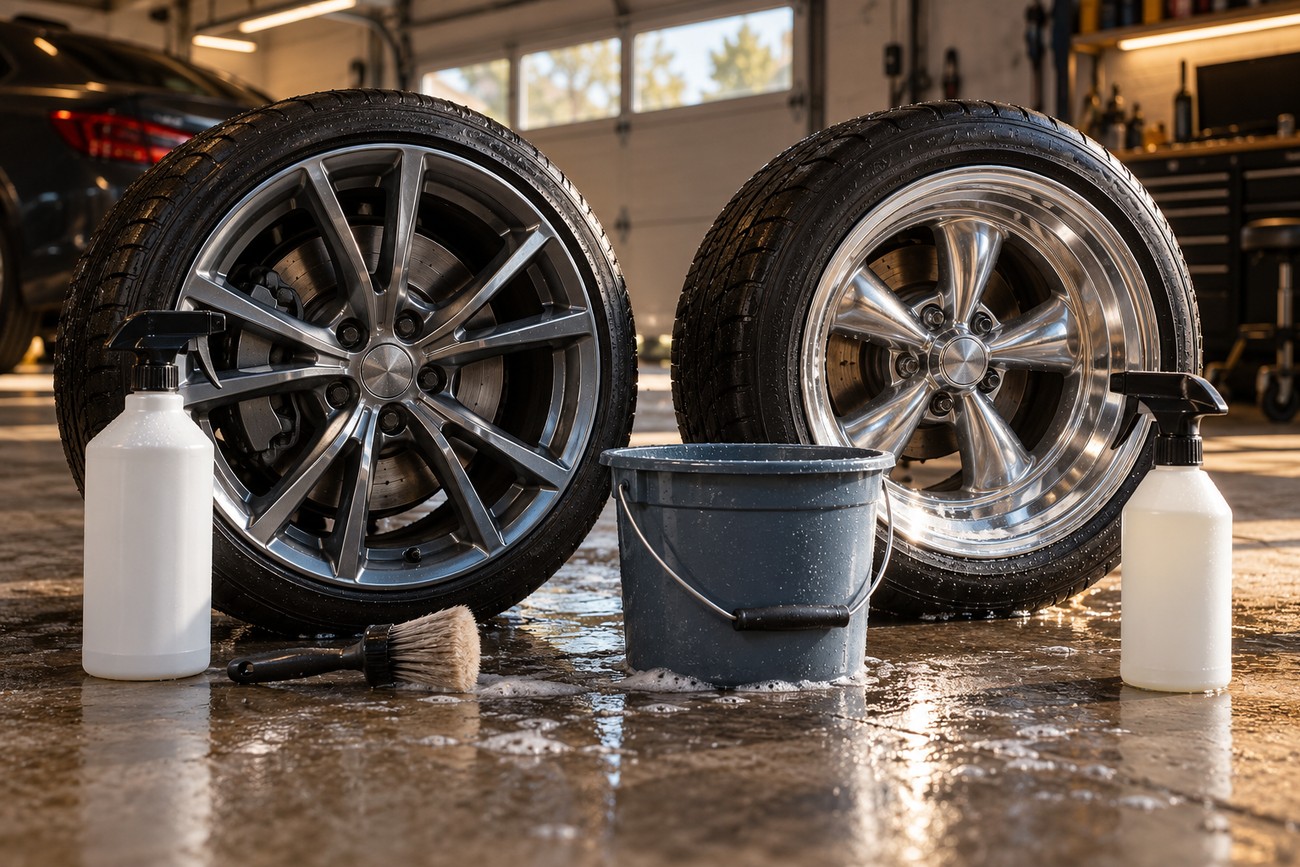
Choose between Mothers and Adam’s only after matching the current product label to the wheel finish. Both brands offer multiple wheel-cleaning products, so check the chemistry and permitted uses of the specific product. The better fit depends on the actual wheel, not a permanent ranking of the brands.
For routine maintenance, a suitable gentler cleaner used regularly can be preferable to occasional aggressive cleaning. Fresh brake dust is generally easier to remove than older, bonded contamination, so preventing heavy buildup may reduce brushing and chemical exposure over time.
For stubborn contamination, a stronger cleaner may improve removal while reducing the safety margin on sensitive finishes. That choice can make sense on a compatible, intact surface, but it does not remove the need for correct dwell time, shade, rinsing, and inspection.
The decision rule is simple: identify the finish, read the exact bottle, start with the least aggressive suitable approach, and add controlled brushing or a separate iron-decontamination step when the residue demands it. Neither Mothers nor Adam’s is a universal winner across every wheel and every product.
Frequently asked questions
Product names alone cannot settle finish compatibility or application directions. Check the current label even when comparing two cleaners from the same brand. If a cleaner dries or leaves marks, the wheel’s finish and the product directions should guide what you do next.
What is the difference between Adam’s Wheel Cleaner and Adam’s Wheel & Tire Cleaner?
Adam’s Wheel Cleaner is positioned for wheel cleaning, while Adam’s Wheel & Tire Cleaner is intended for a combined wheel-and-tire task. The practical difference is where the product is meant to be used and what the current directions permit.
Do not assume identical chemistry, dilution, or finish compatibility from the names alone. Check the current bottle for approved surfaces, application instructions, and restrictions before using either product on a particular wheel or tire.
What should I do if wheel cleaner dries on the wheel?
Cool the surface and rinse according to the product directions as soon as possible. Reassess the wheel once it is clean; if marks remain, avoid aggressive scrubbing, especially on polished, bare, damaged, or otherwise sensitive finishes.
A second controlled application may be appropriate only if the label permits it. Test an inconspicuous area first, and seek a finish-safe corrective approach if the marks do not rinse away.
Which wheel cleaner is better, Adam’s or Chemical Guys?
Neither brand is automatically better across all products. Compare the exact bottles by finish compatibility, intended contamination, working directions, odor, and whether the label supports the wheel you own.
For a fair test, use the same cool conditions, comparable coverage, a suitable brush, and complete rinsing. A difference in technique or wheel condition can outweigh a brand comparison.
Which wheel cleaner is better, Meguiar’s or Adam’s?
The better choice depends on the specific formula and the wheel finish, rather than the brand name. Check each current label for permitted surfaces and restrictions, then match the product to routine dust or heavier bonded contamination.
Choose the product that gives adequate cleaning with a suitable safety margin and predictable application on your wheels. A stronger formula is not automatically preferable if the finish is sensitive or already compromised.