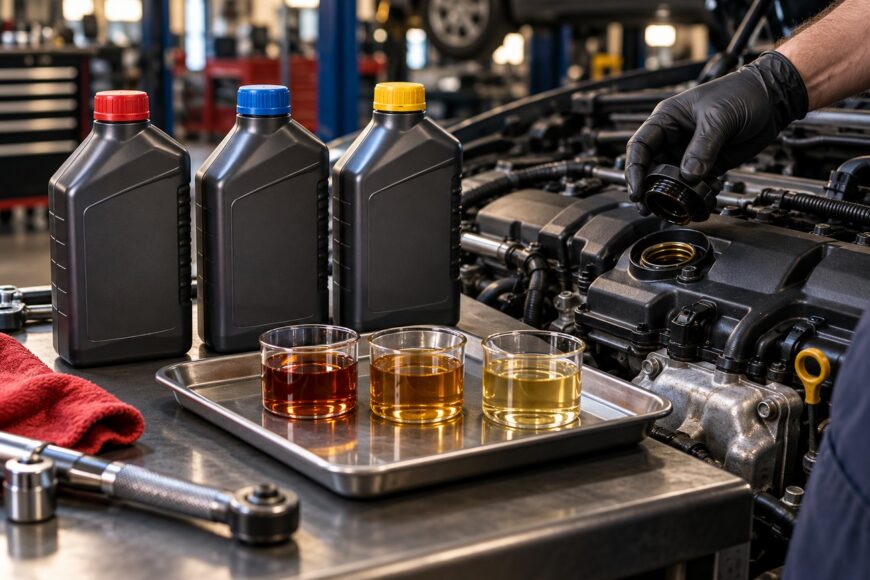
Choosing between Mobil 1, Castrol Edge, and Pennzoil Ultra Platinum can be confusing when advertising promises maximum protection while owner reports point in opposite directions. One driver hears less valvetrain noise after switching brands; another reports higher oil consumption from the same family. Those experiences may be genuine, yet they do not establish a universal winner.
A useful comparison starts with the exact product: SAE viscosity, OEM approval, market, and product version. Authenticity and the engine’s condition matter just as much. A premium label cannot correct excessive clearances, a design-related consumption issue, or an oil that lacks the approval required by the vehicle manufacturer.
For a fair purchase decision, compare matching SKUs under the same operating requirements. The best oil is the one that meets the engine’s specification, comes from a reliable supply chain, and can be changed at a sensible interval for the vehicle’s use.
- Why a Brand-Only Oil Comparison Gives the Wrong Answer
- Read the Approval Before You Read the Marketing
- Mobil 1 vs. Castrol Edge vs. Pennzoil Ultra Platinum: What Actually Differs
- Which One Fits a Modern Turbo or GDI Engine?
- Why Owners Notice Noise, Consumption, and Price Differences
- The Hidden Variables: Market, Viscosity, and Authenticity
- A Practical Buying Decision: Choose the Right Product, Not the Loudest Claim
- Frequently asked questions
- What should I document if oil consumption changes after a brand switch?
- Which is better, Pennzoil, Castrol, or Mobil 1?
- What oil is comparable to Pennzoil Ultra Platinum?
Why a Brand-Only Oil Comparison Gives the Wrong Answer
“Mobil 1,” “Castrol Edge,” and “Pennzoil Ultra Platinum” are product families, not single formulas. Each family includes several SAE viscosities and versions intended for different engines and markets. Formulations and additive packages can vary by market and viscosity, so a family name alone is too broad for a technically honest ranking.
A fair comparison uses the same SAE viscosity and the same required OEM approval. Comparing a 0W-20 product with a 5W-30 product can make one oil seem quieter, thicker, or more stable for reasons related to viscosity and engine fit rather than brand quality. The same problem appears when one product carries a required manufacturer approval and the other does not.
Operating conditions also change the result. Short trips, high temperatures, towing, extended highway use, heavy traffic, and engine age place different demands on the lubricant. A report from a low-mileage naturally aspirated engine cannot automatically settle a question about a turbocharged GDI engine.
Noise and oil-consumption reports deserve caution. A change in sound after an oil service can fall within normal variation, while consumption can reflect leaks, piston-ring condition, driving conditions, or measurement error. In real use, correct approval, price, authenticity, availability, and the change interval often matter more than the logo on the bottle.
Read the Approval Before You Read the Marketing
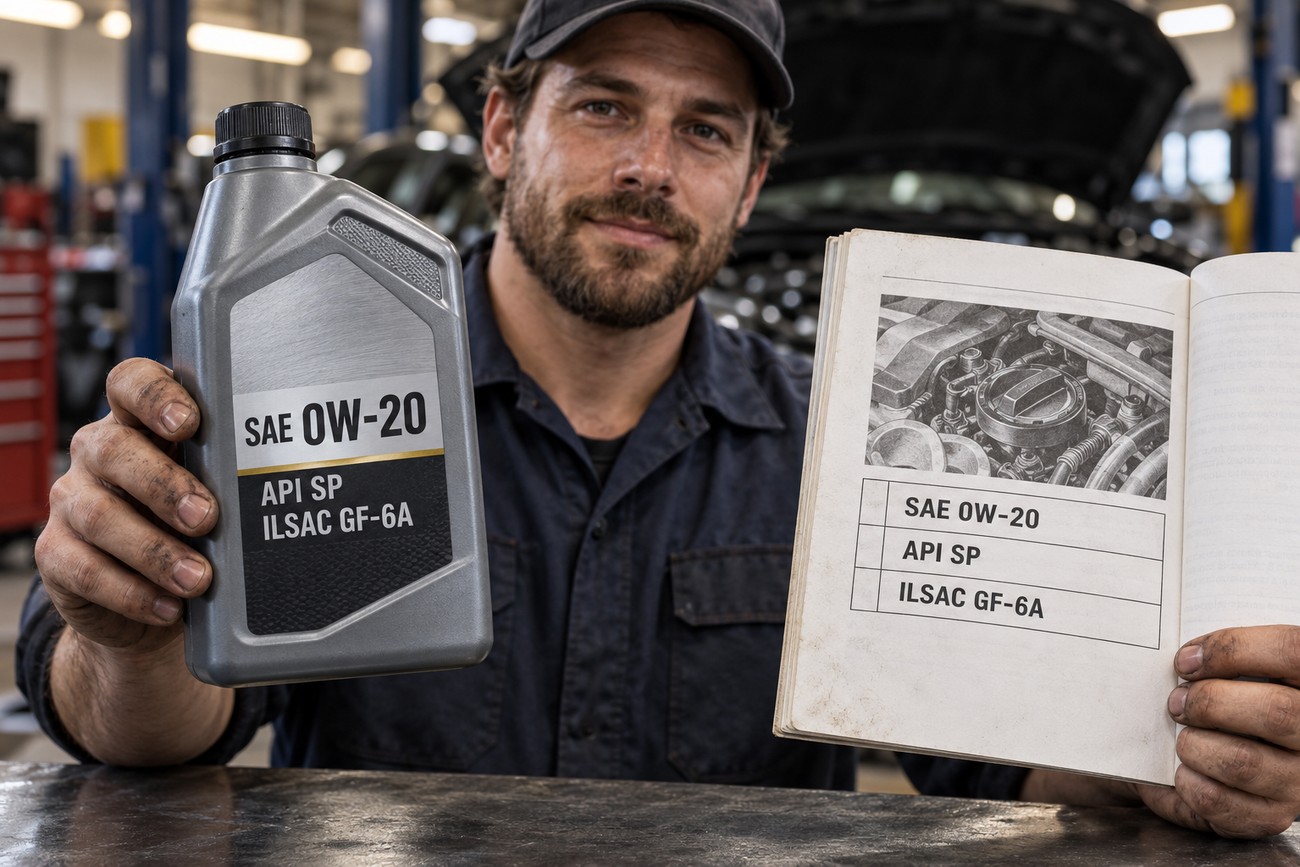
Start with the owner’s manual or the manufacturer’s current service information. Record the required SAE viscosity and every named OEM approval, then check the exact container and current product datasheet. The vehicle manufacturer’s required approval and SAE viscosity take priority over brand reputation or “full synthetic” wording.
Many products in all three families are available in API SP / ILSAC GF-6A versions for modern gasoline engines. The exact certification depends on viscosity, product version, and market, so the claim should be verified on the specific package or datasheet rather than inferred from the product family.
For a modern turbo GDI engine, verify API SP / ILSAC GF-6 and demos1 Gen 3 when the vehicle manufacturer specifies them. These requirements address operating risks relevant to such engines, including low-speed pre-ignition, deposits, timing-chain wear, and fuel economy.
Packaging language can be incomplete or market-specific. A bottle marked “full synthetic” is not automatically suitable for every modern engine, and a product sold under a familiar global name may have a different approval list in another country. If the required approval is absent or unclear, choose a product with verifiable documentation.
Mobil 1 vs. Castrol Edge vs. Pennzoil Ultra Platinum: What Actually Differs
The table below compares buyer-verifiable characteristics. It does not rank the families, because a valid ranking requires matching SKUs, viscosity, approvals, market, and operating conditions.
| Product family | Formulation and technology emphasis | Common certification positioning | Market and viscosity variation | What to verify before purchase |
|---|---|---|---|---|
| Mobil 1 | Broad range designed around different applications and OEM specifications. | Many versions are available with API SP / ILSAC GF-6A positioning, depending on the exact product. | Formulations and additive packages can vary by market and viscosity. | Exact SKU, SAE viscosity, OEM approval, market datasheet, and seller authenticity. |
| Castrol Edge | Wide regional assortment with an emphasis on OEM applications and product-specific performance claims. | Many versions are available with API SP / ILSAC GF-6A positioning, depending on the exact product. | Formulations, approvals, and additive packages can vary by market and viscosity. | Exact Edge variant, SAE viscosity, required OEM approval, and current local documentation. |
| Pennzoil Ultra Platinum | Emphasizes PurePlus GTL base oil made from gas. GTL is used as feedstock for a Group III+ base. | Many versions are available with API SP / ILSAC GF-6A positioning, depending on the exact product. | The product version, viscosity, and market still determine the actual specification and formula. | Exact SKU, API and ILSAC status, OEM approval, market datasheet, and product authenticity. |
Mobil 1 should be understood as a broad range rather than one universal formula. Its practical strength is the number of versions aimed at different OEM specifications and applications. That breadth helps only when the buyer selects the correct version.
Castrol Edge is widely available and has a broad regional OEM-specification assortment. Availability can simplify routine servicing, especially where a specific approval is stocked locally. The Edge name alone still does not identify the required viscosity or approval.
Pennzoil Ultra Platinum’s distinctive emphasis is its PurePlus process and GTL base oil made from gas. GTL is not “synthetic from air”; it is used as feedstock for a Group III+ base. That technology description explains the formulation emphasis, yet it does not prove that every Ultra Platinum version is the best fit for every engine.
Which One Fits a Modern Turbo or GDI Engine?
Turbocharged and gasoline-direct-injection engines place particular importance on the correct oil specification. API SP and ILSAC GF-6 emphasize LSPI control, piston and turbo deposit control, timing-chain wear protection, and fuel economy. Those functions are more useful for selection than a general statement about maximum protection.
Check the manual for the required SAE viscosity and OEM approval, then confirm both on the exact bottle. For a vehicle requiring demos1 Gen 3, an oil carrying only a broad “full synthetic” description is insufficient. The same applies when the manual names another manufacturer approval or a specific performance standard.
Viscosity remains part of engine design, especially in a turbo application. A 0W-20, 5W-30, and 0W-40 product from the same family can have different characteristics and cannot be treated as interchangeable simply because the brand is familiar.
Deposit control and LSPI performance are certification and formulation matters, not qualities that can be reliably judged from engine sound after one oil change. If two products meet the same required approval and viscosity, purchase factors such as authenticity, availability, price, and a suitable change interval become more significant.
Why Owners Notice Noise, Consumption, and Price Differences

Drivers may hear a quieter or louder engine after changing brands. Oil level, temperature, fuel dilution, filter condition, ambient weather, and normal mechanical variation can influence that impression. Without controlled measurements, a perceived sound change does not establish superiority.
Oil consumption should be measured over a consistent period rather than judged from one refill. Park the vehicle on the same type of surface, check the level under the same conditions, record mileage, and account for leaks and operating conditions. A single top-up cannot separate oil behavior from measurement variation or an existing engine fault.
Premium oil does not repair mechanical wear or a design-related oil-consumption problem. Worn rings, valve-guide issues, leaks, or excessive clearances require diagnosis. Changing brands may alter the rate temporarily, yet the underlying condition remains.
Price also creates unrealistic expectations. A more expensive oil is not objectively better for every engine; the price may reflect a particular formulation, approval set, marketing, distribution cost, or limited availability. Once technical compatibility is established, value depends on the entire service plan rather than the bottle price alone.
The Hidden Variables: Market, Viscosity, and Authenticity
A global brand name does not guarantee one identical formula in every country. Regional regulations, available approvals, base oils, additive packages, filling locations, and packaging can differ. This is why a product found in an overseas comparison may not match the version sold locally.
Viscosity comparisons are especially easy to misuse. A 0W-20 product is not a direct substitute for a 5W-30 or 0W-40 product merely because all three carry the same family name. Compare the same SAE grade and required approval before drawing conclusions about noise, consumption, or protection.
Record the exact viscosity, approval text, market, seller, and batch details before blaming an oil for a change in noise or consumption. That simple service habit separates a product issue from a vehicle, measurement, or supply issue.
Differences in reported oil consumption between regions or batches remain anecdotal unless supported by controlled testing. A change in packaging, color, or odor can also reflect a different market or filling source, although those observations alone cannot authenticate or condemn a product.
Buy from a reliable seller and retain the container, receipt, product details, and batch information until the service interval is complete. Check the packaging and available manufacturer information for consistency. Seller reliability, packaging and batch checks, and product authenticity can matter as much as the brand choice.
A Practical Buying Decision: Choose the Right Product, Not the Loudest Claim
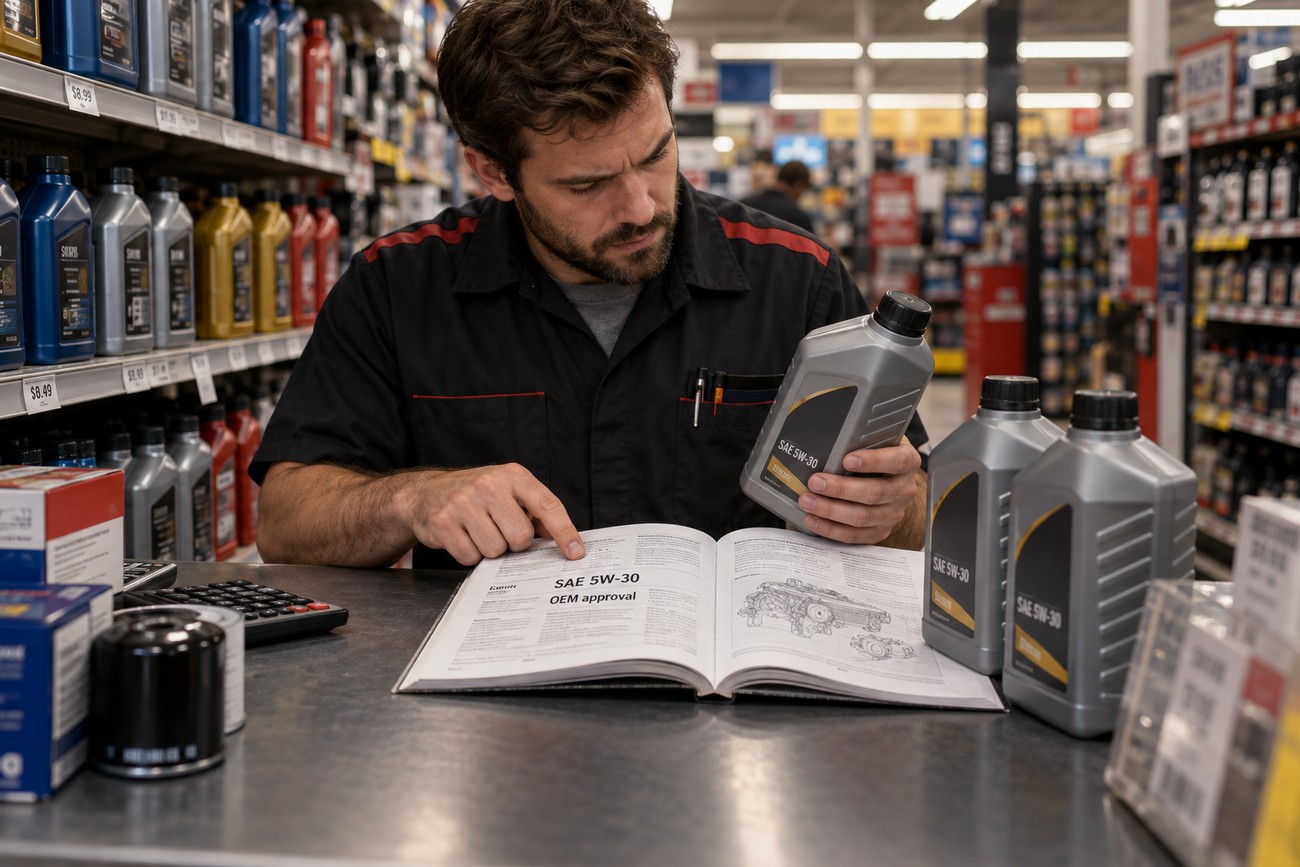
Use the vehicle documentation as the starting point. Write down the required SAE viscosity and OEM approvals, then identify products that meet both requirements. If the manual lists several acceptable options, compare price, availability, and documentation within that approved group.
- Confirm the required SAE viscosity.
- Identify every named OEM approval and relevant API or ILSAC requirement.
- Compare Mobil 1, Castrol Edge, or Pennzoil Ultra Platinum products at the same viscosity.
- Check the market-specific datasheet and the exact container.
- Assess the seller, packaging, batch information, price, and expected availability.
- Choose a change interval suited to the vehicle’s use and condition.
Comparisons become methodologically weak when one product has a different viscosity or an unverified regional specification. Marketing claims such as “maximum protection” or “best low-temperature performance” do not create a fair cross-brand ranking without a named, comparable test.
For a healthy engine, any verified product that meets the required specification can be a sound choice. Pennzoil Ultra Platinum may appeal to buyers who value its GTL-based PurePlus emphasis; Mobil 1 may suit those needing a broad OEM-specific range; Castrol Edge may be practical where its regional approval assortment is readily available.
There is no permanent winner across all engines. Correct approval, authenticity, price, availability, and the change interval should decide after technical compatibility is established. An expensive oil cannot compensate for excessive clearances, mechanical wear, or an incorrect specification.
Frequently asked questions
What should I document if oil consumption changes after a brand switch?
Record the exact product name and SKU, SAE viscosity, approvals, market of sale, seller, batch details, date of service, oil level before and after the change, and mileage. Note any filter change, leaks, warning lights, fuel dilution concerns, and whether the vehicle was used for short trips, highway driving, towing, or heavy traffic.
Measure consumption over more than one comparable check rather than treating one refill as proof. Use the same level surface and checking procedure, then inspect for external leaks before attributing the change to the oil. If consumption remains abnormal, the engine needs diagnosis for mechanical or design-related causes.
Which is better, Pennzoil, Castrol, or Mobil 1?
None is universally better. The better choice is the exact product that matches the engine’s required viscosity and OEM approval, is authentic in the local market, and can be purchased and serviced consistently.
After those conditions are equal, differences in price, availability, product documentation, and personal service preferences can reasonably decide the purchase. Brand reputation alone cannot settle a comparison between unmatched SKUs.
What oil is comparable to Pennzoil Ultra Platinum?
A comparable product must match the same SAE viscosity, API or ILSAC category, OEM approval, and intended market. A Mobil 1 or Castrol Edge product with matching requirements may be a practical comparison; the family name alone does not establish equivalence.
Check the current datasheets and exact containers side by side. Compare the approval lists and service requirements first, then consider formulation descriptions such as Pennzoil Ultra Platinum’s PurePlus GTL emphasis. Similar branding or a similar price is not enough to make two oils technically comparable.