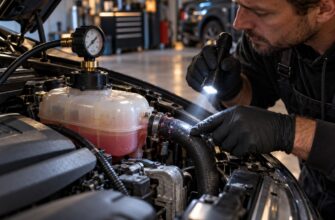
Mass airflow sensor cleaning is often treated like routine maintenance or an automatic cure for a check-engine light. That approach can waste time, damage a serviceable sensor, or hide an intake leak that needs repair. Symptoms such as an unstable idle, hesitation, increased fuel consumption, or a mixture code do not prove that the MAF is dirty.
The sound process is to diagnose the air-measurement problem first. Scan data, airflow readings, fuel trims, intake leaks, and related engine systems should determine whether careful cleaning is justified, or whether repair and replacement are more appropriate. Vehicle manuals commonly emphasize replacing a faulty MAF, while technicians report useful results from cleaning selected sensors with removable contamination; neither position makes cleaning universally suitable.
- What MAF Cleaning Can—and Cannot—Fix
- Diagnose the Airflow Problem Before Cleaning
- When Cleaning Is Reasonable—and What to Inspect First
- How to Clean a MAF Sensor Without Damaging It
- The Chemicals and Techniques That Commonly Kill a MAF
- After Cleaning: Reinstallation, Testing, and the Replacement Decision
- Frequently asked questions
- What are the symptoms of a dirty mass air flow sensor?
- How much does it cost to clean a MAF sensor?
What MAF Cleaning Can—and Cannot—Fix
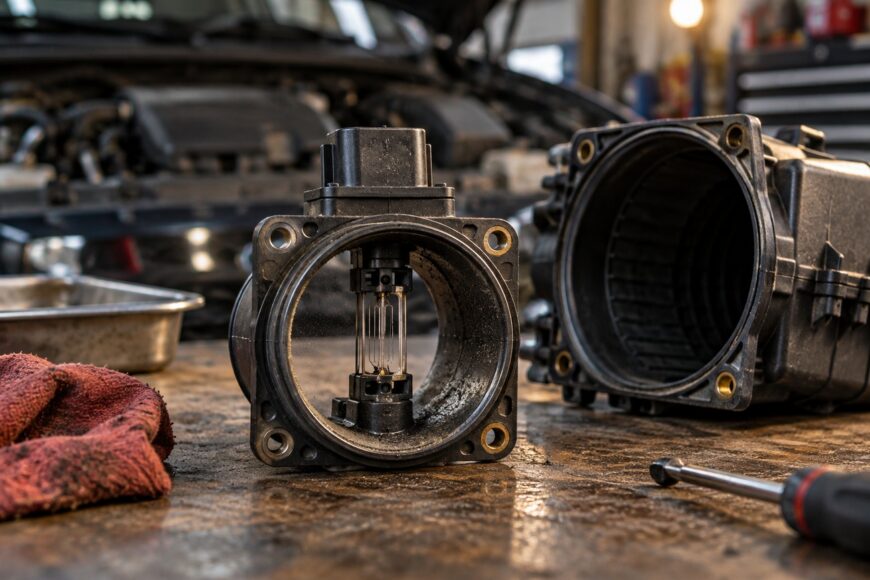
A mass airflow sensor measures the amount of air entering the engine so the control module can calculate fuel delivery. Wire-type and film-type mass airflow sensors use a heated sensing element whose electrical response changes as air passes over it. The control module interprets that response as airflow and uses it alongside engine speed, oxygen-sensor feedback, and other inputs.
Dust, oil, or residue on the sensing element can alter heat transfer and produce a biased airflow signal. The result may be a mixture that is too lean or too rich, especially when the sensor signal is already marginal. A light deposit can also be harmless when the MAF signal remains within the expected range under relevant operating conditions.
Most MAF sensors are designed for the engine’s service life and have no scheduled cleaning interval. Vehicle manuals commonly specify replacement for a faulty MAF rather than routine cleaning. Many engines also use a post-shutdown burn-off or self-cleaning cycle, so manual cleaning is not automatically required when the air filter and intake system are in good condition.
Cleaning may remove removable contamination from an otherwise functioning sensor. It cannot restore a physically damaged sensing element, deteriorated coating, broken wire, or failed electronics. If the signal remains implausible after proper diagnosis and careful handling, repeated cleaning is unlikely to provide a durable repair.
Diagnose the Airflow Problem Before Cleaning

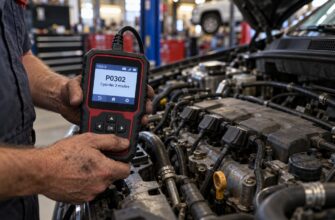
Symptoms provide a starting point, not proof. A dirty or inaccurate MAF can contribute to an unstable idle, hesitation or flat spots during acceleration, increased fuel consumption, and mixture-related trouble codes such as P0171 or P0172. The same pattern can result from unmetered air entering the intake, an oxygen-sensor problem, incorrect fuel pressure, restricted delivery, or injector faults.
A professional diagnosis commonly begins with stored and pending codes, freeze-frame information, live airflow data, and short- and long-term fuel trims. The readings should be considered at idle and under operating conditions that reproduce the complaint. A MAF value that appears reasonable at one engine speed can still be misleading under load, so a single reading rarely settles the issue.
The useful sequence is to compare the MAF signal with fuel-trim behavior, then check for intake leaks before touching the sensor. If trims change sharply between idle and higher airflow, an air leak may be more likely than contamination; a consistently implausible signal across conditions points the investigation toward the sensor, its wiring, or its installation.
Inspect the intake duct, clamps, throttle-body area, filter housing, and crankcase-ventilation connections for leaks or disconnections. Check the air filter and its seating, because poor filtration can introduce contamination while a badly fitted filter can allow unfiltered air into the system. The connector, wiring, and sensor ground also deserve attention before a chemical cleaner is used.
Fuel delivery and oxygen-sensor feedback should remain in the diagnostic picture. Cleaning first and diagnosing later can temporarily change the symptoms without correcting the cause, leaving the vehicle with the same fault and a greater risk of a damaged sensor.
When Cleaning Is Reasonable—and What to Inspect First
Cleaning is most reasonable when there is visible, removable contamination, the sensor data is plausible but questionable, and no unresolved intake-system fault explains the symptoms. It is a limited intervention for a sensor that may be dirty, not a general response to every mixture code or rough idle complaint.
Before removing the MAF, identify how contamination could have reached it. Oiled air filters, crankcase-ventilation leaks, and poor air filtration are common contamination routes. If the source remains in place, a clean sensing element can become contaminated again, making repeated spraying an expensive substitute for repairing the intake system.
A complete inspection includes the air filter, filter housing, intake ducting, clamps, seals, and crankcase-ventilation system. Examine the MAF seal and housing for damage before disturbing them. A hardened O-ring, distorted housing, or poorly seated duct can introduce unmetered air after the cleaning and create symptoms that were absent beforehand.
Many engines perform a burn-off or self-cleaning cycle after shutdown. That design reduces the need for manual service when filtration is normal and the sensor is operating within its expected range. Repeated cleaning of an aging sensor may produce only a short-lived improvement and can accelerate deterioration of its coating or sensing element.
How to Clean a MAF Sensor Without Damaging It
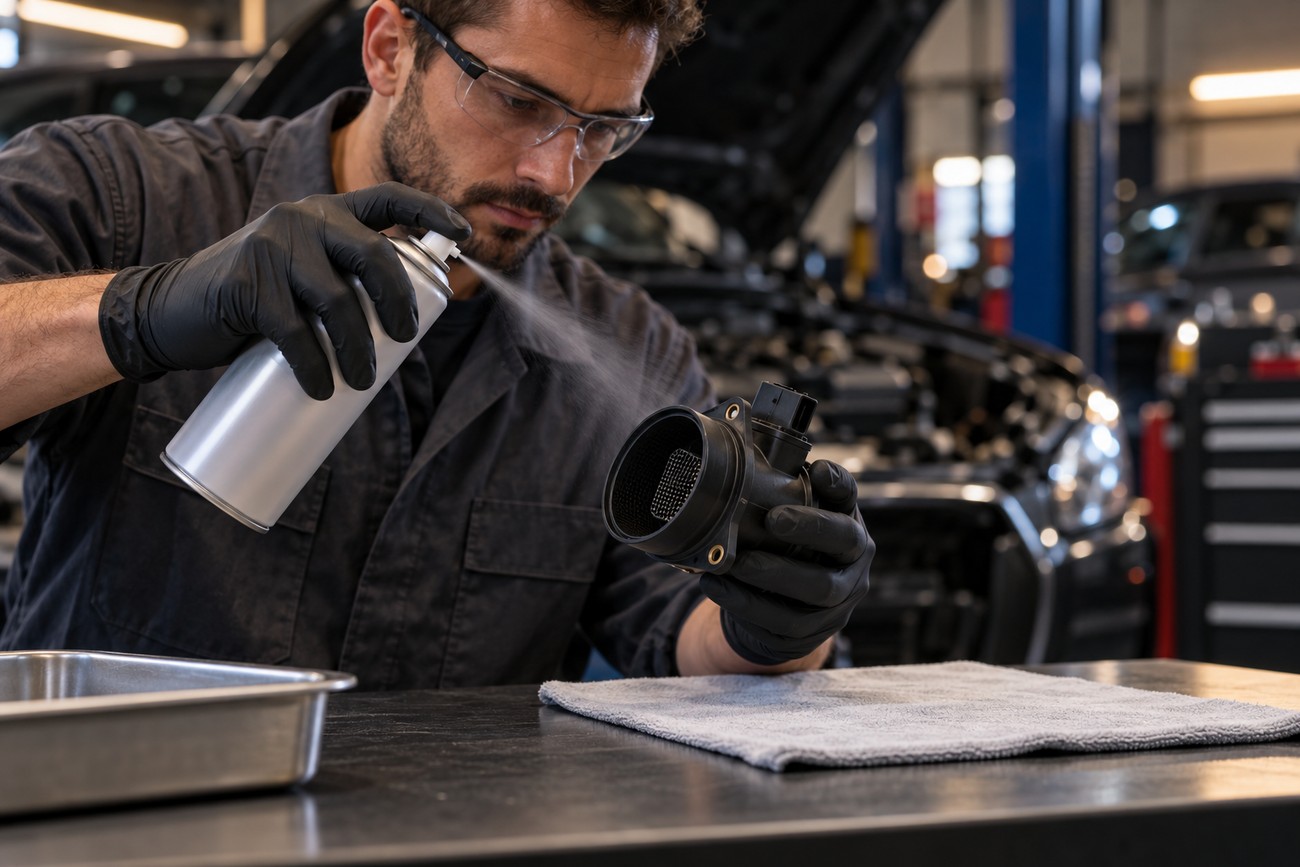
Use the vehicle service information to determine how to disconnect power and remove the sensor. Prevent accidental electrical contact as appropriate, and avoid pulling on the connector or twisting the housing. Remove the sensor without stressing the O-ring, gasket, intake duct, or mounting surface.
Use only a purpose-made MAF cleaner with a fast-evaporating, non-film formula intended for MAF sensing elements. Its purpose is to reduce the chance of leaving residue or attacking the element’s coating. A product marketed as universal or MAF-safe still deserves scrutiny, because marketing language does not confirm compatibility from the vehicle or sensor manufacturer.
- Hold the sensor securely by its housing, away from the sensing wire or film.
- Apply the approved cleaner without touching the sensing element.
- Avoid close, high-pressure spraying that could detach or deform the wire or film.
- Allow the solvent to evaporate completely in a clean location before reinstallation.
- Refit the sensor with an intact seal and reconnect the electrical connector securely.
Never wipe, brush, swab, or scrape the sensing element. Delicate wires and films can be deformed or broken by contact that feels harmless. The element must be completely dry and free of solvent before the engine is started.
Inspect the connector, housing, O-ring, gasket, and intake duct during reassembly. A damaged or hardened seal can create an air leak after the work, while a loose connector can produce a new electrical fault. Cleaning is complete only when the sensor and the surrounding intake system are correctly sealed.
The Chemicals and Techniques That Commonly Kill a MAF
Carburetor cleaner, brake cleaner, acetone, and other aggressive solvents can attack the sensing element, its coating, or nearby plastics. Manufacturers such as Bosch and Denso generally caution against aggressive solvents and unnecessary handling. The fact that a chemical removes oil effectively does not make it suitable for a delicate MAF.
Mechanical contact creates a separate failure risk. A cloth, cotton swab, brush, or fingertip can break or deform a sensing wire or film and leave fibers or residue behind. Spraying too close or with excessive pressure can also detach or deform the sensing element, even when the liquid itself is chemically compatible.
Starting the engine before the solvent has fully evaporated can leave condensation or residue on the element and produce incorrect readings. It also introduces a preventable ignition and intake-system risk. Complete evaporation is a basic requirement, regardless of the product’s claimed drying speed.
Universal products deserve particular caution. Some are marketed as safe for MAF sensors without confirmed compatibility from the sensor manufacturer. Claims that certain low-cost MAF cleaners resemble brake cleaner have appeared in forum discussions, but that is an unverified anecdote rather than a general chemical finding. The label and available compatibility guidance should control product selection.
After Cleaning: Reinstallation, Testing, and the Replacement Decision
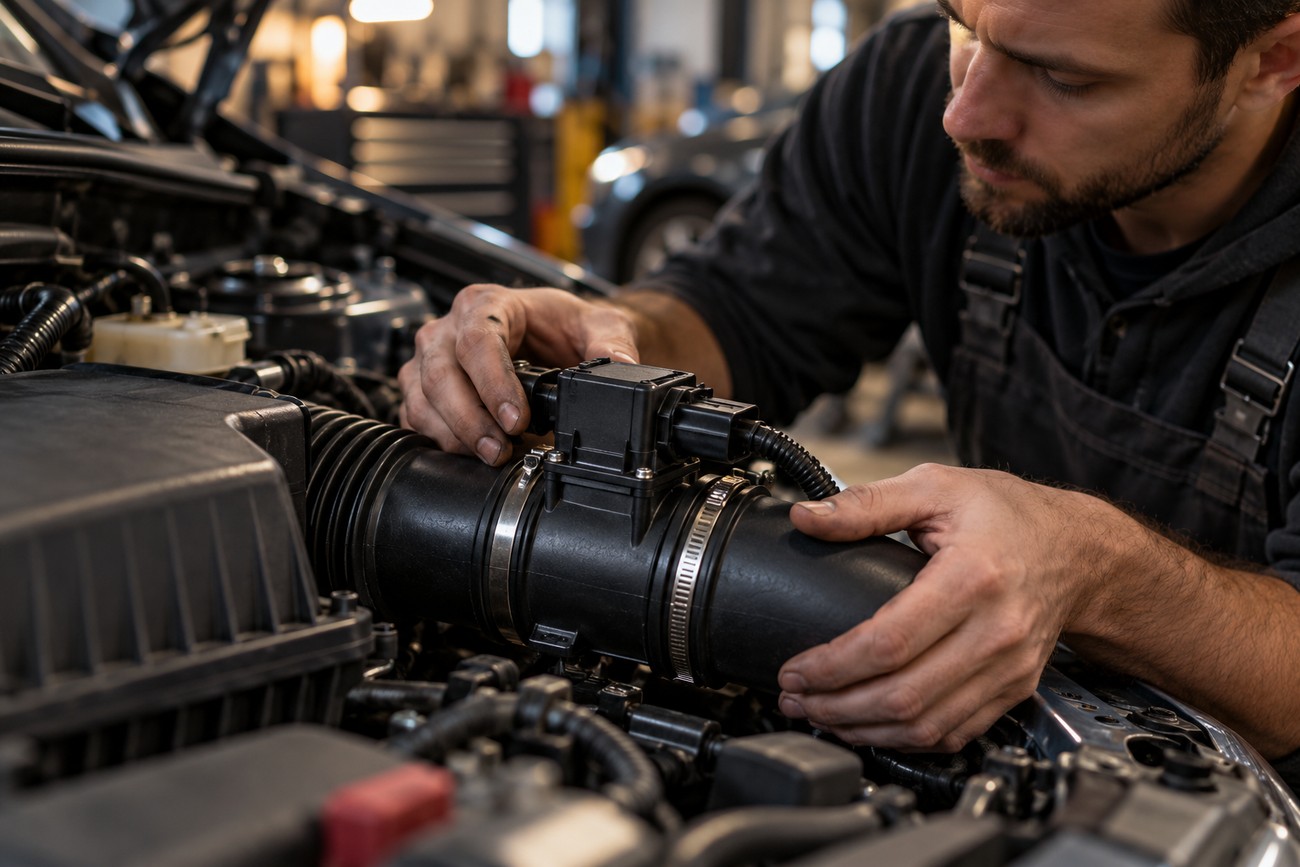
Before starting the engine, verify that the MAF seal, O-ring or gasket, housing, intake duct, clamps, filter, and connector are correctly installed. The intake tract must be sealed so that all air entering the engine is measured. An air leak at the MAF seal or duct can create symptoms worse than those present before cleaning.
After the element is completely dry, restart the engine and reassess the original complaint. Check idle quality, scan-tool codes, fuel trims, and airflow data under the same conditions used during the initial diagnosis. A change in how the vehicle feels is useful evidence, but it does not replace confirming that the signal and fuel control have returned to a plausible range.
Cleaning does not automatically erase the underlying cause of a mixture code. If airflow data remains implausible, inspect the wiring, power supply, grounds, connector, intake system, and related engine controls. Persistent problems after careful cleaning point toward further diagnosis or replacement rather than another cleaning attempt.
The cost decision depends on diagnostic labor, access, the cleaner and seals required, and the price and quality of a replacement sensor. A cleanable deposit can justify a careful intervention, while physical damage, electrical failure, or persistent implausible readings support replacement. The correct replacement should match the vehicle application and be supported by reliable parts information.
Frequently asked questions
What are the symptoms of a dirty mass air flow sensor?
Typical symptoms include an unstable idle, hesitation or flat spots under acceleration, increased fuel consumption, and mixture-related codes such as P0171 or P0172. Symptoms mainly at idle can point toward an intake leak or idle-control issue; symptoms that appear under load may involve fuel delivery, ignition, or airflow measurement.
The most useful distinction comes from comparing the symptom pattern with MAF data and fuel trims. If trims change substantially between idle and higher airflow, unmetered air deserves attention. If the MAF signal stays implausible across conditions, the sensor or its circuit becomes more suspicious, although this still cannot prove contamination.
How much does it cost to clean a MAF sensor?
There is no universal cleaning price because labor, access, diagnosis, seals, and replacement choices vary. A basic cleaning quote can expand if the technician needs to test for an intake leak, replace a damaged seal, service the air filter, repair the intake duct, or diagnose wiring and fuel-trim data.
A low cleaning price is not necessarily the lowest total-cost option. Cleaning an electrically failed or physically damaged sensor can lead to repeat visits, while a neglected contamination source can foul it again. The useful estimate should cover diagnosis and the condition of the surrounding intake system, not only the spray application.