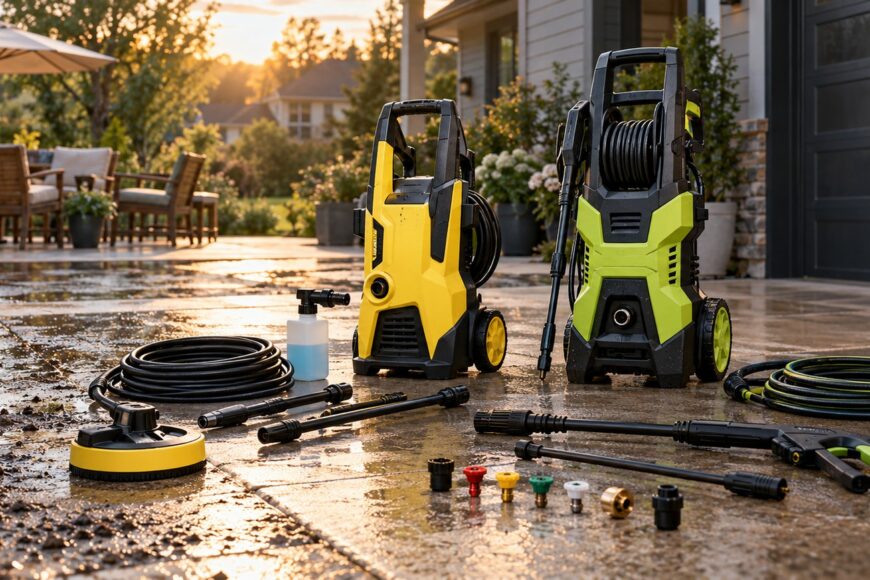
The choice often starts with a higher pressure rating versus a washer that is easier to move around a car or patio. In practice, hose reach, water flow, and the supplied accessories can create more frustration than a modest difference in advertised pressure.
Kärcher and Ryobi cover different parts of the electric pressure-washer market. Kärcher’s household corded range runs from K2 to K7, while Ryobi sells corded washers alongside separate 18V ONE+ and 36V cordless lines. These categories should be compared by task and equipment rather than treated as direct equivalents.
A useful comparison therefore starts with named models, their published specifications, and the way you expect to work. A washer for occasional patio cleaning has different priorities from one used regularly around a car or across a larger paved area.
- The short answer: which brand fits your jobs?
- Why maximum pressure is a poor shortcut
- Kärcher and Ryobi corded models: published figures at a glance
- The ownership details you notice halfway around the car
- Which washer makes sense for cars, patios, and occasional cleanup?
- Common mistakes that make either brand disappoint
- The final choice: compare the package, not the logo
- Frequently asked questions
- What should I check before buying a used electric pressure washer?
- Why does my electric pressure washer pulse instead of spraying steadily?
- Which brand of pressure washer is better, Ryobi or Kärcher?
- What is the best brand for electric pressure washers?
- What pressure washer is better than Kärcher?
The short answer: which brand fits your jobs?
Kärcher suits buyers who want a broad household corded range and a well-developed accessory ecosystem. K2 and K3 are lighter-duty household choices for occasional cleaning, while higher models are more relevant when you need greater water flow or expect larger outdoor jobs. The exact package still matters, since pressure, hose length, nozzles, and detergent equipment vary by model.
Ryobi makes sense when a particular corded model has the right equipment or when cordless operation is valuable. Its 18V ONE+ and 36V lines belong to separate cordless ranges, so battery convenience comes with runtime limits and should not be treated as equivalent to continuous corded operation.
For frequent car washing, compare steady rinsing performance, hose handling, and the supplied nozzles before choosing by brand. A suitable Ryobi corded washer can be close in class to part of the Kärcher household range, while a Kärcher model may offer a better fit if its accessories and connections match your routine.
Larger or more frequent outdoor work usually justifies comparing higher-capacity machines from either brand. There is no useful brand-wide pressure ranking: published figures belong to specific models, and the equipment around those models determines how effectively you can use them.
Why maximum pressure is a poor shortcut
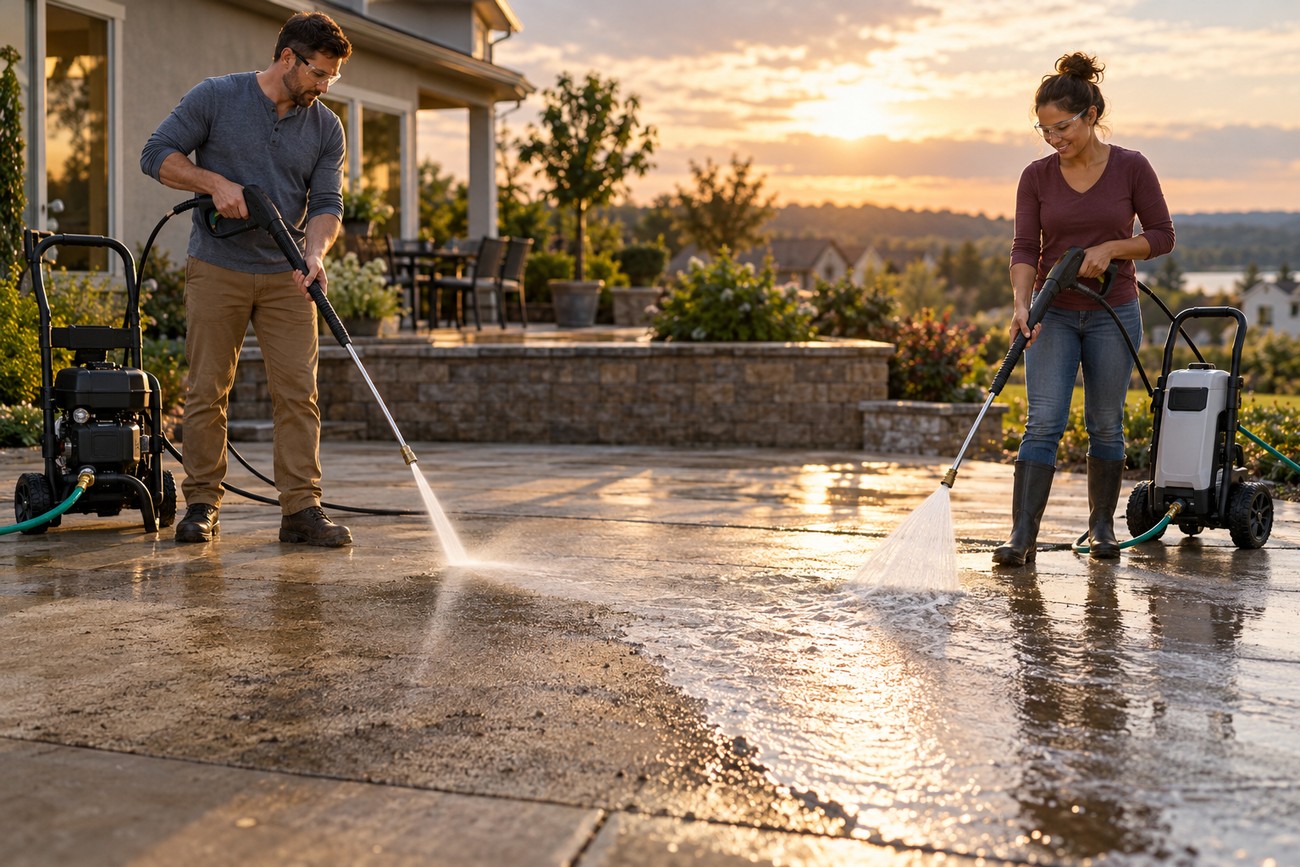
Advertised maximum pressure is useful context, but it does not establish cleaning speed by itself. Water flow, nozzle choice, detergent, surface condition, and working distance all affect the result. A high pressure figure with limited flow may loosen dirt without rinsing it away quickly.
Kärcher lists the K5 Basic at up to 145 bar and 500 L/h. The K7 is listed at up to 180 bar and 600 L/h. These figures show why pressure and flow should be read together, while still avoiding the assumption that either number alone guarantees a particular cleaning result.
Rinsing already-loosened dirt favors useful flow and a nozzle that covers the surface without excessive force. Washing a car calls for controlled pressure, an appropriate spray pattern, and detergent that helps release road film. Stubborn deposits may need pre-soaking, dwell time, and a suitable narrow nozzle rather than simply more pressure.
The trade-off is practical. More pressure can help with localized deposits, while more water flow can improve rinsing and reduce repeated passes. Choose the combination that fits the material and task instead of replacing one simplistic rule with another.
Kärcher and Ryobi corded models: published figures at a glance
The figures below compare named corded models only. Ryobi flow entries are marked as not established here, and figures listed for a differently named RPW130X model should not be transferred to RPW130XRBB.
| Model | Published maximum pressure | Published water flow | Practical reading |
|---|---|---|---|
| Kärcher K5 Basic | Up to 145 bar | Up to 500 L/h | Pressure and flow are both published for this model. |
| Kärcher K7 | Up to 180 bar | Up to 600 L/h | Higher published capacity within the household corded range. |
| Ryobi RPW130XRBB | 130 bar | Not established here | Do not substitute specifications listed for RPW130X. |
| Ryobi RY140PWA | 140 bar | Not established here | Check the current local product listing for flow and included equipment. |
Specifications and accessories can differ by market and package. Check the exact local listing, especially for hose length, supplied nozzles, detergent equipment, and connector type.
The ownership details you notice halfway around the car
A hose that twists, stiffens, or falls short changes the entire working routine. You may have to drag the machine, reposition it, or stop to untangle the line before reaching the next panel. Cord length creates a similar problem when the nearest outlet is not near the washing area.
Inspect the usable hose reach rather than relying only on the machine’s compact size. Also check whether the gun and lance feel secure, whether connections have unwanted movement, and whether the package includes the spray tools you will actually use. A basic detergent setup may produce thinner foam than expected, leading some owners to consider a separate foam attachment.
A hose that cannot reach around a parked car can turn a technically adequate washer into a stop-and-start tool, because repositioning the machine becomes part of every panel.
Kärcher’s broad accessory range can be useful when you want a patio cleaner, replacement hose, or different spray tool, provided it fits the exact product line. Ryobi’s tool-platform appeal is strongest for buyers already invested in its battery ecosystem, but that does not make every accessory or quick-connect fitting interchangeable across corded, 18V ONE+, and 36V products.
Before buying, confirm the hose length, connector standard, supplied nozzles, detergent method, and the cost and availability of compatible accessories. These details often affect comfort more than a small difference in advertised pressure.
Which washer makes sense for cars, patios, and occasional cleanup?
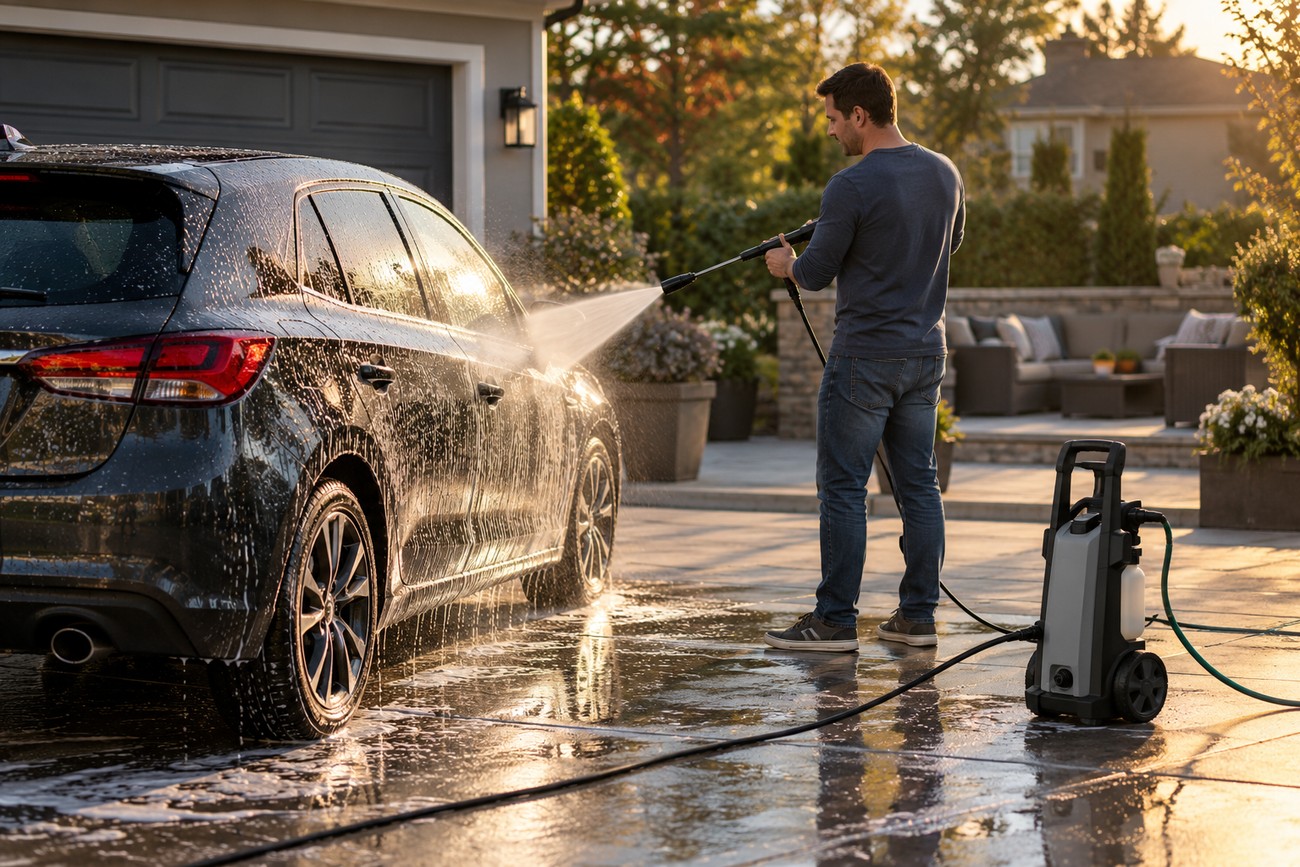
For a car, prioritize controlled spray patterns, suitable detergent equipment, steady rinsing, and enough hose reach to work around the vehicle. A strong narrow jet used too close to paint or trim can cause damage, while an unsuitable wide spray can make cleaning slow. Maximum bar alone is a poor guide to vehicle-washing quality.
A small paved area or occasional household cleanup can suit a lighter Kärcher K2 or K3. These are positioned as lighter-duty household choices, so they should not be assumed suitable for long uninterrupted sessions. Follow the manual’s operating guidance and allow the machine to work within its intended duty pattern.
For larger areas or more frequent cleaning, compare higher-capacity machines and their water-flow figures. Kärcher’s K5 Basic and K7 provide published pressure-and-flow figures for this comparison, while Ryobi buyers should verify the flow specification for the exact corded model rather than infer it from a similarly named product.
A cordless Ryobi washer belongs in a separate convenience-versus-runtime category. It can be useful where power access is awkward, but battery runtime limits the session. Corded operation avoids that battery constraint, yet still depends on an adequate inlet water supply that meets the washer’s requirements.
Common mistakes that make either brand disappoint
Buying from the maximum bar figure alone is the most common mistake. Cleaning speed also depends on water flow, nozzle choice, detergent, and the condition of the surface. A washer can remove loose dirt well and still struggle with old deposits if the preparation and attachment are wrong.
An overly aggressive nozzle can damage paint, plastic, seals, or joints, particularly when held close to the surface. Start with a broader spray and a sensible working distance, then adjust only when the material and residue allow it. Test an inconspicuous area before treating a large visible surface.
Pre-soaking and suitable detergent often reduce the need for force. Let the chemical work according to its instructions, loosen heavy contamination, and use the washer to rinse it away. A household electric washer should not be expected to deliver a professional result on every deposit without preparation.
Check that the inlet supply provides adequate water before a long session. Poor supply can reduce performance and place unnecessary strain on the pump. After use, follow the manual’s draining procedure and remove water before freezing storage, since trapped water can cause problems with valves and the pump.
The final choice: compare the package, not the logo
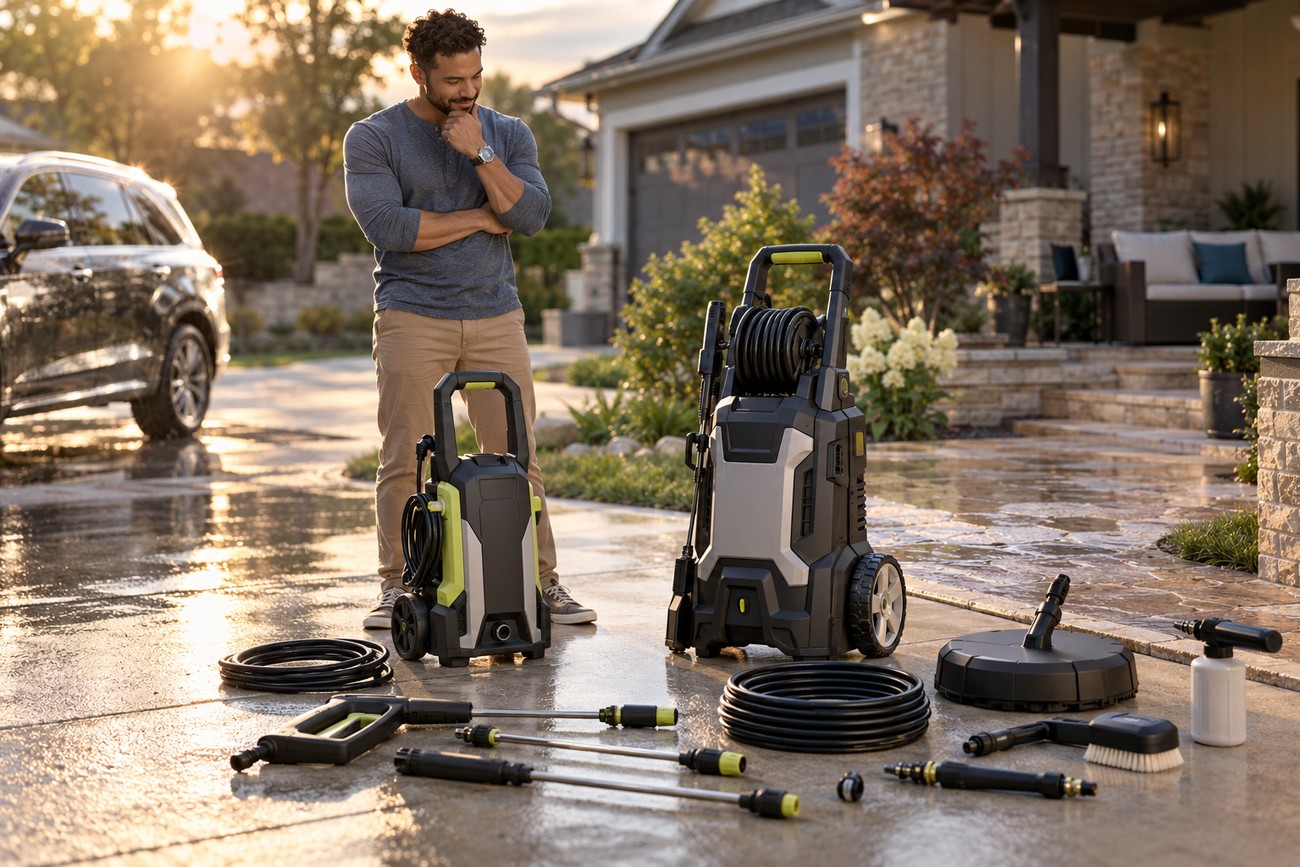
Start with the work: occasional cleanup, regular car washing, patio maintenance, or larger outdoor areas. Then compare the named model’s published pressure and flow rather than applying a general Kärcher-versus-Ryobi label. The figures should be read alongside the intended surface and operating pattern.
- Check the usable hose reach and power-cord arrangement.
- Confirm the supplied gun, lance, nozzles, and detergent setup.
- Verify quick-connect and accessory compatibility for the exact model.
- Check that your water supply meets the machine’s requirements.
- Consider local parts, accessories, service, and battery availability.
Kärcher’s K2–K7 household corded range gives buyers more steps between light and higher-capacity use, with an accessory ecosystem that may simplify future upgrades. Ryobi offers corded models plus separate 18V ONE+ and 36V cordless lines, which can be persuasive if mobility or an existing battery platform matters.
The practical winner is the specific machine that fits the work and removes the irritations most likely to affect its use. A well-equipped Ryobi can be the better choice for one buyer, while a Kärcher with longer reach or more suitable accessories can be the better choice for another.
Frequently asked questions
Choosing between Kärcher and Ryobi depends on the exact model, the cleaning task, and the equipment included. The questions below cover model condition, operating problems, and brand comparisons.
What should I check before buying a used electric pressure washer?
Run the washer if possible and look for leaks around the pump, hose, gun, and fittings. The spray should remain reasonably steady during the test, without an obvious loss of pressure. Inspect the power cable for cuts or damaged insulation, and check that the correct gun, lance, hose, and required connectors are included.
Ask for the manual or identify the exact model before buying replacement parts. Missing proprietary fittings or an unsuitable hose can cost more and create more inconvenience than the used machine initially suggests.
Why does my electric pressure washer pulse instead of spraying steadily?
Check the inlet water supply first, then inspect the hose for restrictions and allow trapped air to clear according to the manual. A blocked nozzle, loose connection, or leak on the inlet side can also interrupt the flow and make the pump pulse.
Stop running the washer if it remains poorly supplied. Clean or replace the nozzle only as the manual permits, check for visible leaks, and use the model’s troubleshooting procedure before continuing. Electrical and pump instructions are not identical across models.
Which brand of pressure washer is better, Ryobi or Kärcher?
Neither brand is universally better. Kärcher offers the broader K2–K7 household corded range, while Ryobi combines corded washers with separate 18V ONE+ and 36V cordless lines. Choose the exact model with the better match for your hose reach, attachments, water supply, and working frequency.
What is the best brand for electric pressure washers?
There is no single best brand for every electric pressure-washer job. The best fit is the model with suitable pressure and flow, usable reach, compatible accessories, and support available in your market. Compare the complete package rather than relying on the logo or maximum bar figure.
What pressure washer is better than Kärcher?
A Ryobi model may be a better choice if its equipment, platform compatibility, or cordless format suits your work more closely. Another Kärcher model may be the better upgrade if you need greater capacity or a particular accessory. Compare named models and current local specifications before deciding.