You agree on a car price, then the monthly payment changes, a package appears on the paperwork, or the dealer adds a fee you had not discussed. A discount from the manufacturer’s suggested retail price, or MSRP, tells you little if those other costs change the deal. The number worth negotiating is the verifiable total payable for the vehicle you intend to buy.
That total is easier to check before you visit the dealership. A written quote tied to a specific car lets you compare offers without relying on a salesperson’s description of the deal. It also gives you something concrete to check against the buyer’s order before you sign.
- Set Your Price and Financing Baseline Before You Contact a Dealer
- Compare Written Out-the-Door Quotes on the Same Terms
- Make the Offer by Email, Then Negotiate the Total
- Challenge Markups, Mandatory Packages, and Surprise Fees
- Keep the Loan and Trade-In From Undoing Your Savings
- Check the Buyer’s Order Before You Sign or Leave a Deposit
- Frequently asked questions
- What is the $3,000 rule for buying cars?
- How do you beat a car salesman at his own game?
- How to negotiate a better price at the dealership example?
Set Your Price and Financing Baseline Before You Contact a Dealer
Start with cars you would actually buy. Match the trim, major equipment, and model year across listings, then note the VIN or stock number for each one. A lower advertised price on a differently equipped car is a poor basis for an offer on your preferred vehicle.
Check competing listings and ask more than one dealership for a quote. Use those offers to set a target vehicle price, while keeping it distinct from the out-the-door total that includes fees, applicable taxes, registration, and any add-ons. A discount from MSRP is meaningful only in the context of comparable offers and the final amount you would pay.
Arrange an outside financing offer if you plan to borrow. It gives you a basis for comparing a dealer’s APR, loan term, and total borrowing cost, rather than assuming the offered rate is competitive. You can still choose dealer financing if its full terms work better.
Leave room for the market to tell you what is realistic. Negotiation results vary by model, inventory, demand, and dealership. Buyers report both little room to negotiate and discounts ranging from several hundred dollars to roughly $5,000 below MSRP; those are individual experiences, not a benchmark for your purchase.
Compare Written Out-the-Door Quotes on the Same Terms
Send the same request to each dealer and compare equivalent vehicles using the same payment method. Ask for the total payable for the identified vehicle, with every component shown separately.
| Quote item | What to request | What can distort the comparison |
|---|---|---|
| Vehicle | VIN or stock number, trim, and equipment | Different specifications |
| Selling price | Price before taxes and registration | A conditional discount |
| Dealer fees | Each fee, including the full doc fee | Charges omitted from a headline price |
| Add-ons | Each product, price, and whether it is optional | A package included in only one quote |
| Government charges | Taxes and registration separately | Confusing them with dealer fees |
| Payment terms | Conditions for each quoted price | Comparing a financing-only price with a cash price |
| Out-the-door total | Total payable with all conditions identified | Missing or estimated line items |
Make the Offer by Email, Then Negotiate the Total

Email lets you approach several dealers without committing to a long visit. Name the car you want and make your request specific enough to produce comparable answers. For example: “I’m interested in the vehicle with VIN [VIN]. Please send an itemized out-the-door price showing the vehicle price, dealer fees, applicable taxes, registration, add-ons, and any discount conditions. Can you beat the comparable written offer I have for the same equipment and payment method?”
A dealer may respond with a monthly payment or say the price needs a manager’s approval. Neither response settles the total. A useful follow-up is: “Thank you. Please confirm the complete out-the-door quote in writing, tied to that VIN, before we discuss payments or arrange a visit.” Give a reasonable date by which you need the answer, particularly if you are comparing available cars.
If the dealer cannot yet confirm a price, ask when a written quote will be available. Some dealers may hold firm on popular vehicles, while others may improve an offer; neither outcome proves the process was unfair. If no written total arrives by your deadline, move on to a dealer whose terms you can evaluate.
Challenge Markups, Mandatory Packages, and Surprise Fees
Review a markup, doc fee, or package as a separate line item before debating the total. Ask which charges the dealer imposes, which products are optional, and whether the quoted total changes if you decline them. An advertised discount can disappear once a required package is added, so compare the amount payable rather than the size of the discount.
The FTC says advertised prices must include mandatory dealer-imposed charges, including the full doc fee; direct government charges are separate. State rules may also apply. If a mandatory dealer fee appears only after you request a quote, ask the dealer to explain the difference between the advertisement and the written total.
A dealer must not misrepresent an optional product as required or charge for it without your consent. A product’s preinstallation alone does not make an optional purchase mandatory. Still, physical removal or a price concession is not guaranteed: if the dealer will sell that particular car only at a total you dislike, another vehicle or dealer may be the practical alternative.
Keep the discussion precise. A markup may be a price you can negotiate or reject, whereas taxes and registration are direct government charges that should be identified separately. Ask for a revised written total after any change so that a removed charge does not reappear under a different label.
Keep the Loan and Trade-In From Undoing Your Savings
Settle the vehicle price first, evaluate your trade-in separately, then compare financing offers. Folding all three into one monthly payment makes it harder to see where a concession was made or taken back. A higher trade-in allowance, for instance, has less value if the car’s selling price rises by a similar amount.
Bring an outside financing offer to the discussion if you intend to borrow. Compare APR, loan term, amount financed, and total borrowing cost, not the monthly payment alone. A lower payment can result from a longer term while leaving you with a more expensive loan.
A discount tied to dealer financing can be worthwhile, but assess it against the loan’s cost. Ask for the price available with other payment methods, then compare the complete transactions on the same basis. A large selling-price discount does not establish the better deal if the required financing costs substantially more.
Keep any trade-in figure visible on its own paperwork, along with any amount still owed on the old car. That makes it easier to see how much value the trade contributes and how much debt, if any, enters the new transaction. Check the final amount financed against the deal you chose before accepting a payment figure.
Check the Buyer’s Order Before You Sign or Leave a Deposit
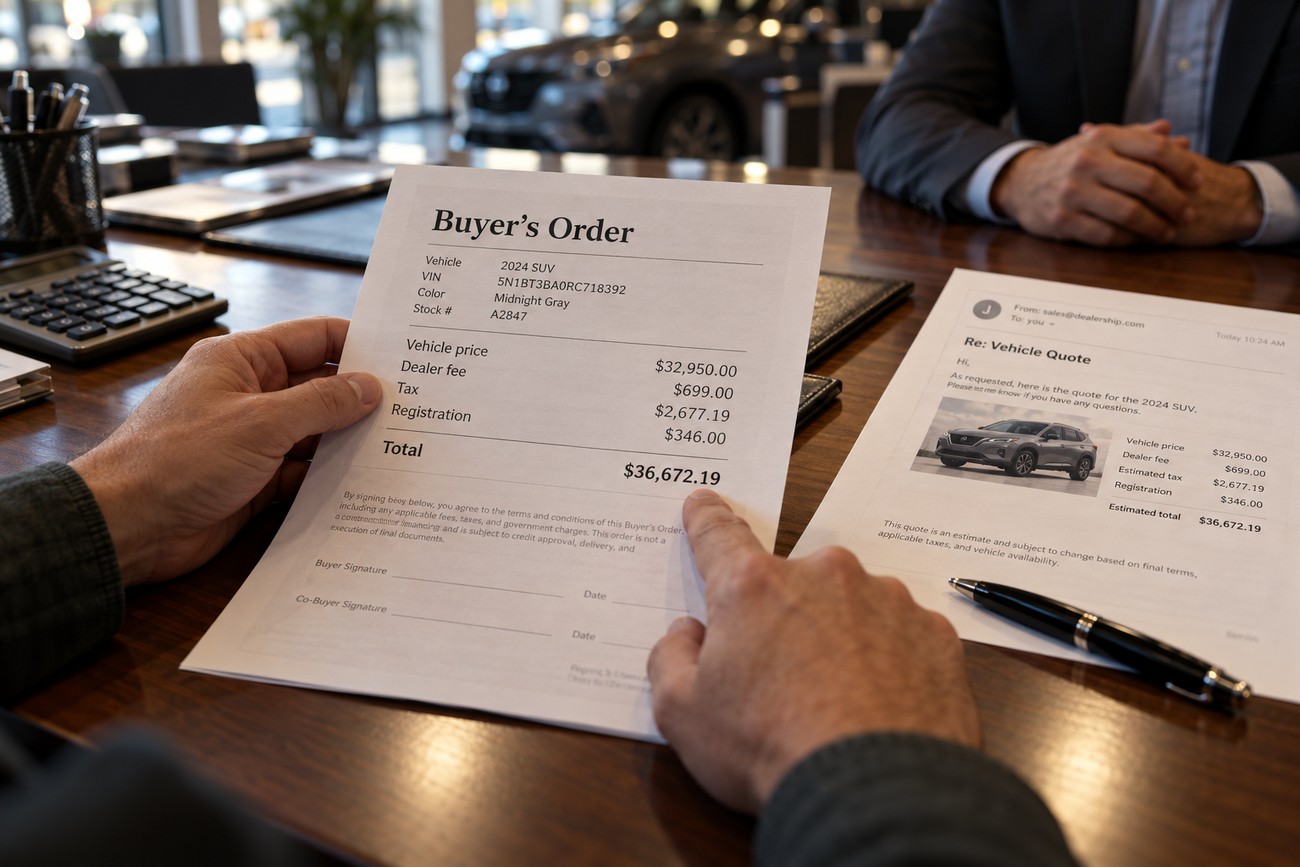
A written email quote is a useful negotiating record, but it does not by itself finalize a sale. Before signing, compare the buyer’s order with that quote. Confirm the VIN, agreed vehicle price, every dealer charge, applicable taxes, registration, add-ons, and the conditions attached to any discount.
Read the financing documents with the same care. Verify the APR, term, amount financed, and total borrowing cost, and check that any trade-in allowance appears as agreed. If an optional product is listed that you did not accept, ask for corrected paperwork before proceeding.
Do not leave a deposit until the full price and the deposit’s refund conditions are in writing. Confirm the amount, what happens if financing or delivery terms change, and whether a cancellation would affect your refund. Rules can vary by location, so do not assume a deposit is automatically refundable.
If the price changes when you arrive, point to the written quote and ask for a corrected buyer’s order. A mandatory dealer charge should not be a surprise: the FTC says advertised prices must include mandatory dealer-imposed charges, including the full doc fee, while direct government charges are separate. If the dealer will not provide paperwork matching terms you are willing to accept, leave without signing.
Frequently asked questions
Negotiating advice often reduces a complicated purchase to a single discount target or a clever line to say in the showroom. Neither replaces a comparable offer and clear paperwork. These answers focus on the decisions that can change what you pay.
What is the $3,000 rule for buying cars?
There is no reliable universal $3,000 discount rule for car purchases. A fixed amount below MSRP does not account for the model, local inventory, demand, or charges added to the sale. Use comparable local out-the-door offers to judge whether a price is competitive, even when the advertised discount looks substantial.
How do you beat a car salesman at his own game?
Treat the discussion as a comparison of written terms, not a contest with the salesperson. State the vehicle and total you are considering, give the dealer a chance to respond, and pause if the conversation shifts to a payment or an unitemized promise. A salesperson may need approval or may have little room to move; your protection is the ability to verify the offer and decline it.
How to negotiate a better price at the dealership example?
Suppose you arrive with a written quote for a specific car and the buyer’s order includes a package that was absent from it. Point to the difference, ask whether the package is optional, and request a revised total if you decline it. Compare the corrected order with your other offer before signing; if the dealer will not clarify the change, you can leave without committing to the purchase.