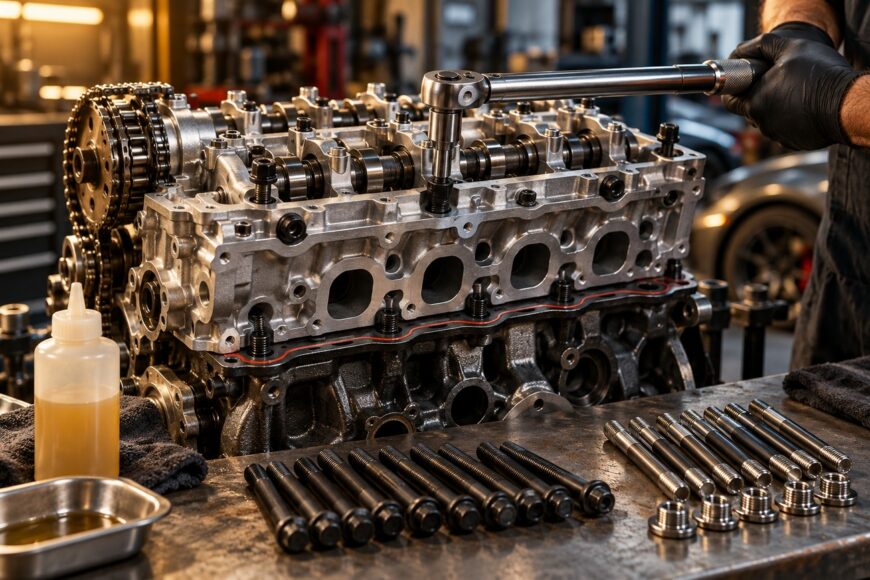
A torque wrench can show the specified reading while a head gasket still leaks, a bolt breaks, or a thread pulls out of the block. Torque measures resistance to turning; it does not directly measure bolt stretch or the clamp load holding the head down.
Torque-to-yield (TTY) head bolts and aftermarket studs use different installation rules. Choosing between them starts with the instructions for the exact engine, fastener, and lubricant, rather than a universal torque chart or the assumption that more tightening means a better seal.
- Why Head Bolt Torque Does Not Equal Clamp Load
- TTY Head Bolts and Stretch Bolts: Different Rules
- TTY Bolts vs. ARP Studs: What Changes at Assembly
- A Reliable Head Fastener Installation Sequence
- Frequently asked questions
- How much does a bolt stretch when torqued?
- What should head bolts be torqued to?
- What is the recommended torque for engine head bolts?
Why Head Bolt Torque Does Not Equal Clamp Load
Most tightening torque is spent overcoming friction in the threads and beneath the bolt head or nut. The remainder helps stretch the fastener, creating the load that clamps the head and gasket. Torque is therefore an indirect proxy for clamp load, even when the wrench is accurate.
Lubricant changes that friction. So do corrosion, damaged threads, and the condition of the threaded hole. Substituting oil for a specified assembly lubricant can change the clamp load at the same wrench setting. A dirty hole may also make a bolt feel tight before it has properly clamped the head.
A correct reading cannot protect a weak or damaged block thread from pulling out. Nor can it seal a gasket against a warped head or block. If the joint leaks, check the fastener procedure and the mating surfaces before assuming it needs more torque.
For some fasteners and applications, measured stretch gives a more direct indication of what tightening achieved. That requires a recorded length before installation and a final length after tightening, compared with the fastener maker’s specification. There is no stretch figure that applies to every head bolt.
TTY Head Bolts and Stretch Bolts: Different Rules
A TTY head bolt is tightened through a specified torque stage followed by a specified angle stage. The angle advances the bolt through a controlled amount of rotation after the preliminary load is established. The engine manufacturer’s manual sets the values, stages, and tightening sequence for that engine.
TTY bolts are designed to undergo controlled plastic stretch during installation. Generally replace them after removal unless the engine manufacturer explicitly permits reuse. A previously stretched bolt may develop less clamp load on reinstallation, allowing gasket leakage or bolt failure.
“Stretch bolt” is sometimes used loosely for any bolt that lengthens under load; all loaded bolts stretch to some degree. It does not make every high-strength fastener single-use. Some aftermarket fasteners can be reused if they remain within the manufacturer’s condition and elongation limits, but that permission does not extend to OEM TTY bolts.
If an angle stage suddenly becomes impossible to complete, stop rather than forcing the wrench farther. The resistance may point to damaged threads, debris, a bolt reaching the bottom of its hole, or the wrong fastener. More leverage can turn an assembly problem into a broken bolt or damaged block.
TTY Bolts vs. ARP Studs: What Changes at Assembly
These systems differ in how the fastener is seated, tightened, and assessed for reuse.
| Check | TTY head bolts | ARP-style studs |
|---|---|---|
| Installation | Bolt passes through the head and threads into the block. | Stud is threaded into the block by hand; the internal hex is not used to tighten it down. |
| Lubrication | Follow the engine manual’s specified thread and bearing-surface condition. | Use the lubricant specified for the particular kit. |
| Tightening | Specified torque stage, then angle stage, in the stated sequence. | Nuts are commonly tightened in stated torque stages. One specific set uses 40, 80, and 115 ft-lb; those values are not universal. |
| Reuse | Generally replace after removal unless explicitly permitted otherwise. | Serviceable fasteners may be reused; replace those with galled threads, corrosion, or excessive permanent elongation. |
| Limitation | Reuse can compromise clamp load. | Studs cannot correct a warped head or block, or an incorrect gasket. |
Studs can help with alignment and reduce tightening distortion, but their torque values belong to a specific kit, lubricant, and application. Confirm that the kit suits the block and head before treating it as an upgrade.
A Reliable Head Fastener Installation Sequence
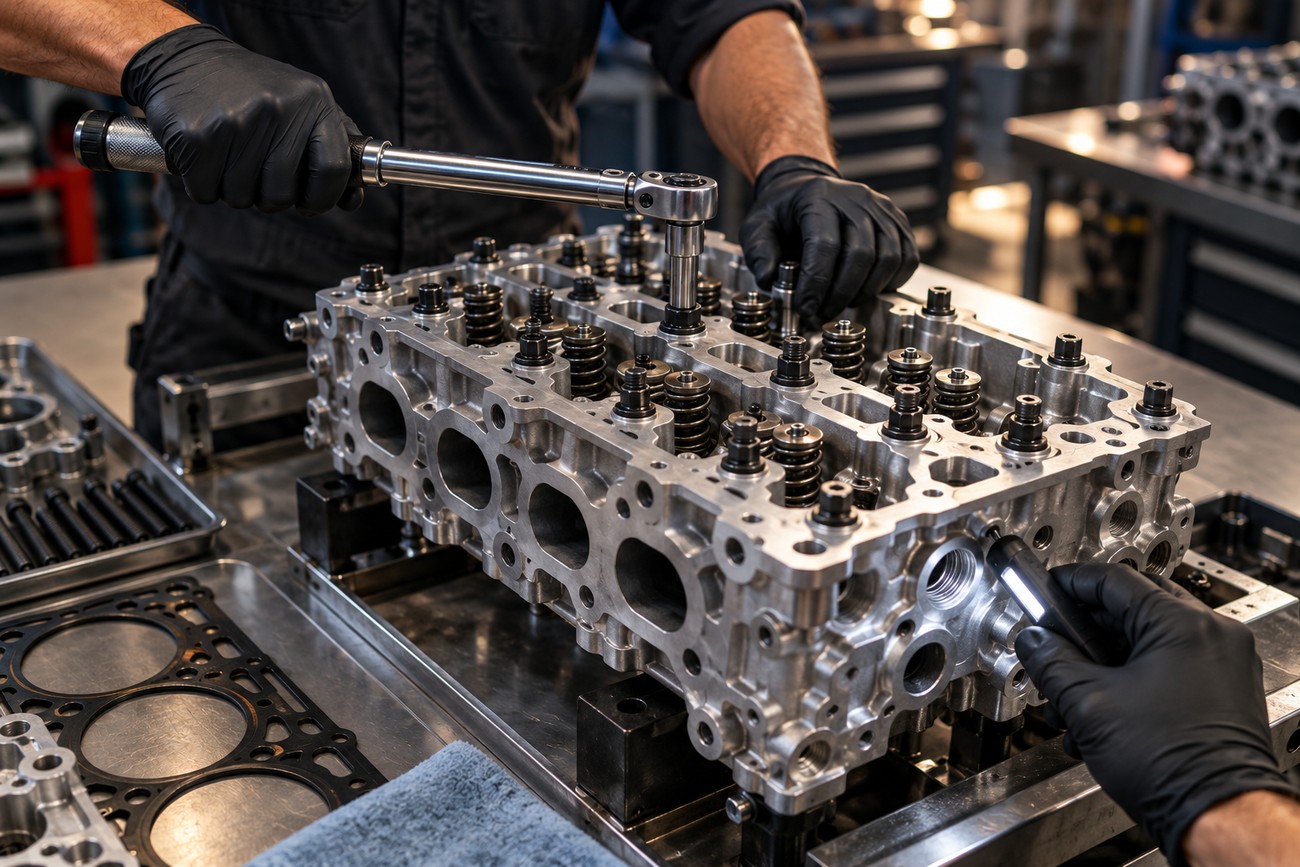
Identify the exact engine and fastener first. Obtain the engine manual for OEM bolts or the instructions for the particular stud kit, then confirm the lubricant condition, stages, and tightening order. A chart based only on bolt diameter cannot account for the joint you are assembling.
Inspect the head and block mating surfaces, then clean and check every threaded hole. Look for damaged threads, corrosion, and trapped debris. Confirm that each bolt has the required engagement without reaching the bottom of its hole before it can clamp the head.
Install ARP studs into the block by hand; do not use the internal hex to torque them down. Check that their length and seating allow the nuts to clamp the head. If a stud appears to bottom in the block before the nut can clamp the head, stop and verify the kit and installation rather than forcing it deeper.
Apply only the lubricant specified for the fastener and to the surfaces identified in its instructions. Tighten in the prescribed order and stages so all fasteners reach a consistent preliminary load before the final stage. If a torque figure conflicts with the kit instructions, identify the source of the mismatch before proceeding; do not average the two values.
Stop if an angle stage cannot be completed or a wrench reading behaves unexpectedly, and inspect the fastener and hole. Once assembled, follow any retightening instruction specific to the gasket or application. ARP generally does not recommend retightening on a hot engine unless the relevant instructions require it.
Frequently asked questions
The specification is a procedure, not a single number. Before comparing readings or deciding whether a fastener can be reused, establish which fastener and instructions apply to the assembly.
How much does a bolt stretch when torqued?
There is no universal stretch amount. Where stretch measurement is specified and the fastener can be measured, record its original length before installation, tighten it by the required procedure, and compare its final length with the initial reading. For reuse, assess any permanent elongation against that fastener manufacturer’s limit. A measurement taken only after removal cannot reveal how much it stretched from its original length.
What should head bolts be torqued to?
Use the specification for the exact engine and bolt type, including its required lubricant condition, torque stages, angle stages, and sequence. Check the fastener identification before picking up the wrench: a value for a same-diameter bolt in another engine may produce a different clamp load or damage the threads.
What is the recommended torque for engine head bolts?
There is no single recommended head-bolt torque for all engines. For original equipment bolts, use the engine manufacturer’s current procedure; for an approved aftermarket kit, use its application-specific instructions and confirm any engine-specific requirements. If those documents are missing or disagree, resolve the specification before assembly rather than selecting the higher figure.