Many drivers expect highway fuel economy to be clearly better than city economy, then see consumption approach urban levels at 120–130 km/h. The reason is easy to miss: the engine may be operating smoothly, yet the car is pushing much harder against the air. The extra speed can erase the benefit of uninterrupted travel.
Highway efficiency is a trade-off between arrival time and fuel use. Speed, throttle control, tire pressure, vehicle load, roof equipment, climate control, wind, and route choice all influence the result. There is no universal magic speed, so the practical goal is to find a sensible operating range for your vehicle and the conditions of the trip.
- Why Highway MPG Can Get Worse at High Speed
- Choose an Efficient Speed and Drive Smoothly
- Prepare the Car Before a Long Highway Trip
- Use Air Conditioning, Idling, and Fuel Stops Intelligently
- Plan the Route Around Real Fuel Use
- Check Whether the MPG Number Is Real
- Highway Fuel-Saving Myths That Cost Drivers Money
- Frequently asked questions
- How can I find the most economical speed for my specific car?
- Why does my car’s trip computer show better MPG than my fuel receipts?
- How can I improve MPG on the highway?
- What trick gets the best gas mileage?
- What is the most effective way to save gas on a road trip?
Why Highway MPG Can Get Worse at High Speed
Highway driving is usually efficient because the vehicle avoids repeated stops, launches, and braking. Once speed rises, aerodynamic resistance becomes the dominant factor for many passenger cars. Aerodynamic drag rises approximately with the square of speed, so each additional increase demands disproportionately more power from the engine.
A change from 90 to 130 km/h can increase highway fuel use by almost 1.5–2 times. That does not mean every car will show exactly this result, since body shape, wind, gearing, tires, load, and road surface all matter. It explains why a modest increase on the speedometer can create a large change on the fuel display.
For most passenger cars, 80–100 km/h usually offers the best balance between travel time and fuel consumption. After roughly 100–110 km/h, aerodynamic losses increasingly dominate fuel consumption, and the engine must produce more power simply to maintain speed. A diesel, a small gasoline hatchback, a large SUV, and an electric vehicle may each have a different low-consumption point.
Official economy figures are measured under controlled conditions that may differ from a real road trip. Testing may involve a lighter vehicle, calm weather, limited traffic, and fewer speed changes than your journey. Roof equipment, passengers, hills, cold air, strong wind, air conditioning, and high cruising speeds can all move real consumption away from the published number.
Choose an Efficient Speed and Drive Smoothly

Choose a speed that keeps the trip moving without forcing the vehicle into the aerodynamic penalty zone. For many cars, a steady 80–100 km/h is a useful starting range, while traffic rules, road design, and local conditions remain the priority. Compare the time saved by driving faster with the additional fuel required for the whole journey.
Smooth driving without sharp acceleration and braking can reduce highway fuel use by about 10–15%, with savings of up to 30% possible for some drivers who substantially change their driving style. Look farther ahead, leave space for traffic to settle, and build speed progressively. Repeatedly accelerating to pass, then braking for slower traffic, wastes energy that never contributes to useful progress.
Use the highest practical gear once the road and engine allow it. Around 2,000 rpm in the highest practical gear is commonly an efficient highway operating point, although the engine should still respond cleanly without shuddering or struggling. On a long downhill, remain in a controlled gear and use minimal throttle where appropriate; coasting in neutral removes engine braking and reduces your immediate control of the car.
On rolling roads, allowing a small speed variation can be more efficient than making the car forcefully regain every kilometer per hour before the next rise. Easing off before a climb often avoids the repeated high-load acceleration produced by rigid speed holding.
Cruise control is generally most efficient on a flat, steady road. On rolling terrain, it may increase consumption by forcing acceleration to hold the selected speed, then repeating that cycle over every rise and descent. Strong crosswinds create a similar aerodynamic penalty, so reducing speed slightly can help more than trying to maintain the original setting.
Prepare the Car Before a Long Highway Trip
Check tire pressure when the tires are cold, using the manufacturer’s recommendation rather than the maximum pressure printed on the tire sidewall. Low pressure increases rolling resistance and fuel use; the brief’s typical passenger-car range is about 2.2–2.5 atm, though the correct value depends on the vehicle and load. A heavily loaded rear axle may require the manufacturer’s higher rear-axle setting.
Remove items that will not be used during the trip. Reducing vehicle mass by about 50 kg can save roughly 1–2% of fuel, with effects that add to other measures. The saving from one forgotten tool or bag is small, yet unnecessary items impose their penalty for every kilometer.
Roof racks, roof boxes, and similar equipment deserve special attention. They disturb airflow where the vehicle is most sensitive to it, and they can add several liters per 100 km at speeds above 100 km/h. Remove the equipment after the trip if it is no longer needed; an empty roof rack still creates aerodynamic resistance.
A fully loaded car can use about 1–1.5 liters per 100 km more than the same car on a lightly loaded trip. Check the owner’s guidance for tire pressure with passengers and luggage, distribute heavy items securely, and avoid carrying extra fuel containers or supplies without a clear reason. Load planning also improves stability, which makes smooth driving easier.
Use Air Conditioning, Idling, and Fuel Stops Intelligently

Air conditioning adds approximately 0.5 l/100 km on the highway and up to 1.5 l/100 km in city driving. The highway penalty is often lower in relative terms because steady cruising makes the added load a smaller share of total fuel use, yet the compressor still requires engine power. Use a comfortable setting and avoid running the system harder than necessary.
Long stationary periods can justify switching off the engine when it is safe and permitted. Roadworks, traffic holds, and extended waiting can turn idling into a meaningful fuel loss, especially in trucks and large crossovers. Keep the engine running when needed for visibility, climate control, battery protection, or traffic safety.
A nearly empty tank is not a dependable fuel-saving strategy. Carrying less fuel does reduce mass slightly, but the practical benefit is limited and must be weighed against condensation and fuel-system risks when the tank is frequently nearly empty. Plan refueling around reliable stations and the route rather than trying to finish every trip with the warning light on.
Fuel-stop planning also reduces rushed decisions. A well-timed stop can prevent an unnecessary detour, while a very late stop may force you into an expensive or inconvenient station. The aim is consistent, safe travel with measured fuel use, rather than chasing small changes in tank weight.
Plan the Route Around Real Fuel Use
Route choice is a fuel-economy decision as well as a navigation decision. A route that sends you through cities and congestion can create extra stops and higher fuel use than a longer, uninterrupted highway route. Compare the full journey, including urban approaches, intersections, traffic lights, and likely delays.
A nominally shorter route may consume more fuel if it includes frequent speed changes. Repeated overtaking followed by braking wastes fuel compared with anticipating traffic and maintaining a stable speed. A steady route with a few extra kilometers can be the better choice when it avoids stop-and-go sections and unnecessary interruptions.
Before leaving, compare expected travel time, terrain, traffic, road quality, and the amount of steady-speed driving. A route through hills may be reasonable if traffic is light, while a flat route can lose its advantage during congestion. Weather forecasts also matter: strong winds can change the cost of maintaining a given speed.
The effect is substantial in commercial driving. On the same route, truck fuel use can differ by 10–20% because of speed, driving style, and vehicle condition. Passenger cars show the same underlying pattern, although the exact difference depends on the vehicle and trip. Route planning works best when paired with a realistic speed and a vehicle prepared for the load.
Check Whether the MPG Number Is Real
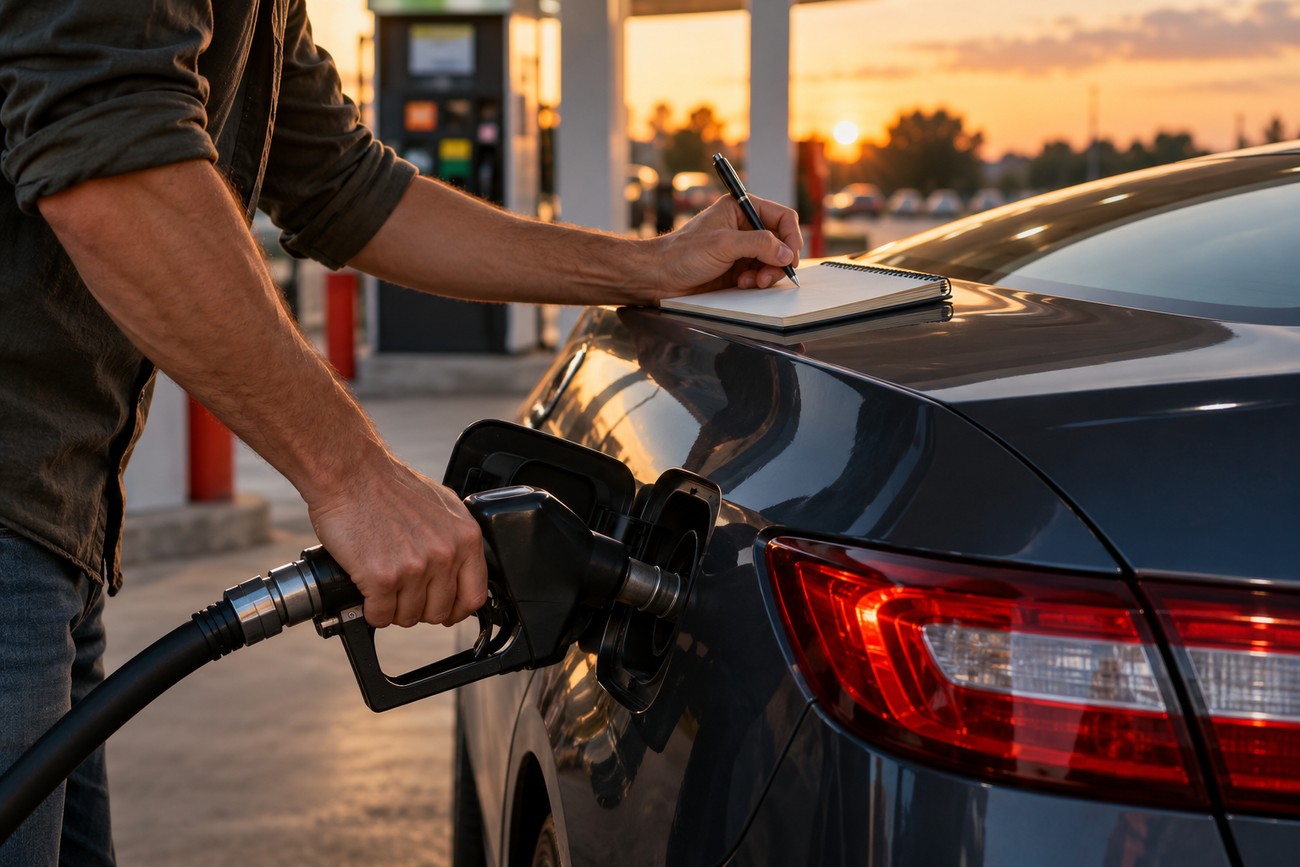
The most useful real-world comparison is based on fuel added and distance traveled rather than a single dashboard estimate. At a fill-up, record the odometer or trip distance and the amount of fuel added. At the next comparable fill-up, divide the fuel used by the distance traveled and multiply by 100 to obtain l/100 km.
For a reliable result, fill the tank in a consistent way and compare several refueling cycles. Automatic pump shutoff can vary, and a different fill level changes the apparent result for one individual tank. A multi-tank average smooths out those measurement differences.
Compare like with like before diagnosing the vehicle. Record speed, load, roof equipment, wind, hills, traffic, temperature, and air-conditioning use. A trip at 130 km/h with luggage and a headwind cannot fairly be compared with a lightly loaded trip at 90 km/h in calm weather.
Eco mode may have limited benefit at high highway speeds because aerodynamics and overtaking behavior often matter more than throttle-response changes. Use it if it makes smooth driving easier, then verify the result over measured trips. If consumption changes sharply without a clear change in conditions, inspect tire pressure, brakes, alignment, and engine operation.
Highway Fuel-Saving Myths That Cost Drivers Money
The idea that higher speed improves economy because the engine reaches its “best” operating range fails once air resistance takes over. After roughly 100–110 km/h, increasing speed usually raises fuel consumption sharply rather than improving economy. A lower, steady speed often saves more fuel than a small reduction in engine load at a higher speed.
Cruise control is useful on a flat, open road, where it prevents unnecessary speed drift. It can increase fuel use on hilly or rolling roads when it aggressively holds the selected speed through every rise. Manual control can be more economical when it allows small, safe variations in speed and avoids needless acceleration.
Eco mode cannot cancel aerodynamic drag. It may soften throttle response, delay downshifts, or alter climate-control behavior, yet those changes have limited influence when the main energy demand comes from moving quickly through the air. Reducing speed and moderating overtaking usually produce a clearer measurable effect.
Power-oriented chip tuning can increase real-world highway fuel use despite claims of an economical mode. A carefully calibrated change may work for a particular vehicle and driving pattern, but extra available power often encourages stronger acceleration. Judge any modification by repeated fuel measurements under comparable conditions rather than by its marketing description.
The most economical speed is vehicle-specific. 80–85 km/h is not universally optimal, while 90–100 km/h may be a more realistic compromise for some cars, depending on engine, transmission, body shape, load, and conditions. The useful answer comes from measured trips, legal road speeds, and a speed you can hold smoothly.
Frequently asked questions
How can I find the most economical speed for my specific car?
Test several steady speeds on the same road, using similar weather, load, tire pressure, traffic, and air-conditioning settings. For each run, reset the trip meter, maintain the selected speed where safe, and calculate consumption from fuel added rather than relying only on the display. Repeat each speed over more than one trip or refueling cycle, then compare the results alongside travel time.
Why does my car’s trip computer show better MPG than my fuel receipts?
The dashboard estimate may use injector data and calculated distance, while fuel receipts measure how much fuel actually enters the tank. Fill-level variation, pump shutoff, short measurement intervals, and rounding can make one tank look unusually efficient. Record fuel and distance across several full refueling cycles to produce a more reliable average.
How can I improve MPG on the highway?
Start with the factors that affect the entire trip: reduce speed when practical, keep acceleration and braking smooth, remove roof equipment, set tire pressure correctly, and avoid unnecessary load. Then compare measured fuel use over similar journeys. This approach identifies which change helps your car instead of assuming that one driving mode works everywhere.
What trick gets the best gas mileage?
There is no single trick that overcomes high aerodynamic drag. The strongest repeatable result usually comes from combining a sensible cruising speed with stable throttle control, correct tire pressure, and a clean, lightly loaded vehicle. Small improvements add together, while an unneeded roof box or frequent hard acceleration can erase them.
What is the most effective way to save gas on a road trip?
Use a route that supports steady travel, select a realistic speed for the car and road, and measure the result over the whole journey. Diesel vehicles generally use less fuel than comparable gasoline vehicles at the same highway speed, although their most efficient speed range can be slightly higher. Engine type, transmission, body shape, load, and road conditions determine the final result.