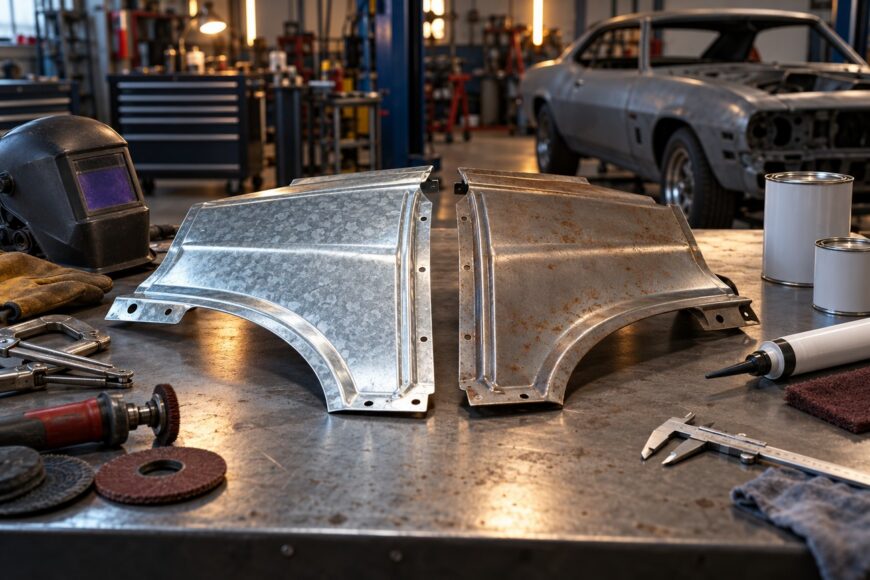
Galvanized and bare-steel repair panels solve different problems. Galvanized steel provides a zinc barrier and sacrificial protection, yet welding, cutting, grinding, and impact damage the coating that creates that advantage. Bare steel is easier to weld and prime predictably, although moisture, salt, contamination, and even condensation can produce surface rust quickly.
The better choice depends on more than the material label. Panel fit, sheet thickness, flange geometry, coating documentation, welding conditions, storage control, and the quality of the finishing system all affect the result. A well-made bare-steel panel with disciplined protection can outperform a poorly fitting galvanized panel that requires extensive cutting, rework, and coating repair.
- Galvanized vs. Bare-Steel Repair Panels: At a Glance
- What the Zinc Coating Actually Protects
- Welding Galvanized Panels Without Creating a New Problem
- Post-Weld Protection and Corrosion Control
- Bare Steel: Easier Fabrication, Tighter Timing
- Fit and Manufacturing Quality Can Outweigh the Material Label
- How to Choose for the Repair You Actually Have
- Common Mistakes and Myths About Repair Panels
- Frequently asked questions
- Why do some welders drink milk after welding galvanized steel?
- What is the main downside of galvanized steel for a repair panel?
- What does white vinegar do to galvanized metal?
- How should a bare-steel repair panel be stored before installation?
Galvanized vs. Bare-Steel Repair Panels: At a Glance
This comparison focuses on workshop consequences rather than marketing descriptions. Manufacturer quality remains decisive for both materials.
| Repair factor | Galvanized steel | Bare steel |
|---|---|---|
| Corrosion behavior | Zinc provides a physical barrier and sacrificial protection. It can corrode first and protect steel around small scratches, while damaged edges, welds, holes, bends, and cavities remain vulnerable. | There is no zinc layer to provide sacrificial protection. Surface rust can develop quickly with moisture, salt, or contamination. |
| Welding preparation | Remove coating in the weld zone as required by the process and joint. Arc welding also requires fume extraction and ventilation because zinc produces zinc-oxide fumes. | Generally simpler and more predictable to weld, provided the surface is clean and free from oil, transport coating, rust, and condensation. |
| Storage risk | The coating offers some protection, but scratches, cut edges, and exposed steel still need attention. Damp storage can also contaminate the surface. | Keep dry and protected during transport and storage. Condensation, salt, dirt, and fingerprints can start corrosion before installation. |
| Finishing workflow | Clean zinc dust and residue, repair damaged coating, then apply compatible primer, seam sealer, paint, and cavity protection as appropriate. | Prepare and prime promptly after cleaning. Temporary protection may be needed if painting or installation is delayed. |
| Fit considerations | The word galvanized does not establish sheet thickness, stamping accuracy, flange shape, or coating quality. | The same manufacturing variables apply. A precise bare-steel panel may reduce fabrication and finishing work. |
| Suitable conditions | Useful where documented coating quality and safe welding controls are available, with a defined plan to restore protection. | Useful where the panel fits well and the shop can control moisture, contamination, preparation, and prompt coating. |
What the Zinc Coating Actually Protects
Galvanizing protects steel in two related ways. The zinc forms a physical barrier between the steel and the environment, limiting contact with water, oxygen, and salts. Zinc also provides sacrificial protection: when steel and zinc are connected in the presence of an electrolyte, zinc tends to corrode first.
That sacrificial action explains why a small scratch does not always become an immediate rust line. Nearby zinc can help protect the exposed steel while the zinc is consumed. The effect is useful, although it has limits that depend on the size and location of the damage, the environment, and the amount of remaining coating.
Repair work creates vulnerable areas by design. Cutting exposes edges, drilling exposes holes, bending can thin or crack the coating, and welding removes protection around the joint. Grinding through the surface has the same consequence. These locations often receive water, road salt, trapped dirt, or condensation, so they need separate treatment after fabrication.
“Galvanized” also describes no single universal coating process or service life. Coating thickness, application method, substrate preparation, and quality control vary by supplier. ASTM A123 covers hot-dip galvanizing of iron and steel products and structures; it does not automatically certify the coating on a specific thin automotive repair panel.
Welding Galvanized Panels Without Creating a New Problem
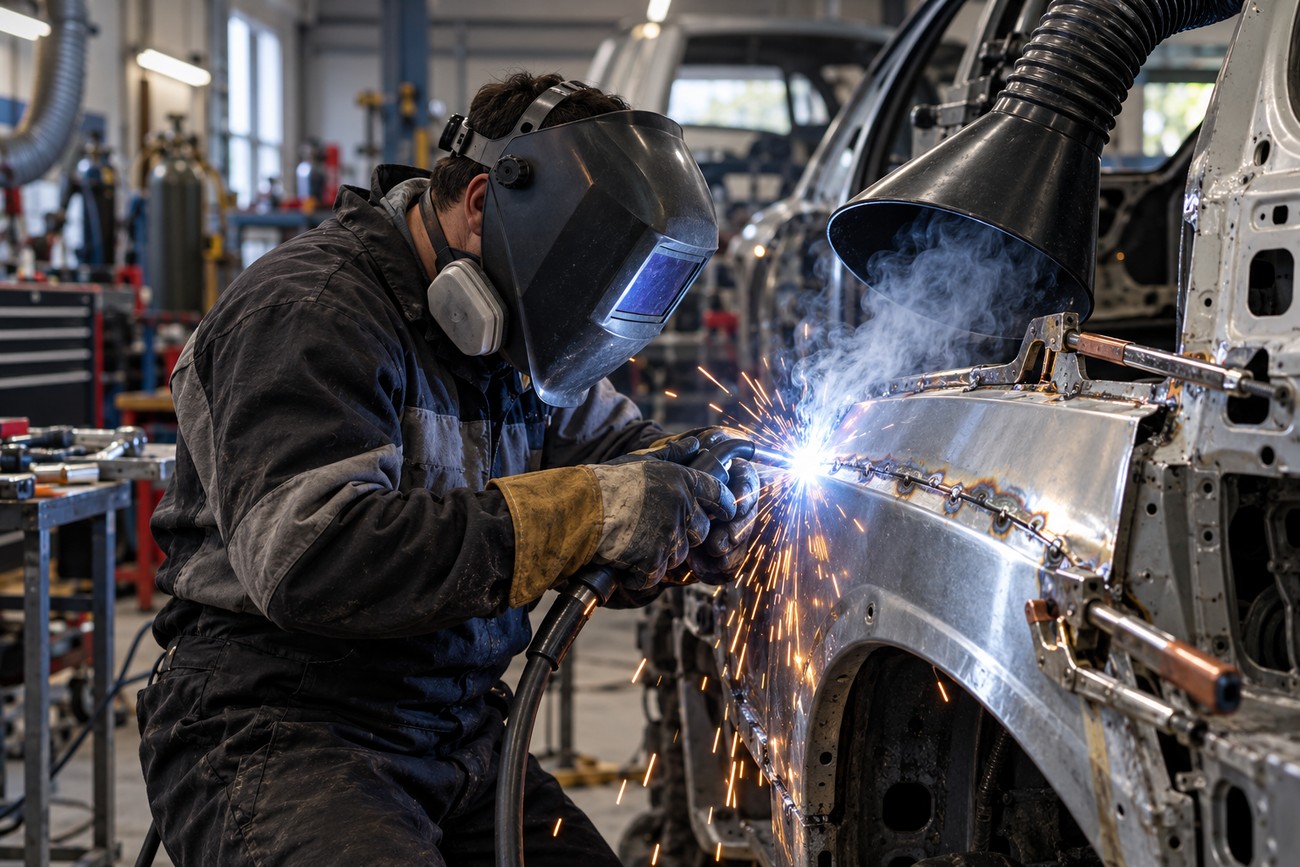
Arc welding galvanized steel requires control of both the joint and the fumes. Zinc vaporizes before steel during arc welding and forms zinc-oxide fumes. The visible smoke is a process warning, not a harmless nuisance, particularly in a closed garage or a shop where air movement carries the plume across the operator’s breathing zone.
Use local fume extraction positioned to capture emissions without disturbing the shielding gas, together with effective general ventilation. Keep the extraction close to the weld and arrange the work so the operator does not place their face above the plume. A respirator, where required by the workplace risk assessment, supports the control plan; it does not replace extraction, ventilation, or sensible positioning.
Remove coating from the weld zone as required by the welding process, joint design, and panel construction. This can reduce smoke, porosity, and spatter, and it gives the operator a cleaner arc area. There is no single universal coating-removal width for every panel, process, and joint, so preparation should follow the welding procedure rather than an arbitrary measurement.
Removing zinc solves only the first half of the problem. The cleaned strip becomes the first place likely to rust unless the repair plan includes a defined post-weld protection step after the joint has been cleaned and cooled.
Preparation must also account for access and heat. Remove loose coating and contamination without thinning the panel unnecessarily, then weld with settings and fit-up appropriate to the sheet. Repeated welds, excessive heat, and grinding enlarge the damaged area, increasing the amount of protection that must later be restored.
After welding, inspect the joint for porosity, incomplete fusion, excessive spatter, and openings that could admit water. Do not treat reduced smoke as proof that the coating has been restored. Fume control, weld quality, and corrosion protection are separate parts of the repair.
Post-Weld Protection and Corrosion Control
Post-weld corrosion control begins after the metal has cooled. Remove welding residue, abrasive dust, loose zinc, oil, and other contamination using a preparation method compatible with the next coating. The surface must be clean enough for the primer and sealers to adhere, while the joint should be inspected before it disappears beneath the finishing system.
Every weld, cut, grind-through, and repeated weld locally removes or damages the original zinc protection. Restore protection over those areas before completing primer, seam sealing, paint, and cavity protection. The exact products and order depend on the repair system, the exposed surfaces, and the product technical data.
ASTM A780 addresses repair of damaged hot-dip galvanized coatings. In the applicable industrial coating repair cases described by that standard, the repair layer may require a minimum thickness of 50.8 micrometers and a maximum of 100 micrometers. Those values should not be transferred automatically to a thin automotive repair panel without checking the coating specification, repair product, and applicable procedure.
A zinc-rich product is not automatically equivalent to the original coating. Composition, zinc content, dry-film thickness, adhesion, cure, and compatibility with subsequent primer or paint all matter. A product label that says “zinc” does not by itself establish that it will reproduce the protection of the factory coating or satisfy a particular repair specification.
Seam sealer must cover the joint as intended without trapping contamination or leaving a path into a flange. Paint protects exposed surfaces, while cavity protection addresses the hidden side of seams, boxed sections, and internal folds. The repair is complete only when the visible and concealed surfaces have been considered together.
Bare Steel: Easier Fabrication, Tighter Timing
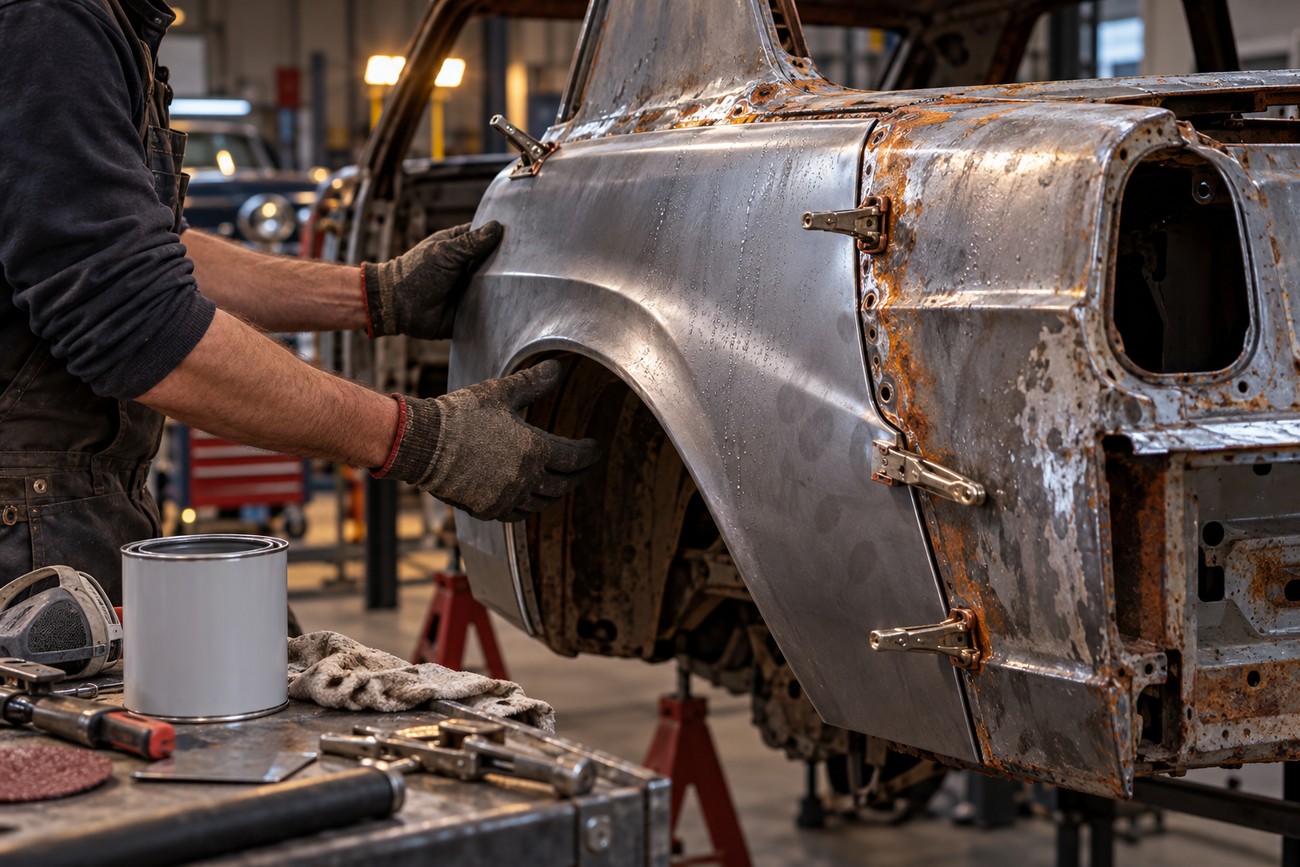
Bare steel usually gives the welder a cleaner, more controllable surface. There is no zinc layer to remove in the joint, and the operator can establish a consistent preparation and priming routine. That simplicity can be valuable on a repair involving many welds, tight access, or repeated trial fitting.
The penalty is exposure time. Bare steel can develop surface rust quickly when exposed to moisture, salt, or a contaminated surface. Condensation during delivery or overnight storage may be enough to create a visible film, especially where dirt or fingerprints hold moisture against the sheet.
Before priming, remove oil, transport wax, condensation, metal dust, and other residues. Painting over a faint rust film or a greasy transport coating leaves a weak foundation that may later blister, peel, or allow corrosion to spread beneath the finish. Preparation should follow the product data for the chosen primer rather than a generic wipe-down routine.
Plan the sequence before the panel arrives. If installation or painting will be delayed, keep the panel dry, protected from salt and shop dust, and covered in a way that does not trap condensation. A bare-steel panel may be the more practical choice when its fit and repair workflow are substantially better than those of a poorly made galvanized panel, provided the shop can protect it promptly.
Fit and Manufacturing Quality Can Outweigh the Material Label
Panel material is only one part of panel quality. Thickness, flange geometry, stamping accuracy, hole locations, fastening points, and coating quality vary by manufacturer. A galvanized panel with inaccurate contours can create more exposed and stressed areas during fitting than a precisely formed bare-steel replacement.
Poor fit commonly shows up as uneven gaps, a flange that does not follow the body, misplaced mounting holes, or a curvature that changes near the repair boundary. Correcting those problems may involve trimming, stretching, reshaping, altering flanges, moving fastener points, and repeatedly checking adjacent panels. Each operation can damage the coating or expose fresh steel.
Fit should be assessed before committing to final welding or coating. Test the panel against fixed reference points, check the major body lines, and confirm that doors, lamps, moldings, and adjoining panels can be aligned without forcing the replacement into position. A panel that requires excessive force may spring out of shape after welding or leave residual stress at the joint.
The word galvanized does not guarantee identical corrosion resistance between suppliers. A good bare-steel panel can be preferable to a poorly fitting galvanized panel because it reduces fabrication and finishing problems. The final result depends on the quality of the panel and the discipline of the repair system, rather than on the coating label alone.
How to Choose for the Repair You Actually Have
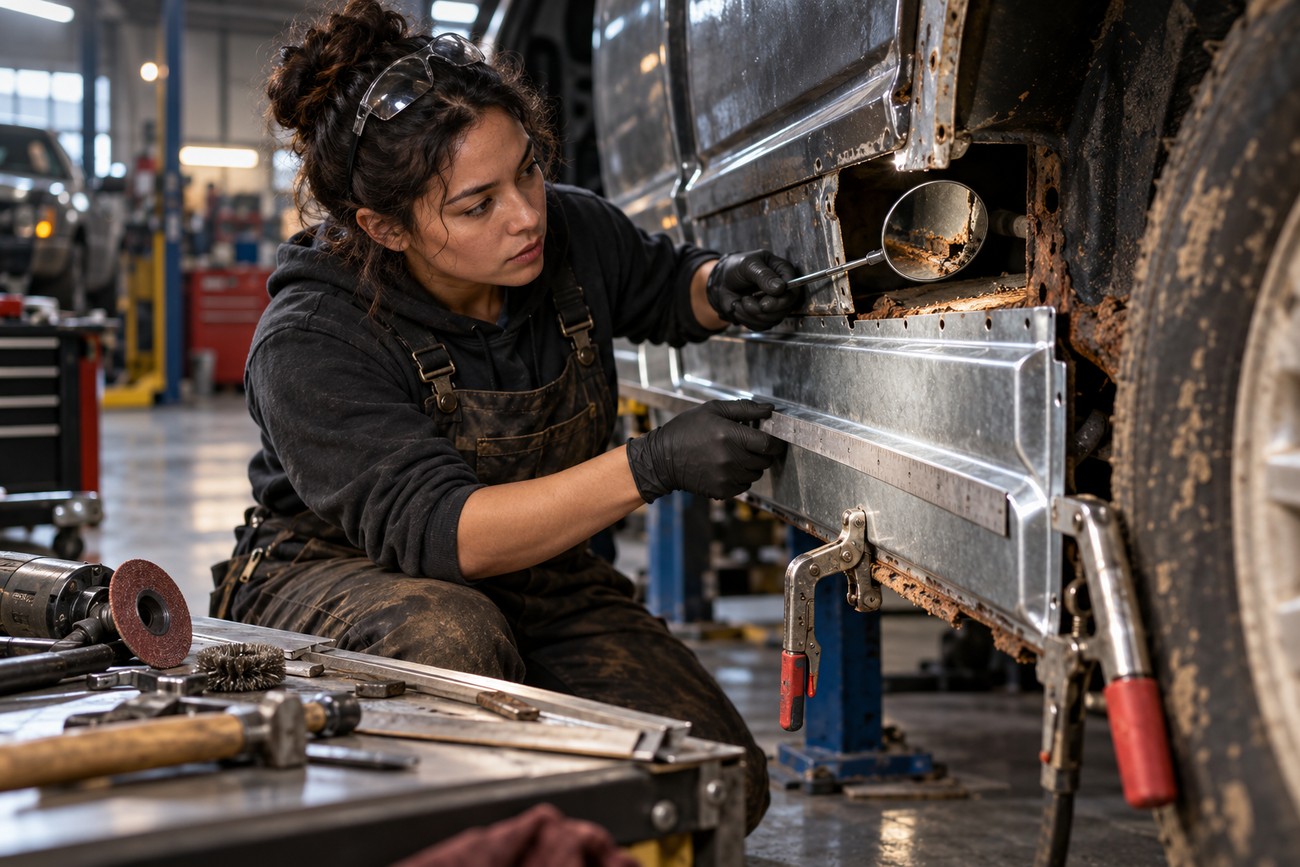
Start with the vehicle’s exposure and the location of the repair. A panel near road spray, salt, mud, or a cavity that is difficult to inspect benefits from documented corrosion protection, although edges, welds, scratches, and internal folds still require separate treatment. A sheltered panel in a controlled shop may place greater emphasis on fit and fabrication time.
Next, assess the welding scope and the available controls. A galvanized panel is a reasonable choice when the coating is documented, the team can remove coating in the weld zone as required, and local extraction and ventilation are available. If welding will be extensive in a poorly ventilated space, the fumes and preparation demands should be treated as a decisive operational issue.
Storage conditions can change the decision. Bare steel requires strict moisture control between delivery, fabrication, priming, and painting. Galvanized steel tolerates some handling damage better because zinc can provide sacrificial protection, but it still needs protection where the coating is cut, ground, scratched, or removed.
Compare the actual panels rather than selecting from the material description alone. Check the supplier’s stated thickness, coating information, flange shape, hole locations, and return or inspection procedure. If the galvanized specification is vague and the panel fit is poor, a precisely made bare-steel part with a controlled finishing plan may offer the lower-risk repair.
Use a complete sequence: surface preparation, welding, contamination removal, primer, seam sealer, paint, and cavity protection. The correct choice is the panel that the shop can fit accurately, weld safely, protect during storage, and finish without leaving inaccessible bare metal.
Common Mistakes and Myths About Repair Panels
Galvanized steel can be welded. The practical issue is that zinc vaporizes before steel during arc welding, creating zinc-oxide fumes and potential process problems. Safe work requires fume extraction, ventilation, suitable exposure controls, and preparation of the weld zone; simply putting on a welding helmet does not control the plume.
Galvanized steel can also rust. Zinc is consumed over time, and factory protection is damaged by cutting, grinding, welding, impact, and handling. Edges, holes, bends, seams, and enclosed cavities are especially dependent on the later repair system.
Cleaning away zinc is not the final corrosion treatment. It may reduce smoke, porosity, and spatter, yet it creates an unprotected strip that must be cleaned, cooled, and covered with a compatible protection system. The common failure sequence is predictable: smoke leads to hurried preparation, the exposed steel remains untreated, contamination is sealed into a seam, and corrosion appears later.
Any zinc-rich paint should not be assumed to restore the factory coating. Check its composition, dry-film requirements, compatibility, and intended use. No comparable independent statistics were identified for return or complaint rates by repair-panel material, so material claims should be judged through documented specifications and workshop controls rather than unsupported promises.
Frequently asked questions
The questions below address welding exposure, corrosion protection, cleaning, and storage. The answers distinguish workshop beliefs from practical controls and preparation steps. These principles apply to both material choices and the finishing work that follows.
Why do some welders drink milk after welding galvanized steel?
Milk is a workshop belief, not a substitute for local fume extraction, ventilation, exposure control, or medical evaluation when symptoms occur. It does not remove zinc-oxide fumes from the breathing zone or prevent exposure during welding.
If welding fumes cause flu-like symptoms, unusual irritation, breathing difficulty, or other concerning effects, stop the exposure and seek appropriate medical advice. The preventive measure is to control the plume at its source, keep your head out of the smoke, and follow the applicable workplace safety procedure.
What is the main downside of galvanized steel for a repair panel?
The main operational downside is the extra preparation and fume-control work. Coating removal around the weld, local extraction, ventilation, cleanup, and post-weld restoration can make a corrosion-resistant panel slower and more demanding to repair in a poorly equipped shop.
That cost is justified only when the panel also fits well and the coating is properly specified. A nominal corrosion advantage can be lost through poor fit, unprotected welds, or careless finishing.
What does white vinegar do to galvanized metal?
White vinegar contains acetic acid, which can react with and attack zinc. It may dull or remove surface zinc, so it is not a harmless universal cleaner or a reliable corrosion-treatment method for galvanized repair panels.
Use a cleaning product and preparation process approved for the coating and the next finishing layer. If vinegar has already contacted the panel, remove residue, assess the surface, and follow the coating manufacturer’s preparation guidance before priming.
How should a bare-steel repair panel be stored before installation?
Keep the panel dry, clean, and protected from condensation, salt, shop dust, and handling contamination. Store it where temperature changes will not create moisture on the metal, and avoid coverings that hold damp air against the surface.
If installation or painting is delayed, apply suitable temporary protection compatible with the planned preparation system. Inspect the panel before use, remove any protective residue as specified, and address early surface rust before welding or coating.