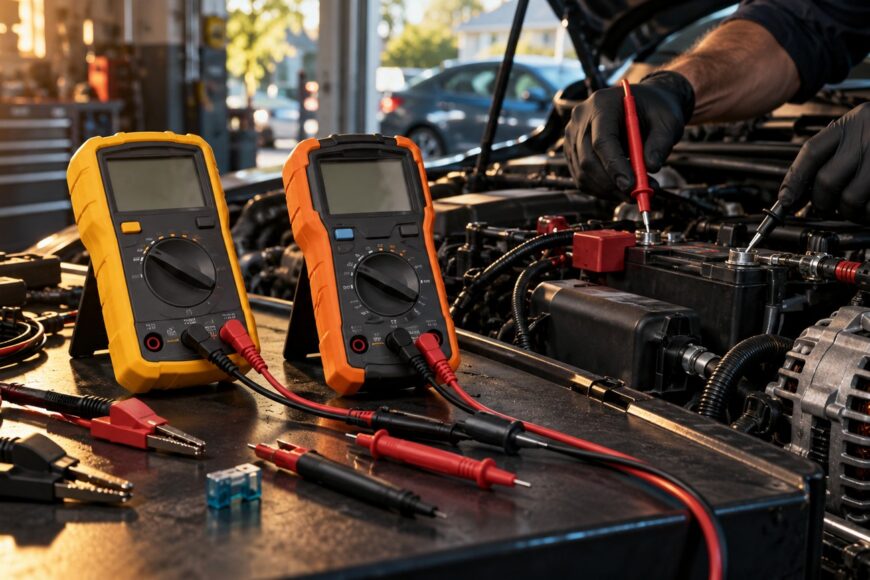
Fluke usually offers stronger professional trust, petrology confidence, certification emphasis, and long-term reassurance. Klein can deliver many functions required for automotive work at a lower cost, especially for routine 12-volt testing, continuity checks, and basic charging-system diagnosis.
The real choice is shaped by automotive faults rather than by general electrical specifications. Phantom voltage can mislead a technician, noisy signals can expose weak measurement methods, and stiff leads can slow work in cramped engine bays. Current-drain testing also raises a separate issue: a digital multimeter and a current clamp perform different jobs.
There is no universal winner. A professional who needs LowZ, advanced automotive measurements, high confidence in long-term accuracy, and heavy-duty construction may justify Fluke. A garage user may obtain the required functions from Klein and reserve money for a clamp meter, load tester, or oscilloscope.
- What an Automotive Electrician Actually Needs from a Multimeter
- Fluke and Klein Automotive Multimeters: What Their Lineups Offer
- Fluke vs Klein: Feature and Value Comparison for Auto Work
- Which Meter Fits Each Automotive Diagnostic Scenario?
- Safety, Durability, Leads, and Everyday Usability
- Common Buying and Diagnostic Mistakes
- Which Should You Buy: Fluke or Klein?
- Frequently asked questions
- What is the best multimeter for an auto electrician: Fluke 87V or Fluke 88V Automotive?
- What should I check on a used multimeter before buying it for automotive work?
- What is the best multimeter for an auto electrician?
- Which multimeter is best for automotive use?
- Which brand of multimeter is considered the best?
What an Automotive Electrician Actually Needs from a Multimeter
A useful automotive multimeter should make common tests quick and repeatable. Battery voltage, alternator output, voltage drop, continuity, resistance, and fuse checks form the daily workload for many technicians. Those jobs do not automatically require the most expensive instrument, although a clear display, dependable leads, and protection against incorrect connections affect the result in every vehicle.
LowZ is valuable when wiring contains phantom voltages. A high-impedance meter can display voltage induced through another circuit or through a weak electronic path, even when the circuit cannot supply meaningful current. LowZ lowers the input impedance and helps suppress that misleading reading, allowing you to distinguish a usable supply from an electrical trace that disappears under a suitable load.
True RMS matters when the measured waveform is distorted, non-sinusoidal, or noisy. Automotive systems contain switching devices, pulse-width-controlled loads, alternators, ignition-related signals, and electronic control circuits, so this capability can improve confidence in the right measurement. It is not automatically necessary for every basic 12-volt DC check, and it should not replace correct test setup or waveform analysis.
Continuity access, min/max recording, duty cycle, temperature, and microamp measurement each solve different problems. A fast continuity response helps with harness work, min/max can capture an intermittent event, and duty cycle can describe a control signal that a simple voltage reading hides. Temperature is useful for comparing sensors and components, while microamps can matter when evaluating small parasitic loads or electronic circuits.
The physical interface deserves the same attention as the specification sheet. A readable display helps when the meter is positioned below a dashboard, while a sensible rotary switch reduces range and function errors. Flexible leads, sharp but safe probes, secure input sockets, and a clear warning when a current lead is inserted can save more workshop time than a small improvement in stated accuracy.
Hard faults also exceed the scope of a single DMM. A current clamp measures current without opening or breaking the circuit, which makes it useful for parasitic-drain investigation and changing loads. A load tester can reveal a connection that looks acceptable at rest, and an oscilloscope may be required when the shape and timing of a sensor or actuator signal matter.
Fluke and Klein Automotive Multimeters: What Their Lineups Offer
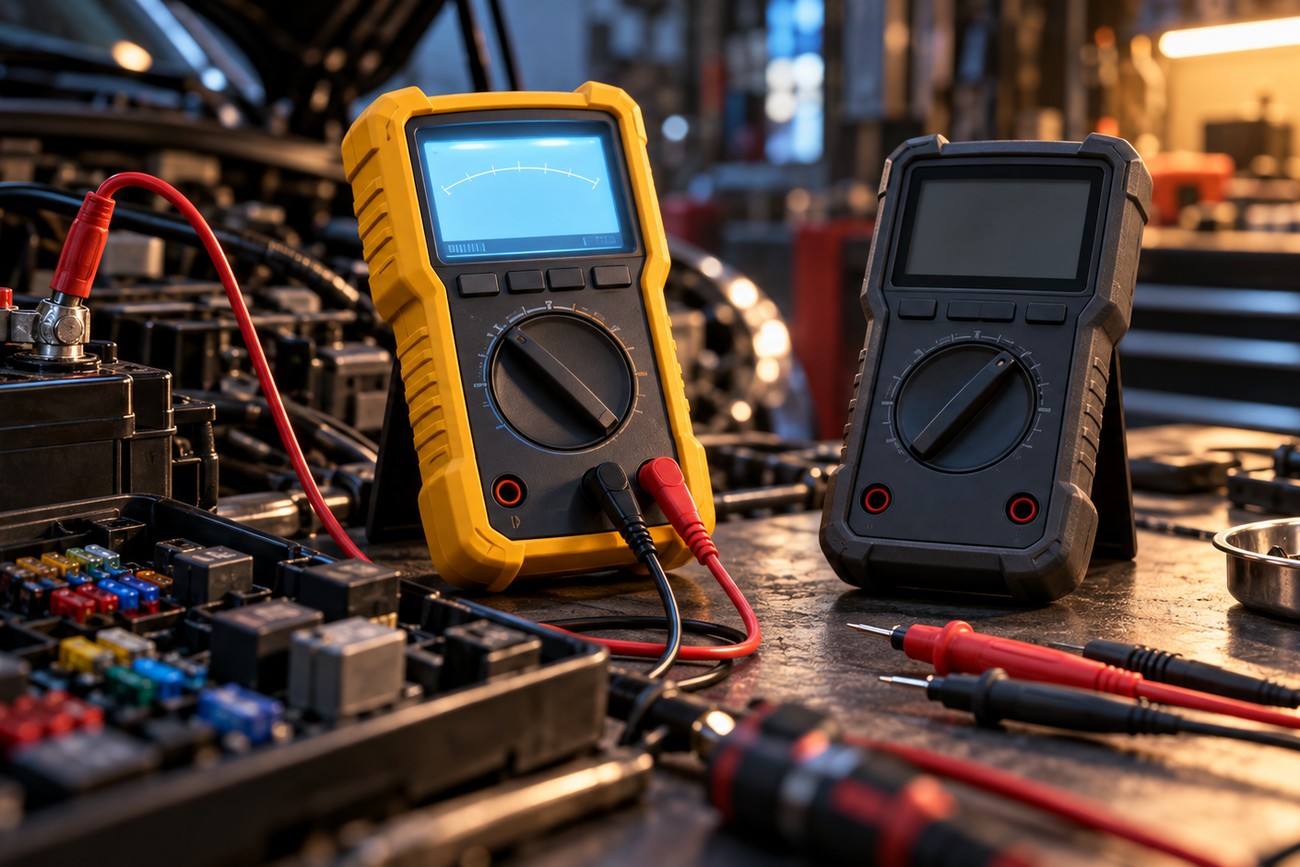
Fluke and Klein should be compared by model rather than by logo. Each brand sells instruments with different measurement ranges, safety categories, protection, display behavior, and automotive functions. A model number is more informative than a general claim that one brand is professional or the other is budget-oriented.
The Fluke 87V is commonly used as a versatile professional reference by automotive electricians. It includes True RMS, frequency, temperature, and LowZ, giving it a useful spread for electrical diagnosis beyond basic battery checks. Its appeal comes from the combination of measurement confidence, familiar operation, and a reputation for surviving demanding service environments.
The Fluke 88V Automotive is aimed more directly at vehicle diagnosis. It adds RPM measurement through an inductive pickup, duty cycle, and injection pulse width. Those functions can be valuable on vehicles where the required signal can be accessed and interpreted correctly, although their presence does not make every repair faster or every vehicle compatible with the same test method.
Fluke 287 and 289 instruments are high-end measurement and logging tools. Their official measurement scope includes DC and AC voltage and current, resistance, capacitance, frequency, and temperature. Logging can help with intermittent faults that are difficult to reproduce while watching a display, though the added cost and size make these models less compelling for a user whose work ends with routine voltage and continuity checks.
Klein models such as the MM420, MM600, and MM700 appear in comparisons and practical discussions as lower-cost alternatives. They can cover many common automotive tasks, depending on the exact specification. Their pricing can leave room in the tool budget for a current clamp or test accessories, but the buyer must verify LowZ, True RMS, microamp capability, duty cycle, input protection, and safety ratings for the individual model.
Fluke vs Klein: Feature and Value Comparison for Auto Work
The table describes typical positioning and model-specific facts without treating either brand as uniform. Check the exact manual and markings before buying, especially for safety category, protection, and automotive functions.
| Criterion | Fluke | Klein | Workshop meaning |
|---|---|---|---|
| LowZ | Available on models such as the 87V; verify the exact instrument. | Available only where the individual model specification states it. | Helps reduce phantom voltages and prevents misleading conclusions in wiring diagnosis. |
| True RMS | Included on the Fluke 87V and selected other models. | Model-dependent; do not infer it from the brand. | Useful for distorted, non-sinusoidal, or noisy signals; less important for a simple 12-volt DC check. |
| Automotive-specific functions | The 88V Automotive includes RPM through an inductive pickup, duty cycle, and injection pulse width. | Depends on the exact model and its listed functions. | Useful only when the vehicle, signal access, and test method support the measurement. |
| Measurement categories | Fluke 287/289 are officially described as measuring DC/AC voltage and current, resistance, capacitance, frequency, and temperature. | Ranges and functions vary substantially between models such as MM420, MM600, and MM700. | Compare the functions required for the actual repair rather than the number of items on the product page. |
| Current-drain work | Can be paired with a current clamp; a DMM alone still requires correct circuit insertion. | Same limitation applies. | A clamp measures current without breaking the circuit and can avoid disturbing an intermittent fault. |
| Safety category | Some individual models appear with CAT IV 600V ratings. | Some individual models also appear with CAT IV 600V ratings. | CAT IV 600V applies to the tested model, not automatically to every meter from the brand. |
| Durability claims | The 87V MAX is specified with IP67 protection and drop resistance up to 4 m. The 28 II is described in reviews with IP67 and drops up to 10 ft. | Some models are described in reviews with IP67 and drops up to 10 ft. | Protection and drop resistance depend on the exact model, enclosure, and test claim. |
| Lead feel | Some users find certain standard leads stiff. | Klein leads are often praised for greater flexibility. | Lead movement and probe grip influence speed in crowded engine bays. |
| Professional trust | Comparisons often emphasize independent third-party test-lab certification, petrology confidence, and long-term professional trust. | Often selected for useful coverage and lower cost, with possible compromises in perceived long-term precision or refinement. | Confidence has value when a meter is used daily or when a wrong reading can lead to expensive parts replacement. |
| Price and value | Usually commands a higher price for perceived reliability, certification, and professional confidence. | Often offers a lower-cost route to common functions. | The premium may have little visible effect on routine 12-volt results, so budget can sometimes be better spent on complementary tools. |
Which Meter Fits Each Automotive Diagnostic Scenario?
Battery and charging checks are straightforward when the system is healthy. A suitable Klein can handle voltage, resistance, continuity, and many current measurements if its ranges and safety specifications match the job. The Fluke 87V becomes more attractive when the same meter will also be used for difficult voltage-drop work, intermittent faults, noisy signals, and measurements where LowZ and a stable display reduce uncertainty.
Voltage-drop testing rewards a meter with dependable leads, good probe contact, and a responsive continuity and voltage interface. The numerical accuracy of either brand can be wasted if a probe touches corrosion, insulation, or a loose terminal instead of the conductor. For phantom-voltage diagnosis, LowZ is particularly useful because it helps separate a real supply from a voltage induced through a neighboring circuit.
For a difficult intermittent drain, a current clamp paired with a DMM is usually more informative than repeatedly moving a meter into the circuit. The DMM can record voltage or support other checks, while the clamp observes current without breaking the connection. A suitable Klein can serve as the DMM in this arrangement, although the clamp’s low-current resolution and the vehicle’s sleep behavior deserve separate verification.
Noisy or non-sinusoidal signals are a stronger reason to consider True RMS, especially when a conventional average-responding reading could be misleading. Temperature checks benefit from a meter that supports the appropriate temperature function and accessory. The Fluke 87V offers a broad general-purpose combination, while a lower-cost meter may be adequate if those specific functions are present and correctly rated.
Injector and control-signal work is where the Fluke 88V Automotive can justify its specialist position. RPM through an inductive pickup, duty cycle, and injection pulse width provide information that a basic voltage reading may not show. Their usefulness still depends on the vehicle, sensor setup, signal access, and the technician’s ability to interpret the result; a specialist function that cannot be connected properly is only unused specification-sheet space.
Automotive systems commonly operate around 12 volts, yet the working environment can include charging transients, hybrid or electric vehicle systems, exposed conductors, and accidental contact with higher-energy circuits. Select the safety category for the actual environment and follow the vehicle and meter instructions. A model’s CAT marking cannot be borrowed from a different Fluke or Klein instrument.
Safety, Durability, Leads, and Everyday Usability
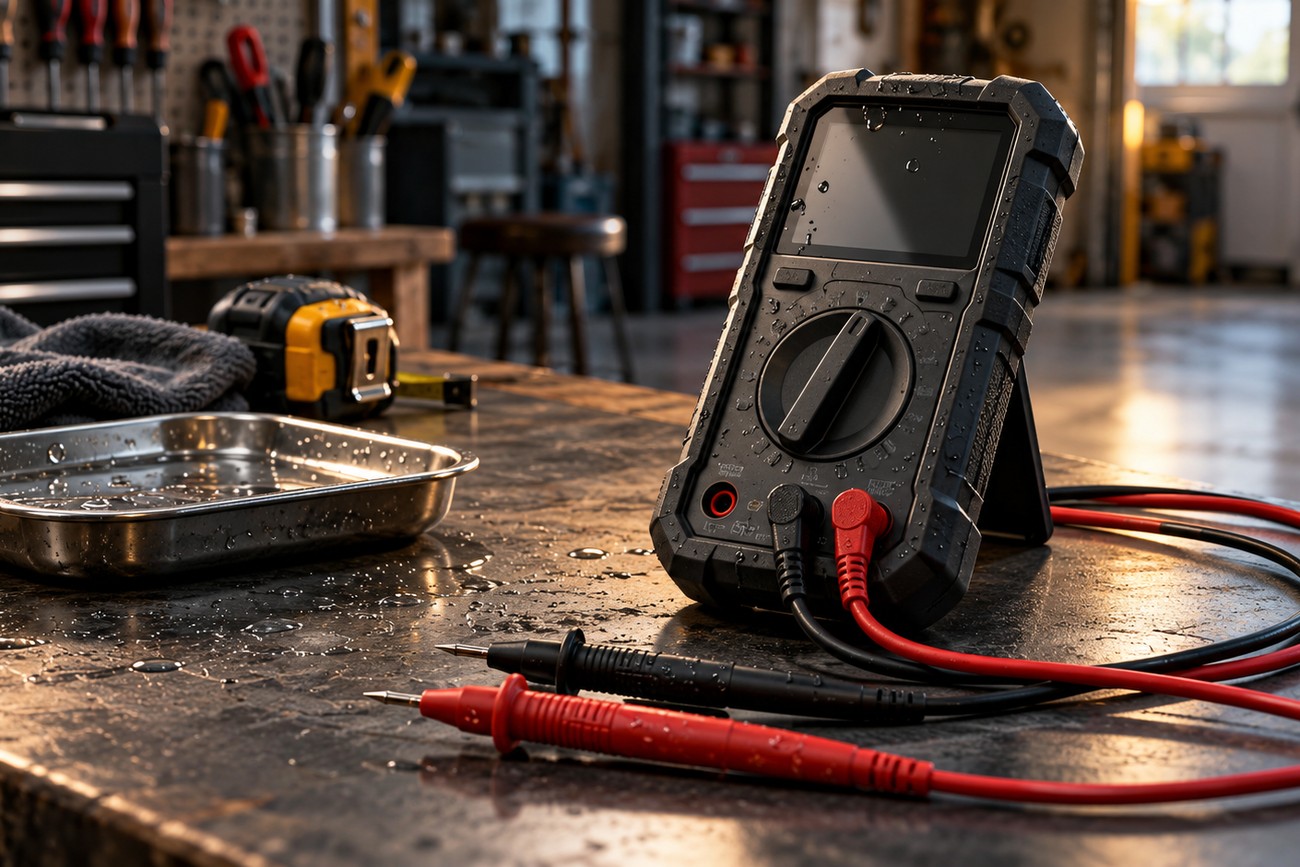
CAT IV 600V is a model-specific rating. Individual Fluke and Klein meters appear with this classification, but it does not make every model from either brand equivalent. The rating should be read together with the input limits, lead category, fusing, inspection condition, and the electrical environment where the meter will be used.
Enclosure claims also require model-level checking. The Fluke 87V MAX is specified with IP67 protection and drop resistance up to 4 m. Reviews describe IP67 protection and drops up to 10 ft for the Fluke 28 II and some Klein models, but those statements depend on the exact model and should not be extended across a whole lineup.
Workshop usability is shaped by small physical details. A screen that remains readable from an angle, a rotary switch that can be turned with one hand, and probes that hold securely on a back-probe point reduce interruptions. Some users find certain factory leads stiff, while Klein leads are often praised for greater flexibility; the supplied kit should be checked rather than assumed from the brand.
Protection against wrong connections is especially important when several vehicles are being serviced in succession. A misplaced lead in the current socket or a range selected for the wrong circuit can damage a meter and create a hazardous condition. Good fusing and clear warnings help, but they do not replace deliberate lead placement and inspection before every measurement.
Ruggedness has practical value when a meter is carried between vehicles, placed on a battery tray, or exposed to dust and moisture. It does not automatically improve a routine voltage reading. A less expensive model with the required protection and a well-designed lead set may be more productive than a premium instrument whose controls are slow or whose probes are awkward for the technician’s working position.
Common Buying and Diagnostic Mistakes
The first mistake is buying by brand instead of by task. A buyer may choose a respected name and discover later that the selected model lacks LowZ, duty cycle, temperature, microamps, True RMS, or a suitable current range. The correct sequence is to list the vehicle faults and measurements, then check the exact model specification against that list.
Paying for a professional flagship can also be poor value when the workload is limited to 12-volt checks, continuity, fuse testing, and occasional charging diagnosis. A premium meter may provide greater confidence and longer service life, but those benefits should be weighed against a current clamp, better probes, or a load tester that could expand the diagnostic capability of the whole kit.
Confusing a DMM with a current clamp causes a different kind of failure. A DMM measures current in series, which means the circuit must be opened and the meter inserted correctly. A clamp measures current without opening or breaking the circuit, making it the more practical tool for many parasitic-drain and changing-load investigations.
CAT markings are another source of false confidence. CAT IV 600V on one model does not make a different model interchangeable, even if both instruments carry the same brand. The input protection, fuses, leads, published limits, and condition of a used meter must all match the environment in which you intend to work.
Autoranging can save time during mixed measurements, but a slow or awkward implementation can create repeated pauses. A confusing function layout has the same effect. Before buying, examine how quickly the meter reaches continuity, duty cycle, temperature, min/max, and LowZ, and consider whether the display and switch can be used while holding a probe in a crowded engine bay.
Leads are easy to ignore because they appear to be an accessory. In practice, poor probe contact, stiff insulation, damaged shrouds, or loose plugs can produce unstable readings and slow every test. Protection and lead quality affect productivity as much as a small difference in stated accuracy, particularly when the diagnostic process involves dozens of checks.
Which Should You Buy: Fluke or Klein?
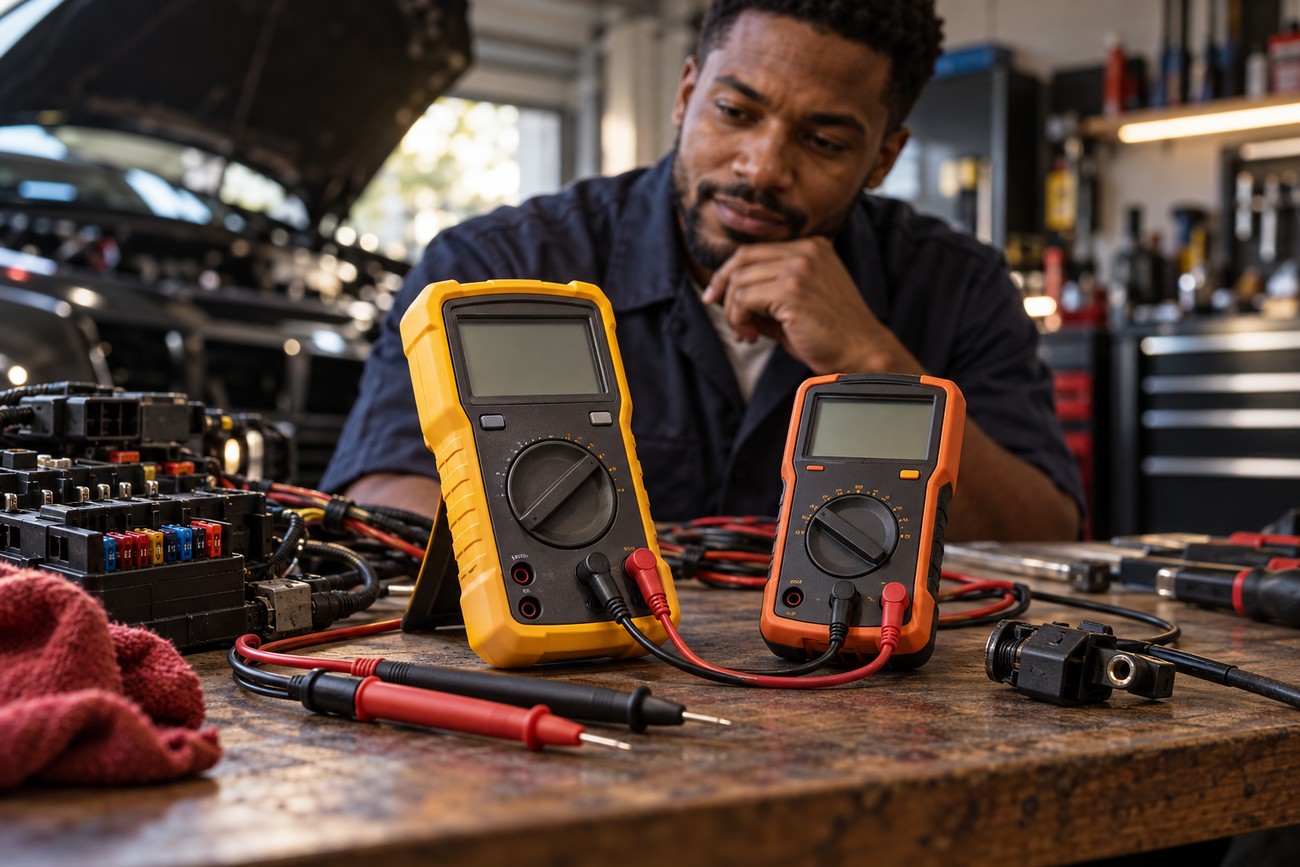
Choose Fluke when the meter will be used professionally, carried between vehicles daily, and expected to provide long-term confidence across difficult electrical faults. The 87V is a strong general-purpose choice when True RMS, frequency, temperature, and LowZ are useful. The 88V Automotive deserves consideration when RPM, duty cycle, and injection pulse width are genuinely part of the work rather than occasional features that will remain unused.
Choose Klein when the budget is tighter and the exact model covers the required measurements and safety environment. Its value can be attractive for routine automotive work, and flexible leads may improve access in real workshop use. The buyer should accept that perceived long-term precision, refinement, or professional confidence may not match the reason many technicians pay more for Fluke.
For a professional auto electrician, Fluke often makes sense as the primary DMM, with the decision between the 87V and 88V Automotive based on the diagnostic functions actually used. For a serious DIY owner, a suitable Klein or mid-range Fluke paired with a current clamp may produce more useful capability than an expensive DMM alone. For a garage user, first secure correct safety ratings, continuity, voltage, resistance, and dependable leads before paying for specialized measurements.
The strongest setup is often a system rather than a single instrument. A DMM handles voltage, resistance, continuity, and control-signal checks; a current clamp observes loads without opening the circuit; a load tester or oscilloscope addresses faults that static meter readings cannot explain. Brand reputation matters, but task coverage, model-specific protection, usability, and budget determine whether the purchase helps with the vehicle.
Frequently asked questions
What is the best multimeter for an auto electrician: Fluke 87V or Fluke 88V Automotive?
The Fluke 87V is the better general-purpose choice when the work spans battery and charging tests, voltage drops, noisy signals, temperature, frequency, and phantom-voltage diagnosis. Its True RMS and LowZ functions support a broad range of electrical fault-finding without making the meter dependent on a particular engine-management test.
The Fluke 88V Automotive earns its higher specialist value when RPM through an inductive pickup, duty cycle, and injection pulse width are regularly required. Those functions justify the choice only when the vehicle and available signal connections support them. If most jobs are conventional voltage, resistance, and continuity checks, the 87V may be the more sensible instrument even when the 88V Automotive appears more vehicle-specific.
What should I check on a used multimeter before buying it for automotive work?
Inspect the case, display, rotary switch, input sockets, fuse compartment, and all leads. Look for cracked insulation, damaged probe shrouds, loose plugs, heat marks, unreliable range switching, and a display that fades or loses segments. Confirm that continuity responds consistently and that the meter does not reset or behave erratically when leads are moved.
Read the exact model markings and compare them with the manufacturer’s specifications. Confirm the CAT rating, input limits, fusing, LowZ, True RMS, temperature, duty cycle, microamp, and current functions you actually need. A brand name cannot confirm the condition of input protection, and a used meter with missing safety markings should be treated cautiously regardless of its apparent price.
What is the best multimeter for an auto electrician?
The best choice is the model that matches the electrician’s fault types, safety environment, and supporting tools. A Fluke 87V is a strong general-purpose professional option because it combines True RMS, frequency, temperature, and LowZ. A suitable Klein can cover many common jobs at lower cost when its exact specifications and protection meet the requirement.
For advanced automotive work, the meter should be selected alongside a current clamp and, where necessary, a load tester or oscilloscope. That combination can diagnose more faults than spending the entire budget on a single high-end DMM.
Which multimeter is best for automotive use?
For routine automotive use, select a meter with reliable voltage, resistance, continuity, and current functions, plus the safety category required by the working environment. LowZ is useful for phantom-voltage diagnosis, True RMS helps with distorted or noisy signals, and temperature or duty cycle may be valuable for specific vehicles.
A current clamp is often the better addition for parasitic-drain work because it measures current without breaking the circuit. The ideal automotive setup therefore depends on the jobs being performed, rather than on a universal brand ranking.
Which brand of multimeter is considered the best?
Fluke generally has the stronger professional reputation, petrology confidence, and certification emphasis. That reputation can justify the higher price for daily workshop use, long-term instrument confidence, and demanding measurement work.
Klein remains a practical value option for many common automotive tasks, especially when the exact model provides the necessary functions, protection, and usable leads. Neither brand is uniform, so CAT ratings, IP67 protection, drop resistance, accuracy, and automotive functions must be verified for the specific meter.