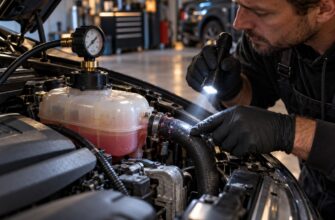
A recurring lean code can be frustrating when the engine still starts, idles, and drives almost normally. High fuel trims may also return after a sensor replacement or after the battery has been disconnected, leaving the original fault unresolved.
A lean result means the ECU is seeing too much oxygen relative to the commanded fuel mixture. That can result from unmetered air, insufficient fuel, an inaccurate MAF or oxygen-sensor signal, or an exhaust leak that lets oxygen reach the sensor. Save freeze-frame data and fuel-trim values before clearing codes, then test the condition at warm idle, elevated rpm, and under load instead of replacing the oxygen sensor by default.
- What an Engine Running Lean Actually Means
- Common Causes: Air Leaks, Fuel Delivery, MAF, and Exhaust
- Read Fuel Trims Before Replacing Parts
- Fuel-Trim Patterns That Narrow the Diagnosis
- A Practical Diagnostic Sequence for P0171 and P0174
- Why Normal Tests Can Still Miss the Fault
- Common Lean-Code Mistakes and Myths
- Frequently asked questions
- What sensors can cause a lean condition?
- How long can you drive with P0171 or P0174?
- Why can a lean code return immediately after the battery is disconnected?
What an Engine Running Lean Actually Means
The ECU uses oxygen-sensor feedback and fuel trims to keep the air-fuel mixture within its target range. Positive STFT and LTFT mean the ECU is adding fuel because its measured result appears lean. Negative trims mean the ECU is reducing fuel because the mixture appears richer than commanded.
P0171 means the ECU reached its calibrated positive fuel-trim limit on Bank 1. P0174 means it reached the equivalent limit on Bank 2. These codes describe a control condition; they do not identify a failed oxygen sensor or another single component.
A lean result can reflect genuinely excess oxygen in the combustion process, such as air entering after the MAF, or insufficient fuel from a restricted injector, weak pump, or delivery problem. It can also be misleading when the MAF under-reports airflow or an exhaust leak admits oxygen before the front sensor.
There is no universal fuel-trim normal range or MIL threshold for every vehicle. Approximately +20–25% correction often leads to lean-code setting, but the exact threshold depends on ECU calibration. Approximately +7–10% is used by some technicians as a practical deviation guide, not as a universal limit.
Common Causes: Air Leaks, Fuel Delivery, MAF, and Exhaust
Unmetered air is a frequent cause. Air entering after the MAF through a cracked intake boot, PCV hose, vacuum line, manifold gasket, or throttle-body seal is absent from the ECU’s airflow calculation. The oxygen sensor then reports the resulting excess oxygen, and the ECU adds fuel through positive trims.
Fuel delivery can create the same outcome from the opposite direction. Low volume from a restricted filter, weak pump, faulty regulator, inadequate pump power, or underperforming injectors can leave the engine short of fuel, especially during acceleration. A single idle pressure reading cannot rule out this group of faults.
The MAF may also report less air than the engine is actually receiving. Contamination, damage, wiring faults, or an air-path problem can affect plausibility. A lean code alone cannot prove that the MAF is dirty or failed; its signal must be compared with engine load, rpm, and fuel-trim behavior.
An exhaust leak before the front oxygen sensor can admit outside oxygen and falsely suggest a lean mixture. On a V6 or V8, simultaneous P0171 and P0174 usually favor a shared intake, MAF, or fuel-delivery issue rather than two unrelated sensor failures. A single-bank code more often points toward a localized intake, injector, or pre-front-sensor exhaust problem, although several small faults can coexist.
Read Fuel Trims Before Replacing Parts
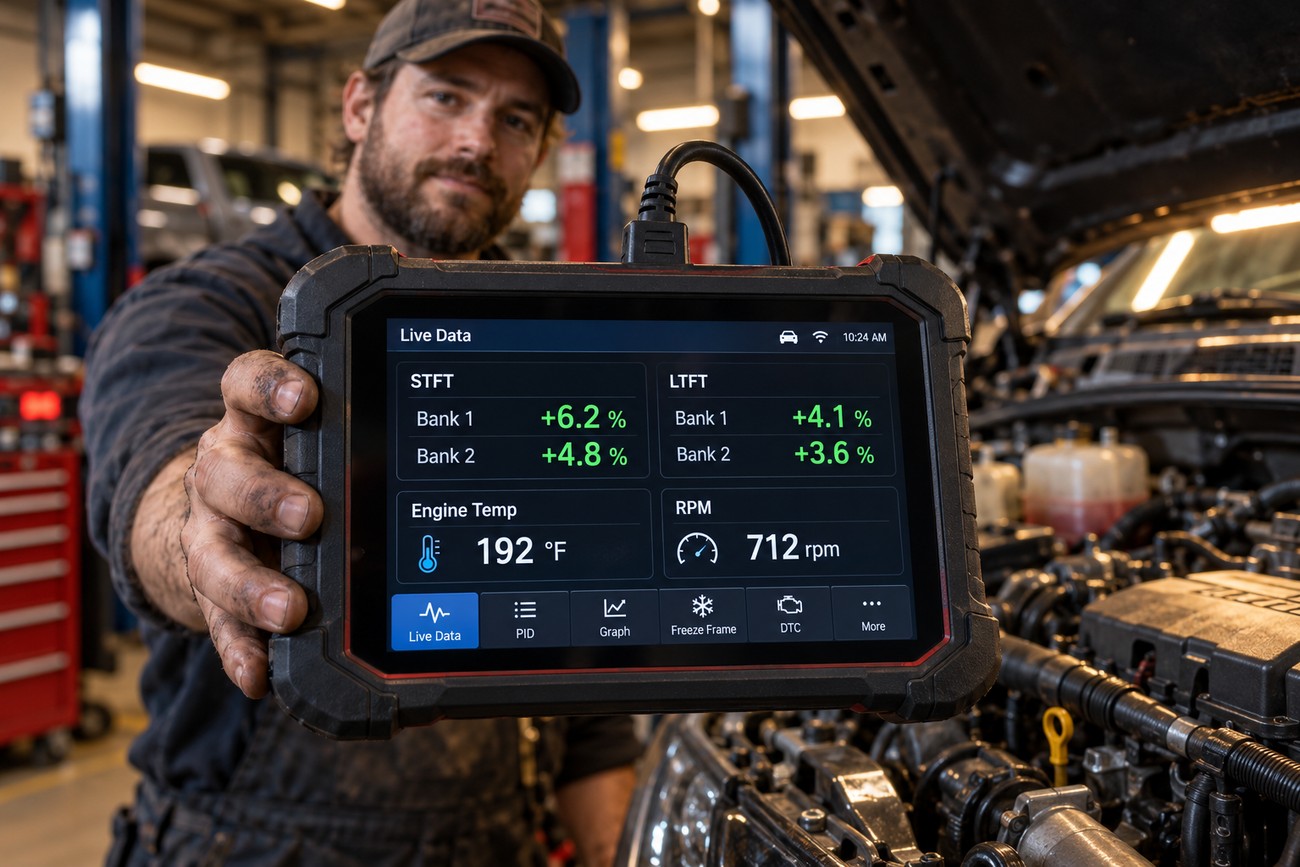
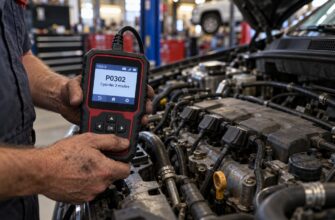
Begin by saving the stored codes and freeze-frame data. Record engine temperature, rpm, calculated load, STFT, LTFT, and the behavior of both banks before clearing anything. This preserves the conditions under which the ECU decided that correction had reached its limit.
Compare trims with the engine fully warm at idle and again at approximately 2,500 rpm. Positive values show fuel addition, while negative values show fuel removal. The relationship between the two operating points is often more useful than one isolated number.
A combined correction around +20–25% often leads to lean-code setting, although the exact threshold depends on ECU calibration. Some technicians use approximately +7–10% as a practical indication of noticeable deviation. Neither figure is a universal specification, so the vehicle manufacturer’s data takes priority.
Resetting the ECU can make a vehicle feel better temporarily because learned corrections are erased. That change does not repair the cause. The ECU may simply rebuild the same correction after it returns to the operating conditions that expose the fault.
Fuel-Trim Patterns That Narrow the Diagnosis
Fuel-trim behavior narrows the test direction without proving a failed component. Use the pattern as a guide, then confirm it with a targeted inspection or measurement.
| Observed pattern | Likely direction | Next tests |
|---|---|---|
| High trims mainly at warm idle | Vacuum or intake leak, especially after the MAF | Inspect PCV and vacuum lines, intake ducting, and gaskets; use a smoke test |
| High trims at idle that improve at approximately 2,500 rpm | Vacuum or intake leak | Smoke-test the intake, PCV system, manifold, and throttle-body sealing areas |
| Trims rise under load | Fuel supply, regulation, injector, or pump-power problem | Check pressure, residual pressure, volume, and electrical supply under the factory load procedure |
| Correction concentrated on one bank | Localized intake, injector, or pre-front-sensor exhaust issue | Compare bank data and inspect that bank’s intake, injectors, and exhaust joints |
| Both banks show similar elevated trims | Shared intake, MAF, or fuel-delivery issue | Check for common air leaks, MAF plausibility, and fuel pressure and volume |
A Practical Diagnostic Sequence for P0171 and P0174
Start with the complete data set: symptoms, stored and pending codes, freeze-frame conditions, engine temperature, rpm, load, and fuel trims. Note whether the fault is present at idle, during steady cruising, or only under acceleration. This establishes a testable pattern before any component is removed.
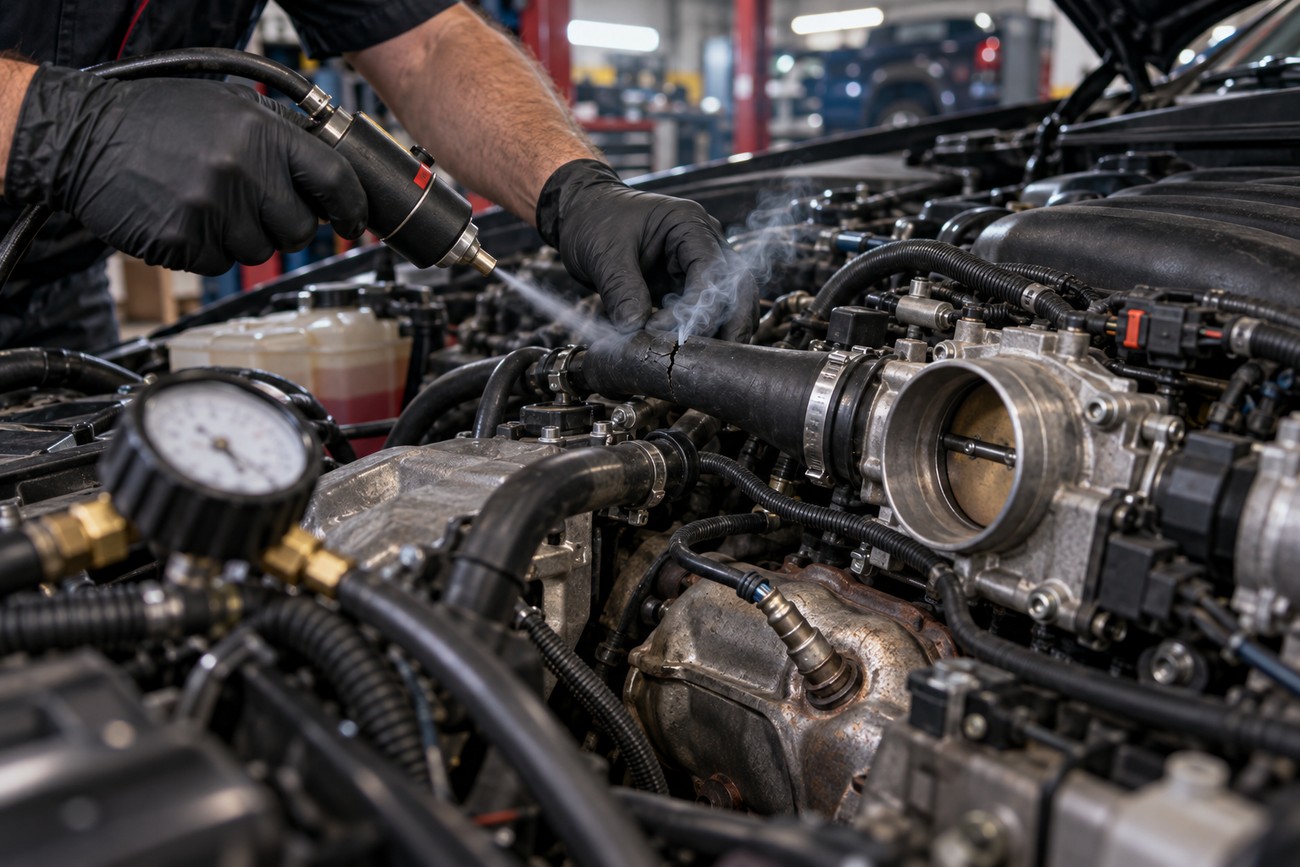
Inspect the intake duct between the MAF and throttle body, PCV lines, vacuum hoses, manifold connections, and electrical connectors. Look for split rubber, loose clamps, disconnected lines, and wiring damage. Visual inspection can miss small leaks, so a smoke test may be required when trims are high at idle.
Freeze-frame and trim behavior can disappear as a useful pattern after the ECU is reset. Capturing that information first helps separate an intake leak that dominates at idle from fuel starvation that appears under load.
Next, assess MAF plausibility against engine load and rpm, following the vehicle’s service information. Use only a cleaner specified for MAF sensors, and avoid touching the sensing element. Then test fuel pressure, residual pressure, and volume according to the factory procedure, including conditions that reproduce the load-related fault.
Finish by checking for exhaust leakage before the front oxygen sensor. The front sensor participates in mixture control, while the rear sensor generally monitors catalytic-converter efficiency and should not automatically be blamed for P0171 or P0174. After repairs, clear codes only after recording the original data, allow the ECU to relearn, and verify the result through an appropriate drive cycle.
Why Normal Tests Can Still Miss the Fault
A pump can show acceptable pressure at idle while failing to maintain pressure or volume during acceleration. A restricted filter, weak pump, failing regulator, poor pump ground, or voltage drop may appear only when demand increases. Fuel pressure must therefore be judged against the vehicle’s factory range and test procedure, including load conditions.
A small exhaust leak near one manifold or flange may admit enough oxygen to influence one front sensor without producing an obvious exhaust noise. This can create a single-bank lean code even when the engine has no severe drivability symptom. Inspect joints and flex sections carefully, especially when bank data is significantly different.
A low MAF reading also requires context. Compare the signal with engine load, rpm, calculated airflow, and fuel trims rather than diagnosing a failed sensor from P0171 alone. A sensor can be contaminated, electrically faulty, or affected by intake turbulence, while a separate intake leak can produce similar trim behavior.
Carburetor cleaner, brake cleaner, or physical contact can damage a MAF sensing element or make its reading less reliable. Use the specified MAF cleaner and the manufacturer’s handling procedure. Cleaning a sensor is a controlled inspection step, not proof that the sensor caused the lean condition.
Common Lean-Code Mistakes and Myths
P0171 and P0174 identify a fuel-trim condition, not a direct oxygen-sensor failure. Replacing the front sensor without checking trims, intake leaks, MAF plausibility, fuel delivery, and exhaust sealing often leaves the code unchanged. The sensor may be accurately reporting the result of another fault.
Lean does not always mean too much air. Excess unmetered air, insufficient fuel, incorrect MAF or oxygen information, and an exhaust leak can all produce a lean result. The same code can therefore come from different physical causes.
One normal fuel-pressure reading does not prove that the fuel system is healthy. Pressure, residual pressure, volume, electrical supply, and performance under load all matter. The correct comparison is the vehicle’s factory procedure rather than a generic pressure figure.
Fixed ±10% trim limits are not universal. Clearing codes or disconnecting the battery erases learned corrections temporarily, which may make the engine seem improved until the ECU relearns the same correction. Save the diagnostic data first, repair the confirmed cause, and then verify that trims remain stable during the relevant operating conditions.
Frequently asked questions
What sensors can cause a lean condition?
The MAF can contribute to a lean condition when it under-reports the air entering the engine, because the ECU commands less fuel than the engine actually needs. The front oxygen sensor can also report a lean result through its feedback signal, although that signal may be accurate and simply reflect an intake or fuel-delivery fault. Check sensor plausibility against load, rpm, and trim behavior before condemning either component.
The rear oxygen sensor generally monitors catalytic-converter efficiency. It is usually not the starting point for P0171 or P0174, which are primarily related to front-sensor mixture control and the ECU’s fuel-trim response.
How long can you drive with P0171 or P0174?
A stored code with mild or no symptoms may allow limited driving to a repair facility, but continued use should be minimized until the cause is identified. A lean condition can become more serious under load, and the risk is higher when the engine has active misfire, stalling, severe hesitation, overheating, or a flashing MIL.
Stop driving and seek prompt diagnosis when the engine misfires badly, loses power in traffic, or the MIL flashes. Save the code and freeze-frame information before clearing it, because severe symptoms can change the test priorities toward immediate ignition, fuel, or mechanical checks.
Why can a lean code return immediately after the battery is disconnected?
Disconnecting the battery or clearing codes resets adaptive fuel values. The engine may run differently until the ECU rebuilds those values, but the underlying leak, fuel-delivery problem, MAF error, or exhaust leak remains.
Once monitoring conditions return, the ECU can calculate the same positive correction and set P0171 or P0174 again. The immediate return is useful evidence that the fault remains active; it is not evidence that the battery reset repaired or damaged a sensor.