A service book may allow a long interval, while a filter exposed to dust, traffic, or construction debris can look exhausted much sooner. The usual passenger-car guidance is 15,000–30,000 km or 1–2 years, yet that range assumes operating conditions that may differ greatly from daily urban driving.
Mileage is therefore a starting point rather than a complete decision rule. Inspection, the filter’s sealing edge, airbox condition, and the environment around the vehicle all matter. A clean-looking installation with a poor seal can be more damaging than a visibly dusty filter that still controls airflow correctly.
- How often should you replace an engine air filter?
- Engine air filter intervals by driving conditions
- Symptoms and inspection clues that the filter is overdue
- Replacement mistakes that let dirt reach the engine
- OEM, aftermarket, and reusable filters: what actually matters
- A practical replacement decision: schedule, condition, or both?
- Frequently asked questions
- How can you check whether an engine air filter is genuine rather than counterfeit?
- How much does engine air filter replacement cost?
- How often do you really need to change an engine air filter?
- What are the symptoms of a bad engine air filter?
How often should you replace an engine air filter?
For many passenger cars, the normal manufacturer baseline is 15,000–30,000 km or 1–2 years. The owner’s manual remains the first reference because the interval reflects the engine’s intake design, filter size, service strategy, and testing assumptions. Some manufacturers specify a schedule around 30,000 km under normal conditions.
That schedule is usually a replacement point, while earlier inspection is appropriate when the vehicle operates in dust or other severe conditions. Owner manuals commonly permit more frequent replacement when the filter shows heavy contamination. A service technician should also check whether the element is seated correctly and whether the airbox has remained clean.
Real-world mechanics often recommend a maximum of 10,000–20,000 km in demanding conditions. This advice can be sensible for vehicles used on dusty roads, around construction areas, in frequent traffic, or as taxis. It should still be treated as a condition-based adjustment rather than a universal rule for every model and climate.
The disagreement between a fixed 30,000 km schedule and a shorter workshop recommendation usually comes from different assumptions about use. A vehicle that spends most of its time on clean highways may follow the published interval successfully. The same model used for short urban trips beside construction traffic may need inspection and replacement much earlier.
Engine air filter intervals by driving conditions
The interval should reflect how quickly the intake sees dust and how much time the engine spends working in contaminated air. The table gives a practical framework; the vehicle’s manual and the filter’s actual condition still take priority.
| Driving conditions | Likely inspection or replacement approach | Why the interval may change |
|---|---|---|
| Clean highway driving with little dust | Follow the owner’s manual, with inspection at scheduled service | Lower airborne contamination usually allows the standard interval to remain relevant |
| Normal mixed city and highway use | Use the manufacturer baseline of 15,000–30,000 km or 1–2 years | Traffic and urban dust create more contamination than steady highway travel |
| Dusty roads or rural unpaved routes | Inspect earlier and consider the severe-use range of 10,000–15,000 km | Fine dust can load the filter quickly and may pass through poor seals |
| Construction areas | Inspect frequently and replace when restriction or heavy contamination is evident | Concrete, soil, and construction debris can create a high dust load |
| Frequent traffic and short urban trips | Use earlier inspection; replacement may be appropriate before the normal mileage point | Repeated low-speed driving exposes the intake to urban dust and leaves little margin for a loaded element |
| Taxi use | Apply severe-use guidance and judge the element by condition | High operating time and constant exposure to traffic increase contamination |
Symptoms and inspection clues that the filter is overdue
A restricted engine air filter can contribute to reduced power, higher fuel consumption, and slower throttle response. These symptoms are clues rather than a diagnosis: ignition faults, fuel-system problems, boost leaks, and sensor issues can produce similar behavior. A filter inspection is a simple early check before assuming a more complex fault.
Turbocharged engines can reveal intake restriction sooner because the engine moves a large volume of air when producing boost. Moderate contamination may therefore be accompanied by a noticeable loss of response or increased fuel use before the filter appears completely blocked. The effect depends on the engine, filter design, driving conditions, and control system.
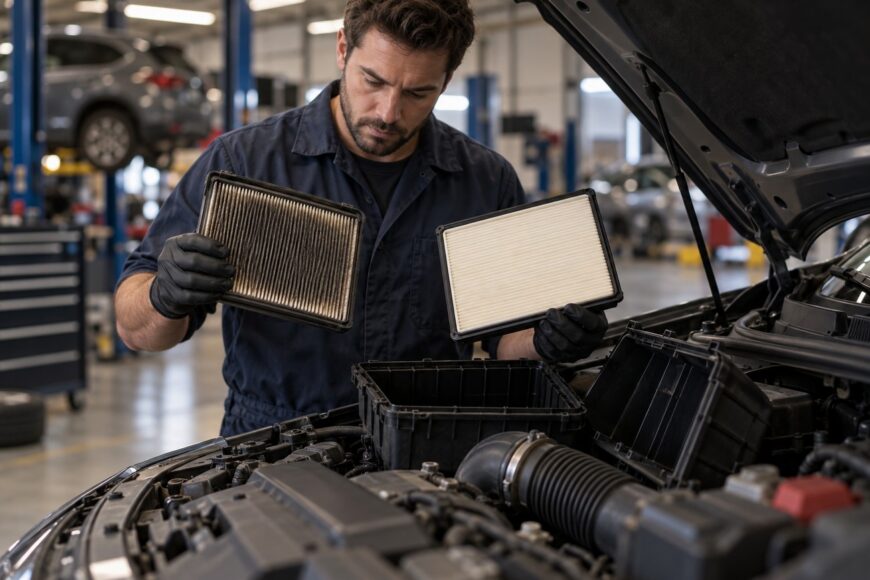
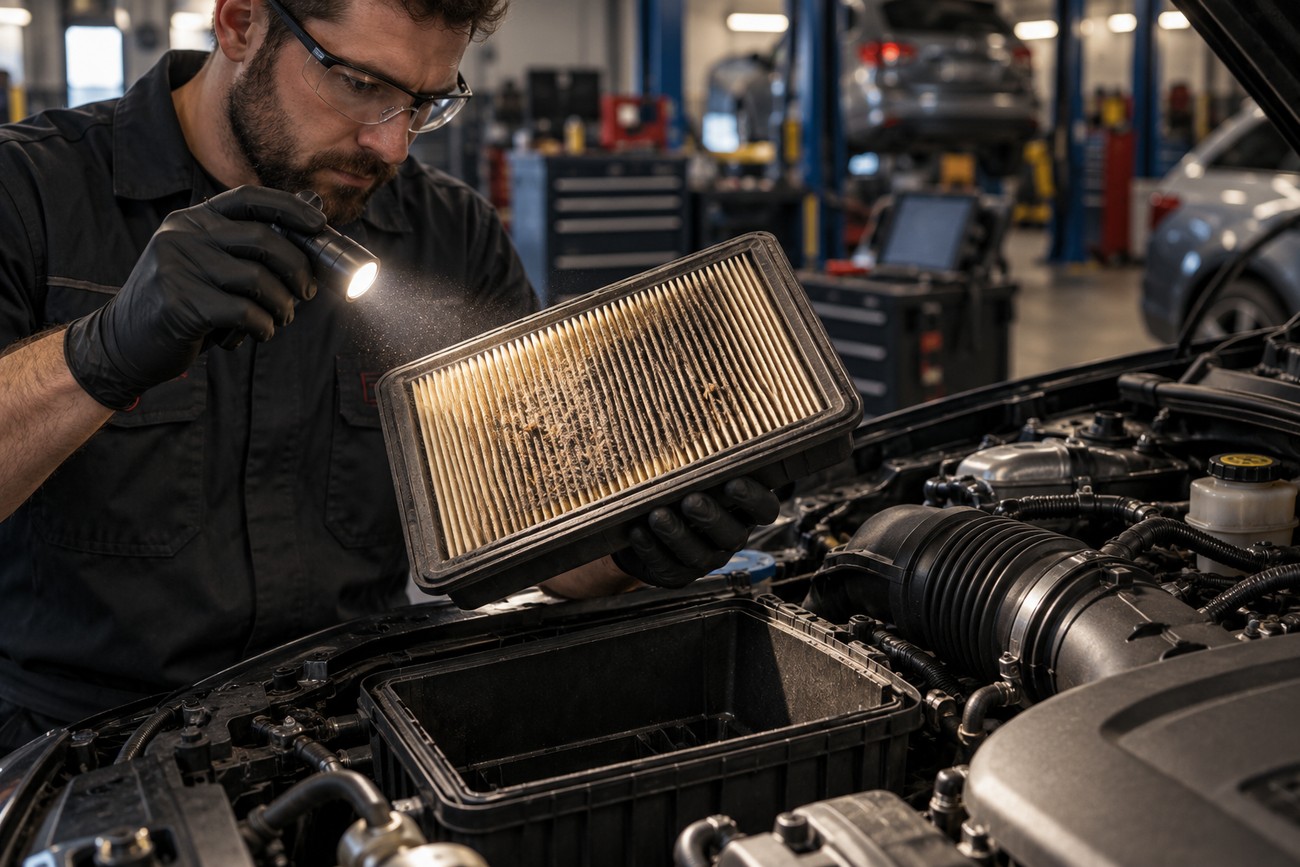
Color alone does not establish that a filter has reached the end of its service life. A light layer of dust can darken the media while the element still provides adequate airflow. Filter manufacturers assess the end of life through excessive pressure drop or inadequate airflow capacity, so restriction and the filter’s condition matter more than appearance alone.
Inspection should include the clean side of the filter housing. Dust on that side, a damaged pleat, a distorted gasket, or dirt tracks around the sealing edge indicate that air may have bypassed the media. A replacement is then justified even if the mileage is low, because filtration quality has already been compromised.
Replacement mistakes that let dirt reach the engine
Blowing out a disposable paper filter with compressed air is not a proper replacement method. High-pressure air can damage the filter structure, enlarge weak points in the media, and reduce filtration efficiency. It may remove loose surface dust while leaving fine particles embedded in the element, creating a false impression that the filter has been restored.
A replacement filter must match the specified dimensions and sealing profile. A poorly made or incorrectly sized element can leave gaps around the perimeter, allowing unfiltered air into the engine. This bypass route can be difficult to see once the airbox is closed, especially when a soft gasket has folded or failed to contact the housing evenly.
The sealing edge deserves the same attention as the filter media. A correctly chosen element cannot protect the engine if the airbox lid closes over a folded gasket, trapped debris, or a crooked filter.
The airbox lid should close evenly across its full perimeter, and its clips or fasteners should engage without excessive force. Some crossovers have crowded engine bays, plastic ducting, and fragile clips that make access difficult. Forcing the cover can distort the housing or break a clip, leaving a permanent bypass path after the service is complete.
After installation, check that the filter is fully seated, the housing is free of loose dirt, and connected intake ducts are secure. A new element with a damaged airbox, loose duct, or misaligned cover can provide less protection than expected. The practical objective is a continuous sealed route through the filter media.
OEM, aftermarket, and reusable filters: what actually matters
The word “original” does not automatically prove superior performance. Fit, sealing, filter-media quality, production consistency, and traceability matter more than the label alone. A reputable aftermarket filter can match or exceed OEM quality and service life when it is designed for the exact application.
Some supposedly original filters may come from the same suppliers as lower-priced aftermarket products. That fact does not make every aftermarket part equivalent. Different brands and production batches can vary in pleat geometry, gasket quality, media construction, and quality control, so the specific source remains important.
Counterfeit or poorly made parts create a separate risk. Packaging may appear convincing while the filter has an incorrect part number, weak sealing foam, uneven pleats, or a distorted frame. Buying through a traceable seller and comparing the part with the vehicle specification reduces the chance of installing an element that fits loosely or offers inadequate filtration.
Reusable high-flow filters require disciplined maintenance. Incorrect cleaning can damage the media, while excessive oiling can contaminate airflow sensors or the turbocharger. Any possible airflow benefit also depends on the complete intake system and engine calibration; a reusable filter is not automatically a power upgrade, and poor servicing can reduce filtration.
A practical replacement decision: schedule, condition, or both?

Start with the vehicle’s service schedule, then adjust it for the way the vehicle is actually used. Mileage alone is incomplete because contamination rate depends on dust, traffic, short trips, regional conditions, and the condition of the airbox. An inspection can justify earlier replacement even when the calendar or odometer does not.
Dusty regional conditions, construction traffic, frequent urban driving, and taxi use support earlier inspection and may place the vehicle in the severe-use range of 10,000–15,000 km. Short urban trips deserve attention because the vehicle repeatedly operates in low-speed traffic and may encounter a high concentration of road dust. A filter marketed as “extended life” still needs to be judged in its actual environment.
Replacing the filter at every service visit may be unnecessary when the element is correctly seated, the clean side is free of dirt, and airflow remains adequate. The opposite mistake is accepting marketing claims of 40,000–60,000 km without checking the filter. Those claims should not override the vehicle schedule and condition inspection.
Modified engines with higher power demand can be affected more strongly by an already restricted filter. This does not create a universal replacement mileage, but it reduces the value of postponing inspection when performance has changed. A sensible decision combines the manual, operating conditions, physical inspection, and any evidence of intake restriction.
Frequently asked questions
These answers apply as general guidance. The vehicle’s service documentation and the condition of the complete intake system remain the final references for a specific model.
How can you check whether an engine air filter is genuine rather than counterfeit?
Buy from a traceable seller and confirm that the part number matches the vehicle’s engine and production specification. Check the packaging for clear printing, consistent labeling, intact security features where applicable, and manufacturer identification that does not look altered or reprinted.
Compare the filter’s frame, pleat shape, gasket, and dimensions with the removed element or a verified reference. A genuine-looking box does not compensate for poor sealing geometry. If the filter sits loosely, has uneven construction, or requires distortion to fit, return it before installation.
How much does engine air filter replacement cost?
There is no reliable universal price because the total depends on the filter design, the part chosen, vehicle access, and labor time. A simple airbox with an easily accessible element generally requires less work than a crowded engine bay with fragile clips or multiple intake covers.
Part cost also varies between OEM, reputable aftermarket, and reusable designs. Ask for the exact part number and whether the quoted work includes inspection of the airbox seal. The cheapest component can become poor value if it fits badly or allows dirt past the filter.
How often do you really need to change an engine air filter?
For many passenger cars, use 15,000–30,000 km or 1–2 years as the normal starting point. Severe operating conditions can shorten the interval to 10,000–15,000 km, especially with dusty roads, construction areas, frequent traffic, taxi use, or short urban trips.
Inspection can override either mileage when the filter is damaged, heavily contaminated, or showing evidence of bypass. A clean highway-driven vehicle may follow the longer schedule, while a vehicle in a dusty city may need earlier replacement.
What are the symptoms of a bad engine air filter?
Possible symptoms include reduced power, slower response, and increased fuel consumption. Turbocharged engines can show these effects with moderate restriction. Similar symptoms can come from other engine or intake faults, so filter replacement should follow an inspection rather than serve as an automatic diagnosis.
Look for damaged media, a deformed gasket, dirt on the clean side, or dust tracks around the housing. A dark filter alone does not prove that airflow capacity has fallen below an acceptable level, but visible damage or bypass contamination warrants replacement.