The buying problem is easy to misread: Eastwood Clecos, Eastwood Intergrip clamps, and Steck panel clamps may perform different jobs. Clecos hold overlapping parts through aligned holes, while Intergrip hardware controls a butt-jointed edge without Cleco holes. A panel clamp sold under another brand may follow either design, so the product name alone is insufficient.
Choose Clecos when repeated removal and refitting matter and you can accept drilling through both panels. Choose Intergrip when the main task is holding a sheet-metal edge with a controlled welding gap. A fair Steck comparison requires exact part numbers; no verified official Steck data was found for holding force, hole tolerance, or service life.
- Clecos, Panel Clamps, and Intergrip: What Are You Actually Comparing?
- What the Eastwood Cleco System Actually Offers
- When Eastwood Intergrip Is the Better Tool
- Eastwood vs Steck: The Comparison the Evidence Supports
- Choose by Workflow: Holes, Edge Access, or a Mixed Setup
- Common Mistakes, Hidden Trade-Offs, and Marketing Myths
- A Practical Selection Checklist Before You Buy
- Frequently asked questions
- Who makes Clecos?
- What are the different sizes of Cleco clamps?
- How do you hold sheet metal together without drilling holes?
Clecos, Panel Clamps, and Intergrip: What Are You Actually Comparing?
A Cleco is temporary through-hole tooling. The fastener passes through aligned holes in two parts and holds them together during fitting, welding, or riveting. After the joint has been positioned or welded sufficiently, the Clecos are removed.
Edge-grip and panel clamps work from the side of the material. They are useful where a through-hole would damage a visible surface, interfere with a reinforcement, or provide poor access to the panel edge. Side holders serve a similar access problem where a standard Cleco cannot grip effectively.
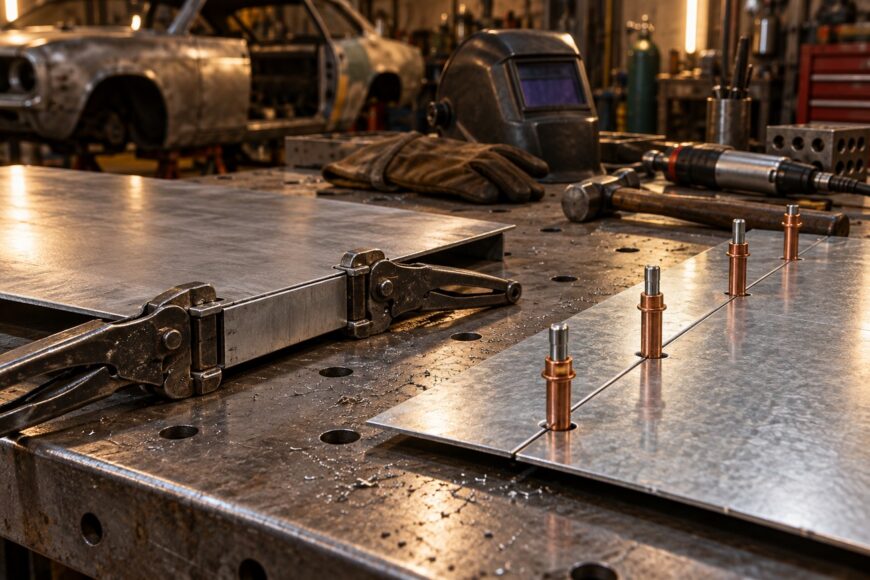
Eastwood Intergrip is a separate system designed to align butt-jointed edges. It does not require Cleco holes and is intended to hold the joint during tacking and welding. That makes it complementary to Clecos rather than a direct substitute.
The distinction matters during a repair. A Cleco helps register two overlapping pieces and preserves their position through repeated test-fitting. Intergrip helps maintain the relationship between two prepared edges, including the designed welding gap.
What the Eastwood Cleco System Actually Offers
Eastwood specifies a 1/8-inch hole for its Cleco panel-holding system. The stated grip range is up to 1/4 inch, and Eastwood claims nearly 20 lb of holding force. These are published figures for the Eastwood system, rather than independent performance results.
The kit includes Cleco pliers and side holders. The side holders are important when a standard through-hole Cleco cannot properly access or hold the panel edge. Eastwood also states that the pliers are compatible with 3/16-inch fasteners, although the basic system is specified for 1/8-inch holes.
The hole requirement gives the system a useful registration function. Once two panels have been drilled and aligned, the same holes can help restore their position after removal. This is valuable during repeated trimming, fitting, and inspection.
Holding force should be read as a retention claim, not as a panel-straightening guarantee. A distorted or highly stressed panel may need forming, temporary bracing, or a different clamping arrangement before the Clecos can hold the intended geometry.
When Eastwood Intergrip Is the Better Tool
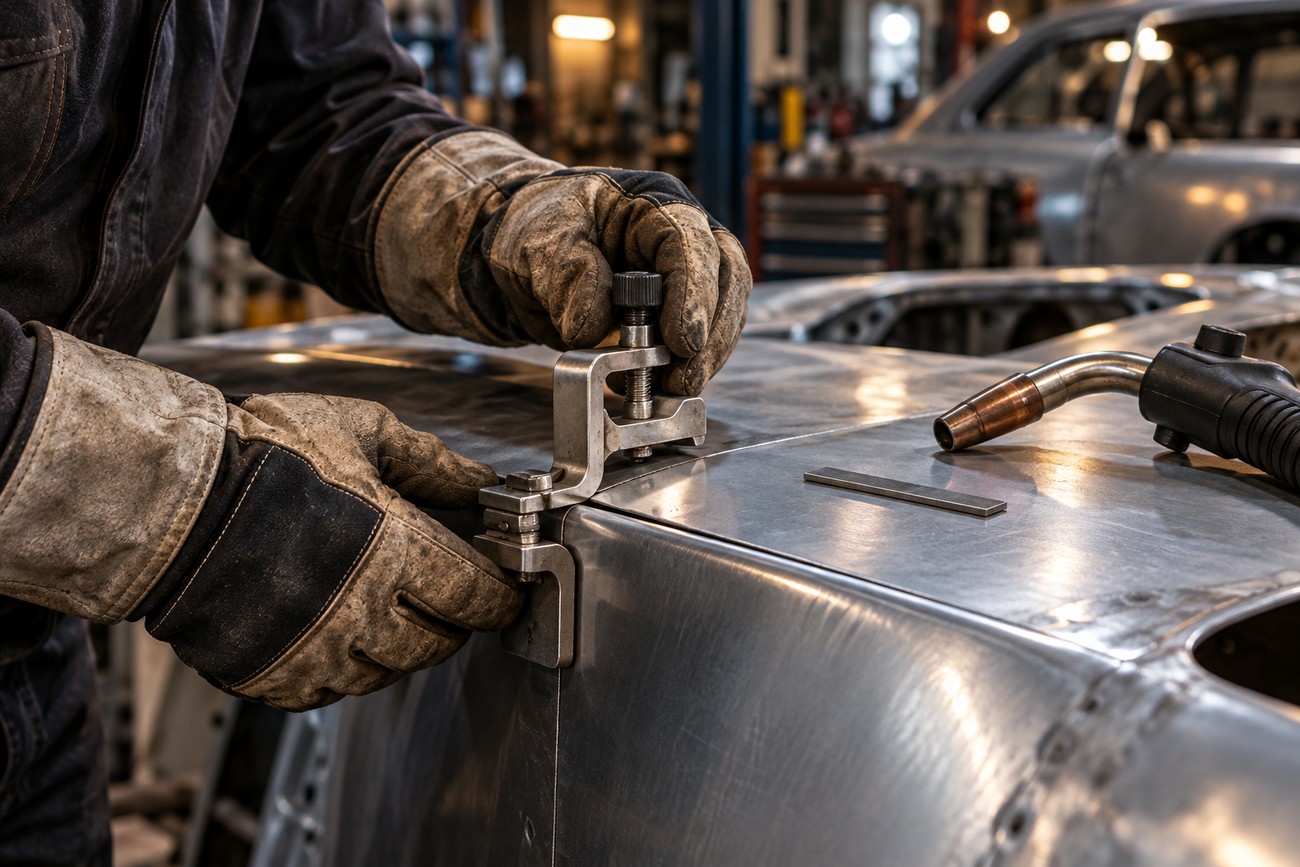
Eastwood Intergrip is designed to leave a stated 0.040-inch gap for butt welding. The clamps grip the adjoining edges, allowing the fabricator to align the joint, make tack welds, remove the clamps, and complete the weld.
The no-hole workflow suits visible surfaces and repairs where drilling would create extra finishing work. It also avoids placing registration holes in areas that may later become part of the weld zone or sit over a structural reinforcement.
An eight-piece Intergrip set may be insufficient for a long seam without repositioning or additional clamps. Moving the clamps during the process can work, provided each section is checked again before tacking and the secured area does not shift.
The 0.040-inch figure describes the stated design gap of the clamp. It does not correct poorly fitted edges, inconsistent curvature, or differences in panel stiffness. The finished seam still depends on preparation, alignment, and weld control.
Eastwood vs Steck: The Comparison the Evidence Supports
The table separates published Eastwood information from the limits of the available Steck evidence. A meaningful Steck comparison requires the exact product number, since “panel clamp” and “Cleco” can describe different designs, sizes, and arrangements.
| Comparison point | Eastwood Cleco | Eastwood Intergrip | Steck panel-clamp or Cleco product |
|---|---|---|---|
| Primary function | Temporary through-hole fastening for fitting, welding, or riveting | Edge alignment for butt welding | Depends on the exact product design |
| Hole requirement | Eastwood specifies 1/8-inch holes | Does not require Cleco holes | No confirmed official hole specification was found |
| Edge access | Side holders are included for locations where standard access is unsuitable | Grips the butt-jointed edge | Must be checked against the exact part number |
| Published specifications | Up to 1/4-inch grip range; nearly 20 lb holding-force claim; plier compatibility with 3/16-inch fasteners | 0.040-inch stated design gap | No confirmed official specification was found for holding force, hole tolerance, or service life |
| Evidence confidence | Eastwood’s own published product claims | Eastwood’s own published product claims | Insufficient verified information for a fair general comparison |
Eastwood’s published figures describe its own products and do not constitute an Eastwood-versus-Steck test. They also do not establish that one brand will hold every thickness, curve, or panel combination better than another.
A buyer comparing price or specifications should match the fastener type, hole size, grip range, and intended edge access first. Without that match, a cheaper or stronger-looking specification may describe a different tool category.
Choose by Workflow: Holes, Edge Access, or a Mixed Setup
Repeated test-fitting favors Clecos. Once the holes are correctly placed, the panels can be removed and refitted using the same registration points. This reduces the need to re-establish alignment after every trimming or inspection step.
A visible panel or inaccessible edge favors side-grip hardware. Standard through-hole Clecos need suitable access and leave holes in both panels, while side holders can secure locations where drilling or ordinary Cleco access is unsuitable.
Intergrip is the more direct choice when the repair centers on a butt joint. It holds the edges with its stated gap while tack welds are placed, then can be removed before the final welding passes.
A mixed setup can be efficient on complex repairs. Clecos can position accessible areas and provide repeatable registration, while Intergrip clamps control the butt-joint edge. This arrangement uses each tool for the positioning problem it is designed to solve.
Common Mistakes, Hidden Trade-Offs, and Marketing Myths
Plan every Cleco hole before drilling. The 1/8-inch hole must be checked against the future weld zone, reinforcement, and any surface that cannot be damaged. Cleco holes remain in both panels and may require later repair or sealing, especially on visible bodywork.
Registration holes should sit where they will not intersect the final weld or reinforcement. If the panel edge cannot tolerate a standard Cleco, side-grip hardware is the safer choice for preserving access and surface condition.
Using a standard Cleco at an unsuitable edge can leave the panel poorly supported. Side holders exist for that limitation; they are not merely extra versions of the same fastener.
The nearly 20 lb figure is Eastwood’s holding-force claim for its system. It should not be treated as proof that the tool will force a distorted panel into alignment. Likewise, an up-to-1/4-inch range does not guarantee equal performance across all thickness, curvature, and stiffness combinations.
More clamps can create their own problem on thin sheet metal. Excessive local force or too many tightly loaded points may deform the sheet, leaving a joint that appears secured but has acquired shallow distortion between or beneath the clamps.
The 0.040-inch Intergrip gap does not automatically produce a correct weld joint. Poor edge preparation, uneven curvature, and inconsistent panel support can still produce an unsuitable seam. Clecos also require preparation: drilling, access for the pliers, and a plan for the resulting holes.
A Practical Selection Checklist Before You Buy
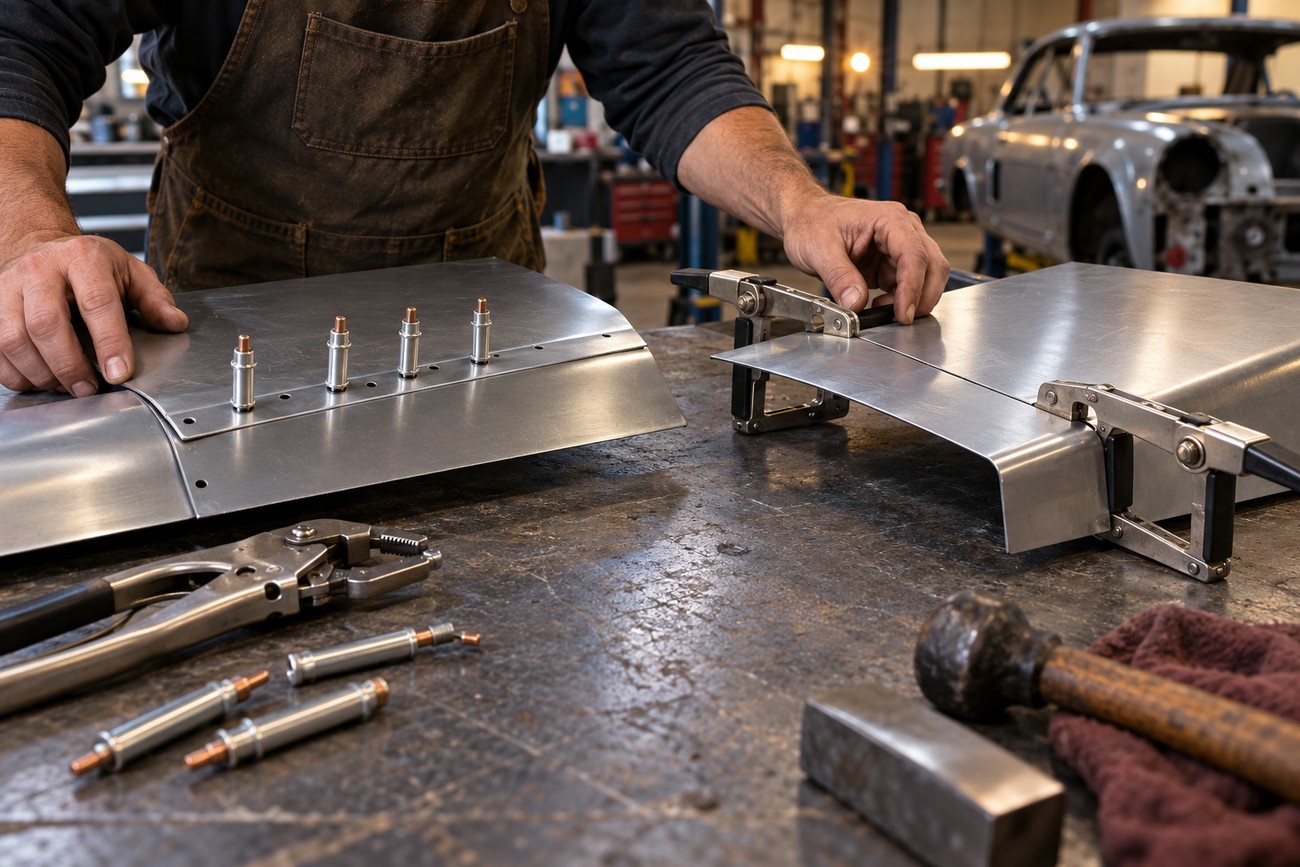
Start by classifying the joint. Through-hole work and repeated registration point toward Clecos; butt-edge work with a controlled welding gap points toward Intergrip or another suitable edge clamp.
Check access around the entire repair. Standard Clecos require through-holes and room for the fastener and pliers. Where that access is unavailable, confirm that side-grip holders can reach and support the panel edge without damaging the finished surface.
Estimate the seam length and clamp spacing before choosing a kit. The number of clamps controls how much seam can be held at one time. An eight-piece Intergrip set may require repositioning or additional clamps on a long seam, and the same planning principle applies to any temporary clamp system.
Finally, decide whether post-weld hole repair is acceptable and where those holes can safely go. Before comparing Steck specifications or price, identify the exact Steck part number; only then can its design, size, and published data be compared with the Eastwood tool you intend to use.
Frequently asked questions
Who makes Clecos?
“Cleco” is commonly used both as a generic name for this class of temporary fastener and as a reference to branded products. The word alone therefore does not identify the manufacturer, material, size, or quality of a kit.
Check the manufacturer and exact part number before buying replacement fasteners, pliers, or side holders. Eastwood positions its Cleco system for sheet metal and fiberglass, while another product using the same general term may have different dimensions or compatibility.
What are the different sizes of Cleco clamps?
Size labels can refer to the fastener diameter, the required hole, or the clamp’s working range. Those descriptions are related, yet they are not interchangeable purchasing terms.
Verify the required hole and the fastener size separately. Pliers that work with one size should not be assumed to work with another; Eastwood specifies 1/8-inch holes for its basic system and also states that its pliers are compatible with 3/16-inch fasteners.
How do you hold sheet metal together without drilling holes?
Use edge-grip hardware such as Eastwood Intergrip when the panels can be supported from their edges. Intergrip is designed for butt joints, does not require Cleco holes, and has a stated 0.040-inch design gap for welding.
This approach is preferable for many visible surfaces because it avoids creating holes that later need repair or sealing. It still requires accurate edge preparation and enough clamps for the seam length; the clamp’s stated gap cannot correct poor overall panel fit.