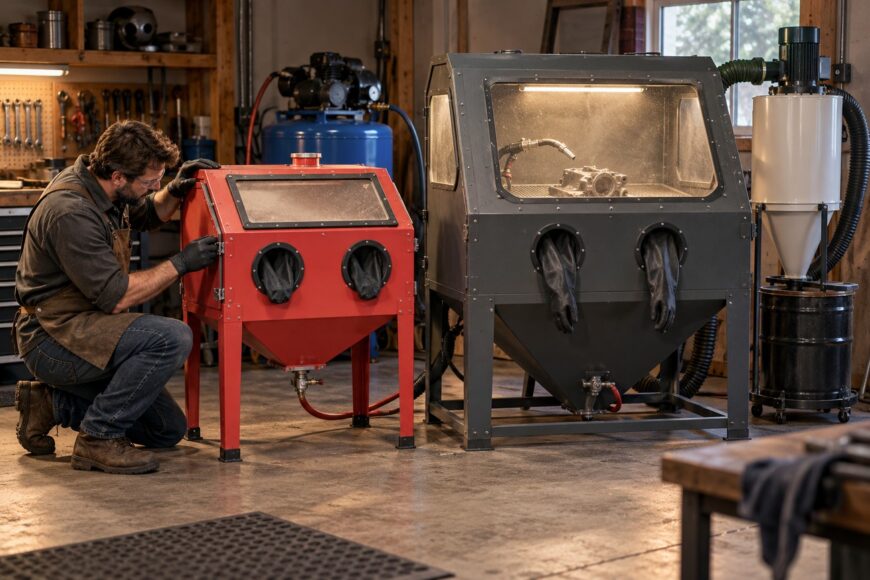
A lower purchase price is appealing when you only blast parts occasionally. A cabinet that needs less assembly or adjustment may be worth more if you use it regularly. That choice changes once dust clouds the window, abrasive escapes around a door, or the compressor cannot sustain the airflow your nozzle needs.
Eastwood cabinets are commonly positioned as mid-size DIY or garage equipment; Harbor Freight cabinets are commonly considered budget options for hobby or occasional use. Those are useful starting points, not specifications for every model. Compare the cabinet, compressor, abrasive, dust collection, and parts you plan to blast as one working setup.
- The short verdict: which cabinet makes sense for your shop?
- Eastwood vs Harbor Freight: what to compare before you buy
- Air supply and dust collection decide how well either cabinet works
- Usable space, visibility, and the parts you actually blast
- The hidden cost of making a budget cabinet usable
- First-setup mistakes that make a good cabinet seem bad
- Choose by total setup, not sticker price
- Frequently asked questions
- What is the best blast media for a home cabinet?
- What should I inspect when buying a used blast cabinet?
- How do I choose replacement gloves for a blast cabinet?
The short verdict: which cabinet makes sense for your shop?
A Harbor Freight cabinet can make sense if you want a lower-cost starting point and are willing to inspect the assembly, seal gaps where needed, and improve the light or dust collection. For occasional work, that effort may be acceptable. Budget-cabinet complaints are reasons to check a unit carefully, not proof that every unit has the same faults.
Eastwood may appeal if you want a garage cabinet that requires less work to suit your routine. Still, verify the exact model’s door access, fittings, and service parts before paying more. A higher purchase price does not establish how well a particular cabinet fits your parts.
Neither choice compensates for insufficient sustained compressor output at the required pressure. Dust collection matters just as much to the experience at the window: poor extraction can make a sound cabinet frustrating to use. Price the improvements and consumables you expect to need before deciding which option costs less in practice.
Eastwood vs Harbor Freight: what to compare before you buy
Use the exact models and your own parts for this comparison; brand positioning cannot answer these checks.
| Check | What to compare on each model | Why it matters |
|---|---|---|
| Cabinet fit | Usable interior space with the part positioned for blasting | Exterior dimensions do not show the room available to turn a part. |
| Loading access | Door opening, door swing, and clearance past the gloves | A part may fit inside yet be awkward to load. |
| Compressor requirements | The chosen nozzle’s airflow demand against the compressor’s sustained CFM at the required pressure | Tank size alone does not establish continuous blasting performance. |
| Sealing | Door seal, seams, window edge, glove ports, and latches | Gaps may release dust or abrasive into the shop. |
| Visibility | Viewing angle, light position, and replaceable window protection | Detail work depends on seeing the surface after dust builds up. |
| Dust collection | Port or fitting compatibility with the collection equipment you intend to use | A connection on the cabinet does not guarantee effective extraction. |
| Service access | Access to the hopper bottom, feed path, and replaceable wear items | Cleaning and abrasive changes become routine jobs. |
| Added costs | Cabinet price plus collection equipment, sealing, lighting, gloves, and window protection as needed | The cheaper cabinet may cost more to make usable than its sticker price suggests. |
Air supply and dust collection decide how well either cabinet works
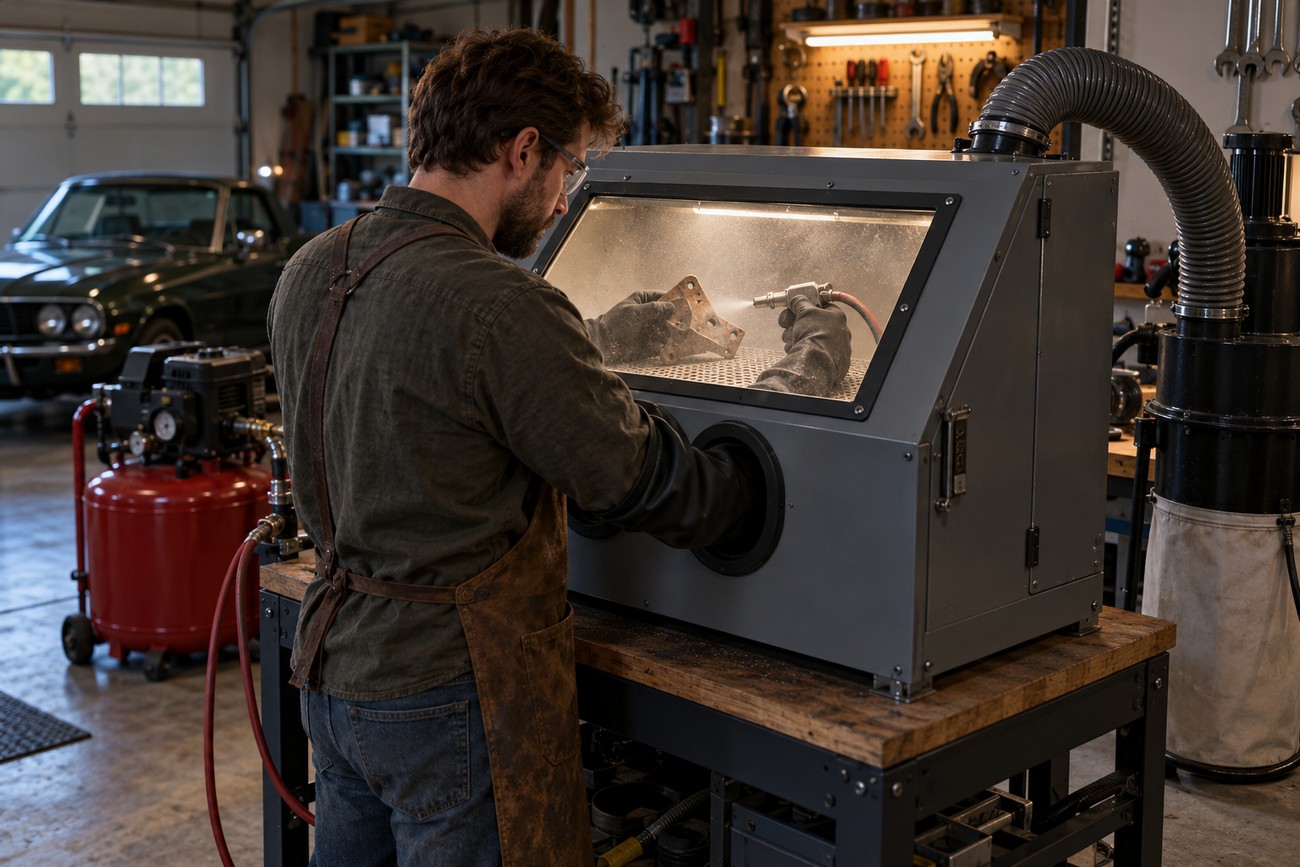
Blasting performance depends on sufficient sustained CFM at the pressure required by the chosen setup; no universal CFM figure applies to every cabinet and nozzle. Check the nozzle and compressor specifications together. A large receiver can delay a pressure drop, but it cannot make an undersized compressor supply enough air continuously.
Airborne dust obscures the work and coats the viewing window. Effective, compatible dust collection matters for either brand, and it should be planned as part of the setup rather than assumed from a cabinet photo or a dust port. Check that the intended collector and connections suit the cabinet and abrasive, and follow the equipment’s operating guidance.
Moisture, unsuitable abrasive, and insufficient airflow can all contribute to feed problems. Start diagnosis with dry media of a suitable type and size, then check the air supply and feed path. If visibility falls while blasting remains strong, investigate extraction and window protection separately from the compressor.
Usable space, visibility, and the parts you actually blast
Measure a representative part in the orientation needed to pass through the door, then allow room to turn it inside the cabinet. Exterior size alone does not establish usable interior space or door clearance. A broad shell can still be awkward if the opening or hopper geometry restricts loading and movement.
Glove position determines whether you can reach the surfaces you need to blast without pressing the part against the window or cabinet wall. Viewing angle matters most on small, detailed work: you need to see the area your hands and gun can reach. Catalog photos cannot show how clear that view will remain once abrasive and dust are moving.
Inspect where the light falls when a part is held in a working position. Window film or other protection can become scratched, and the light and window need cleaning and maintenance over time. Also check whether you can reach the bottom to remove spent abrasive; easy access saves effort each time you change media or clear a blockage.
The hidden cost of making a budget cabinet usable
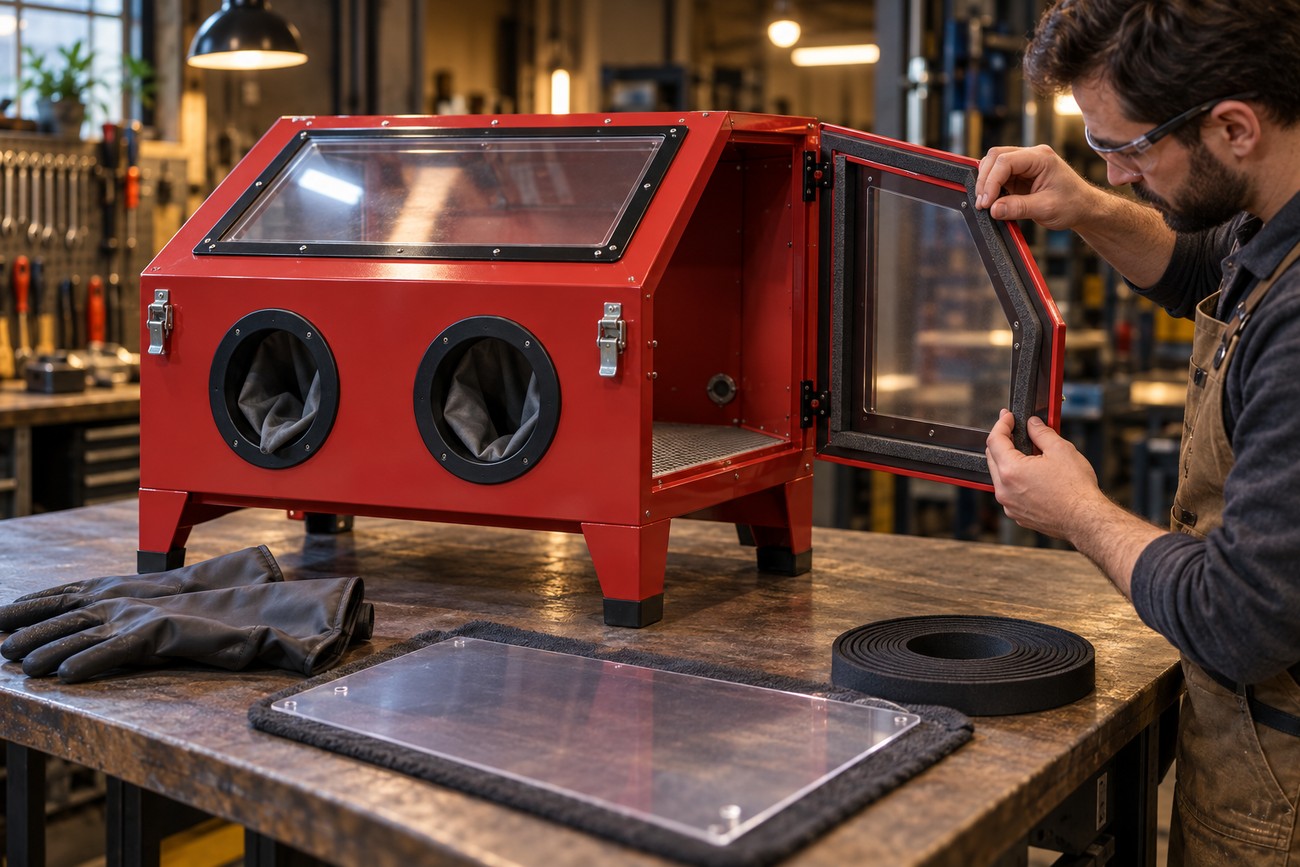
Owners of budget cabinets report weak gloves, imperfect seals or latches, and awkward dust-collection connections. Treat those as inspection points, not guaranteed defects of every Harbor Freight cabinet. Check a newly assembled unit for gaps at the door, seams, window, and glove ports before putting abrasive in it.
Sealing joints, adding suitable lighting, or arranging dust collection takes materials and time. Replacement gloves, window protection, and seals add ongoing cost because they are wear items. A lower purchase price can therefore be offset by the work required to reach a usable setup.
Some owners report needing post-assembly tuning even when a cabinet is marketed as ready to use. Others may find the supplied arrangement adequate for their tasks; neither outcome should be assumed for every unit. Eastwood setups can also need changes to match a particular collector, workpiece, or lighting preference.
Keep the distinction between a cabinet fault and a setup limitation clear. Sealing a leaking door may make the shop cleaner, but it will not give an undersized dust collector enough capacity. Budget for the complete setup, including the parts you expect to replace, rather than treating the cabinet purchase as the final expense.
First-setup mistakes that make a good cabinet seem bad
Start by confirming that the compressor can deliver sufficient sustained CFM at the pressure required by the chosen nozzle and abrasive. Do this before judging blasting strength from a brief trigger pull. A tank can provide a short period of satisfactory performance even when the compressor cannot maintain it.
Next, assemble the cabinet according to its instructions and inspect joints, door fit, window edge, and glove ports. Seal gaps where needed using materials suitable for the equipment. Then connect compatible dust collection and check that you can see the work under the installed light; sealing alone will not remove suspended dust.
Test with dry, suitable abrasive and a part that is easy to handle. If media stops feeding, check for moisture, unsuitable particles, and restrictions before blaming the shell. If blasting weakens as pressure falls, revisit the air supply; if abrasive escapes around a door, inspect the seal and latch instead.
Choose by total setup, not sticker price
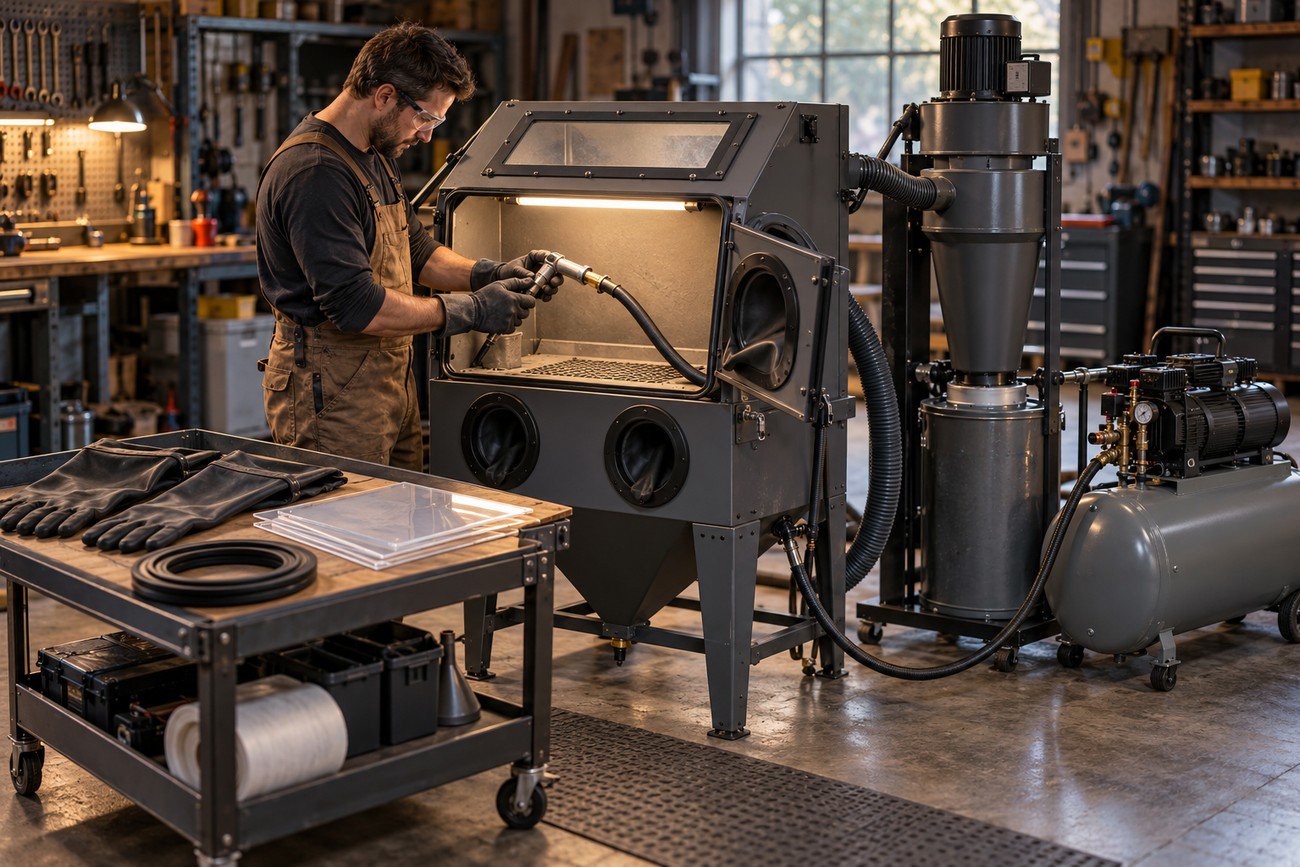
For occasional hobby work, a Harbor Freight cabinet may be a sensible purchase if you are comfortable assembling it and correcting issues you find. For more frequent garage use, an Eastwood model may be appealing if its exact layout and supplied features reduce work you would otherwise do yourself. Neither position replaces a model-by-model check.
Price the cabinet alongside compatible dust collection, likely consumables, and any planned sealing or lighting changes. Then confirm that your compressor can sustain the chosen blasting setup. A low cabinet price offers little benefit if you must immediately buy equipment you did not budget for.
Finally, check a real part against the door opening, working space, glove reach, and view through the window. The better purchase is the exact cabinet that fits those parts and your willingness to modify it, supported by adequate air and dust collection. Without that full setup, there is no reliable brand-wide winner.
Frequently asked questions
The best media depends on the finish you want, while a used cabinet calls for a close inspection of its wear items and fittings. Replacement gloves also need to fit the ports and suit the work. Check each of those details against your equipment before buying.
What is the best blast media for a home cabinet?
Choose media based on the workpiece and desired finish: glass beads often produce a smoother finish, while sharper media such as aluminum oxide provide more cutting action. Before buying, check that the media type and size suit your cabinet and nozzle, and that your dust-collection setup is appropriate for that abrasive.
What should I inspect when buying a used blast cabinet?
Check the window protection for scratches, the gloves and glove-port attachments for wear, and the seals, latch, and door fit for gaps. Inspect the hopper for damage or buildup, and confirm that dust-collection fittings are present and compatible with your equipment. Include the cost of missing or worn parts in the purchase decision.
How do I choose replacement gloves for a blast cabinet?
Check the glove-port dimensions and attachment method, then choose gloves long enough to reach the work without pulling loose and flexible enough to control the gun and parts. Confirm with the glove and cabinet manufacturers’ guidance that the material suits your intended abrasive and operating conditions.