A big truck can look slow, predictable, and easy to pass. Its size creates a different problem: blind areas, heavy momentum, a wide turning path, and limited room for a smaller vehicle to recover from a mistake. A car may be visible to the driver one moment and hidden by the trailer, mirror overlap, or a lane change the next.
Safe driving around trucks depends less on memorizing fixed distances than on managing visibility, time beside the truck, escape space, and changing road conditions. Give yourself a clear way out, avoid staying in areas the driver may not see, and assume that rain, wind, a slope, or a heavy load can change the situation quickly.
- Why Big Trucks Need More Space Than Cars
- Blind Spots: Make Sure the Truck Can See You
- How to Pass a Truck Without Lingering Beside It
- Following Behind: Braking Room and Better Visibility
- Wide Turns, Intersections, and the Right-Side Trap
- Rain, Wind, and the Mistakes That Create Extra Risk
- Frequently asked questions
- What should I do if a truck starts moving into my lane unexpectedly?
- What does “trucker syndrome” mean in road-safety discussions?
- What should you avoid while driving near large trucks?
- What is the 7/3 rule in trucking?
Why Big Trucks Need More Space Than Cars
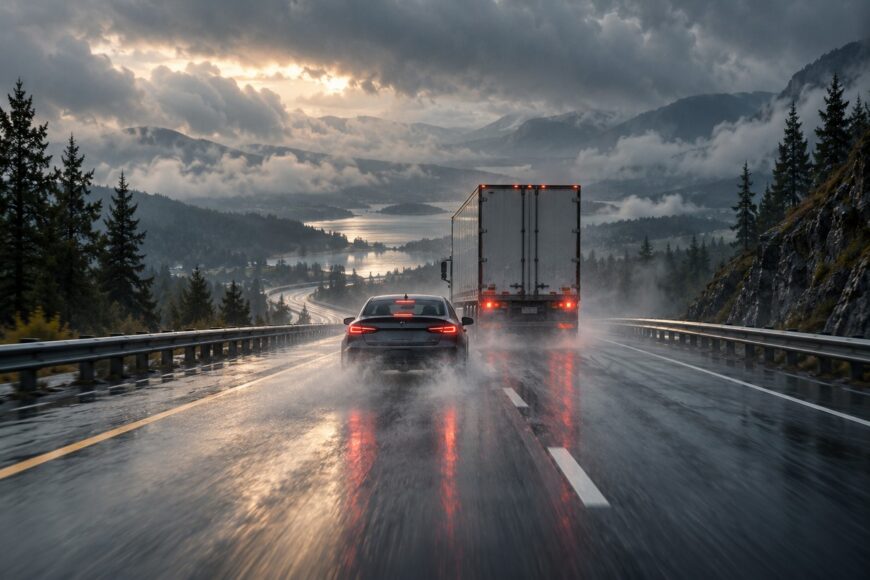
A large truck may need up to two football fields to stop. That comparison is an illustrative upper-range warning, not a constant distance for every truck. Actual stopping distance depends on speed, mass and load, slope, road surface, weather, driver reaction, and the braking system.
A loaded truck descending a wet or icy grade has less braking margin and more momentum to manage than a lightly loaded vehicle on dry, level pavement. Powerful brakes do not cancel the effects of greater mass and inertia. This is why cutting closely in front of a truck can remove the driver’s remaining braking margin even when the truck driver reacts promptly.
In 2023, trucks were 9% of vehicles in fatal crashes, compared with 5% of registered vehicles and 10% of total vehicle miles traveled. Also, 80% of trucks involved in fatal crashes were in multi-vehicle crashes, compared with 63% of passenger vehicles. These figures describe crash involvement, not proof that every truck driver was aggressive or at fault; they show why the interaction between trucks and smaller vehicles deserves careful space management.
Blind Spots: Make Sure the Truck Can See You
Truck blind spots exist in front, behind, and alongside the vehicle. Their boundaries are variable and depend on the cab, mirror arrangement, trailer, and position of the passenger vehicle. A No-Zone diagram is a useful warning about limited visibility, but its shapes and distances must not be treated as fixed universal rectangles.
A practical check is simple: if you cannot see the truck driver’s face in a side mirror, the driver may not be able to see your car. Seeing the mirror itself is not a permanent guarantee of visibility, because your car can be hidden by overlap, movement, or the timing of a mirror check. Treat the rule as a prompt to leave the area, rather than as permission to remain beside the cab.
The common mistake is lingering near the rear axle, the trailer’s rear section, or the cab while waiting for a gap. In those positions, a truck may begin changing lanes while the smaller vehicle is difficult to detect. Move through the exposed area only when traffic, visibility, and speed make that safe, and avoid placing yourself beside a truck without a clear plan to exit.
How to Pass a Truck Without Lingering Beside It
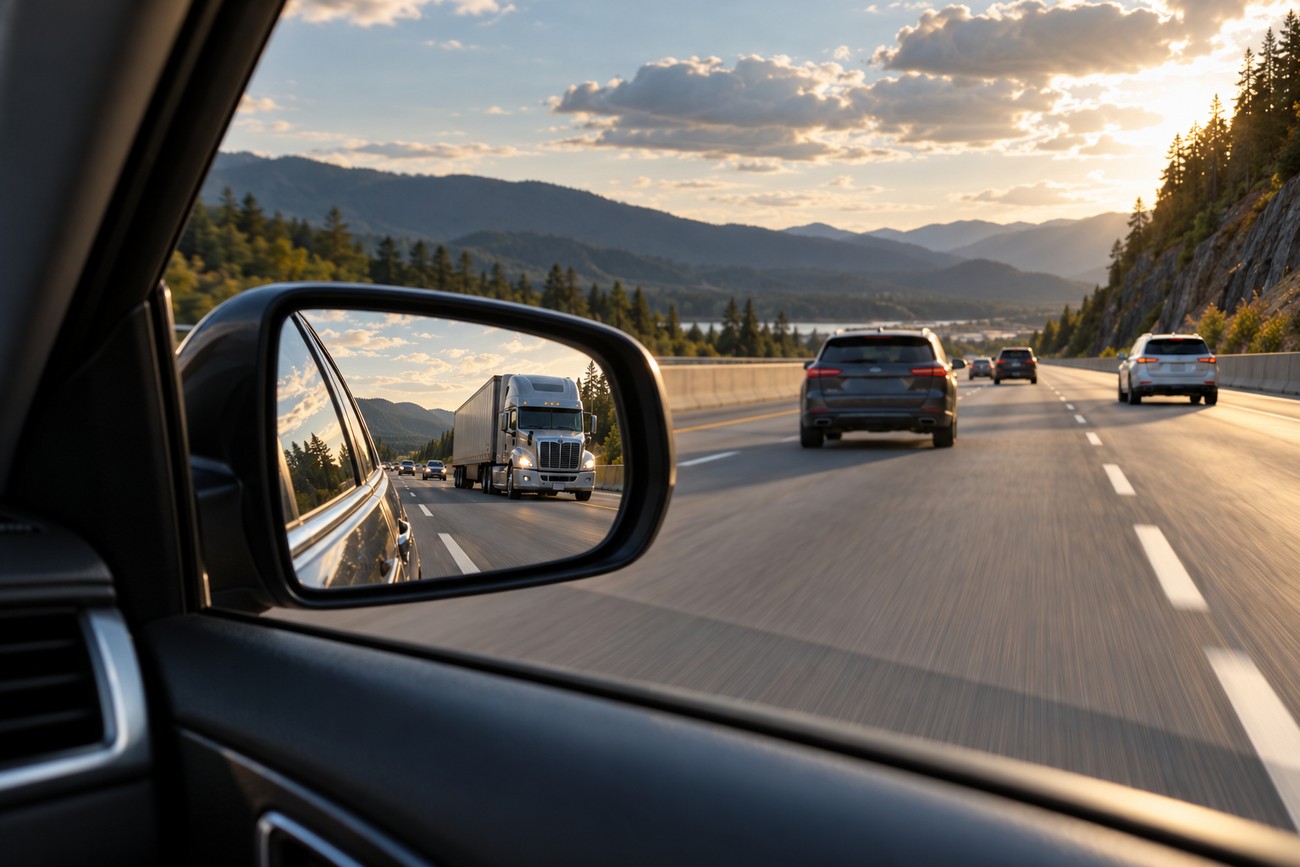
Approach with space and check the lane, road surface, traffic, and visibility before passing. Pass decisively at a legal and safe speed, without turning the maneuver into a race. Return to the lane only after the entire truck is visible in your rearview mirror and a meaningful gap remains between your car and the truck.
A car near the trailer’s rear axle or cab can be missed during a lane change, particularly when mirrors overlap or traffic is dense. A truck’s turn signal is useful information, but it is not permission to hold position alongside the truck. Treat the signal as a reason to create space and avoid racing through the truck’s likely path.
Decide where the pass will finish before you accelerate. Entering a truck’s blind area without enough road ahead turns a routine pass into an improvised maneuver beside the trailer.
After passing, do not immediately cut in front of the cab. Your car may be visible while still leaving too little stopping room for the truck, especially on a descent or in poor weather. If the passing lane ends or traffic closes the gap, slow down smoothly and wait for a safer opportunity rather than forcing your way alongside the truck.
Following Behind: Braking Room and Better Visibility
Tailgating a truck blocks your view of traffic, brake lights, obstacles, and changes in the road ahead. It also places your car in a rear blind area where the truck driver may not see you. The truck’s high body creates a serious risk of the passenger vehicle sliding beneath the rear or trailer in a rear impact.
Stay far enough back to see the road ahead and the truck’s mirrors, then increase that margin on descents, in rain, snow, or ice, and when the truck is heavily loaded. Do not use a universal number of seconds or meters as a substitute for judgment. The correct space grows when visibility, traction, or the truck’s ability to stop becomes less favorable.
Take special care behind a truck stopped on an uphill grade. It may roll backward as the driver moves off, so do not stop tightly against its rear. Leave room to move away, and keep an escape option in mind rather than trapping your car between the truck and the vehicle behind you.
Wide Turns, Intersections, and the Right-Side Trap
Large trucks turn widely and slowly. A truck may initially move opposite to the direction of the turn, then use more than one lane as the trailer follows a different path from the cab. The front wheels do not show the complete path of the trailer, and the signal alone cannot tell you how much room the maneuver will require.
Trying to pass on the right of a turning truck is especially dangerous near a curb, driveway, or intersection. The trailer can move toward the space where a car appears to have room, trapping the car between the trailer and the curb or another obstacle. Wait until the turn is complete instead of predicting the path and trying to squeeze through.
Crash patterns also show why position matters. In truck-versus-other-vehicle crashes, the truck was struck in the rear in 21.2% of cases, compared with 6.3% for the other vehicle; the truck’s front was struck in 32.1% of cases. These figures do not predict an individual collision, but they reinforce the value of avoiding the truck’s rear and side areas when traffic is compressing or turning.
Rain, Wind, and the Mistakes That Create Extra Risk
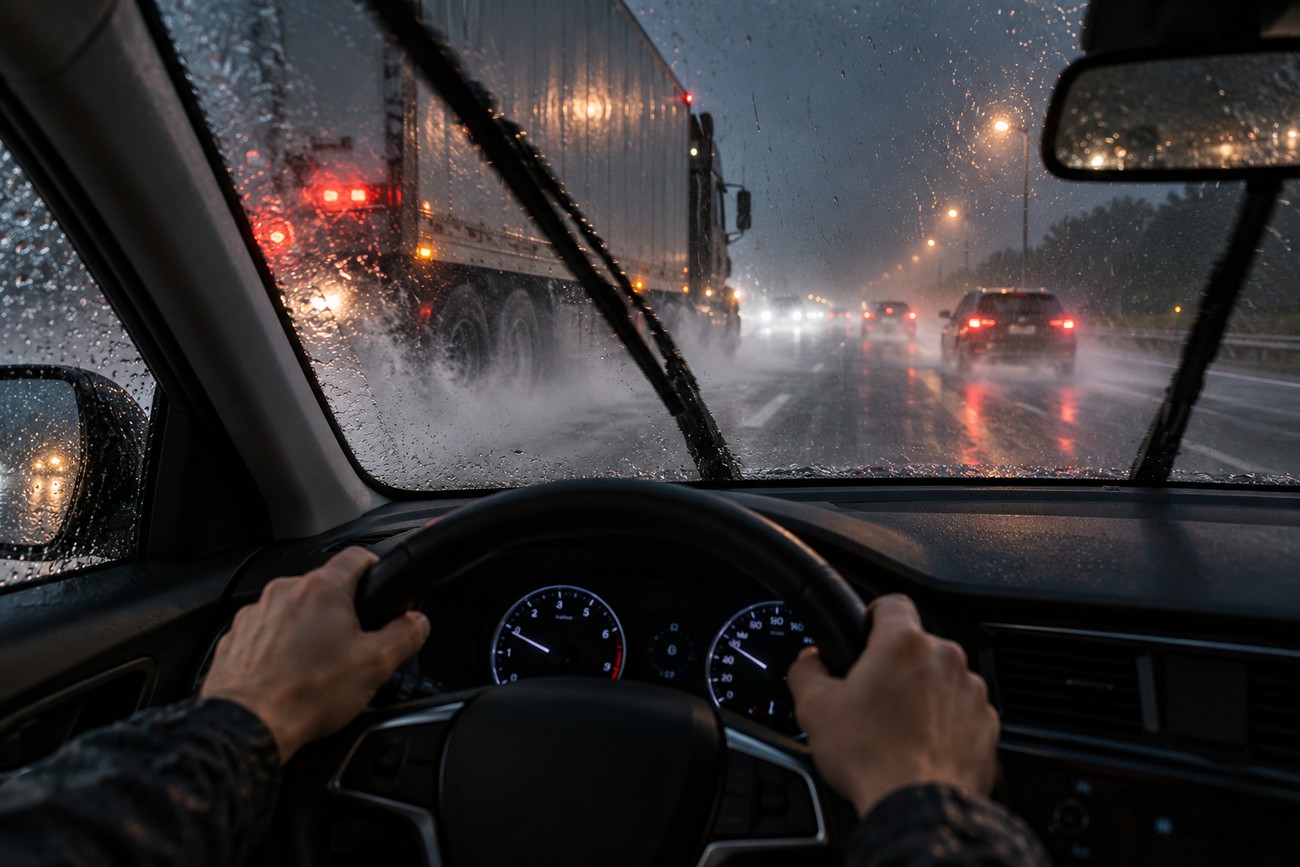
After rain, spray from a truck can sharply reduce visibility, and ordinary wipers may not keep up. Water also reduces tire grip, making abrupt braking or steering less effective. Slow down when the spray obscures lane markings or traffic, and leave the truck’s spray zone when you can do so without making a sudden lane change.
Crosswinds and turbulence can push a passenger vehicle during a meeting or pass. The effect may become most noticeable as the car exits the truck’s aerodynamic shadow and the air pressure changes suddenly. Keep both hands on the wheel, make smooth corrections, and preserve an escape route instead of steering sharply against every movement.
Several common assumptions create extra risk. A truck does not stop faster merely because it has powerful brakes; greater mass and inertia still matter, particularly when it is loaded or the road is wet, snowy, or icy. The absence of a turn signal does not eliminate a blind spot, and apparent movement toward another lane may be part of a normal turn setup. Give the truck room before its path becomes obvious.
Frequently asked questions
Driving near large trucks requires attention to visibility, spacing, and escape routes. Conditions such as rain, wind, slopes, and heavy loads can change the risk quickly. The following answers summarize how to respond to common situations without relying on fixed rules.
What should I do if a truck starts moving into my lane unexpectedly?
Reduce speed and create lateral space if another lane or the shoulder can be used safely. Avoid accelerating into the truck’s blind spot or trying to race past its front or rear. Use the horn only when necessary to alert the driver, while keeping your steering controlled and looking for an open escape path.
If there is no safe space, braking smoothly is usually safer than making a sudden turn into occupied traffic. Once the truck has stabilized in its lane, reassess your position and pass later only when you can see the truck clearly and maintain a proper gap.
What does “trucker syndrome” mean in road-safety discussions?
“Trucker syndrome” is not a standardized technical diagnosis. The label is used inconsistently in informal discussions, so it should not be treated as a formal explanation of a driver’s behavior or condition.
Focus instead on observable risks such as fatigue, reduced attention, highway monotony, or delayed reactions. If a truck is drifting, braking unpredictably, or changing speed repeatedly, increase your distance and avoid remaining beside it.
What should you avoid while driving near large trucks?
Avoid tailgating, lingering beside the cab or trailer, cutting in immediately after passing, and trying to pass on the right while the truck turns. Avoid assuming that a visible mirror, a missing turn signal, or a clear-looking gap guarantees that the truck driver can see your car.
Also avoid driving beside a truck when rain, spray, crosswinds, or poor traction leave you no escape route. If conditions deteriorate, slow down and increase space rather than trying to maintain your previous position.
What is the 7/3 rule in trucking?
The “7/3 rule” does not have one universally standardized official meaning for driving near trucks. Similar labels may refer to following distance, visibility, or other informal guidance, and their interpretation can vary.
Do not let the slogan replace local traffic law, mirror checks, or conditions-based spacing. Use the road, weather, speed, load, and available escape space to decide how much room you need.