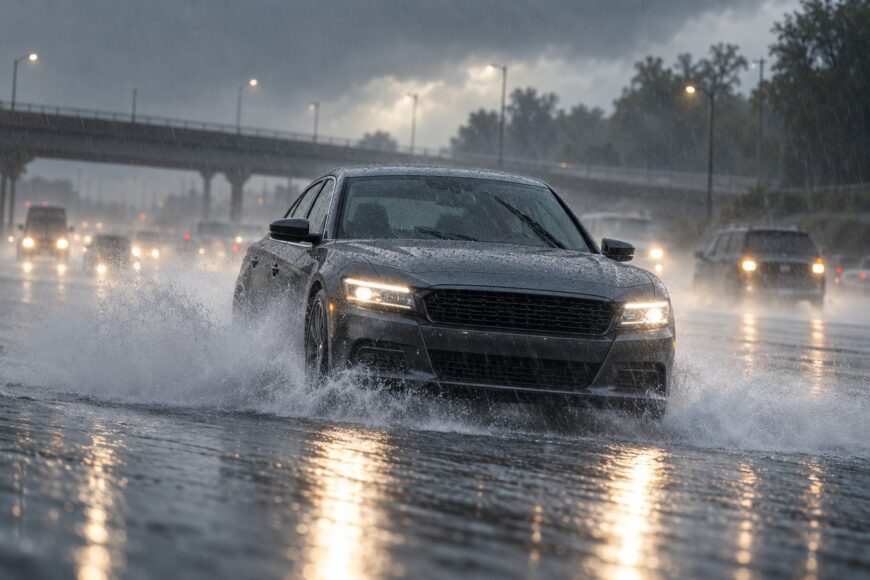
A car can feel completely stable on dry pavement and then lose steering response in a wet lane, a wheel rut, or a puddle. The steering may suddenly feel light, the vehicle may drift, and the tires may seem disconnected from the road. That change can happen before a driver sees a dramatic sheet of standing water.
Hydroplaning occurs when a tire cannot evacuate water from its contact patch quickly enough and loses effective contact with the road. The main controls are speed, water depth, tire condition and pressure, road surface, and smooth driver inputs. Headlights and wipers help you see and be seen, but they cannot restore tire contact once speed and water exceed available grip.
- Why Hydroplaning Happens—and Why It Can Start Earlier Than Expected
- Before You Leave: Make the Car Ready for Wet Roads
- Set a Safe Pace: Speed, Distance, and Visibility
- How to Approach Puddles, Ruts, and Other Wet-Road Hazards
- What to Do if the Car Starts Hydroplaning
- Tires, Myths, and the Mistakes That Make Rain Driving Worse
- Frequently asked questions
- At what speed, in mph, can a car start hydroplaning?
- How many inches of rain are unsafe to drive in?
- How many inches of water on the road can cause hydroplaning?
- Should you use cruise control when driving in heavy rain?
Why Hydroplaning Happens—and Why It Can Start Earlier Than Expected
A moving tire normally pushes water through grooves in the tread and away from the contact patch. If the tire meets water faster than the tread can clear it, a layer of water begins to separate rubber from pavement. The tire can then ride on water rather than grip the road surface, reducing steering, braking, and acceleration control.
Speed is a major factor, but there is no single trigger speed for every vehicle or road. Some tests and practical reviews report hydroplaning onset roughly between 70 and 100 km/h, while worn tires or poor surfaces can allow it to occur at about 40 km/h. These figures are condition-dependent guidance, not a guaranteed threshold or a legal limit.
Water depth changes quickly across a road. A thin film can become hazardous at high speed, especially where the surface is smooth or contaminated. Deep puddles, longitudinal ruts, dirt, uneven pavement, and poor drainage make the water harder for the tire to displace and can cause different wheels to lose grip at different moments.
Tread design and wear also matter. A tire that looks acceptable at a glance may evacuate water less effectively as its grooves wear, while incorrect pressure can alter the shape of the contact patch and reduce wet-road performance. The first strong rain deserves particular caution because water can mix with dust, oil, and dirt on the pavement, creating a slippery surface before drainage has cleared it.
Before You Leave: Make the Car Ready for Wet Roads
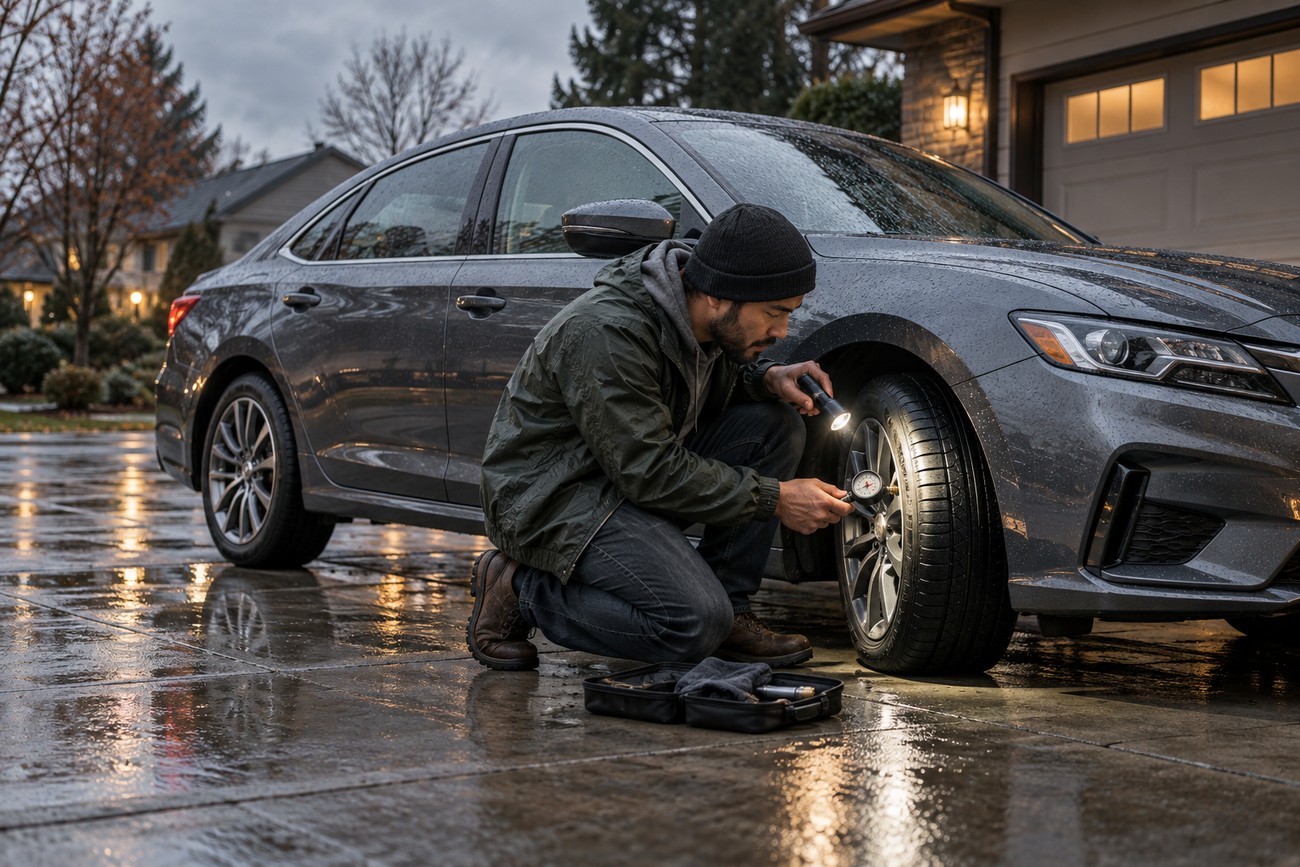
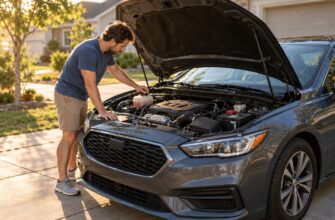
Start with the tires because they provide the only direct connection between the vehicle and the road. Check pressure when the tires are cold and follow the vehicle manufacturer’s specification rather than a number printed on the tire sidewall. Inspect tread for uneven wear, damage, or objects, and replace tires that no longer meet the applicable legal or manufacturer limits.
There is no universal technical or legal rule that every tire must have 4 mm of tread. One source recommends at least 4 mm, but that is a source-specific recommendation, not a requirement for every tire, season, or jurisdiction. Use the manufacturer’s guidance, local legal limits, tire condition, and observed wet-road performance together when deciding whether a tire is suitable.
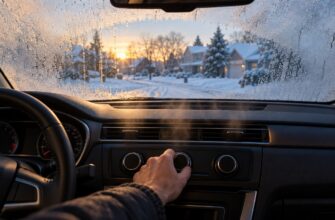
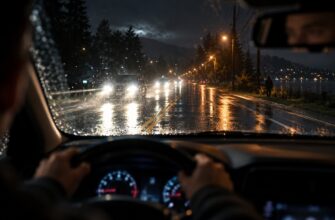
Clear vision is part of vehicle control. Make sure the windshield is clean, the wiper blades do not smear water, and the washer reservoir is filled. Use low-beam headlights or sidelights and windshield wipers in heavy rain so you can see hazards and other road users can see you. These measures improve visibility and conspicuity, but good visibility does not compensate for excessive speed.
Delay the trip, pull over safely, or stop at a suitable location if visibility becomes unmanageable or water is covering the road. A large puddle may conceal a pothole, an open cover, or damaged pavement, creating impact and suspension risks beyond hydroplaning. A car with worn suspension components may also respond less predictably when water and uneven pavement change the load on its tires.
Set a Safe Pace: Speed, Distance, and Visibility
Reduce speed before the rain becomes difficult to manage. In heavy rain, practical guidance often points to about 60–70 km/h, adjusted downward for visibility, water, tires, and pavement. In intense rain or deep standing water, about 40–50 km/h or less may be appropriate. These are practical ranges, not guarantees, and a poorly draining road may require a lower speed still.
Choose speed by what you can see and what the road is doing, rather than by the posted limit alone. If spray from other vehicles obscures lane markings, if water is collecting in ruts, or if you cannot identify the road edge, slow down further. A lawful speed can still be too high for the actual weather and surface conditions.
Increase your following distance to at least twice the normal gap, and consider two to three times the normal gap in severe rain. Wet roads lengthen stopping distances, while spray can delay your view of brake lights or a stopped vehicle. The extra space also gives you more time to brake smoothly and avoid a puddle or damaged section of pavement.
Use low-beam headlights or sidelights and keep the wipers operating when rain is heavy. Many practical recommendations also advise switching cruise control off so you can manage speed and throttle directly as grip changes. Keep both hands available for smooth steering, and avoid treating the chosen speed as fixed if rainfall, visibility, or standing water worsens.
How to Approach Puddles, Ruts, and Other Wet-Road Hazards
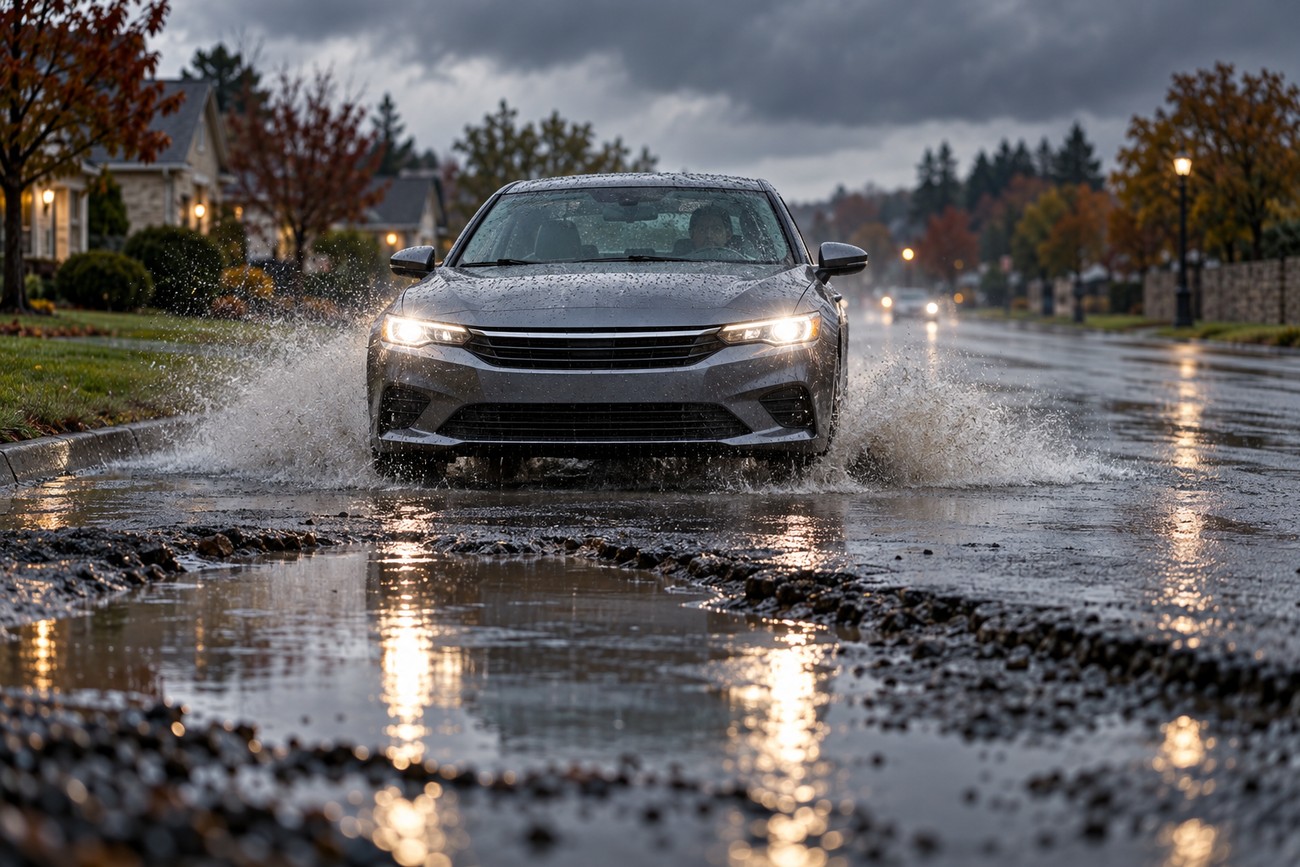
Scan well ahead for dark patches, reflections, standing water, wheel ruts, and spray that behaves differently from the surrounding road. If you can safely avoid a puddle, do so without making a sudden lane change. A puddle can hide a pothole, a cover, or broken pavement, and its depth is often impossible to judge accurately from the driver’s seat.
When you cannot avoid water, reduce speed before reaching it and maintain a steady, moderate pace through the wet section. Avoid abrupt steering, braking, or acceleration while the tires are crossing it. Entering a puddle quickly can produce a sudden loss of grip, while a sharp correction can make the vehicle move sideways as the tires regain contact.
Wheel ruts deserve special attention because they collect water even when the rest of the lane looks relatively clear. Passing another vehicle can add lateral risk: spray may hide the lane, water depth can change near the center or edge of the road, and the vehicle may be affected by both tire grip and air movement. Complete the maneuver only when you have enough visibility and space to keep inputs smooth.
The first strong shower can be especially slippery as water lifts dust, oil, and dirt from the surface. Spray from a truck or bus can briefly reduce visibility almost to zero, so ease off the accelerator before entering that cloud rather than reacting after the view disappears. If the rain continues to overwhelm visibility or the road begins to flood, stop driving when you can reach a safe place.
What to Do if the Car Starts Hydroplaning
The first warning may be a steering wheel that suddenly feels light or vague. The car may drift, respond slowly to steering, or seem to move independently of your intended line. Treat that sensation as reduced tire contact, not as a signal to make a large steering correction.
- Stay calm and look toward the safe path you want the vehicle to follow.
- Ease off the accelerator smoothly to reduce speed without provoking a weight shift.
- Keep the steering pointed in the intended direction with small, steady input.
- Avoid sharp braking, acceleration, or steering until the tires reconnect with the road.
- After grip returns, slow down further and reassess the lane, water, and visibility.
Heavy braking or a sudden lift from the accelerator can change the vehicle’s balance while the tires are already short of grip. Rapidly chasing the car with left-right steering corrections can also turn a brief loss of contact into a larger swerve. The immediate aim is to remove abrupt inputs and give the tires time to reconnect with the pavement.
A light steering feel and a full swerve are different problems. With a light steering feel, trained responses begin by removing abrupt inputs and waiting for contact to return instead of chasing the car with rapid corrections.
Once the vehicle responds normally again, do not immediately resume the previous pace. Increase the following distance, avoid the same water if possible, and decide whether continuing is sensible. If the car repeatedly feels vague or pulls in one direction, stop at a safe location and have the tires, pressure, alignment, and suspension checked.
Tires, Myths, and the Mistakes That Make Rain Driving Worse
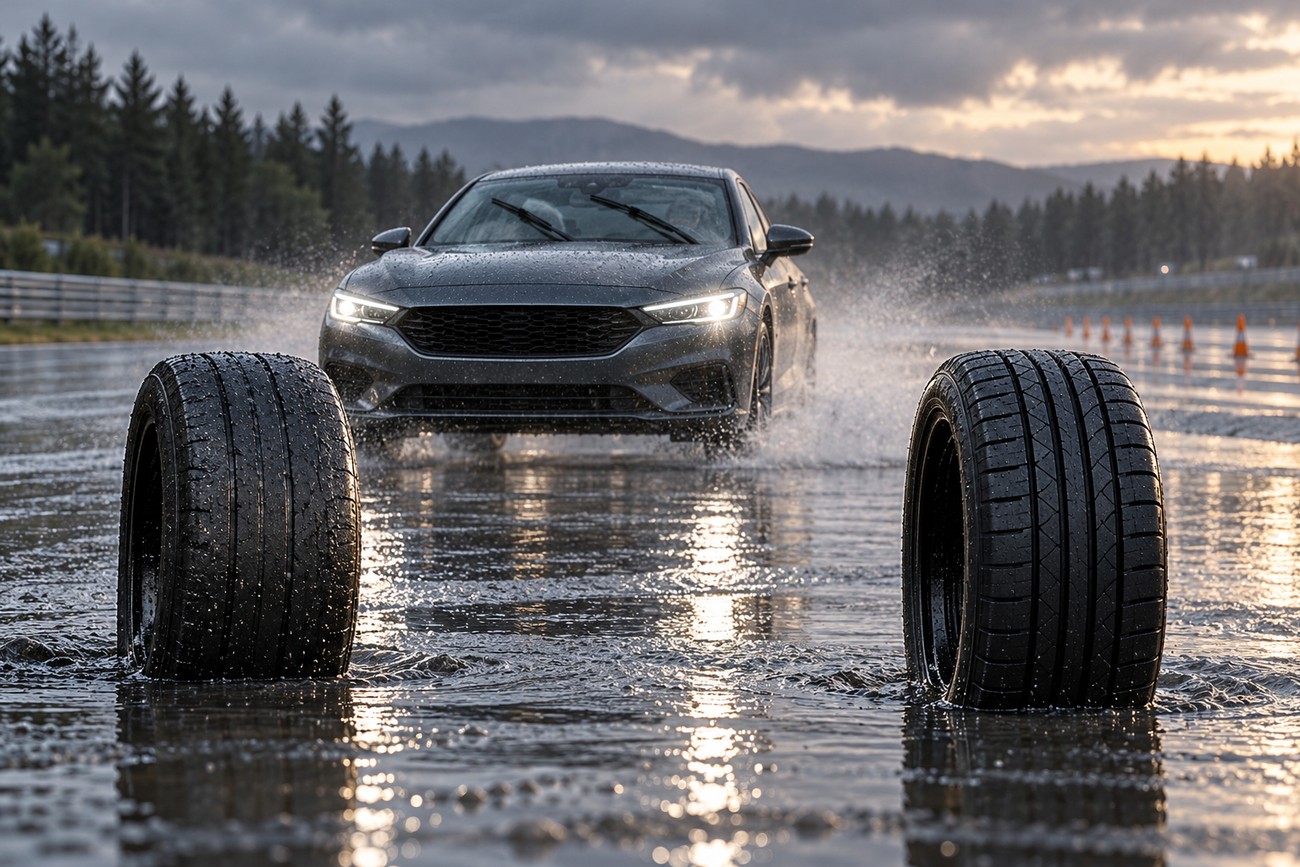
New or premium tires can improve wet-road performance, but they do not eliminate hydroplaning. If speed or water depth exceeds the available grip, even a good tire can lose effective contact. Tire marketing should therefore be read alongside the real conditions: tread wear, pressure, ruts, drainage, pavement quality, and the thickness of the water film.
Lights and wipers solve a visibility problem, not a traction problem. They help you identify hazards and remain visible, but they cannot prevent a tire from riding on water. Similarly, a tread pattern that looks deep enough may perform poorly if the tire is unevenly worn, incorrectly inflated, damaged, or operating on a heavily contaminated surface.
The often-cited 4 mm tread figure should be treated carefully. One source recommends at least 4 mm, but it is not a universal requirement for every tire, season, or jurisdiction. Check applicable rules and manufacturer guidance, then consider the tire’s actual condition and wet-road behavior rather than relying on one number as a guarantee.
The most common rain-driving errors are predictable: maintaining dry-road speed, following too closely, entering puddles quickly, and ignoring tire wear or incorrect pressure. Another mistake is waiting until the car feels unstable before slowing down. Early, smooth speed reduction preserves more control than a late emergency response after water has already changed the vehicle’s behavior.
Frequently asked questions
Hydroplaning cannot be predicted by one speed, rainfall total, or water-depth number. The useful answer depends on how speed, drainage, tires, pavement, and visibility combine at that moment.
At what speed, in mph, can a car start hydroplaning?
There is no single mph threshold that reliably applies to every car or road. Reported onset varies from about 40 km/h in poor conditions to roughly 70–100 km/h in other tests and practical reviews, which is approximately 25 mph to 43–62 mph.
Those conversions should not be treated as a safe-speed rule. Worn tires, incorrect pressure, ruts, poor pavement, and standing water can bring the loss of contact earlier, while a thin water film can still matter at high speed. Choose speed for the actual road and visibility conditions.
How many inches of rain are unsafe to drive in?
No dependable rainfall total in inches guarantees that driving is unsafe. Rainfall is measured over time and across an area, while your immediate risk depends on standing-water depth, drainage, ruts, visibility, tires, and speed.
A smaller rainfall total can create dangerous pooling on a poorly draining road, while heavier rain may be manageable briefly on a well-drained surface with clear visibility. Slow down when water is collecting, spray blocks your view, or you cannot identify the road surface, and stop if conditions become unmanageable.
How many inches of water on the road can cause hydroplaning?
There is no dependable universal inch measurement that marks the start of hydroplaning. A thin film of water can reduce effective contact at high speed, while a deeper pool increases the risk and may conceal potholes or damaged pavement.
Judging visible pooling is more useful than chasing a precise depth that is difficult to measure from the driver’s seat. Reduce speed before the water, avoid it where possible, and keep steering, braking, and throttle changes smooth.
Should you use cruise control when driving in heavy rain?
Many practical recommendations advise switching cruise control off in heavy rain. Direct control of the accelerator makes it easier to reduce speed smoothly as visibility worsens, water collects, or grip changes across the lane.
Cruise control does not cause hydroplaning by itself, but it can make a changing situation harder to manage because the driver is less directly controlling speed and throttle. In heavy rain, use a speed that matches conditions and keep your attention on the road surface ahead.