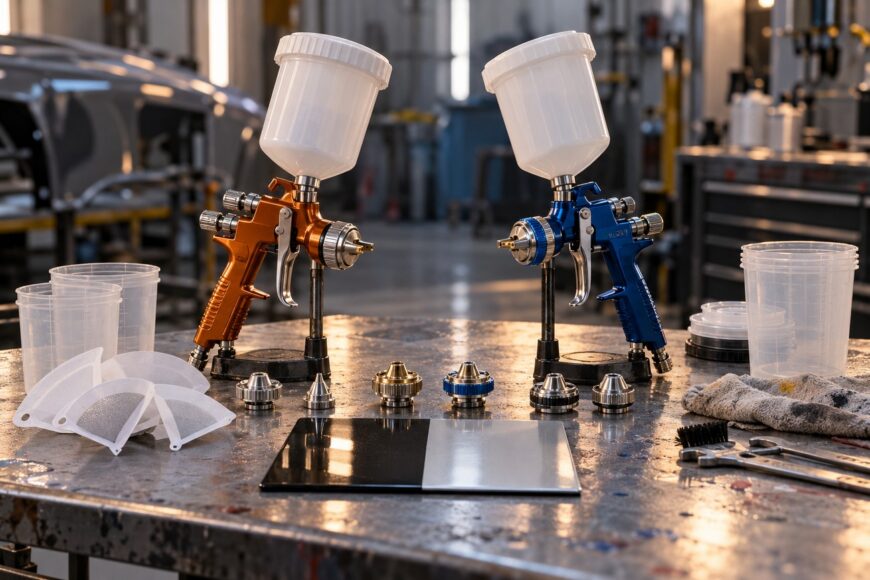
The FLG-5 looks like an inexpensive first spray gun, yet its air demand, material limitations, and varying configurations make the purchase less simple than the price suggests. A buyer who sees “entry-level” may expect a small, forgiving tool. The FLG-5 is closer to a full-size working gun that still requires a properly matched compressor and deliberate setup.
The FinishLine 4 is a competing entry-level choice, but its suitability also depends on the coating, compressor capacity, tip set, and exact package. Neither model deserves a universal-winner verdict. The useful comparison starts with the work you intend to do, then checks whether the gun, material, and air supply can operate together without forcing compromises.
- FLG-5 vs FinishLine 4: The Decision Behind the Names
- What the FLG-5 Specifications Really Mean
- FLG-5 vs FinishLine 4: Specification and Configuration Check
- Basecoat, Clearcoat, and Primer: Where the Difference Shows
- The Compressor Trap: Air Supply Before Spray Quality
- Hidden Costs, Compatibility Risks, and Common Buying Errors
- Which One Should You Buy—and When Should You Walk Away?
- Frequently asked questions
- What is the best automotive spray gun on the market?
- What are the disadvantages of using a gravity-feed spray gun?
- Which is better: gravity feed or siphon feed?
- How can I tell whether my compressor can run an FLG-5 reliably?
- What should I verify when a FinishLine 4 listing does not show the tip set?
FLG-5 vs FinishLine 4: The Decision Behind the Names
Model names are a poor substitute for a spraying plan. Basecoat, clearcoat, primer, and waterborne products place different demands on atomization, tip size, cleaning, and transfer behavior. The same gun can seem successful on one material and frustrating on another because viscosity and reduction change the way the fan develops.
The FLG-5 is an entry-level spray gun for organic materials. Some product descriptions explicitly state that it is not suitable for waterborne paints, so it should not be treated as a universal all-coatings gun. Check that limitation against the exact configuration and local documentation before purchase, especially if the gun is intended for modern automotive refinishing systems.
The FinishLine 4 should be approached with the same discipline. The family name alone does not identify one universal air requirement, cup arrangement, pressure range, or tip package. Retail listings may combine details from different versions, so a comparison that assigns one fixed FinishLine 4 specification can create false confidence.
Practical user reports often favor the FLG-5 for clearcoat and describe the FinishLine 4 as more pleasant on basecoat. That is useful workshop experience rather than an absolute performance rule or a controlled laboratory verdict. The right decision therefore depends on the coating that makes up most of your work, the available air supply, and how much setup adjustment you are willing to perform.
What the FLG-5 Specifications Really Mean
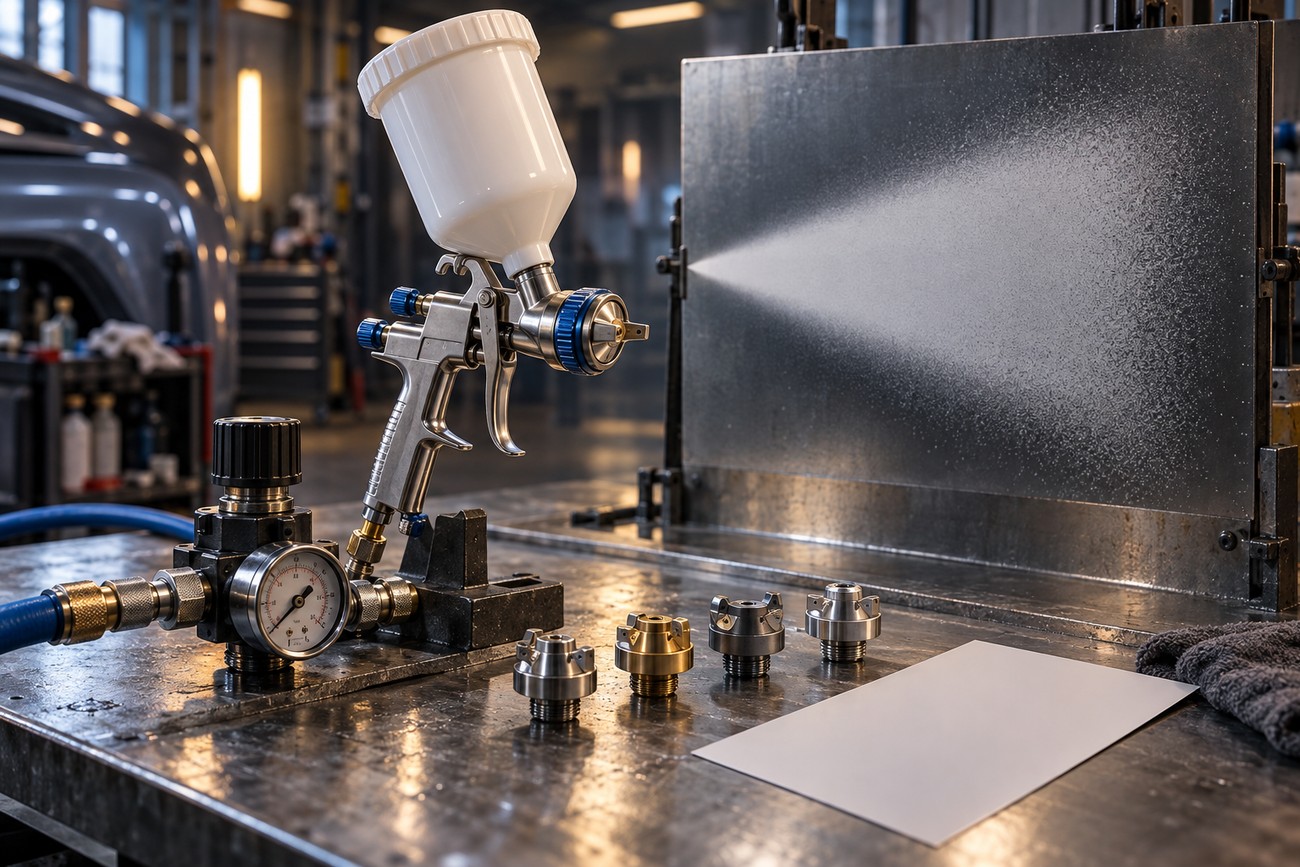
The commonly reported FLG-5 air consumption is 277–280 L/min, with working pressure around 2.0–2.4 bar. Those figures matter more than the low purchase price because they determine whether the compressor can maintain a stable spray pattern during a full pass. A gun that receives falling pressure may begin with an acceptable fan and finish with weak atomization or uneven material distribution.
That air requirement places the FLG-5 closer to a full-size working tool than to a small touch-up gun. A small household compressor may run it briefly yet fail to deliver stable air once the motor cycles or the receiver pressure falls. The result is often blamed on the gun, although the actual restriction is the compressor, hose, regulator, or air treatment system.
Gravity-feed versions commonly use a 560 ml cup. Bottom-feed versions may use a 1140 ml cup, which changes both the working duration and the balance of the tool. The larger container can suit extended coverage, while the gravity arrangement usually makes material loading and short jobs more straightforward. These are different configurations, not interchangeable descriptions of one physical package.
Commonly listed tip sizes are 1.2, 1.3, 1.4, 1.8, and 2.0 mm, depending on the version and market. A smaller tip may suit thinner basecoat or clearcoat when the product allows it; heavier primer or surface generally demands a larger passage. The correct size still comes from the coating manufacturer’s technical sheet, since the gun cannot compensate for material that is too thick, poorly strained, or incorrectly reduced.
Terminology adds another layer of confusion. FLG-5 listings variously use Trans-Tech, High Efficiency, compliant, and sometimes LVLP. The safest description is a low-to-medium-pressure compliant system associated with Trans-Tech or High Efficiency. HVLP, LVLP, and Trans-Tech are different approaches and should not be treated as interchangeable labels that predict identical air use or spray behavior.
FLG-5 vs FinishLine 4: Specification and Configuration Check
The table separates commonly reported FLG-5 information from details that must be confirmed for the exact FinishLine 4 package. A seller’s title is insufficient evidence when the nozzle set, feed arrangement, or technical data is unclear.
| Purchase point | FLG-5 | FinishLine 4 |
|---|---|---|
| Positioning | Entry-level gun for organic materials; not a universal all-coatings gun. | Entry-level family; identify the exact version before comparing specifications. |
| Air consumption | Typically 277–280 L/min. | Verify the delivered-air requirement for the exact model and package. |
| Working pressure | Approximately 2.0–2.4 bar. | Verify the pressure range for the exact version. |
| Gravity cup | Commonly 560 ml. | Confirm cup capacity and feed arrangement in the listing. |
| Bottom-feed cup | Commonly 1140 ml. | Confirm whether the package is gravity-feed or bottom-feed. |
| Tip availability | Commonly listed as 1.2, 1.3, 1.4, 1.8, and 2.0 mm, depending on the market and configuration. | Confirm the supplied nozzle and needle set; do not assume a complete range. |
| Material compatibility | Some descriptions explicitly state that it is not suitable for waterborne paints. | Check the manufacturer’s information for the exact configuration and coating system. |
| Listing risk | Retail data may differ on weight, pressure, tips, and cup configuration. | Family-level listings may combine details from different versions. |
This comparison also explains why a cheap package can become expensive. If the included tip is unsuitable, the cup configuration is wrong for the job, or the compressor cannot maintain the required air, the buyer may need additional parts before achieving a usable result.
Basecoat, Clearcoat, and Primer: Where the Difference Shows
The FLG-5 and FinishLine 4 should be judged by the coating being applied rather than by a general claim of spray quality. Forum experience commonly describes the FLG-5 as more clearcoat-friendly than the FinishLine 4, while the FinishLine 4 is often praised for basecoat application. That distinction can matter more than a small difference in purchase price when one material dominates your work.
Clearcoat exposes setup errors quickly because an unstable fan, excessive pressure, or unsuitable reduction can affect flow and texture across the panel. Users who prefer the FLG-5 for clearcoat may be responding to its practical balance of fan behavior and material delivery. The preference does not mean every clearcoat will perform better, since product chemistry and tip selection remain decisive.
Basecoat brings a different set of concerns. Even coverage, controlled overlap, and predictable orientation of metallic or pearl particles depend on viscosity, distance, pressure, and fan width. A gun that feels natural with one clearcoat may require more adjustment with basecoat, which helps explain why some users prefer the FinishLine 4 for that stage.
Primer and surface make nozzle choice especially important. A 1.2 mm tip cannot be assumed to handle every material simply because it is included in the box, while a larger tip can overload a thin product and create excess texture or runs. The coating’s technical data sheet should guide the starting point, followed by a test pattern on a suitable panel.
The practical lesson is that model selection and setup are linked. Strain the material, confirm its reduction instructions, set the fan deliberately, and test the pattern before spraying the vehicle. Entry-level guns are often sensitive to pressure, viscosity, tip, and fan adjustment; their main weakness is not necessarily consistently poor atomization.
The Compressor Trap: Air Supply Before Spray Quality
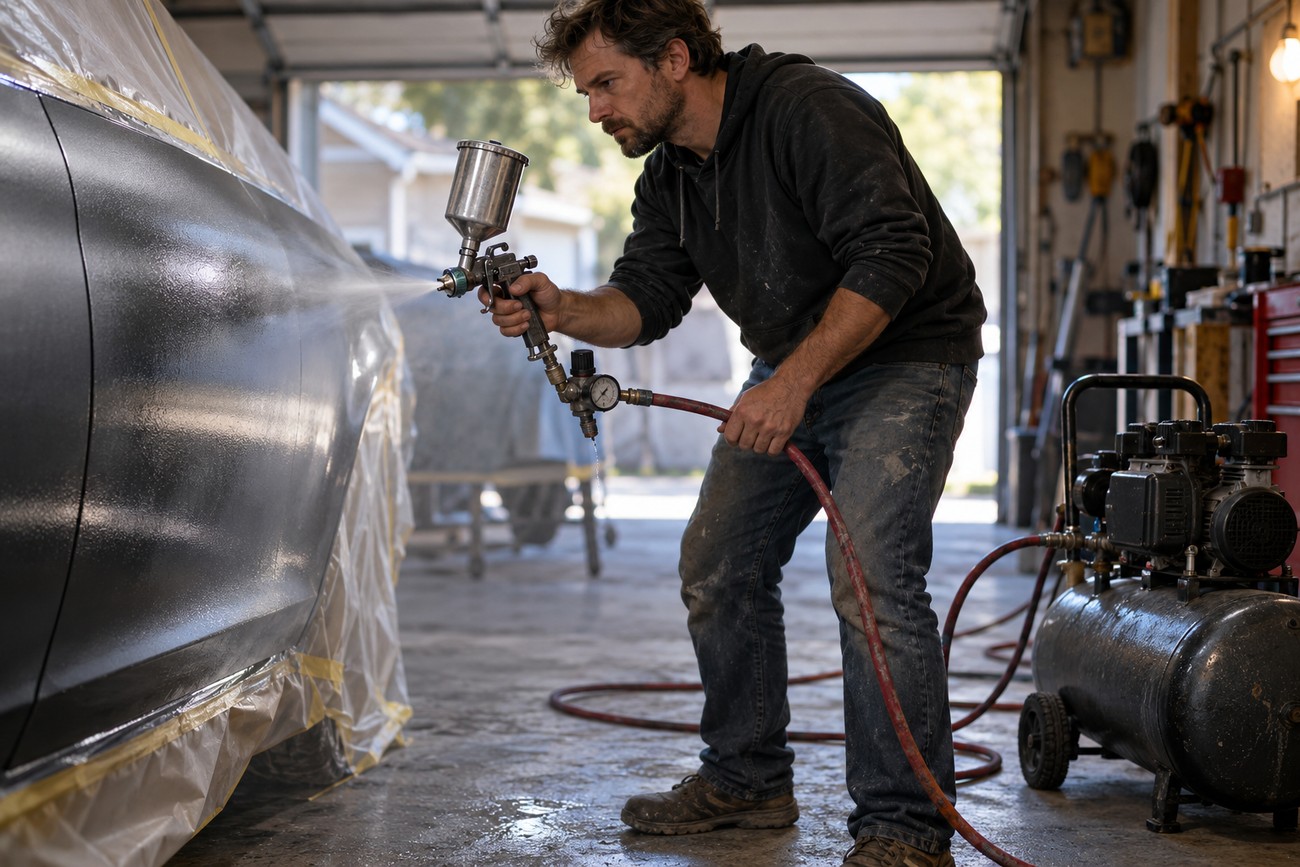
The FLG-5 typically consumes about 277–280 L/min of air. That is a substantial demand for an entry-level gun and can exceed the capability of a small household compressor. Checking only the receiver size or a marketing label such as LVLP is insufficient; the relevant question is how much air the compressor delivers at working pressure.
Insufficient supply produces recognizable symptoms. The fan may narrow or change shape during a pass, atomization can become coarse, and pressure at the gun may fall even though the regulator initially shows the correct setting. A user may then open the fluid control to compensate, increasing the risk of uneven film build and overspray.
Judge the compressor by stable delivered air during a continuous pass, not by tank size or the gun’s LVLP label. A pressure drop can change the fan suddenly and make atomization uneven before the operator notices the gauge.
Trans-Tech or compliant design can improve transfer efficiency and reduce air demand compared with some conventional arrangements, but it does not mean the gun requires negligible air. “Economical” may refer to material transfer under suitable conditions, while the compressor still has to provide the stated volume consistently.
Actual economy depends on pressure, material, setup, and operator technique. A correctly adjusted gun can reduce waste, while an over-open fan, excessive pressure, or repeated correction passes can erase that benefit. The compressor should therefore be assessed before the gun is ordered, including the hose, regulator, filtration, and the distance between the compressor and the spray gun.
Hidden Costs, Compatibility Risks, and Common Buying Errors
The first compatibility check is the coating system. Some FLG-5 descriptions explicitly state that the gun is not suitable for waterborne paints. A listing that calls the tool “automotive” or “universal” does not override that warning, so a buyer working with waterborne basecoat should obtain clear manufacturer guidance for the exact version before proceeding.
Retailer listings can also differ on weight, pressure, air consumption, included tips, and cup configuration. A 560 ml gravity cup and a 1140 ml bottom-feed cup represent materially different tools in use, particularly for panel size, balance, refill frequency, and cleaning. Treating every photograph and description as one standardized FLG-5 package is a common route to disappointment.
The nozzle set deserves the same scrutiny. Commonly listed FLG-5 tips range from 1.2 to 2.0 mm, but the included set depends on the market and package. Basecoat, clearcoat, and primer do not automatically share one ideal nozzle, so buying the cheapest listing with an unspecified tip can create a second purchase before any paint reaches the panel.
Configuration errors also affect setup time. A new user may spend hours changing pressure and viscosity while the real problem is an unsuitable tip or a compressor that cannot maintain delivery. Entry-level equipment can work predictably, but it does not remove the need for a clean test surface, accurate material preparation, and a verified spray pattern.
These risks are part of the ownership cost. A compressor upgrade, replacement nozzle, different cup, unsuitable coating, or extended tuning can outweigh the initial saving. Before ordering, confirm the exact feed type, cup capacity, supplied tip, material compatibility, replacement-part availability, and the seller’s return conditions.
Which One Should You Buy—and When Should You Walk Away?
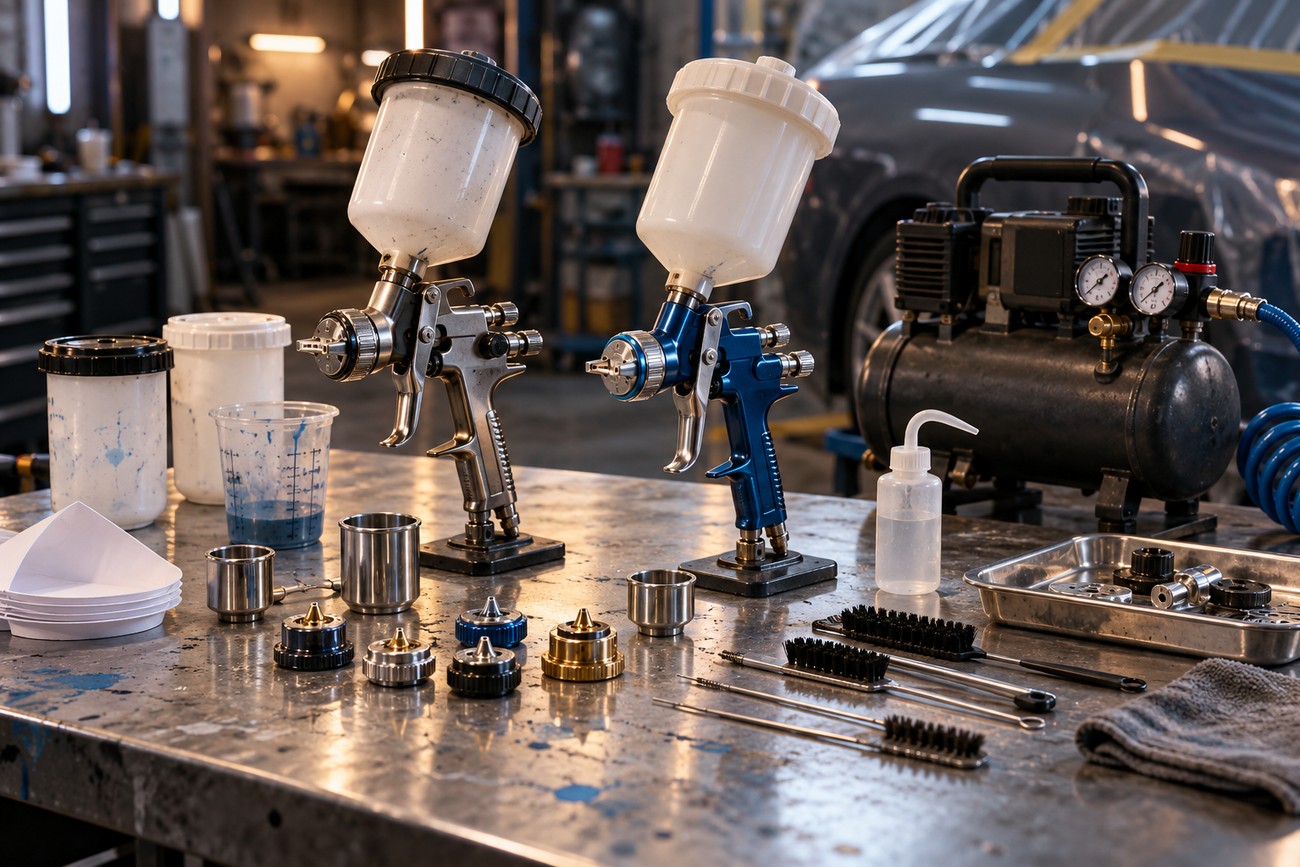
Choose the FLG-5 when you have adequate air, work mainly with compatible organic materials, and accept the need for careful setup. Its appeal is practical simplicity and predictable operation once the pressure, viscosity, tip, and fan are matched. It should not be selected as a safe default for waterborne paint or as a single tool for every coating.
The FinishLine 4 deserves closer attention when its exact configuration better matches the intended material and compressor. For basecoat-focused work, the commonly reported preference for the FinishLine 4 may make that family worth investigating. The decision should still be based on the supplied tip set and verified technical data rather than on the FinishLine name alone.
For clearcoat-focused work, the FLG-5 is a reasonable entry-level candidate if the compressor can sustain its approximately 277–280 L/min demand. For basecoat-focused work, compare the actual FinishLine 4 package and the availability of suitable tips. For mixed materials, first confirm compatibility and accept that one gun may require compromises in setup and cleaning.
Walk away from either option when the air supply is marginal, the listing cannot identify the version, or the seller cannot confirm the included nozzle and needle set. Buyers seeking professional-level control should also keep expectations realistic: the FLG-5 does not offer the same level of control as higher-end GTi Pro or Pro Lite lines. Its value lies in matching a defined job, not in imitating a premium gun.
Frequently asked questions
The answers below apply the comparison to common buying decisions. Exact FinishLine 4 specifications still require identification of the particular version and package.
What is the best automotive spray gun on the market?
There is no universal best automotive spray gun. The correct hierarchy is the coating system first, the available delivered air second, the compatible tip ecosystem third, and the required finish level after that. A gun that suits clearcoat and a strong compressor may be a poor choice for waterborne basecoat or a limited air supply.
For an entry-level buyer, a well-supported configuration with available parts and a verified tip set is often more useful than a popular model with unsuitable accessories. Higher-end guns generally provide more control, but they still cannot correct incorrect viscosity, unstable pressure, or poor preparation.
What are the disadvantages of using a gravity-feed spray gun?
A gravity-feed gun commonly has a limited cup capacity compared with a bottom-feed arrangement, so larger jobs may require more frequent refilling. Each refill interrupts the pass and introduces another opportunity for contamination or a change in material consistency.
The operator must also manage the cup angle so the pickup remains covered while the gun is tilted around edges and lower panels. Leftover material in the cup can be harder to use efficiently, especially when only a small amount remains. These trade-offs are often acceptable for controlled automotive work, but they should be included in the purchase decision.
Which is better: gravity feed or siphon feed?
Gravity feed is generally the more practical choice for smaller batches, frequent material changes, and users who want the cup positioned above the gun body. It can reduce the need to maintain suction and is convenient when the coating quantity is modest.
Siphon or bottom-feed arrangements become more attractive when a larger container and uninterrupted coverage matter more than compact handling. The FLG-5’s commonly reported 1140 ml bottom-feed configuration illustrates that this is a different working format from the 560 ml gravity arrangement. The better system depends on panel size, refill tolerance, balance, and cleaning routine.
How can I tell whether my compressor can run an FLG-5 reliably?
Compare the compressor’s delivered-air rating at the intended working pressure with the FLG-5’s typical demand of 277–280 L/min. Use delivered air rather than an optimistic displacement figure, and account for losses through the regulator, hose, fittings, and filtration.
Then perform a continuous test pass with the gun adjusted for the chosen material. Watch for pressure falling at the gun, a fan that changes shape, or atomization becoming coarse as the pass continues. If those symptoms appear, the system is not supplying stable air, regardless of the tank label or the gun’s LVLP description.
What should I verify when a FinishLine 4 listing does not show the tip set?
Ask the seller to identify the exact FinishLine 4 variant, supplied nozzle and needle set, feed configuration, cup arrangement, and the technical data for pressure and air demand. Confirm that replacement tips and other wear parts are available for that version.
Also check whether the package can be returned if the specification differs from the listing. A photograph may show a different cup or tip than the one supplied, and family-level descriptions can combine details from multiple packages. Written confirmation is safer than assuming that a familiar model name includes the equipment needed for your coating.