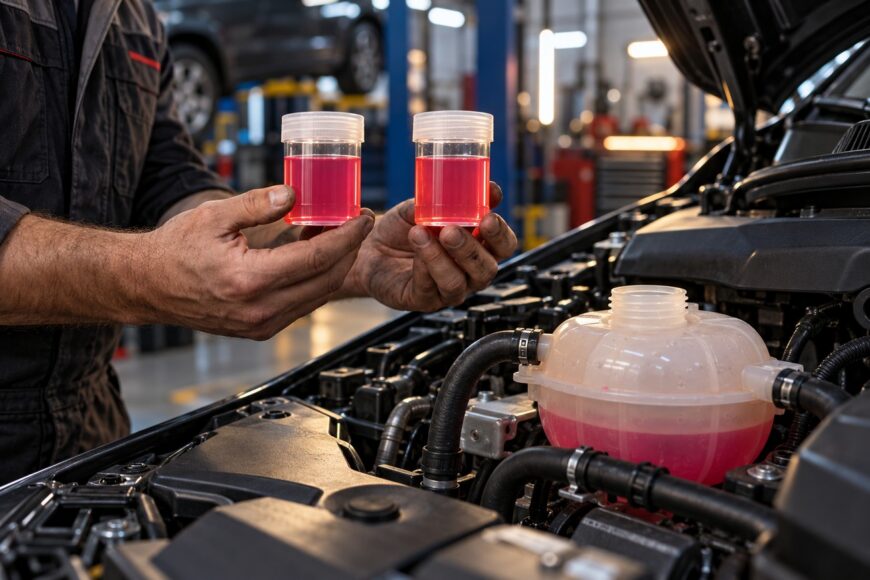
Two coolants can look alike yet contain different corrosion inhibitors. Mixing them may leave deposits in the cooling system, restrict the heater core, or weaken protection for engine parts. A mixture does not have to form visible flakes to be a poor long-term choice.
Choose coolant by considering its formulation, concentration, dilution water, and the vehicle or engine manufacturer’s approval together. Color is a dye, and “universal” on a container is not proof that a product will preserve the protection or service interval of the coolant already in the system. For a routine top-up, the safest starting point is the exact coolant specification in the manual.
- What IAT, OAT, and HOAT Coolant Types Mean
- Coolant Standards, Concentration, and OEM Requirements
- IAT, OAT, and HOAT: What the Labels Actually Tell You
- Which Coolants Can Be Mixed Safely?
- How to Dilute, Top Up, and Check Coolant Correctly
- When a Full Flush Is Safer Than a Top-Up
- Frequently asked questions
- Which coolants cannot be mixed?
- What if I don’t know which coolant is in the system?
- How can I tell whether coolant is concentrate or premixed?
What IAT, OAT, and HOAT Coolant Types Mean
Inorganic Additive Technology (IAT) and Organic Acid Technology (OAT) describe approaches to corrosion inhibition. Hybrid Organic Acid Technology (HOAT) combines inhibitor approaches. These terms identify broad chemistry categories; they do not certify that two finished products can be mixed.
Coolant color comes from dye, with no standardized color code for chemistry or compatibility. Two liquids of the same color can use different inhibitor packages, while approved products may look different. Matching the liquid in the expansion tank by sight therefore gives you little useful information about what to add.
The full formulation must protect the materials in the particular cooling system, including aluminum components and seals. Engine design matters as well: a heavy-duty diesel with wet sleeves can have protection needs that a passenger-car coolant does not address. Check the specified approval and the product label rather than assuming that an IAT, OAT, or HOAT name settles those requirements.
If deposits appear after a top-up, they may restrict narrow passages such as those in the heater core and reduce cabin heat. That outcome is a reason to investigate the mixture, though it does not mean every pair of different coolants will react visibly. Even clear-looking coolant cannot confirm that its inhibitors remain suitable.
Coolant Standards, Concentration, and OEM Requirements
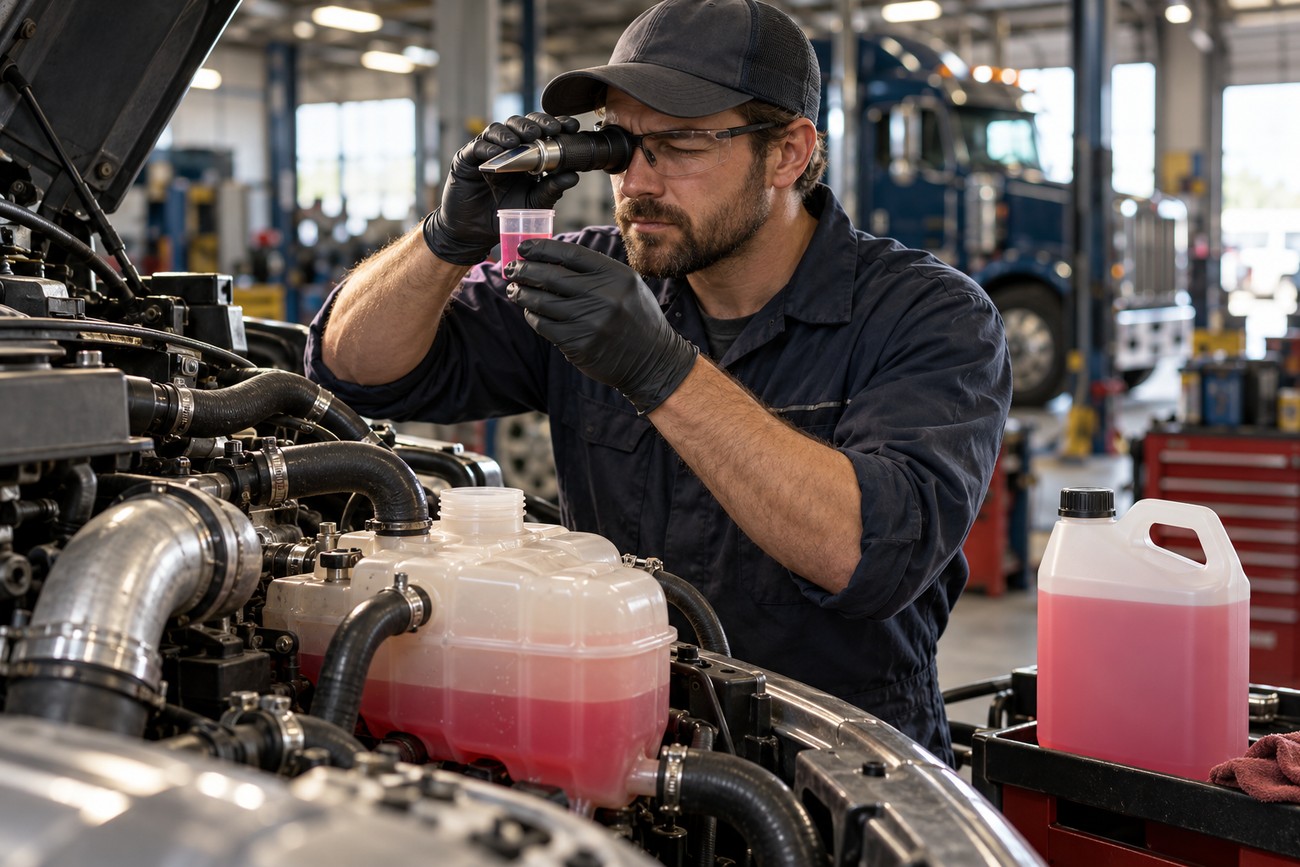
ASTM D3306 applies to passenger-car and light-commercial engine coolants. Its typical concentrate range is 40–70%, and a ready-to-use mixture contains at least 50% concentrate by volume. Those figures describe the standard’s scope; the vehicle manual still determines the appropriate product and concentration for your engine.
ASTM D6210 addresses heavy-duty engine coolants, with a working concentrate range of 40–60% and at least 50% concentrate by volume in a ready-to-use mixture. Heavy-duty diesels may also need supplemental coolant additive (SCA) protection, particularly where wet sleeves and cavitation are concerns. A container citing D3306 alone does not establish that it meets those heavy-duty requirements.
An equipment manufacturer can set a narrower limit than a general standard. Some manufacturers cap glycol concentration at 60%, although ASTM D3306 permits up to 70% in its range. Follow the limit in the specific vehicle or engine manual instead of treating the highest concentration on a standards label as a target.
Read a standards claim alongside the manufacturer approval, coolant type, and maintenance instructions. A product can be suitable within a broad ASTM category without being approved for your engine. This distinction is especially important when selecting fluid for a heavy-duty diesel rather than a passenger vehicle.
IAT, OAT, and HOAT: What the Labels Actually Tell You
The labels describe inhibitor approaches, not universal mixing rules. Use them to narrow the search, then confirm the exact product approval and service requirements.
| Type | Inhibitor approach | Service implication | Compatibility warning | Check before mixing |
|---|---|---|---|---|
| IAT | Inorganic Additive Technology uses an inorganic corrosion-inhibitor package. | Follow the specified replacement interval and any required inhibitor checks. | Adding a longer-life coolant does not automatically extend the life of an existing IAT fill. | Confirm the engine approval and whether the top-up product is approved for the fluid already installed. |
| OAT | Organic Acid Technology uses an organic-acid inhibitor approach. | An extended-life claim still requires checks for concentration, contamination, and inhibitor condition. | Other OAT products may use different formulations; the category name alone cannot establish compatibility. | Compare the exact OEM specification and product mixing guidance. |
| HOAT | Hybrid Organic Acid Technology combines inhibitor approaches. | Service life depends on the approved product and its condition, rather than the HOAT label alone. | A “universal” or “all colors” claim may cover a short-term top-up without preserving full protection or service life. | Verify the specific approval, existing fill, and manufacturer instructions. |
Which Coolants Can Be Mixed Safely?
For a planned top-up, use the coolant approved for the engine and, where possible, match the product already in the system. OEM guidance generally discourages mixing different formulations unless the specific products are approved as compatible. There is no universal safe rule for incompatible coolant formulations, even when both containers say “antifreeze.”
If the existing coolant is unknown, do not infer its identity from the reservoir color or an IAT, OAT, or HOAT guess. Look for a service record or a reliable record of the last fill. Without one, a drain, full flush, and refill with an approved product gives you a known starting point.
An emergency top-up is a different decision from a permanent fill. If the level is low and the specified fluid is unavailable, the immediate aim is to prevent overheating and get the vehicle to a place where the system can be corrected. A label promising compatibility with all colors may help with a limited top-up, but it does not establish the original coolant’s full service interval or protection after mixing.
Matching colors does not make fluids compatible, and adding HOAT does not automatically extend the life of an existing IAT coolant. If you intend to change chemistry, arrange a complete system flush before refilling. Coolant left in the block, heater core, and expansion tank can materially alter the new mixture, even after the radiator has been drained.
How to Dilute, Top Up, and Check Coolant Correctly
Start by reading the container: “concentrate” needs dilution, while “premixed” or “ready to use” means the water is already included. Check the stated mixture before pouring. Adding concentrate to an existing 50/50 fill without measuring it can push the glycol level higher than intended; adding more premix to correct a badly diluted system may not bring it to the required concentration.
For concentrate, use water that meets the coolant and engine instructions. Distilled, deionized, or demineralized water is the preferred choice, consistent with Deere guidance. Mineral-rich tap water can introduce salts that contribute to deposits, so water quality matters alongside the coolant formulation.
More glycol is not automatically better. Above 60% ethylene or propylene glycol, a mixture can transfer heat less effectively, while freeze protection does not improve proportionally. Stay within the engine manufacturer’s specified concentration range rather than adding concentrate by eye.
After filling and circulating the coolant according to the vehicle’s procedure, check concentration with a refractometer or a hydrometer suitable for that coolant. Color and apparent clarity cannot measure it. If water alone was needed in an emergency, first restore a safe level and prevent overheating; then check and restore the specified concentration and formulation as soon as practical. Never open a hot, pressurized cooling system.
When a Full Flush Is Safer Than a Top-Up
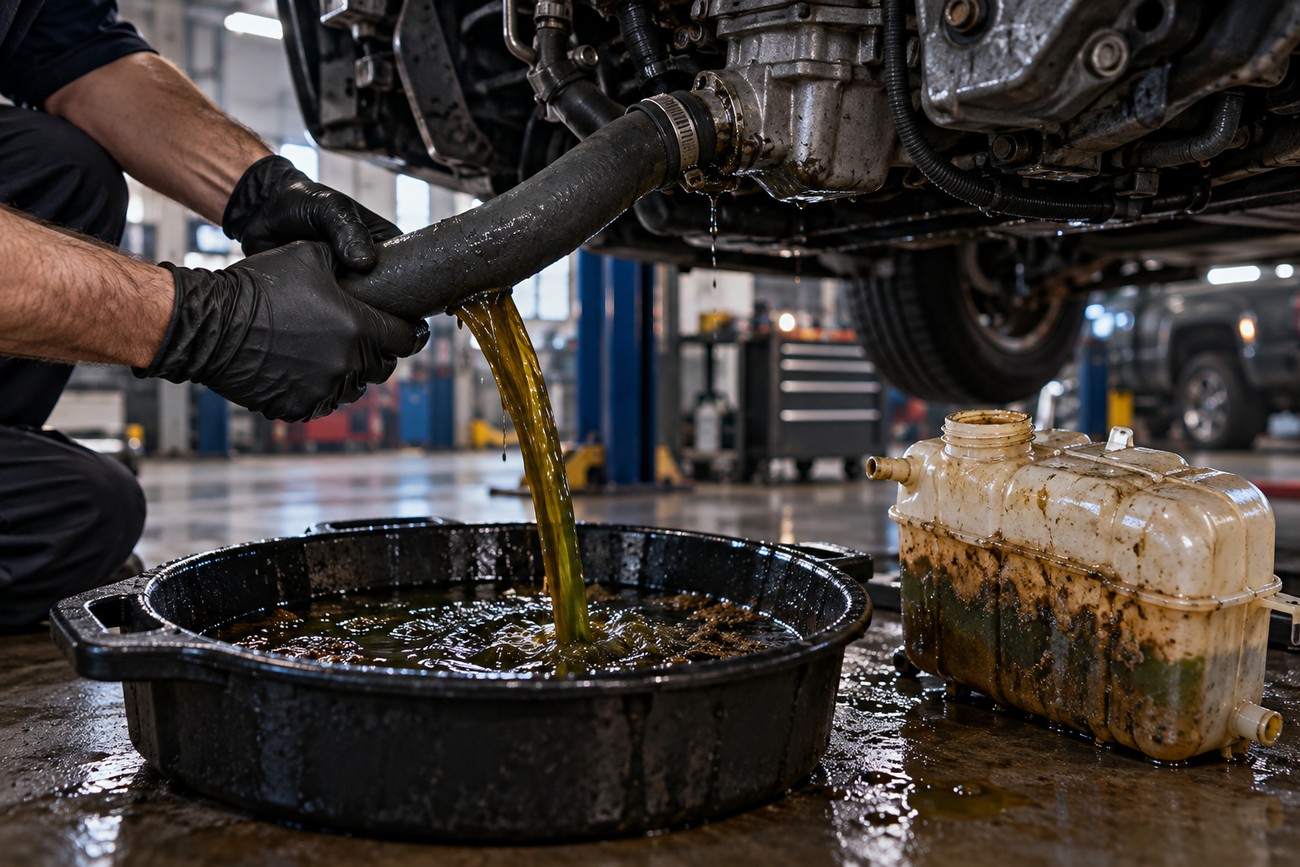
Stop topping up and investigate when the coolant history is unknown, flakes or sludge appear, deposits return after a refill, or a different chemistry has been introduced. A full drain, flush, and approved refill is also prudent if a passenger-car product was used in a heavy-duty diesel without checking its requirements. Deposits or repeated coolant loss may call for diagnosis in addition to a fluid change.
Changing chemistry requires attention to the entire circuit. Draining only the radiator leaves old fluid in other parts of the system, so follow the engine’s prescribed drain and flush procedure before adding the new coolant.
Once unknown or incompatible products have been mixed, appearance cannot tell you how much service life remains. Counting a new maintenance interval from a complete replacement is safer than assuming the longest interval printed on either container still applies. Record the replacement product and date so the next top-up does not depend on guesswork.
Heavy-duty diesel maintenance may include periodic SCA or nitrite checks even with a quality premix. Do not add SCA to a premixed or extended-life coolant unless the product and engine specification require it; extra additive can upset an already balanced inhibitor package. Confirm those instructions before refilling a system with wet sleeves.
Frequently asked questions
For an uncertain fill, separate the immediate need to maintain a safe coolant level from the decision about what stays in the engine long term. These checks help you avoid turning an emergency top-up into an unverified permanent mixture.
Which coolants cannot be mixed?
A pair of coolants should not be treated as mixable unless their exact formulations and product approvals support it. Color and the broad IAT, OAT, or HOAT labels cannot identify every incompatible pair. Compare the engine’s required approval with both product labels and any explicit mixing instructions from their manufacturers.
What if I don’t know which coolant is in the system?
If you cannot identify the existing fluid, avoid making a permanent top-up choice based on appearance. Restore the level safely if necessary to prevent overheating, then plan a complete flush and refill with an approved coolant. That provides a known formulation and a clear point from which to track its service interval.
How can I tell whether coolant is concentrate or premixed?
Read the front and back labels for “concentrate,” “premixed,” “ready to use,” or a stated ratio such as 50/50. A concentrate label will give dilution directions; a ready-to-use product is intended to be poured in without adding water. Do not assume the two products are interchangeable because the packaging looks similar.
Before topping up, check the label on the container you are holding and the record of what is already in the engine. If the existing mixture’s strength is uncertain, measure it with a suitable refractometer or hydrometer before adding concentrate. That check prevents a routine top-up from producing an unnecessarily high glycol concentration.