Choosing between COBB Accessport and EcuTek is rarely a simple hardware decision. The useful result depends on the tuner, ECU version, market, fuel, installed hardware, engine condition, logging process, and support available after the first calibration. Advertised peak power can matter less than whether someone can diagnose a bad log, revise the map, and support your exact vehicle.
COBB offers an accessible handheld-and-map ecosystem, while EcuTek generally follows a tuner-led licensing model tied to a specific vehicle and calibration software. Both can deliver meaningful ECU changes, yet their ownership experience, map availability, feature set, and recovery options vary by application. The sensible comparison therefore centers on fit, compatibility, risk, and long-term usability rather than brand loyalty.
- COBB Accessport and EcuTek: What You Are Actually Buying
- COBB Accessport vs EcuTek: Features, Workflow, and Ownership
- OTS Maps vs Custom Calibration: Where the Real Difference Appears
- Compatibility, Markets, and Greenspeed Restrictions
- Power Gains, Extra Controls, and the Limits of Marketing Claims
- Failure Recovery, Stock Return, and the Risks Buyers Miss
- How to Choose: Tuner Availability, Cost, and Long-Term Support
- A Pre-Purchase Checklist for Either Platform
- Frequently asked questions
- What are the practical alternatives to a COBB Accessport?
- How much horsepower does a COBB tune add?
- What should I save before changing or removing a tune?
COBB Accessport and EcuTek: What You Are Actually Buying
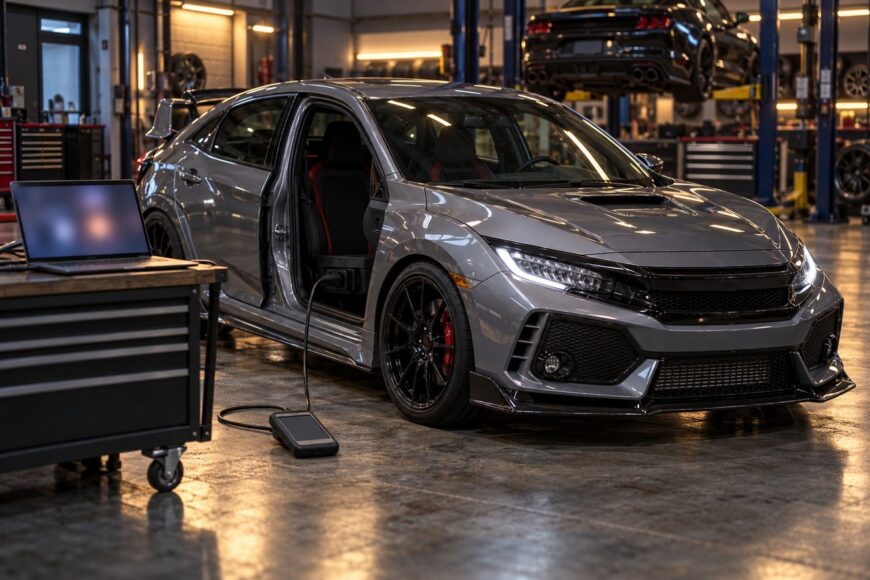
COBB Accessport writes to the factory ECU through the OBD-II port. The handheld device becomes the interface for installing a calibration, selecting supported maps, reading diagnostic information, and recording engine data. This gives the owner a visible, portable workflow, although the Accessport itself does not create a good calibration.
EcuTek uses licensing for a specific vehicle together with tuner software. In practice, the buyer usually works through a calibrator who prepares, installs, and revises the tune. RaceROM features, maps, and accessible parameters depend on the ECU, market, and calibrator, so two vehicles using EcuTek can have different available controls.
The ownership difference is practical. An Accessport may give you access to supported OTS maps and a familiar handheld interface, while EcuTek may place more of the process in the tuner’s hands. Neither arrangement removes the need to verify hardware, fuel, ECU identification, and data logs before changing the calibration.
That distinction also affects support after installation. An Accessport can make basic diagnostics and map management easier for an owner, while an EcuTek installation may rely more heavily on the original tuner for revisions and access to the licensed software workflow. The final result is determined by the calibration and logging process, not by the device alone.
COBB Accessport vs EcuTek: Features, Workflow, and Ownership
The following comparison describes typical platform roles rather than universal capabilities. Vehicle, market, ECU, calibration, and tuner support can change what is actually available.
| Area | COBB Accessport | EcuTek | Buyer implication |
|---|---|---|---|
| Flashing workflow | Writes to the factory ECU through the OBD-II port using the Accessport. | Uses vehicle licensing together with tuner software and a supported ECU. | Confirm the exact ECU and installation process before purchase. |
| Map storage | Can store up to 100 maps. | Map handling depends on the licensed vehicle and tuner workflow. | Storage capacity is useful only when the required maps exist for your car. |
| Map switching | Prepared map slots may be switched without a full ECU reflash when supported by the vehicle and calibration. | Available switching and related controls depend on RaceROM, ECU support, and the calibrator. | Ask which changes can be made on the road and which require a new flash. |
| OTS maps | May include Stage 1, Stage 2, different octane versions, Economy, Valet, and Anti-theft maps where supported. | Usually follows the tuner’s custom calibration and licensing path. | Map labels do not prove hardware compatibility or safe operation. |
| Custom tuning | Available where the vehicle and tuner support it; required for some markets and hardware combinations. | Central to the platform’s tuner-led operating model. | The quality of revisions and logs matters more than the platform name. |
| Diagnostics and logging | Can read and clear diagnostic codes and log supported channels. | Logging and accessible parameters depend on the ECU, software, and tuner. | Verify that the channels needed for your engine are available. |
| Licensing and cost | Typically built around the Accessport device and supported vehicle ecosystem. | Licensing and total cost may depend on the vehicle and tuner. | Compare the complete installation and support cost, not only hardware prices. |
| Recovery | Recovery Mode is intended to remove the Accessport installation and return the ECU to stock condition after a failed installation. | Recovery options depend on the vehicle, software, and tuner support. | Stable power and a compatible saved factory calibration remain essential. |
| Portability and resale | Device use and vehicle association must be checked for the exact product and vehicle. | Transfer, resale, and reuse rules must be confirmed before purchase. | Do not assume that a license or device moves freely to another car. |
| Vehicle limitations | Support varies by model, market, ECU, emissions configuration, and available map. | RaceROM features, maps, and parameters vary by ECU, market, and calibrator. | Physical compatibility does not guarantee the calibration you need. |
OTS Maps vs Custom Calibration: Where the Real Difference Appears
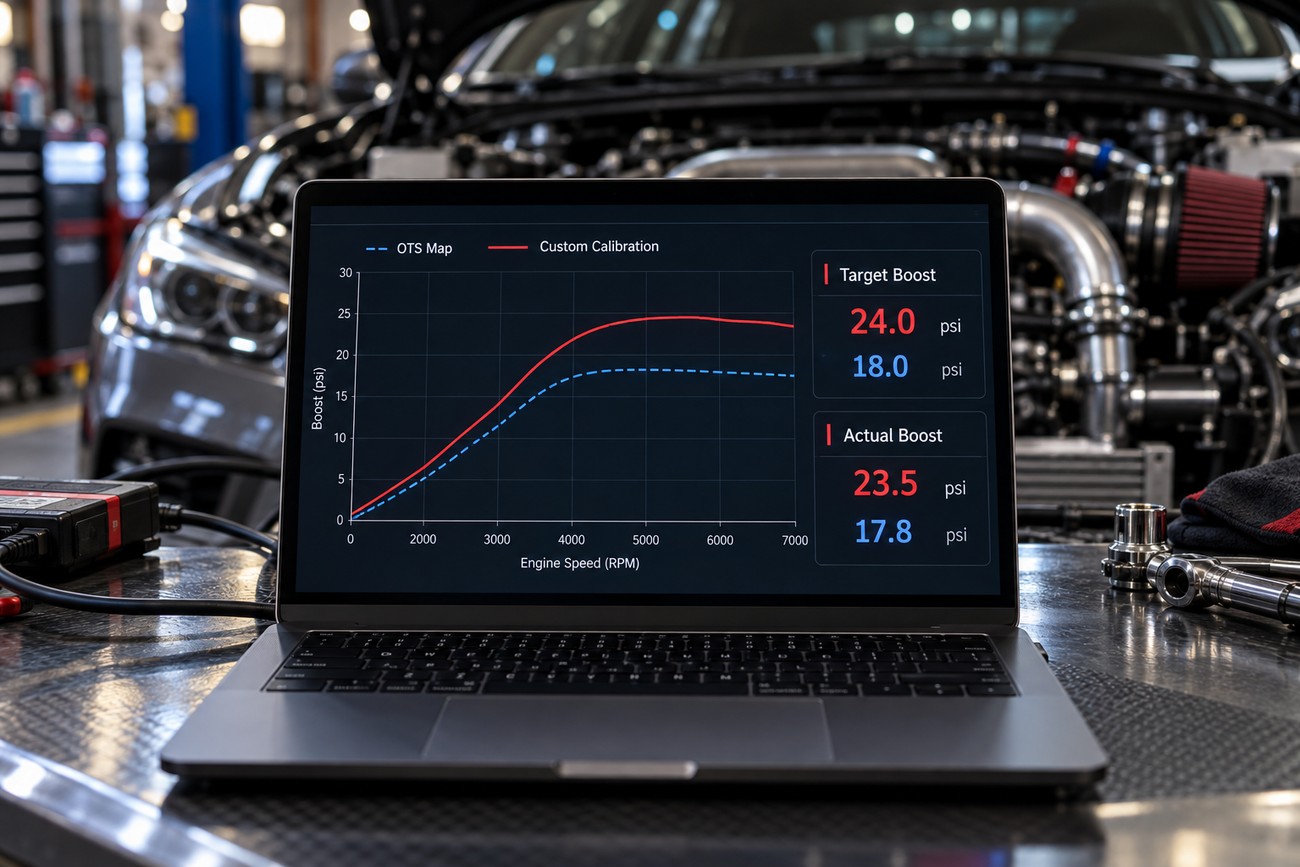
An OTS map is a defined starting configuration, not an inspection of your particular engine. It cannot automatically account for every difference in fuel system condition, intake design, exhaust flow, fuel quality, sensor health, or mechanical wear. A car that matches the listed parts can still produce different data from the vehicle used to develop the map.
Stage 1 and Stage 2 labels also lack a universal technical meaning. The required hardware, fuel assumptions, boost strategy, and safety margin can differ substantially between brands and engines. Treating a Stage 2 map as a standard parts list across unrelated applications is a common way to create an incompatible combination.
Logging is where that uncertainty becomes visible. A tuner can review requested and actual boost, fueling behavior, ignition response, temperatures, and other supported channels to decide whether the calibration is behaving as intended. Without suitable logs, a smooth idle or a strong seat-of-the-pants impression says little about whether the engine is operating within a sensible range.
Custom tuning can therefore matter more than the platform label. A custom COBB calibration and a custom EcuTek calibration can both be appropriate when the tuner understands the ECU strategy and has access to the required tables. The right choice becomes especially important with unusual hardware, local fuel, a rare market version, or an engine whose condition is uncertain.
Accessport is not an independent guarantee of tuning quality. It records and applies a calibration; it does not validate a badly chosen intake, compensate for weak fuel delivery, or replace mechanical diagnosis. The same caution applies to EcuTek: a tuner-led process can be excellent, yet the outcome still depends on the calibration, the data, and the vehicle being tuned.
Compatibility, Markets, and Greenspeed Restrictions
Vehicle compatibility is more specific than a badge, model name, or engine family. The same model sold in different markets can use another ECU, emissions configuration, software strategy, or factory calibration. A physically compatible interface does not prove that the required map or custom-tuning path is available.
COBB states that OTS maps for Mitsubishi are available only for USDM Evo X. Other Mitsubishi versions require a custom tune according to the stated support information. That example illustrates why buying an Accessport before checking the exact year, market, ECU ID, and supported maps can leave the owner with hardware that does not provide the expected ready-made solution.
Greenspeed requirements have also restricted support for some emissions-incompatible configurations and deletes in the COBB ecosystem. The practical effect depends on the vehicle and calibration, so a configuration that was once commonly supported may no longer be handled in the same way. Buyers should discuss the intended emissions equipment and legal use with the tuner before ordering a platform.
Market compatibility deserves the same attention with EcuTek. RaceROM features, accessible parameters, and available maps depend on the ECU, market, and calibrator. A tuner may have a strong solution for one regional version and no equivalent path for another, even when the cars share a model designation.
Power Gains, Extra Controls, and the Limits of Marketing Claims
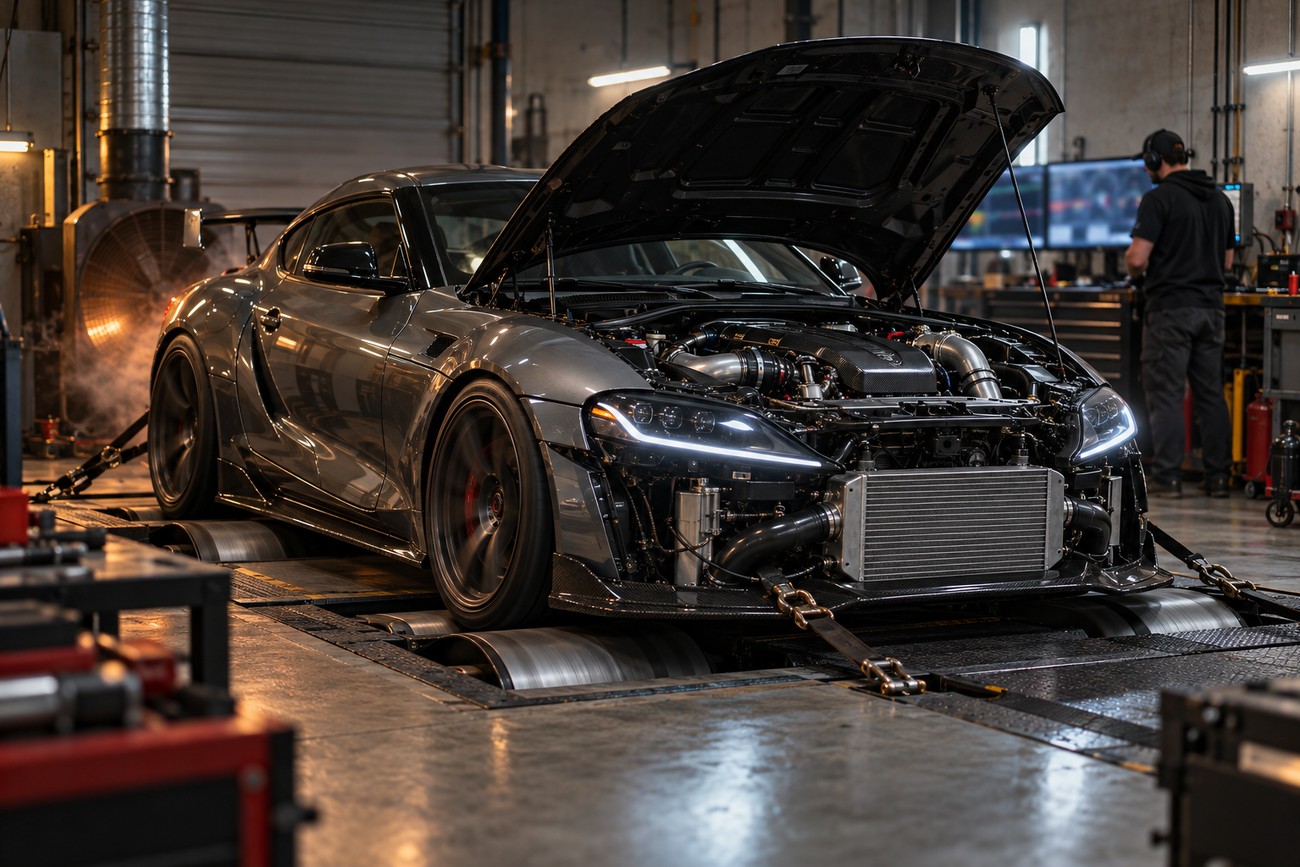
Power comes from the relationship between the engine, hardware, fuel, calibration, and operating conditions. The interface used to write the calibration is part of that process, yet it does not independently determine the output. On many comparable configurations, practical differences between COBB and EcuTek may be minimal.
EcuTek may be selected for access to additional tables or vehicle-specific control strategies on some builds. That can matter on a specialized application where the tuner needs a particular control path. It does not create a universal power advantage, and those extra capabilities may be irrelevant to a lightly modified car with a straightforward calibration.
Launch control, flat-foot shift, traction control, and similar functions are not universal. They require model-specific support and activation in the calibration, and the available behavior can vary with the ECU and vehicle strategy. An Accessport that supports these functions on one application does not promise the same functions on another.
Map switching follows the same rule. Prepared map slots may be switched without a full ECU reflash when supported by the vehicle and calibration, but the hardware alone does not guarantee that feature. Ask the tuner which maps can be selected, what changes between them, and whether the fuel or operating conditions assumed by each map are realistic for your use.
Failure Recovery, Stock Return, and the Risks Buyers Miss
COBB provides Recovery Mode for a failed installation, with the stated result of removing the Accessport installation and returning the ECU to stock condition. This is useful protection when a flash does not complete, yet it should be treated as a recovery procedure rather than permission to ignore preparation.
Flashing should not be attempted with weak battery voltage, unstable power, or an interrupted OBD connection. A charger or properly maintained power supply may be appropriate for the vehicle and procedure, while accessories that create unstable voltage or a loose diagnostic connection increase risk. The exact recovery result depends on the saved factory calibration, stable power, and compatibility with the specific ECU.
COBB documentation warns that overwriting a detected previous installation may be permanent and unrecoverable. This matters when buying a used car with an unknown tuning history or when replacing another owner’s installation. Before accepting a prompt to overwrite existing data, establish what was installed, whether the original calibration is available, and who can recover the vehicle if the process fails.
Returning to stock describes the ECU calibration state. It does not establish that every trace has disappeared from ECU history, dealer records, or external monitoring systems. A stock map can restore normal operation while records, counters, diagnostic history, or other evidence remain available to systems that store them.
Keep the recovery instructions and factory data with the vehicle. If the car changes hands, the next owner needs to know its ECU identity, previous calibration, hardware, and any unresolved diagnostic issue. A platform is safer to own when its records move with the car instead of remaining in a former owner’s phone or email account.
How to Choose: Tuner Availability, Cost, and Long-Term Support

Start with the tuner who can support the exact car, market, ECU, fuel, and hardware plan. A familiar local calibration workflow can outweigh theoretical feature differences because revisions, diagnostics, and recovery are easier when the person understands the vehicle and can respond to a bad log. Remote tuning can work well, provided the logging instructions and revision process are clear.
Ask how many revisions are included, which channels must be logged, how mechanical faults are separated from calibration faults, and what happens if the car develops a problem after flashing. Also clarify whether the tuner supplies an original calibration, a written hardware list, and instructions for changing fuel or returning the car to a usable stock configuration.
COBB may be easier to find in some enthusiast communities because of its consumer-facing device and established map ecosystem. EcuTek may be less widespread, which can make finding another tuner or ready-made map more difficult in some regions. That difference matters if you travel, sell the car, move, or lose access to the original calibrator.
EcuTek licensing and total cost can depend on the vehicle and tuner, so comparing only the price of a handheld device gives an incomplete answer. Rules for transferring, selling, or reusing an EcuTek license should be verified before purchase because they are not confirmed here by official documentation. The same ownership question applies to any device that is associated with a vehicle or prior installation.
A Pre-Purchase Checklist for Either Platform
Before paying for a platform, record the exact vehicle year, market, ECU ID, current software state, emissions configuration, and supported maps. Confirm whether your intended intake, exhaust, turbocharger, fuel system, and fuel grade match the calibration plan. If the vehicle has an unusual ECU or non-standard hardware, assume that a custom tune may be required until the tuner confirms otherwise.
- Verify exact model, year, market, ECU ID, and platform support.
- Confirm which maps and RaceROM or Accessport functions are available for that application.
- List every hardware change and identify the fuel that will actually be used.
- Check battery condition, diagnostic status, and OBD connection before flashing.
- Ask what logs are required and how many calibration revisions are included.
- Save the factory calibration, current map, ECU information, hardware list, and tuner contact details.
- Confirm recovery instructions, uninstall expectations, and support after a failed installation.
- Clarify licensing, transfer, resale, and reuse conditions before buying.
For a supported USDM stock or lightly modified car, COBB can be a practical choice when the desired OTS map, local support, and fuel assumptions match the vehicle. For a rare-market car or heavily modified build, the stronger option is the platform attached to a tuner who can provide a validated custom calibration. For buyers choosing primarily on local tuner quality, use that tuner’s proven workflow unless the exact ECU and support path create a clear limitation.
The correct comparison is platform plus tuner plus support. A cheaper device with weak follow-up can cost more through repeated troubleshooting, while an advanced feature set has little value if the calibrator cannot access or validate it on your ECU. Decide only after the complete vehicle-specific path is clear.
Frequently asked questions
What are the practical alternatives to a COBB Accessport?
EcuTek is one alternative, although it is generally a tuner-led vehicle licensing and software solution rather than a direct plug-in replacement for every Accessport function. A custom ECU calibration through a qualified tuner, or another vehicle-specific supported solution, can also be suitable. Compare the available maps, logging channels, revision process, licensing, recovery support, and local coverage instead of comparing handheld devices alone.
The best alternative is the one that supports your exact ECU and intended hardware. A platform with a broader reputation may still be unsuitable for a rare market version, while a less common system may offer the required control strategy through a strong specialist tuner.
How much horsepower does a COBB tune add?
No responsible universal figure applies. The result depends on the exact engine, baseline condition, hardware, fuel, calibration, dyno method, environmental conditions, and operating limits. A peak number without that context cannot predict what your car will produce or whether the calibration is appropriate.
Judge the change using a documented baseline dyno, the same fuel and hardware, comparable environmental conditions, and before-and-after logs. Review drivability, temperatures, fueling behavior, boost control, and fault history alongside peak output. A smaller measured gain with clean data can be a better result than a larger headline number with uncertain control.
What should I save before changing or removing a tune?
Save the current map, ECU identification, diagnostic codes, relevant datalogs, complete hardware list, fuel specification, and the tuner’s revision history. Keep the original calibration and any recovery instructions in more than one secure location. Photographing ECU labels and recording the current software state can also help when a vehicle has an unclear previous installation.
Write down which map is installed, what fuel it requires, and which changes were made for seasonal or hardware conditions. Before an overwrite or uninstall, confirm whether the detected previous installation may be permanent and unrecoverable, and establish who will support recovery if the process is interrupted.