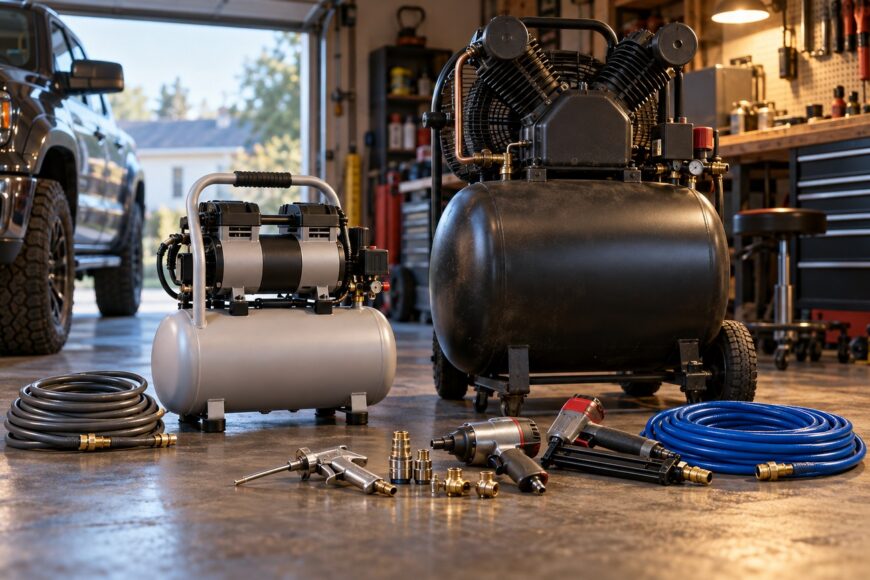
California Air Tools and Quincy address different garage needs. California Air Tools generally favors lower noise, compact ownership, and lighter intermittent use, while Quincy is built around higher output, durability-oriented construction, and sustained shop work. That difference matters more than brand reputation when the compressor will run a spray gun, grinder, or impact wrench for long periods.
Horsepower, tank volume, and maximum PSI cannot settle the choice by themselves. The useful comparison is delivered CFM at 90 psi, with the tool’s actual duty cycle and airflow demand in view. Noise, power supply, maintenance, ventilation, available floor space, and the jobs you perform each week will determine whether a quiet California Air Tools model is sensible or whether Quincy’s larger platform is justified.
- The Real Choice: Quiet Garage Convenience or Shop-Level Air
- California Air Tools: Where the Quiet Advantage Ends
- Quincy QT: Output, Construction, and the Cost of Overkill
- California Air Tools vs Quincy: Specs That Matter in a Garage
- Choose by Tool Demand, Not Horsepower or Tank Size
- The Ownership Traps Buyers Commonly Miss
- A Garage Buying and Setup Checklist That Prevents Regret
- Frequently asked questions
- What is the best air compressor for a garage?
- Where are California Air Tools compressors made?
- How can I verify a compressor’s real CFM before buying?
The Real Choice: Quiet Garage Convenience or Shop-Level Air
California Air Tools spans 0.6–6.5 hp and 1–17 CFM across the stated lineup, with working pressure from 90–135 psi depending on the model. That range includes compact machines suited to inflation, nailers, staplers, and short fastening jobs, as well as larger units intended for more demanding garage work. The headline maximum of 17 CFM should be treated as a lineup figure, not as the output of every quiet home-garage model.
Quincy QT equipment sits in a different part of the market. The range is primarily made up of 5–15 hp, two-stage, oil-lubricated compressors intended for higher and more sustained air demand. That makes Quincy attractive for a shop that regularly uses a spray gun, pneumatic sander, grinder, blasting equipment, or large impact tools, provided the building can support the compressor’s size and electrical requirements.
A homeowner who inflates tires, blows debris from a workbench, and uses a brad nailer may gain little from a large Quincy. Its extra capacity brings more weight, installation work, oil service, and noise-management considerations. A smaller California Air Tools unit can be the more rational purchase if its delivered CFM covers the tool and the pauses between tasks suit its duty limitations.
The decision changes when air consumption is continuous. Painting, sanding, grinding, and sandblasting can outrun a compact compressor even if its tank seems large enough at first. Compare delivered CFM at the tool’s working pressure, then allow a practical reserve; peak PSI and motor horsepower are secondary indicators.
California Air Tools: Where the Quiet Advantage Ends
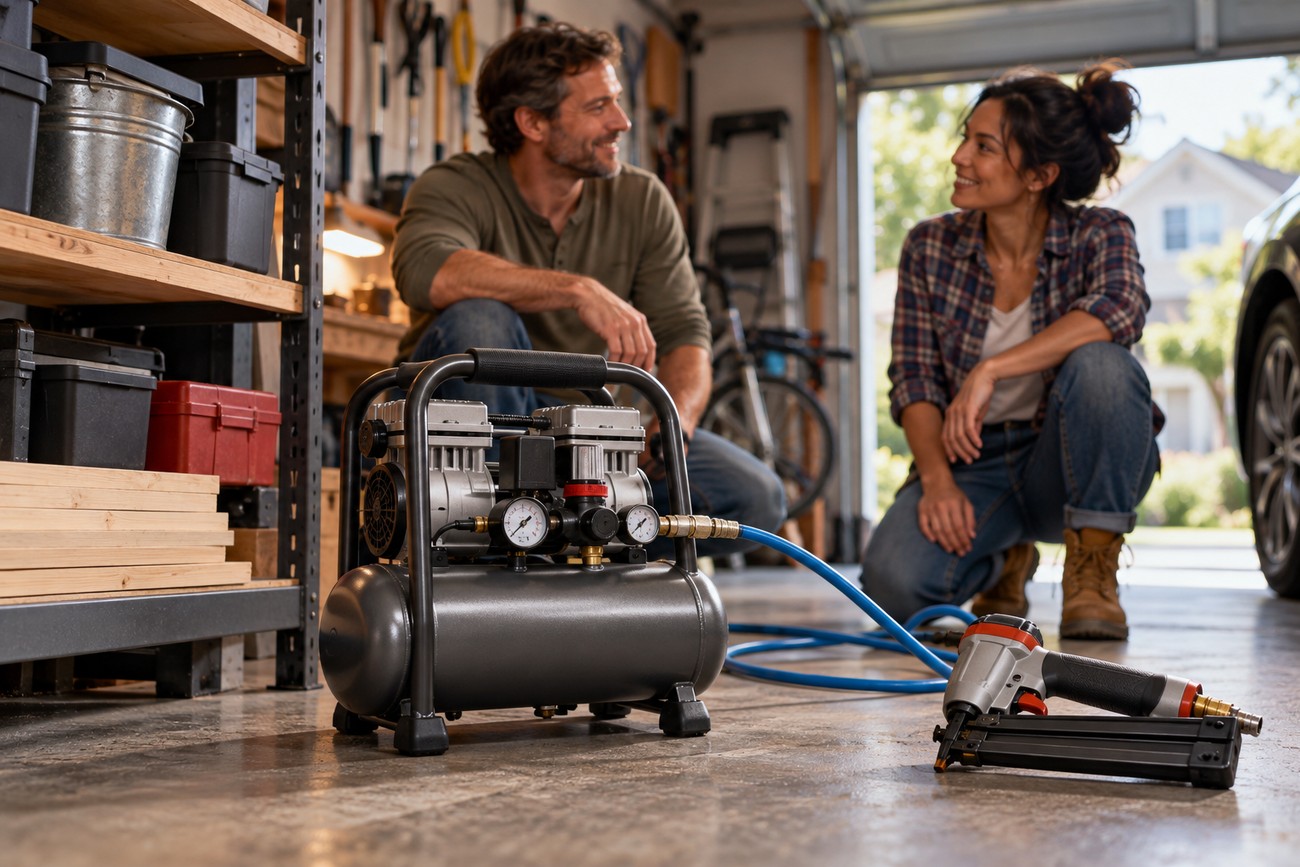
The main attraction of California Air Tools is ownership comfort. Some models are marketed as ultra-quiet and under 75 dB, and owners commonly describe being able to talk nearby while the compressor runs. That is meaningful in a residential garage, attached garage, or shared workspace where a conventional shop compressor would be disruptive.
The quiet design is often paired with an oil-free pump and a compact format. Oil-free operation reduces routine oil checks and changes, and a lighter machine is easier to position or store. Those benefits come with a trade-off: depending on the model, the design may offer less serviceability and long-term durability than an oil-lubricated, cast-iron machine.
Noise claims need careful interpretation. Owner measurements or subjective reports can be around 70 dB, while the actual result changes with the model, distance, floor surface, enclosure, and measurement method. “Ultra-quiet” means comparatively quieter operation, not silent operation; the compressor still produces mechanical and airflow noise during filling and recovery.
Available owner reports also describe failures involving welded tank mounts, regulators, pressure switches, automatic restart, and tank-weld areas. These reports are relevant as inspection points, but they do not establish a line-wide failure rate. One report mentions a weak power cord, although the available evidence does not establish that as a widespread issue. Check the exact model, warranty terms, and replacement-parts access instead of assuming every unit has the same record.
Quincy QT: Output, Construction, and the Cost of Overkill
Quincy QT compressors are primarily two-stage, oil-lubricated machines in the 5–15 hp range, with a stated 100% duty-cycle rating and pressure capability up to 175 psi. Two-stage compression is useful when the machine must build and maintain higher pressure efficiently. It is especially relevant to shop work where the compressor runs repeatedly rather than delivering short bursts from a stored tank.
The construction explains much of the size and price difference. Quincy specifies cast-iron cylinders and crankcase, industrial bearings, an intercooler, and ASME-standard safety valves. These features support a durability-oriented design and can make the unit more serviceable over time, although they do not eliminate wear, poor installation, overheating, or the need for correct maintenance.
The cost of that capacity is practical rather than merely financial. A large QT compressor can be heavy, occupy substantial floor space, and require a correctly sized circuit. Oil changes, condensate draining, ventilation, belt and guard inspection, and access for service all become part of the installation plan. A garage with limited clearance or household electrical capacity may be a poor match even if the advertised output looks attractive.
Quincy portable models are listed at 110–135 psi with enclosed belt guards and ASME-compliant safety valves. A 100% duty-cycle rating does not mean the compressor can be ignored while running: ventilation, oil service, condensate management, and correct electrical installation remain necessary. Likewise, 175 psi does not automatically mean more CFM at the pressure a particular tool uses; compare output under the same test conditions.
California Air Tools vs Quincy: Specs That Matter in a Garage
The figures below show the difference between lineup-level data and model-specific examples. They are useful for screening a purchase, but the exact model manual and performance curve should control the final installation decision.
| Factor | California Air Tools | Quincy QT | Garage implication |
|---|---|---|---|
| Representative lineup | 0.6–6.5 hp and 1–17 CFM across the stated lineup | Primarily 5–15 hp, two-stage, oil-lubricated models | California Air Tools covers lighter and mid-range needs; Quincy targets higher-demand shop work. |
| Working pressure | 90–135 psi, depending on model | Up to 175 psi; portable models are listed at 110–135 psi | Maximum pressure matters only alongside CFM at the tool’s operating pressure. |
| Output examples | Lineup range is 1–17 CFM; the maximum does not describe every quiet model | QT-5: 18.4 CFM at 100 psi; QT-54: 15.2 CFM at 175 psi | Use delivered CFM and consistent test pressure rather than comparing headline numbers. |
| Tank examples | Model-dependent | QT-5 has a 60-gallon tank; QT-54 has an 80-gallon tank | A larger tank extends short bursts but does not increase continuous pump CFM. |
| Drive and lubrication | Many compact models emphasize quiet, oil-free operation | Oil-lubricated, two-stage, belt-driven configurations are common in the QT range | Oil-free ownership is simpler; oil-lubricated construction is generally more service-oriented. |
| Noise positioning | Some models are marketed as ultra-quiet and under 75 dB; reports vary | Higher-output shop equipment generally demands more noise and space planning | Measure or listen under comparable conditions rather than treating a label as a guarantee. |
| Duty-cycle implication | Compact quiet models are commonly better suited to intermittent use; verify the exact manual | Stated 100% duty cycle on QT equipment | Continuous tools require adequate pump capacity, cooling, and maintenance. |
| Maintenance | Lower routine maintenance on oil-free designs, with model-dependent serviceability | Oil changes, condensate draining, ventilation, and mechanical inspection are required | Choose the maintenance burden you can realistically keep up with. |
| Electrical and space burden | Usually easier to accommodate in a small or noise-sensitive garage, depending on model | Large units may require dedicated electrical planning and substantial floor space | Verify voltage, phase, current, clearance, and circuit capacity before purchase. |
| Best-fit tasks | Inflation, nailing, light fastening, and intermittent garage work when CFM is sufficient | Repeated painting, sanding, grinding, blasting, and large impact-tool use | The tool’s delivered CFM requirement should decide the platform. |
Choose by Tool Demand, Not Horsepower or Tank Size
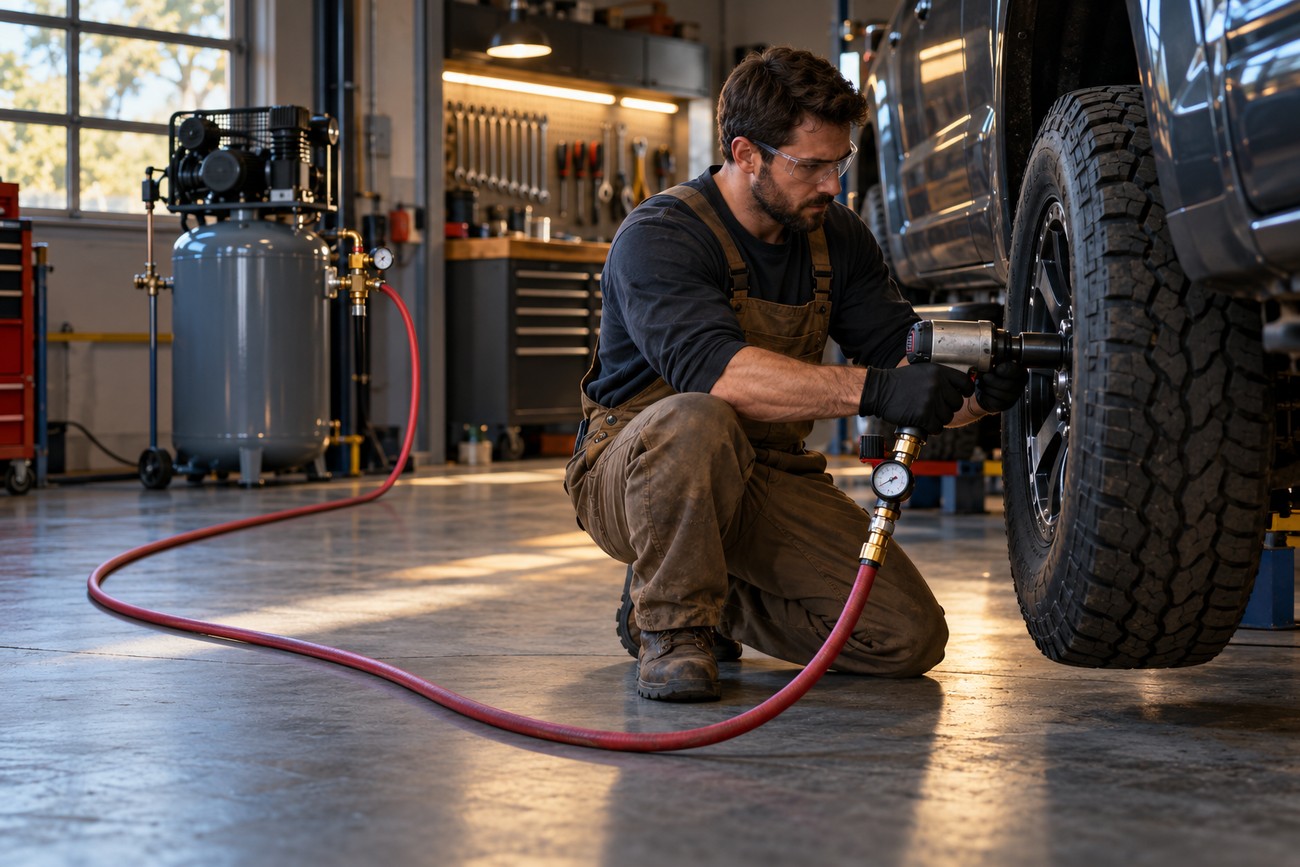
Start with the highest-air-demand tool you genuinely intend to use, then read its CFM requirement at 90 psi. California Air Tools provides a useful reference at that pressure: 2 hp tools are listed at 0.5–2 CFM, 4 hp tools at 2–4 CFM, and 6 hp tools at 4–7 CFM. These figures illustrate why a label such as “6 hp” does not identify the required compressor by itself.
For a practical selection, target delivered CFM at 90 psi with approximately 20–30% reserve above the tool’s stated requirement. That margin helps account for hose losses, fittings, pressure cycling, and real-world variation. It is especially valuable when the tool runs for more than a few seconds at a time.
Read specifications carefully because inlet CFM, displacement, and delivered CFM are different measurements. Displacement describes the volume swept by the pump; inlet CFM may describe air entering under a particular test condition. Delivered CFM, often reported at a stated pressure, is the figure that better represents what reaches the tool.
A large receiver can make an impact wrench or similar intermittent tool feel more capable because stored air covers short bursts. It cannot create additional continuous pump capacity. Once the receiver is depleted, a grinder, sander, spray gun, or blasting nozzle will pull pressure down if the pump cannot match its demand.
That is why a supplemental tank can be useful for short impact-tool use but disappointing for painting or sanding. The receiver changes the interval between pump cycles; it does not change the pump’s sustained CFM. For continuous air use, choose the compressor by recovery under load, not by how long it takes to empty a static tank.
The Ownership Traps Buyers Commonly Miss
Peak PSI is one of the easiest specifications to overvalue. A Quincy rated up to 175 psi is not automatically a higher-CFM solution at a tool that operates around 90 psi than a California Air Tools model rated at 135 psi. The relevant question is how much delivered air remains available at the tool’s working pressure.
Tank volume creates a similar illusion. A large receiver stores more air and can extend a short burst, but it does not increase the pump’s continuous output. Horsepower can also mislead because motor ratings, pump efficiency, test conditions, and electrical supply differ between models. The nameplate should begin the investigation, not end it.
Oil-free California Air Tools designs can reduce routine maintenance, which is valuable when the compressor is used occasionally and stored in a residential garage. The trade-off may be lower repairability or durability compared with oil-lubricated cast-iron equipment, depending on the model. Quincy’s service requirements are more involved, but the construction is oriented toward sustained use and long-term mechanical servicing.
ASME-standard or ASME-compliant safety valves are useful safety features, and the tank rating matters. Neither one proves that an individual tank has no manufacturing or weld defect. Inspect weld areas, mounts, fittings, and guards on delivery, follow the manual’s inspection schedule, and stop using equipment that shows cracking, abnormal leakage, or damaged support hardware.
A Garage Buying and Setup Checklist That Prevents Regret
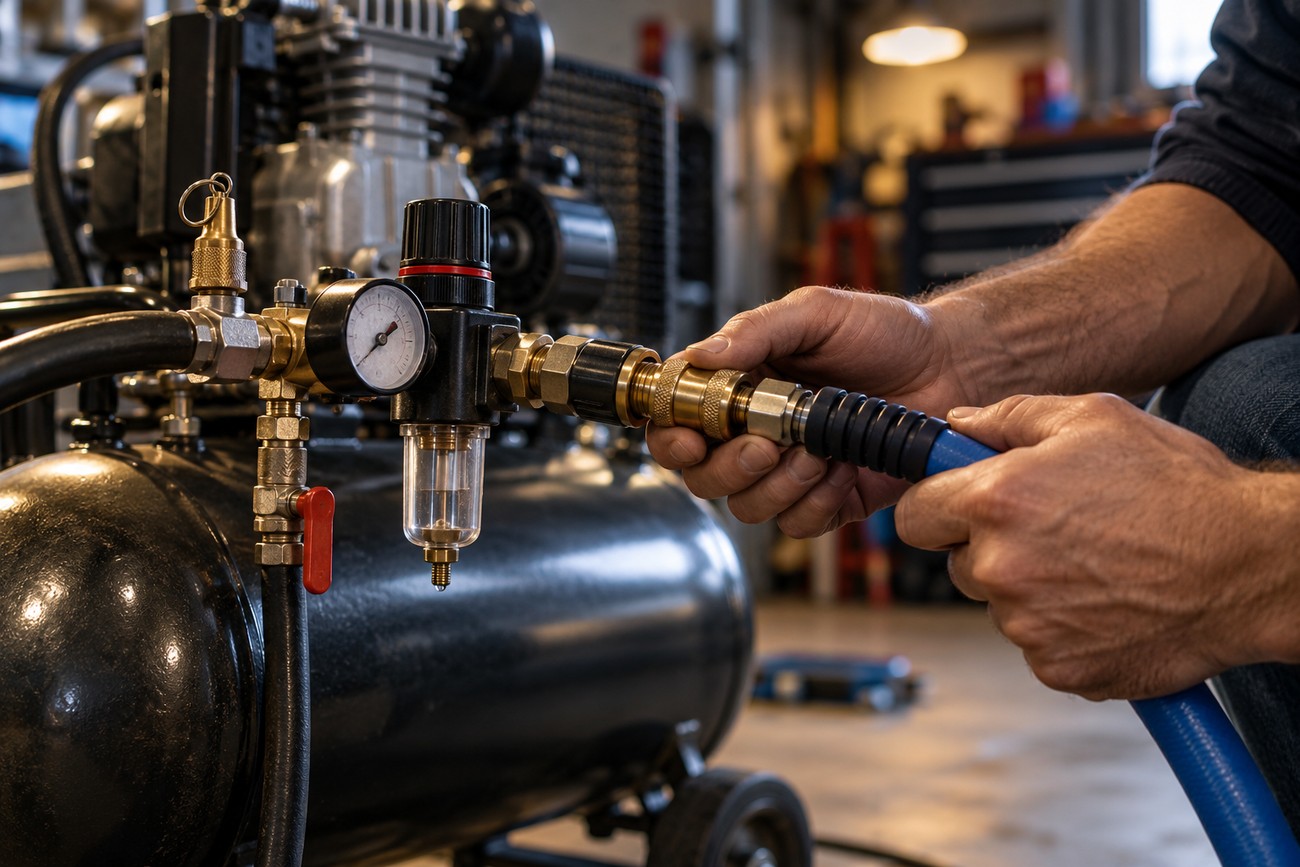
List the tools you will use at the same time, then identify the one with the highest continuous demand. Verify delivered CFM at 90 psi, add approximately 20–30% reserve, and confirm that the compressor’s outlet and your hose fittings can pass the required airflow. A restrictive coupler or undersized hose can undermine an otherwise suitable compressor.
Pressure recovery under the actual tool load reveals more than a nameplate comparison. Check the outlet, hose, and electrical circuit as a system, because a compressor can meet its advertised specification and still perform poorly after a restrictive connection or inadequate supply is added.
If possible, check fill time and pressure recovery rather than judging the machine by tank size alone. Observe whether pressure falls rapidly while the tool is operating, and confirm that the regulator, drain, safety components, and mounting points are in good condition. For a used machine, listen for abnormal pump noise and inspect for oil contamination or damaged weld areas.
Electrical planning is essential for Quincy. Confirm the exact model’s voltage, phase, and current requirements before connecting it, and have the circuit evaluated where necessary. Allow ventilation around the compressor, provide a practical condensate-draining routine, plan oil changes, and leave enough clearance to reach belts, valves, filters, and drain points.
Choose California Air Tools when the garage is noise-sensitive, the work is intermittent, and the selected model provides enough delivered CFM. Choose Quincy when sustained high-demand work justifies its footprint, electrical requirements, oil service, and installation burden. Quincy is not automatically the better choice if its capacity will sit unused, and California Air Tools is not the better choice if the pump cannot maintain the required airflow.
Frequently asked questions
What is the best air compressor for a garage?
The best compressor depends on the work pattern. California Air Tools is often the better fit for a noise-sensitive garage handling inflation, nailing, and short fastening tasks, provided the exact model supplies the required delivered CFM. Quincy is better suited to sustained painting, sanding, grinding, blasting, or repeated large-impact-tool use when the garage has enough space and suitable electrical service.
Available power and tolerance for maintenance can change the answer. A compact compressor that matches the tools will be more useful than an oversize unit that cannot be installed conveniently, while an undersized quiet machine will frustrate anyone expecting continuous shop performance.
Where are California Air Tools compressors made?
Manufacturing origin should not be generalized across the entire California Air Tools range. Product sourcing and production details can vary by model and may change, so verify the exact compressor rather than applying one country of origin to every unit sold under the brand.
Check the current product label, packaging, instruction manual, and model-specific documentation. If those sources do not give a clear answer, contact manufacturer support with the exact model and serial information before buying.
How can I verify a compressor’s real CFM before buying?
Ask for delivered CFM at the stated working pressure, preferably 90 psi, and compare models tested under the same conditions. Do not treat displacement or inlet CFM as equivalent to the air delivered to the tool. If a seller provides only a peak or unspecified figure, the comparison is incomplete.
Match that delivered figure to the tool’s requirement and allow approximately 20–30% reserve. For a used compressor, test pressure recovery while the actual tool is running, because a static tank-fill test may hide restrictions, weak recovery, or insufficient continuous capacity.