Borla versus MagnaFlow is not a simple contest between two volume levels. The useful choice concerns sound character, cabin comfort, and the risk of highway drone. A restrained system can still sound purposeful outside, while a louder system may become tiring once the engine settles into a constant cruising speed.
The result depends on the exact vehicle, engine, body style, transmission, kit number, resonators, and other exhaust modifications. Tube diameter, bends, X-pipe design, mufflers, catalysts, and outlet placement all shape the final sound. Headers, intake parts, removed resonators, or disabled exhaust valves can also change the result enough to make a brand-level comparison misleading.
Cold-start videos create another trap. They emphasize the brief period when the exhaust is loudest, while daily comfort depends more on warm idle, acceleration, and sustained highway rpm. Phone microphones also distort bass, sharpness, and perceived loudness, so a launch clip and a brand-wide ranking are weak evidence on their own.
- What Actually Determines Cat-Back Exhaust Sound
- Borla Sound Profiles: Touring, S-Type, and ATAK
- Why MagnaFlow Does Not Have One Universal Sound
- Borla vs. MagnaFlow: Sound and Comfort at a Glance
- Drone, Cold Starts, and the Sound You Live With
- How to Compare Borla and MagnaFlow Sound Fairly
- Common Buying Mistakes and Hidden Trade-Offs
- Which One Should You Choose?
- Frequently asked questions
- What muffler gives the deepest sound on a V8 or truck?
- Why does my exhaust sound deeper outside than it does inside the cabin?
- Do headers or an X-pipe change which brand sounds better?
What Actually Determines Cat-Back Exhaust Sound
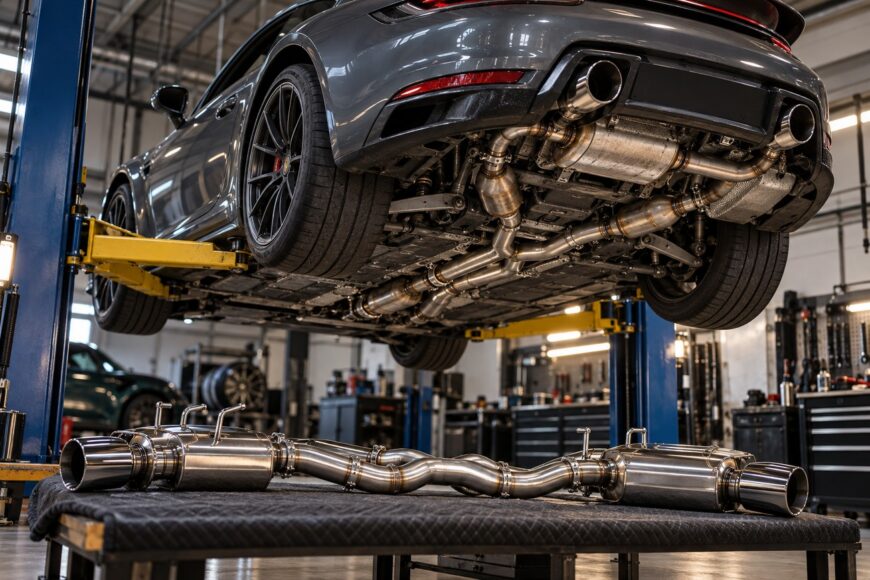
A cat-back replaces the exhaust path from the catalytic converters to the exhaust tips. That includes the pipes, bends, X-pipe or other crossover arrangement, resonators, mufflers, and outlet sections. Changing the complete path can produce a different result from replacing only the mufflers because each part affects how exhaust pulses and sound frequencies travel through the system.
Tube diameter affects flow speed, volume, and the way the system emphasizes certain frequencies. Bends and pipe routing change the effective path length, while an X-pipe changes how exhaust pulses from the two banks mix. Outlet placement also matters: the same muffler can sound different when the tips exit behind the bumper, under the vehicle, or closer to the cabin.
Muffler construction is a major variable. Straight-through designs commonly use a perforated core and packing to reduce sound while maintaining a relatively direct path. Chambered designs use internal sections and reflections to shape the tone. Neither construction automatically produces the better sound because the result depends on the rest of the system and the engine driving it.
Engine displacement, firing order, cylinder count, catalysts, and resonator placement can change the character of the same kit. A system that sounds deep on one V8 may sound sharper on a smaller engine, and a resonator placed farther downstream may affect cabin resonance differently from one placed near the crossover. “Mandrel-bent” describes how the pipe is formed; it does not describe whether the finished tone will be deep, smooth, loud, or comfortable.
Borla Sound Profiles: Touring, S-Type, and ATAK
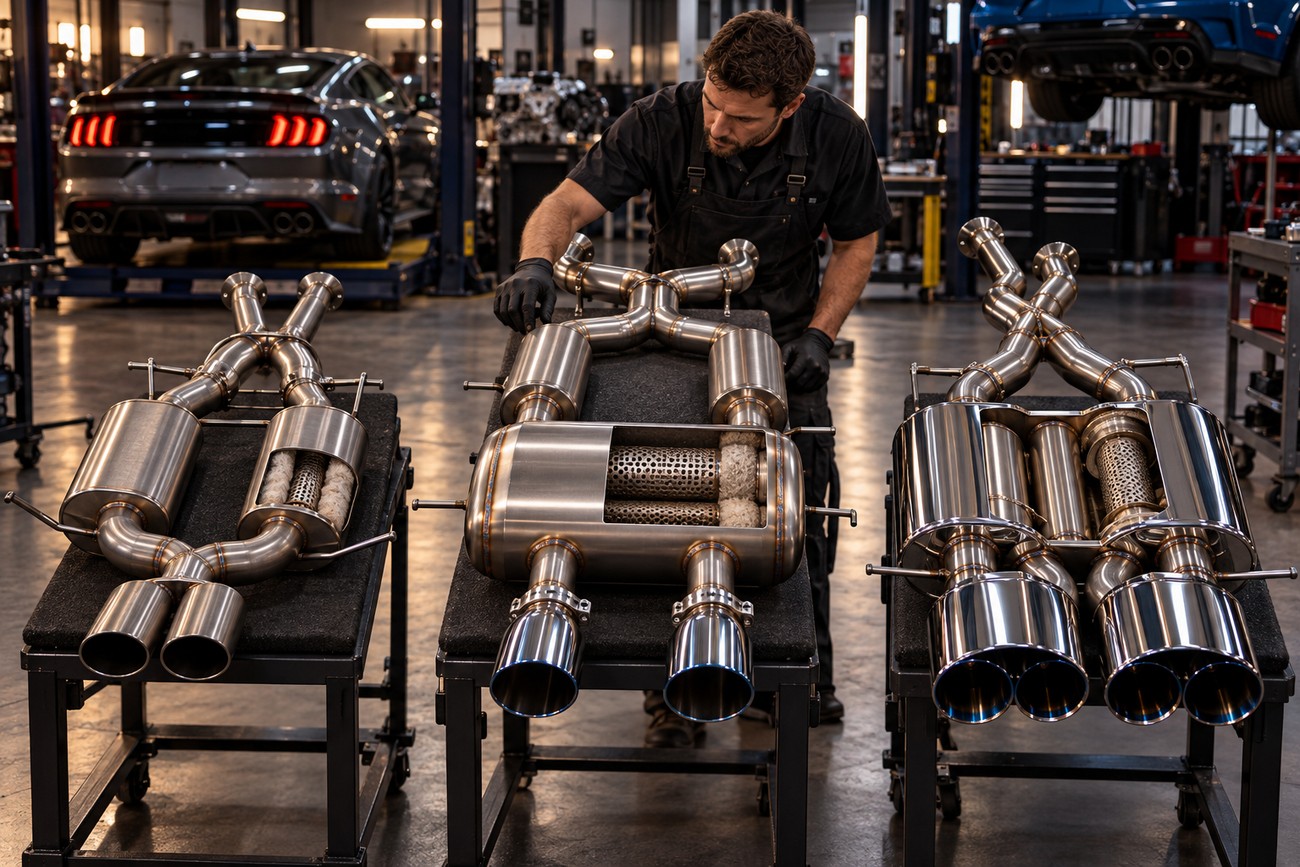
Borla’s three main sound profiles form a clear progression. Touring is the quietest, S-Type is moderately aggressive, and ATAK is the loudest Borla profile. This naming helps narrow the choice, although the installed vehicle still determines how those profiles are heard from the driver’s seat.
Touring generally suits a daily driver that needs more character without making every trip an acoustic event. S-Type occupies the middle ground, with a more pronounced exterior presence and a stronger engine note under acceleration. ATAK is aimed at maximum volume within Borla’s main profile range and is more likely to appeal to drivers who prioritize an aggressive exterior sound.
ATAK is not merely an empty straight-through muffler. Its multichannel cores use differing geometry and perforation to tune frequencies. That approach is intended to increase presence while shaping the sound rather than simply removing all internal restriction and allowing every frequency to pass unchecked.
Maximum volume does not guarantee maximum performance or a pleasant highway sound. ATAK’s louder positioning does not guarantee a measurable power gain, and a system that sounds exciting during acceleration may produce an unwanted narrow-band resonance at steady rpm. The vehicle’s engine, transmission gearing, resonators, and other modifications remain decisive.
Why MagnaFlow Does Not Have One Universal Sound
MagnaFlow cannot be assigned one universal sound profile across its entire range. The company uses both straight-through and chambered mufflers, and the specific series and vehicle fitment determine how those designs work in the complete exhaust path. A MagnaFlow system for one truck should not be treated as a reliable preview of every MagnaFlow system.
This variation makes the exact kit number important. Pipe diameter, crossover design, resonator arrangement, muffler type, and outlet location can produce different levels of bass, sharpness, and cabin presence under the same brand name. A system described as aggressive may deliver a strong exterior note without matching the interior sound of another system carrying a similar marketing label.
The official MagnaFlow SPEQ listing for an F-150 provides a useful example of this distinction. A listed system can be rated “Very Aggressive” outside and “Aggressive” inside. Those labels indicate that exterior and cabin sound are separate considerations, rather than two descriptions of an identical listening experience.
That distinction matters for owners who spend long periods on the highway. A truck can sound controlled from behind the vehicle while still transmitting a persistent frequency into the cabin. MagnaFlow’s construction choices may work well for a particular fitment, but the brand name alone cannot predict whether the result will be deep, sharp, loud, or tiring.
Borla vs. MagnaFlow: Sound and Comfort at a Glance
The comparison below describes tendencies rather than guaranteed outcomes. Exact vehicle fitment, kit number, engine characteristics, and exhaust configuration should take priority over the brand-level summary.
| Factor | Borla | MagnaFlow | Daily-driving implication |
|---|---|---|---|
| Sound naming | Touring is the quietest, S-Type is moderately aggressive, and ATAK is the loudest Borla profile. | No single universal loudness scale applies across all series. | Borla’s profile names make initial screening easier, while MagnaFlow requires closer kit research. |
| Construction variability | ATAK uses multichannel cores with differing geometry and perforation to tune frequencies. | Uses both straight-through and chambered mufflers, depending on the series and application. | The muffler type and the rest of the system matter more than the logo alone. |
| Exterior sound | Ranges from restrained with Touring to highly aggressive with ATAK. | Depends on the exact series, vehicle, pipe layout, and outlet placement. | A louder exterior sound may improve presence but can increase fatigue if it reaches the cabin. |
| Interior sound | Depends on the vehicle and configuration; Anti-Drone language does not cover every possible installation. | Some systems may be rated aggressive inside as well as very aggressive outside. | Review cabin recordings and steady-cruise reports for the exact fitment. |
| Drone-control claim | “Zero drone” language refers to Anti-Drone technology for applicable systems and configurations. | No Drone Technology uses quarter-wave passive noise cancellation in specific system designs. | Both are design claims, not universal guarantees for every vehicle. |
| Likely use case | Touring for restrained daily use, S-Type for moderate aggression, and ATAK for maximum volume. | Select by exact series and fitment according to the desired exterior character and cabin tolerance. | The best choice depends on highway use, engine sound, and tolerance for sustained resonance. |
A louder exhaust is not automatically deeper, better sounding, or more comfortable. Depth depends on the engine and the complete exhaust layout, while comfort depends heavily on the frequency spectrum at steady rpm. A moderate system with controlled bass can be easier to live with than a louder system that creates a narrow resonance in the cabin.
The table is therefore a screening tool, not a universal ranking. A Borla Touring system may be the quieter choice for one vehicle, while a particular MagnaFlow kit may be similarly restrained on another. The reverse can also occur, especially when resonators, crossover design, or other modifications differ.
Drone, Cold Starts, and the Sound You Live With

Cold-start loudness and warmed-up sound are separate experiences. The engine and exhaust may be noticeably louder immediately after startup, then settle as the system reaches operating temperature. Choosing a kit from a cold-start clip can therefore exaggerate the sound level you will hear during most normal driving.
Idle and acceleration also reveal different characteristics. Idle shows the baseline pulse and low-frequency presence, while acceleration exposes volume, sharpness, and how the system responds to changing load. Unpleasant drone usually appears during sustained highway rpm, when the engine, exhaust path, and vehicle cabin repeatedly reinforce a narrow range of frequencies.
Borla’s “zero drone” language refers to Anti-Drone technology for applicable systems and configurations. MagnaFlow’s No Drone Technology uses quarter-wave passive noise cancellation in specific system designs. Both approaches can address particular resonance conditions, but neither claim proves that every vehicle configuration will be free of unpleasant cabin sound.
Drone diagnosis starts with reproducing the customer’s steady-rpm cabin resonance before changing mufflers, resonators, or pipe sections. The offending frequency may be tied to the vehicle’s gearing or body resonance, so replacing a component at random can trade one problem for another.
Transmission gearing is especially relevant because it determines the engine speed held during common highway travel. A system that is comfortable at one rpm can become intrusive when a different transmission, final-drive ratio, tire size, or driving mode holds the engine in another range. This is why steady-cruise evidence from the same vehicle is more useful than a generic claim that a system is drone-free.
For a realistic assessment, listen to the warm cabin sound at the speeds you actually drive. A strong launch note may be acceptable if it fades into the background at cruise; a quieter startup can still hide a persistent resonance that appears only after several minutes on the highway.
How to Compare Borla and MagnaFlow Sound Fairly
Start by matching the complete application. A valid comparison should identify the vehicle, engine, body style, transmission, kit number, and resonator configuration. It should also note whether the vehicle has headers, an X-pipe, altered catalysts, removed resonators, aftermarket intake parts, or disabled exhaust valves.
Then compare the same operating conditions. Useful evidence includes cold-start, warm-running, acceleration, steady-cruise, and in-cabin recordings. The warm cabin recording deserves particular attention because it reveals whether the system creates a persistent resonance that exterior clips cannot show.
Phone recordings can distort bass, sharpness, and perceived loudness. Microphone placement, automatic gain control, wind noise, camera enclosure, and the surface surrounding the vehicle can all change the result. Treat online recordings and owner reports as fitment-specific evidence rather than laboratory measurements.
Check whether the comparison involves a complete cat-back or only a muffler change. An X-pipe changes impulse mixing and subjective tone, so replacing only mufflers is not equivalent to installing the full cat-back. Two videos labeled with the same brand and vehicle can still represent materially different exhaust configurations.
Common Buying Mistakes and Hidden Trade-Offs
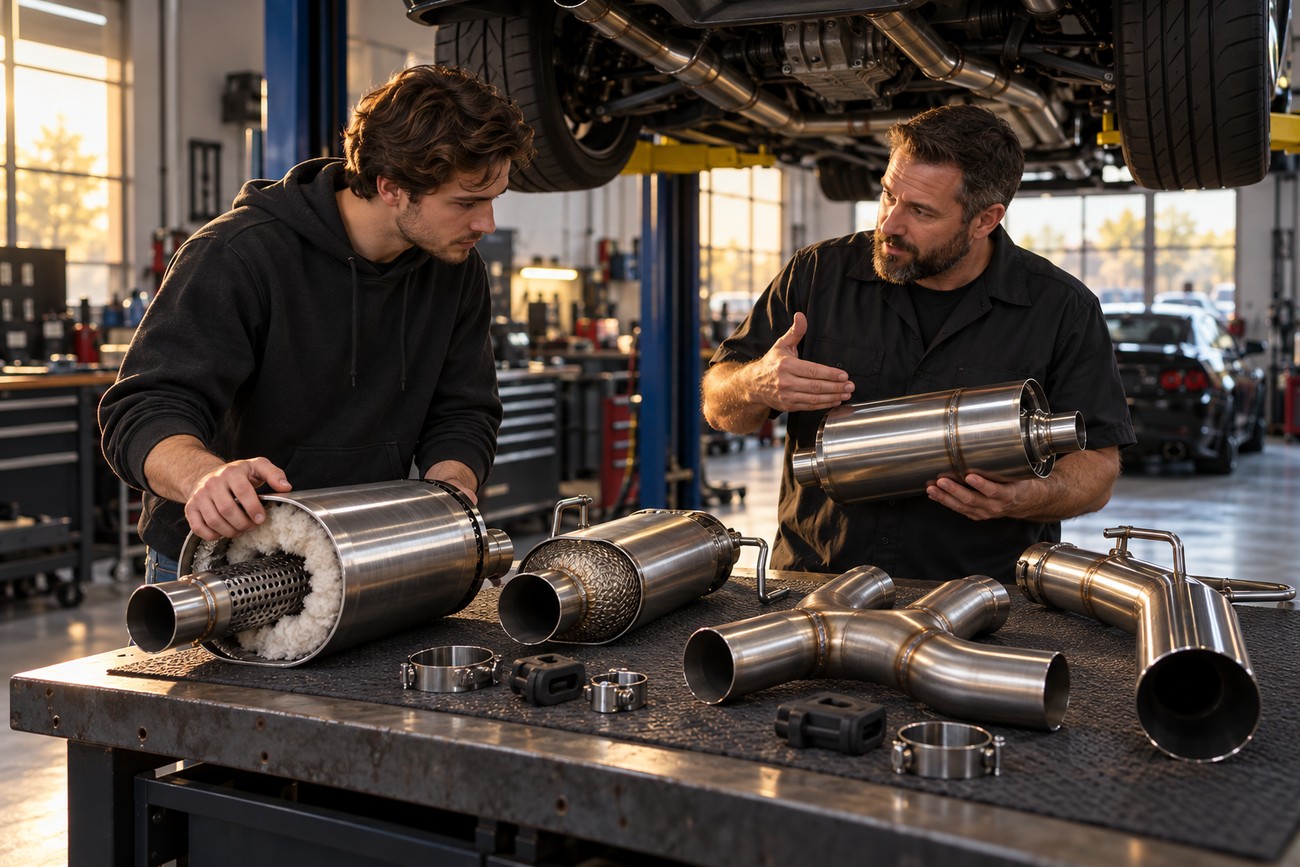
The most common mistake is choosing a loud profile from a startup clip. ATAK or an aggressive MagnaFlow system may sound impressive for a short demonstration, yet the same vehicle can become tiring when a steady highway rpm keeps the cabin energized. A purchase decision should include warm cruising evidence, not only the most dramatic moment in a video.
Straight-through construction can increase flow and volume, but it does not automatically produce the best tone or cabin comfort. Internal volume, packing, resonators, crossover design, and outlet position still shape the result. A freer path can emphasize a frequency that was previously controlled, especially after other components are removed.
Removing resonators or using universal mufflers changes the intended system tuning and can increase resonance. It also makes reviews of the original kit less relevant because the installed vehicle no longer matches the tested configuration. If the goal is predictable sound, altering several parts at once makes later diagnosis harder.
Marketing labels such as “aggressive,” “performance,” or “mandrel-bent” do not describe the complete listening experience. A performance claim also does not guarantee a noticeable power gain without compatible engine tuning and supporting components. Sound and power should be evaluated as separate outcomes.
Fitment creates another practical risk. Brand reputation and price do not guarantee perfect installation on every vehicle. Brackets, clearances, flange alignment, hanger position, and the condition of factory components can affect both installation quality and sound. A system that contacts the body or sits too close to a heat-sensitive area may create noise that is wrongly blamed on the muffler design.
Which One Should You Choose?
Choose Borla Touring when restrained sound and daily comfort are the priority, provided the exact vehicle-specific evidence supports that expectation. S-Type suits drivers who want a clearer exterior presence with moderate aggression. ATAK is the most aggressive Borla option and makes more sense when maximum volume matters more than a subdued highway experience.
MagnaFlow requires a more detailed selection process. Choose the exact series and vehicle-specific kit according to the desired exterior character, interior tolerance, resonator arrangement, and use of the vehicle. The brand name alone does not identify a single sound because MagnaFlow uses both straight-through and chambered mufflers across its range.
For daily driving, prioritize the frequency spectrum at steady rpm over peak loudness. A system that sounds deep and controlled during short acceleration may still produce a narrow, tiring resonance at cruise. Verified recordings from the same engine, body, transmission, and configuration are more useful than a general comparison between brand names.
There is no universal Borla-versus-MagnaFlow winner for sound quality. The best choice depends on the desired exterior character, cabin tolerance, vehicle configuration, and highway use. If those priorities are unclear, a moderate system with documented warm-cabin behavior is usually a safer choice than the loudest available profile.
Frequently asked questions
What muffler gives the deepest sound on a V8 or truck?
No single muffler guarantees the deepest sound because cylinder count, firing order, displacement, resonator volume, and pipe layout all shape the final tone. A V8’s firing pattern may produce a deeper character than a smaller engine with the same muffler, while pipe diameter and crossover design can make that sound smoother, sharper, or louder.
For a truck, compare complete systems rather than muffler brands in isolation. The useful evidence is a warm exterior recording and an in-cabin recording from the exact engine and transmission. A deeper tone also depends on controlling unwanted high-frequency content and resonance; simply choosing the loudest muffler can produce more volume without producing a more pleasing low-frequency character.
Why does my exhaust sound deeper outside than it does inside the cabin?
The cabin filters and reinforces sound differently from open air. Body structure, insulation, window position, exhaust proximity, and the direction of the outlet can reduce some frequencies while amplifying others. A narrow-band resonance inside the vehicle may also make the exhaust seem harsher or thinner than it sounds from behind the vehicle.
Exterior recordings cannot reliably reveal that cabin behavior. Listen from the driver’s seat with the windows closed at warm idle, during acceleration, and at sustained highway rpm. If the outside tone is deep but the cabin is tiring, the issue may involve body acoustics or a specific resonance rather than a simple failure of the muffler to produce bass.
Do headers or an X-pipe change which brand sounds better?
Yes. Headers alter the upstream pulse behavior, and an X-pipe changes how pulses from the two banks mix. Those changes can overwhelm the original muffler character, making a Borla or MagnaFlow system sound substantially different from recordings made with the stock upstream exhaust.
That is why stock-exhaust recordings should not be used as a direct forecast for a vehicle with headers, a different X-pipe, removed resonators, or altered catalysts. Compare systems with the same upstream and downstream configuration, and treat any change to the exhaust path as part of the sound system rather than as an isolated component.