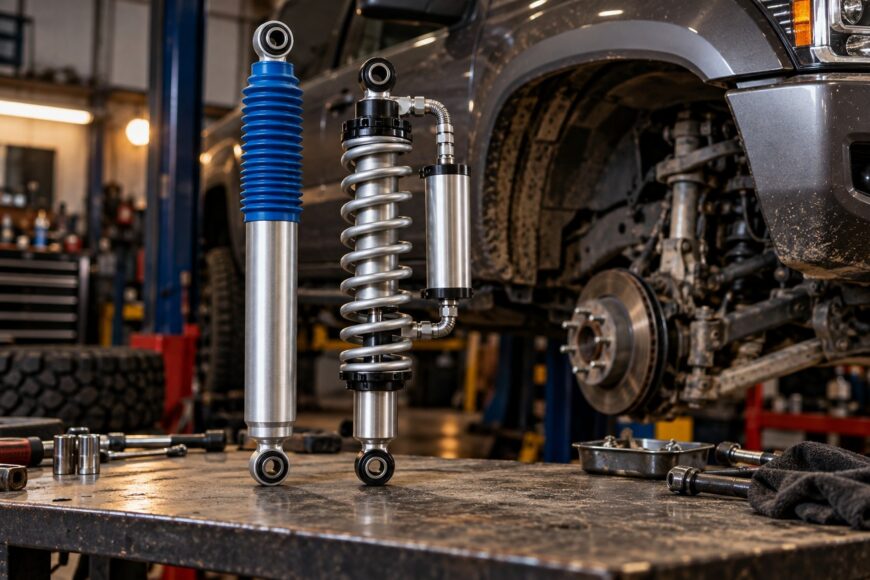
A truck that feels composed while towing can feel harsh when it is empty. A comfortable trail setup can feel loose during highway braking and lane changes. That conflict is usually a suspension-matching problem rather than a simple brand contest.
Bilstein and Fox both offer capable monotube shocks, but their useful differences appear only in context. Truck weight, front-end accessories, tire pressure, spring rate, terrain speed, available wheel travel, and your willingness to service the shocks all matter more than the logo on the body.
- Bilstein 5100, 5160, and 6112 vs. Fox 2.0 and 2.5: The Practical Differences
- Ride and Load Control: Empty Commutes, Heavy Front Ends, and Towing
- Slow Trails vs. Fast Washboard: What Heat and Reservoirs Actually Change
- Purchase Price Is Not Ownership Cost: Rebuilds, Replacement, and Access
- Lift Height and Travel: Check Fit Before Choosing a Logo
- Common Disappointments: Harshness, Float, Noise, and the Wrong Fix
- Which Should You Buy for Your Truck and Driving?
- Frequently Asked Questions
- How do I verify the correct shock part number for my truck?
- What are the best shocks for off-road trucks?
- What is the best brand of shock absorbers for off-roading?
Bilstein 5100, 5160, and 6112 vs. Fox 2.0 and 2.5: The Practical Differences
These families overlap in purpose, yet they are not interchangeable in design, fit, or ownership requirements.
| Line | Construction and reservoir | Typical ride tendency | Service and buyer priority |
|---|---|---|---|
| Bilstein 5100 | High-pressure monotube gas shock; most bodies are steel. Reservoir availability depends on the application. | Often perceived as firm, with an emphasis on control when the truck carries a useful load. | Generally treated as a replacement product. Suits straightforward fitment and predictable loaded control. |
| Bilstein 5160 | Monotube design with reservoir-equipped applications; most bodies are steel. | Application-specific valving, commonly selected for added travel and off-road use. | Usually bought as a complete replacement rather than a standard factory-rebuild unit. |
| Bilstein 6112 | High-pressure monotube front system, commonly paired with a coil spring or spring-seat arrangement. | Often firmer and stable under front-end load, subject to the exact application and valving. | Useful for a matched front suspension package rather than a generic lift choice. |
| Fox 2.0 | Monotube design, commonly with an aluminum body; reservoir versions are model-dependent. | Baseline tuning varies, and many applications favor compliance over a firm loaded feel. | Commonly serviceable with suitable equipment. Appeals to owners prepared to maintain the shock. |
| Fox 2.5 Performance or Factory | Larger monotube design, commonly aluminum, with internal or external reservoir options depending on the product. | Often configured for repeated rough-road cycling, although spring and valving still determine the result. | Serviceable and more configurable, with greater cost, packaging demands, and specialist requirements. |
The practical split is therefore about priorities. Bilstein 5100, 5160, and 6112 are often chosen for firm control, loaded use, and replacement simplicity. Fox 2.0 and 2.5 products can offer more serviceability and tuning scope, but a reservoir is not present on every model and does not guarantee a better ride.
Ride and Load Control: Empty Commutes, Heavy Front Ends, and Towing
Bilstein 5100 and 6112 applications are often perceived as firmer, which can help a truck stay settled with a trailer, tools, or a loaded bed. On a lightly equipped pickup, that same damping can transmit more small bumps through the cabin. The result may be described as “harsh,” even when the shock is controlling body motion correctly.
Some off-the-shelf Fox setups produce the opposite complaint on a heavy pickup. A setup that feels compliant on a lighter truck may allow more float, brake dive, or fore-and-aft motion when installed on a diesel truck with a heavy bumper, winch, or other accessories. Fox baseline tuning varies by application, so the brand alone cannot predict that behavior.
Springs support vehicle weight; shocks control motion. If added equipment has exceeded the useful range of the original or replacement spring, a different damper cannot restore proper ride height or carrying capacity. A suitable spring rate must be considered before blaming either shock for sag, repeated bottoming, or poor steering response.
Towing also changes the balance between front and rear suspension. Firmer damping can reduce pitching, yet excessive firmness may make an empty rear axle skip across broken pavement. Tire pressure and actual carried weight can materially alter the perceived ride, sometimes more than changing between two correctly fitted shock families.
Slow Trails vs. Fast Washboard: What Heat and Reservoirs Actually Change
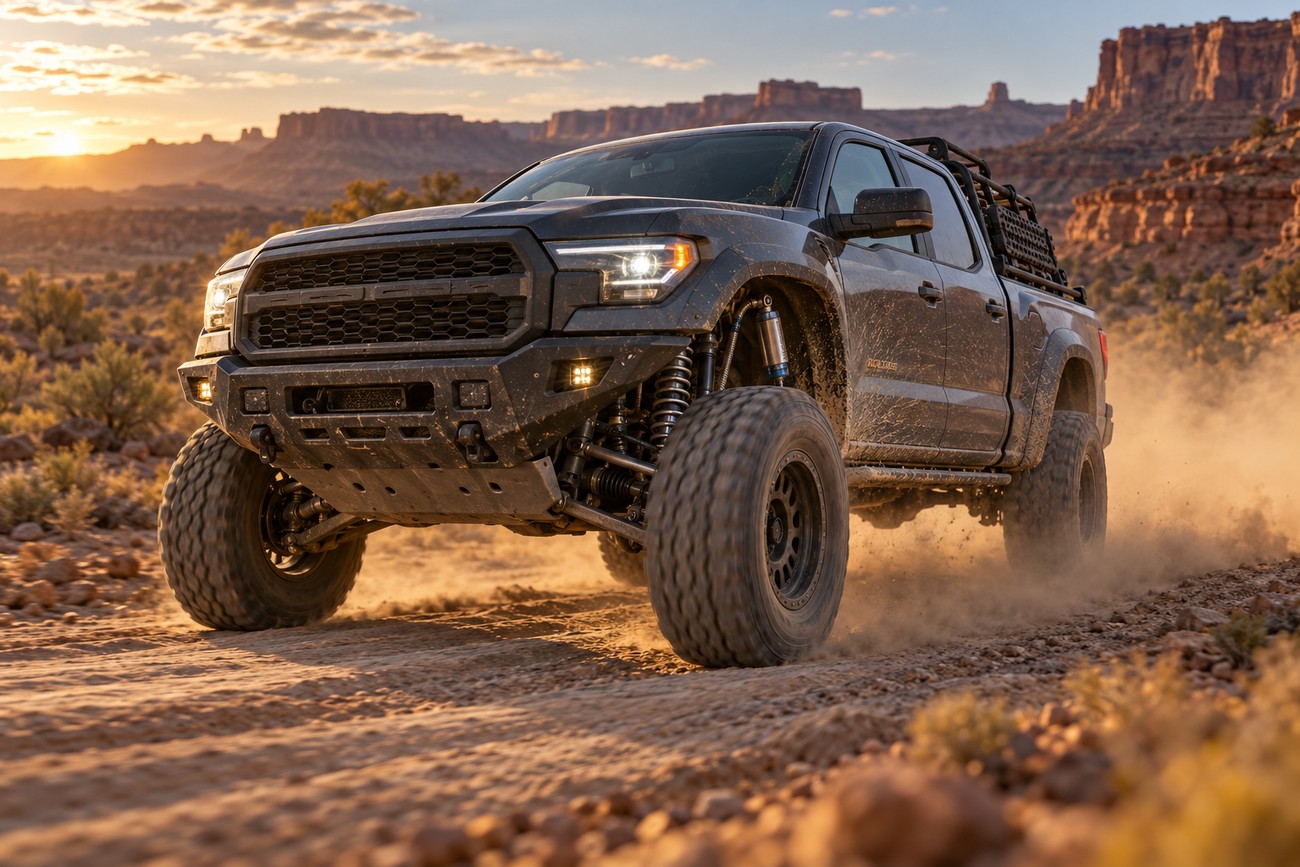
Slow technical driving asks the suspension to articulate around rocks, ledges, and uneven wheel loads. The truck may move slowly, but each wheel can approach its bump or droop limit repeatedly. Correct shock length, spring control, and clearance are usually more important here than simply adding a reservoir.
Fast washboard driving creates a different demand. Repeated high-frequency movement can heat the oil and cause damping to change as the shock cycles. A reservoir primarily adds oil capacity and helps manage sustained heat and repeated cycling. It does not inherently make the shock softer, and it cannot compensate for an unsuitable spring or incorrect valving.
A suitably configured Fox setup is often favored for repeated fast washboard use, while an appropriately specified Bilstein setup can work well on technical trails and loaded trips. These are tendencies rather than universal rankings. A Bilstein 5160 or 6112 matched to the truck can be more useful on a loaded expedition vehicle than a poorly matched reservoir shock.
Bilstein emphasizes resistance to heat-related fade and cavitation. Fox promotes aluminum bodies and reservoir-equipped designs. The available information does not establish a controlled, direct heat-performance winner between the brands, so reservoir size and marketing language should not replace an application-specific specification.
Purchase Price Is Not Ownership Cost: Rebuilds, Replacement, and Access
Fox 2.0 and 2.5 shocks are commonly serviceable, but that advantage has conditions. Rebuilding usually involves removing the shock, replacing oil and seals as required, checking the assembly, and restoring nitrogen pressure with suitable equipment. Revalving also requires the right parts, tools, and knowledge of the vehicle’s weight and use.
Bilstein 4600 and 5100 products are generally treated as replacement shocks rather than standard factory-rebuild products. Specialist rebuild availability is not standardized in the same way as a purpose-built service program. When performance declines, many owners replace the unit or complete set instead of sending it for an uncertain repair process.
Service timing depends on use, contamination, heat, suspension travel, and manufacturer guidance. Active off-road use can bring seal leaks or performance loss to Fox shocks if maintenance is neglected. A rebuildable shock is therefore a serviceable component, not a maintenance-free component.
Reported service life varies widely with truck weight and terrain. Bilstein 5100 shocks on heavy pickups are sometimes reported to remain usable for a long period before noticeable loss of control, while actively used Fox 2.0 shocks may need attention sooner. Those observations are useful for budgeting, not fixed mileage promises for every part number.
Lift Height and Travel: Check Fit Before Choosing a Logo
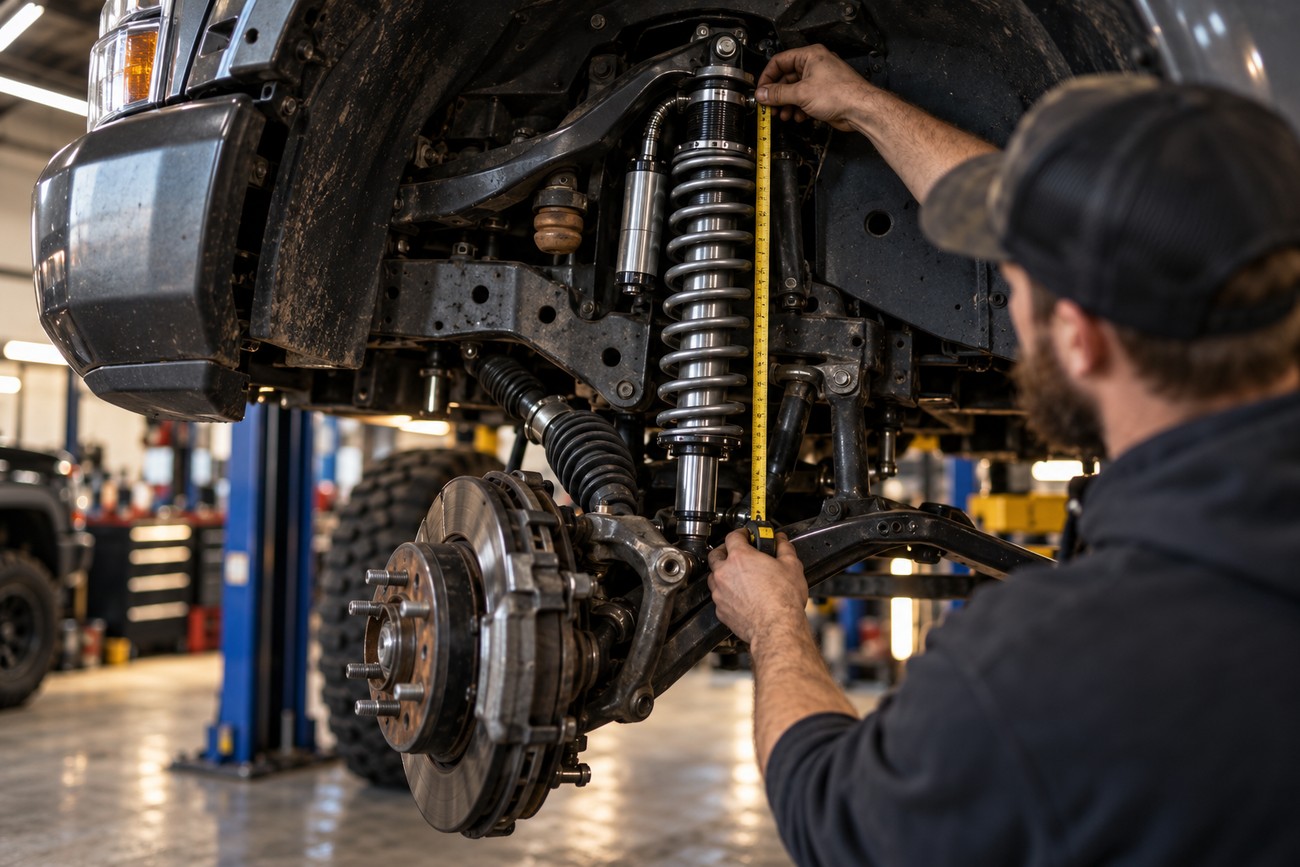
Lift height is only one line in a suspension specification. Bilstein 5100 front applications on many platforms offer roughly 0–2.5 inches of lift, while compatible Fox 2.0 front coilover kits commonly offer up to about 2–3 inches through preload adjustment. Actual fit, spring rate, and safe travel remain application-dependent.
Begin with the exact truck model, drivetrain, axle configuration, and existing lift kit. Then verify the intended spring or coilover pairing, compressed and extended shock lengths, bump-stop position, and available droop. Check tire clearance at full steering lock and full compression before assuming that the advertised lift number describes usable wheel travel.
Compare actual bump and droop limits with the shock’s compressed and extended lengths before approving the parts list. A reservoir that clears the wheel at ride height can still contact the frame, tire, or body during articulation.
Large Fox bodies and external reservoirs can create packaging problems inside the wheel well. A shock that is too long may top out before the suspension reaches its droop limit; one that is too short may force repeated bottoming. Either condition can damage mounts, bushings, ball joints, or control arms, even when the static ride height looks correct.
Lift kits are often engineered around a particular shock, spring, and geometry. Mixing a Fox shock into a Bilstein-based kit, or the reverse, can alter travel and operating angles. Confirm the complete system before purchasing separate parts, especially when the truck already has aftermarket control arms, bump stops, or a modified rear suspension.
Common Disappointments: Harshness, Float, Noise, and the Wrong Fix
Harsh small-bump response starts with a diagnosis, not a brand verdict. Check tire pressure, empty-versus-loaded weight, spring rate, bushing condition, and whether the shock is operating near the end of its travel. A Bilstein 5100 can feel overly firm on a light truck, but excessive pressure or an overly stiff spring may be the larger cause.
Brake dive, highway float, and repeated pitching point toward a broader control problem. Inspect the shock for leakage and compare the truck’s current load with the intended application. On a heavy pickup, a Fox setup that feels soft may be dealing with a spring and valving combination designed for a lighter configuration.
Performance loss can develop gradually. A shock may still be dry and free of obvious damage while the truck has become less controlled over washboard, during lane changes, or after towing. Comparing the current behavior with a known-good baseline and checking both sides of the axle can reveal deterioration that a visual inspection misses.
Noise deserves the same caution. Some Fox reservoir-equipped shocks can produce a hiss or a knock as the suspension changes position, while some Bilstein applications may tap over fine corrugations. The sound may come from mounting hardware, clearance, bushings, or the shock itself; verify torque, contact marks, and travel before declaring the damper failed.
Which Should You Buy for Your Truck and Driving?
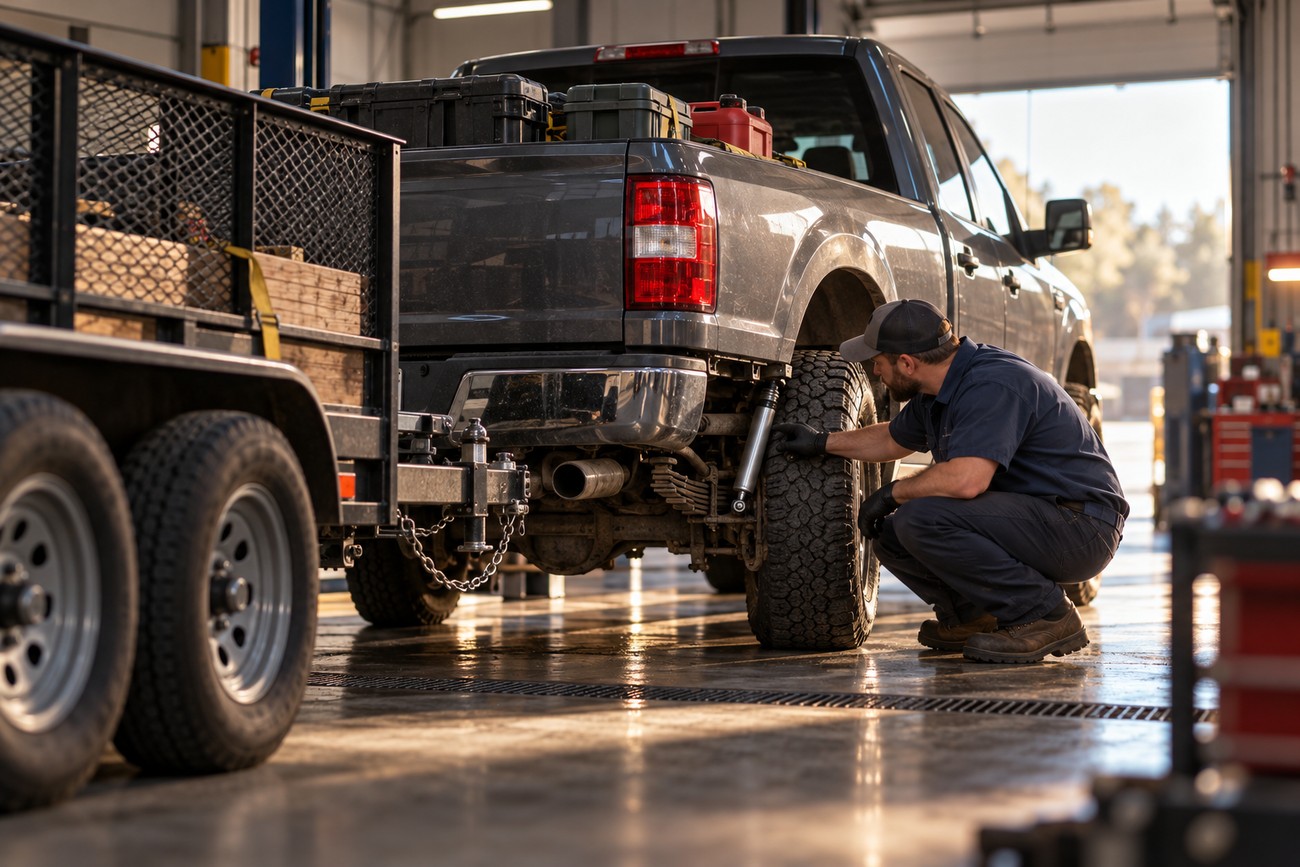
A loaded or frequently towing pickup often suits a correctly specified Bilstein 5100, 5160, or 6112 setup when firm control and straightforward replacement are priorities. Confirm the spring capacity first, particularly with a heavy front bumper, winch, or diesel engine. The shock can improve control, but it does not increase the truck manufacturer’s payload or towing ratings.
A mostly empty daily driver may favor a less aggressive damping setup, especially if the truck spends more time on broken pavement than on fast dirt. Some Fox applications provide the desired compliance, while some Bilstein applications may feel too firm. The exact valving and spring pairing matter more than the general reputation of either brand.
A fast rough-road truck is a stronger candidate for a properly configured Fox 2.0 or 2.5 system, particularly when repeated washboard cycling and future serviceability justify the added cost. Owners should budget for service and confirm that the reservoir can be mounted safely. A reservoir is useful when the truck generates sustained heat, not simply because the vehicle occasionally leaves the pavement.
Mixed-use builds require a short decision sequence:
- Measure the real front and rear load, including accessories, passengers, fuel, and typical cargo.
- Define the terrain and speed: towing, technical trails, fast corrugations, or a combination.
- Verify spring pairing, shock lengths, bump and droop limits, and physical clearance.
- Check whether local service facilities can rebuild, recharge, or replace the chosen product.
- Compare the complete ownership cost, including installation, maintenance, and downtime.
Some heavy-truck owners use firmer front damping with a different rear setup to balance steering control and empty-bed comfort. That approach can work, but front–rear mixing must be checked against the truck’s springs, load, and suspension geometry. A matched lift kit should not be mixed casually, and a qualified specialist may extract more from application-specific Fox valving than a generic shock can provide.
Frequently Asked Questions
How do I verify the correct shock part number for my truck?
Use the exact model year, cab and bed configuration, drivetrain, axle type, and engine or payload version when searching the manufacturer’s application listing. Then include the existing lift kit, spring type, control arms, and reservoir arrangement. A generic truck name is insufficient because the same platform can use different lengths, mounts, or valving.
Compare the listing with the actual vehicle before ordering. Verify compressed and extended lengths, mounting hardware, lift range, spring pairing, and clearance at full steering and suspension travel. If the truck has an aftermarket lift, the lift manufacturer’s approved shock application is often more reliable than choosing by advertised inches alone.
What are the best shocks for off-road trucks?
The best shock is the one matched to the truck’s weight, spring rate, usable travel, terrain, and maintenance plan. A Bilstein setup can suit a loaded or towing truck that values firm control and replacement simplicity. A correctly specified Fox setup can suit repeated fast rough-road use and an owner who accepts scheduled service.
There is no universal winner across light pickups, heavy diesels, technical trail rigs, and high-speed desert-style use. Confirm the complete suspension configuration first; a premium shock with the wrong length or spring pairing will perform worse than a less expensive unit that fits the truck correctly.
What is the best brand of shock absorbers for off-roading?
Bilstein and Fox are both credible choices, but brand reputation should follow application requirements. Bilstein 5100, 5160, and 6112 products are often selected for loaded stability and practical replacement. Fox 2.0 and 2.5 products offer commonly serviceable designs and, in some applications, more scope for tuning and reservoir-based heat management.
Choose by model and valving, not by logo or the presence of an external reservoir. A reservoir adds oil capacity and supports repeated cycling; it does not automatically improve comfort. Installation must also preserve safe travel and clearance, and shock damping does not increase the truck’s rated payload or towing capacity.