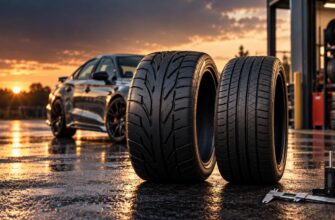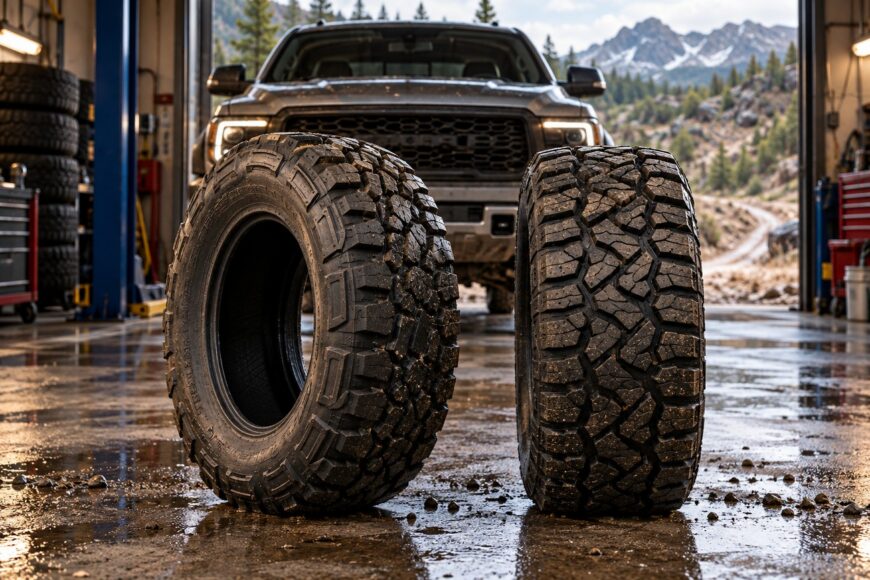
BFGoodrich KO2 tends to appeal to drivers who prioritize sidewall protection, rock use, and a durable off-road feel. Falken Wildpeak AT3W often suits drivers who place more value on wet-road manners, snow traction, lower perceived noise, and everyday composure. Neither is an automatic winner because those priorities rarely occur on the same vehicle in the same proportions.
The result depends on the exact size, P-metric or LT construction, load range, vehicle weight, inflation pressure, alignment, and the surfaces you actually drive. A light SUV used mainly on pavement can make the AT3W feel like the better tire, while a loaded pickup exposed to sharp rocks may justify the KO2. Comparing only the tread pattern or brand reputation produces a less useful answer than comparing matching specifications.
- BFGoodrich KO2 vs Falken Wildpeak AT3W: the short answer
- What the two all-terrain tires are designed to prioritize
- Daily driving: wet roads, noise, and ride quality
- Off-road traction: rocks, gravel, mud, and wet grass
- Snow, ice, and what 3PMSF really tells you
- Tread life, warranty claims, weight, and size availability
- KO2 vs AT3W: the decision table by driving scenario
- How to choose the right version instead of the right legend
- Frequently asked questions
- Do I need to replace all four tires when changing from KO2 to AT3W?
- Why can the same KO2 or AT3W feel different after installation on another truck?
- Which tire is better, the Falken Wildpeak AT3W or the BFG KO2?
- Which is better, BFG or Falken?
- Which tire is better, Goodrich or Falken?
BFGoodrich KO2 vs Falken Wildpeak AT3W: the short answer
Choose the KO2 when sidewall and rock durability are central to the job. KO2 uses CoreGard Technology, and BFGoodrich promotional material claims 20% tougher sidewalls than previous BFGoodrich solutions. That positioning matters on rocky trails, where sharp edges and repeated impacts can expose weaknesses in a tire carcass long before tread wear becomes the limiting factor.
The AT3W is the more natural choice for drivers who spend most of their time on pavement and encounter rain, occasional snow, gravel, and mild trails. Comparative materials often describe it as having class-leading tread depth, while user comparisons commonly describe the tire as quieter and more confident on wet roads and snow. Those are owner-reported tendencies rather than universal test results, and a different vehicle or load range can change the impression.
On dry highways, both tires can provide the stability expected from a serious all-terrain design, but neither has the light steering response or low noise of a highway-terrain tire. The KO2 may develop more audible tread noise as it wears. The AT3W is often perceived as calmer, although AT3W LT versions can still feel firm, particularly on a light truck with high cold inflation pressure.
For moderate off-road travel, the gap is smaller than brand debates suggest. Both can handle gravel, dirt roads, and ordinary trail sections when correctly inflated and driven within their limits. The decisive difference is usually the cost of the compromises: KO2 gives more weight to casing confidence, while AT3W generally gives more weight to wet-road behavior, snow use, and daily refinement.
What the two all-terrain tires are designed to prioritize
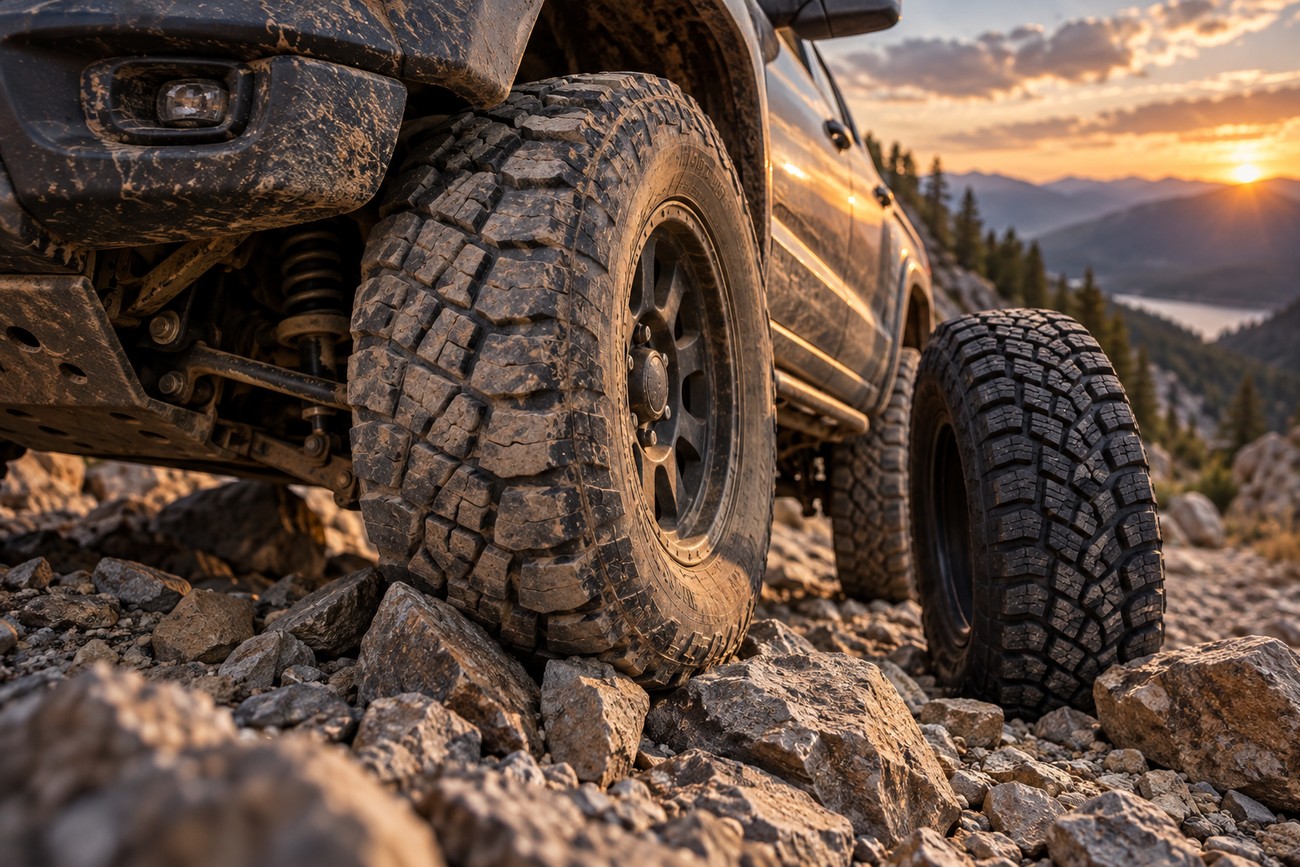
The KO2’s identity is built around resisting damage in demanding terrain. CoreGard Technology is the key construction feature associated with that role, and BFGoodrich’s claim of 20% tougher sidewalls than previous BFGoodrich solutions explains why the tire is popular with drivers who regularly encounter rocks, ledges, and rough access roads. This does not make the casing immune to cuts, punctures, or impact damage.
The AT3W takes a different route to all-terrain versatility. It is frequently presented in comparative materials as having class-leading tread depth, which can provide useful biting edges on loose surfaces and snow when the tire is new. Deep tread also brings trade-offs: more unstrung mass, more tread movement, and a greater possibility of noise or slower steering response than a road-focused tire.
Both designs must work across surfaces that demand conflicting qualities. A tire with a substantial casing and aggressive tread can offer greater confidence away from pavement, yet it may transmit more impact, consume more fuel, and produce more sound. Neither tire can deliver dedicated-winter grip on ice while also behaving like a quiet highway tire and carrying the casing priorities of an off-road tire.
The most important distinction is therefore a design emphasis, not a universal performance ranking. KO2 leans toward damage resistance and rocky terrain. AT3W leans toward a broad daily-use compromise in which wet roads, snow, and perceived noise receive more attention. The exact size and construction can narrow or widen that difference.
Daily driving: wet roads, noise, and ride quality
Daily driving exposes differences that are easy to miss on a short test drive. User comparisons often describe the AT3W as more confident on wet pavement, with a more settled response during ordinary rain and standing-water conditions. That impression depends on tread condition, pressure, alignment, and vehicle balance, so it should be treated as a common tendency rather than a guaranteed result.
KO2 owners frequently report that the tire becomes louder as the tread wears. Uneven wear can amplify that effect, especially on vehicles with incorrect toe settings, worn suspension parts, or irregular rotation intervals. A new KO2 may sound acceptable in a pickup or SUV, but the noise profile can become more prominent as the tread blocks lose their original shape.
AT3W is often perceived as quieter, yet “quieter” does not mean soft. Owners sometimes describe both the AT3W and AT3W LT as firmer than expected from an all-terrain tire. The LT construction, the selected load range, and the pressure needed for the actual axle load can make the ride feel more rigid than the tread appearance suggests.
Steering feel also depends on the vehicle rather than the tire alone. A heavy-duty pickup, a light crossover, and a body-on-frame SUV place different loads on the same casing. Wheel width, suspension geometry, cabin insulation, balance, and alignment can alter both road noise and the effort needed to make a lane change.
A useful comparison requires matching pressure and condition. Testing one tire at the pressure used for a different load range can make it seem harsh, vague, or noisy for the wrong reason. If a set develops cupping or shoulder wear, correct the vehicle setup before treating the resulting sound as a permanent characteristic of KO2 or AT3W.
Off-road traction: rocks, gravel, mud, and wet grass
KO2 is commonly characterized by owners as more oriented toward sidewall toughness and rocks. Its CoreGard positioning is relevant where the sidewall may contact sharp stone or where repeated impacts are unavoidable. Drivers should still use appropriate speed, line choice, and pressure: a tougher sidewall reduces risk, but it does not remove the possibility of a cut or puncture.
On gravel and hard-packed trails, the difference is less dramatic. Both tires can provide useful traction when the vehicle is driven smoothly and the inflation pressure suits the load and surface. Excessive pressure can reduce the contact patch and make the vehicle skip over loose rock, while excessive speed increases heat and impact energy in either casing.
Neither tire is a mud tire. Both can clog or lose effectiveness in mud and on wet grass when conditions exceed the normal all-terrain use case. Heavy throttle can spin the tread clean in one patch and bury the vehicle in the next, particularly on wet grass, where the surface can be slippery even when the mud depth looks modest.
AT3W can be the better fit for mixed routes that include long pavement sections, rain, light snow, and occasional trail work. KO2 makes more sense where sharp rocks and sidewall exposure are routine. For deep mud, repeated bog crossings, or specialized rock crawling, the limits of an all-terrain tire become more important than the small differences between these two models.
Snow, ice, and what 3PMSF really tells you
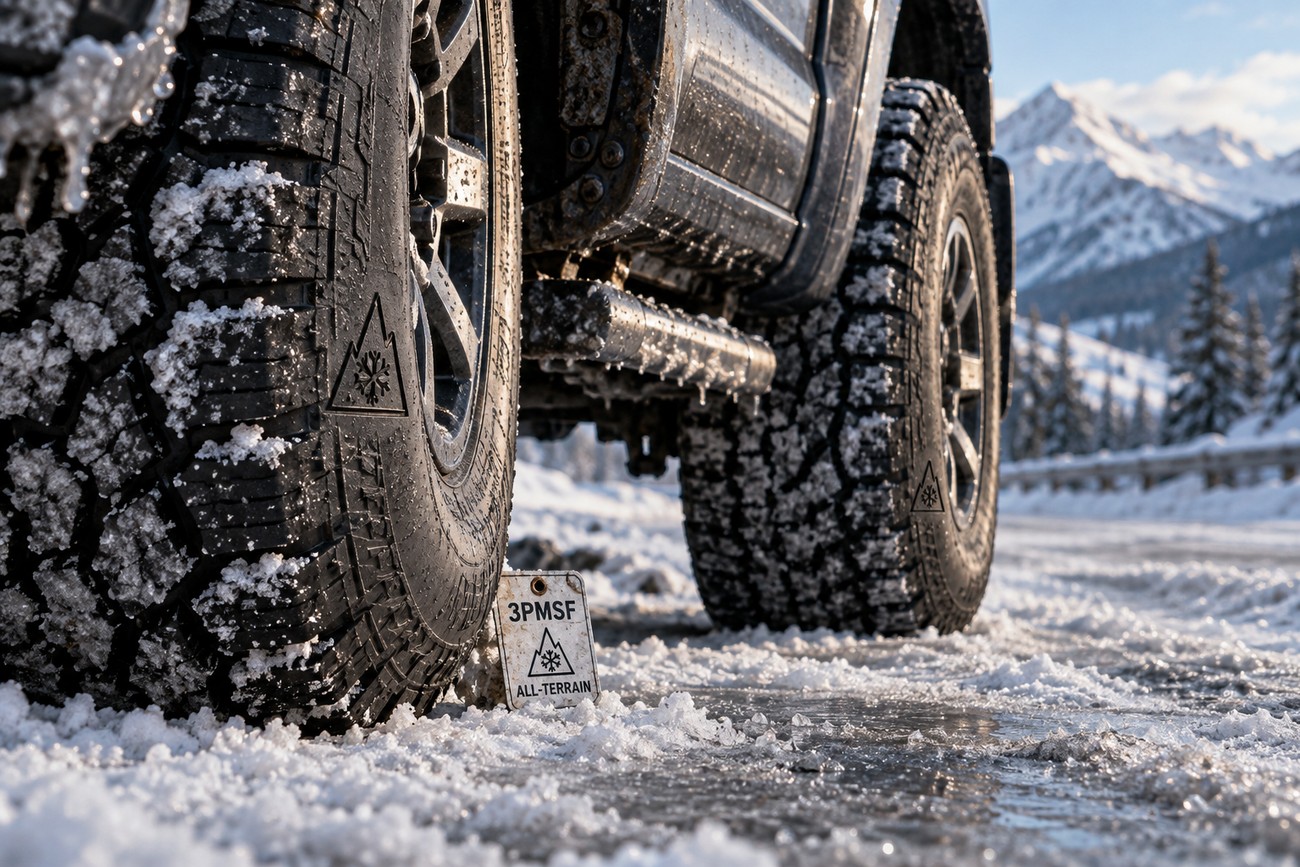
Both models are commonly positioned as 3PMSF-rated. The Three-Peak Mountain Snowflake marking indicates severe-snow performance under a standardized test, which is useful information for drivers who regularly encounter packed snow or winter roads. It does not describe every aspect of cold-weather behavior.
3PMSF does not make an all-terrain tire equivalent to a dedicated winter tire. The marking does not by itself specify noise, wet braking, tread life, or ice performance, and it does not guarantee superior grip on polished intersections or hard-packed snow. Users commonly report useful snow traction from these tires while still finding their performance on ice limited.
AT3W is often described in owner comparisons as more confident in snow, especially during ordinary winter driving on roads that alternate between dry pavement, slush, and loose snow. KO2 can also provide capable snow traction, but its tougher, more aggressive character does not overcome the basic limitation of an all-terrain tread compound on ice.
Use the 3PMSF mark as one selection filter, not as a substitute for a winter tire. If winter driving includes frequent ice, steep untreated roads, emergency braking, or consistently low temperatures, a dedicated winter set may provide a larger safety margin than choosing between two all-terrain models.
Tread life, warranty claims, weight, and size availability
A 50,000-mile warranty is often listed for KO2, while some comparative summaries cite a 55,000-mile limited tread life warranty for AT3W. These figures should be verified for the exact size, construction, and market. Warranty mileage is not directly comparable without matching size, load range, construction, market, and warranty terms.
Actual tread life depends heavily on alignment, pressure, load, rotation, vehicle mass, driving conditions, and uneven wear. A tire can have substantial remaining tread yet perform poorly if the shoulders are worn or the tread has developed a repeating pattern. Conversely, a vehicle with correct alignment and regular rotation may obtain more useful service from a configuration that looks less impressive on a warranty label.
Owners have reported LT KO2 and AT3W weights being close, with a difference of about 4 lb per tire in one size. That is a size-specific observation, not a model-wide rule. The correct comparison requires checking the published weight for the exact tire, because a heavier construction can affect acceleration, braking response, fuel consumption, suspension load, and ride quality.
AT3W is often listed in sizes from 15 inches to 22 inches, while exact availability for both models depends on market, diameter, size, load range, and construction. A popular nominal diameter may still be difficult to source in the needed width, load index, or LT specification. Availability can therefore influence the final choice as much as a small difference in road manners.
Compare complete specifications before comparing prices. A lower listed price may belong to a different load range or construction, and an apparently similar tire may have a different approved load index or sidewall design. The usable value comes from the correct tire for the vehicle, not from the lowest number in a search result.
KO2 vs AT3W: the decision table by driving scenario
The table summarizes the common fitment logic while separating owner-reported tendencies from specifications that must be checked for the exact application.
| Driving factor | BFGoodrich KO2 | Falken Wildpeak AT3W |
|---|---|---|
| Construction priority | Sidewall and casing confidence, with CoreGard Technology and a promotional claim of 20% tougher sidewalls than previous BFGoodrich solutions. | Deep-tread all-terrain positioning; comparative materials often describe the tread depth as class-leading. |
| Sharp rocks and impacts | Commonly associated with sidewall toughness and rock use. It remains vulnerable to cuts, punctures, and severe impacts. | Capable for ordinary trail use, though owners more often associate it with balanced daily and winter-road behavior than with maximum rock focus. |
| Wet-road behavior | Can be competent when correctly fitted and maintained, but is less often praised by owners than AT3W in this area. | Often described by users as more confident on wet pavement; the result varies with vehicle, pressure, wear, and alignment. |
| Noise | Owner reports commonly mention increasing noise as the tread wears. | Often perceived as quieter, although vehicle insulation, tread wear, and rotation strongly affect the result. |
| Ride firmness | Can feel firm, particularly in heavier or higher-load-range configurations. | AT3W and AT3W LT can also feel firmer than expected, especially with unsuitable pressure or a light vehicle. |
| Mud and wet grass | Not a mud tire; can clog or lose grip when driven beyond normal all-terrain conditions. | Has the same basic limitation and can lose effectiveness on wet grass or in mud outside its intended use. |
| Snow | Commonly positioned as 3PMSF-rated and useful in snow, but not a dedicated winter tire. | Commonly positioned as 3PMSF-rated and often reported as confident in snow, but still not a dedicated winter tire. |
| Ice | 3PMSF does not guarantee strong ice performance; users commonly describe ice grip as limited. | Has the same limitation. Dedicated winter tires remain the more appropriate reference for ice. |
| Commonly cited warranty | A 50,000-mile warranty is often listed, subject to the exact size, construction, market, and terms. | A 55,000-mile limited tread life warranty is cited in some summaries, while commercial listings and applications can differ. |
| Weight | LT weight can be close to AT3W; a reported difference of about 4 lb per tire applies to one size, not every size. | LT weight can be close to KO2; exact published weight must be checked for the chosen specification. |
| Size availability | Exact range varies by market, diameter, size, load range, and construction. | Often listed from 15 inches to 22 inches, with exact availability varying by market and specification. |
| Best-fit driver | A driver whose main concern is sidewall and rock durability and who accepts more potential noise, mass, and firmness. | A driver prioritizing wet-road manners, snow use, perceived quietness, and everyday versatility. |
How to choose the right version instead of the right legend
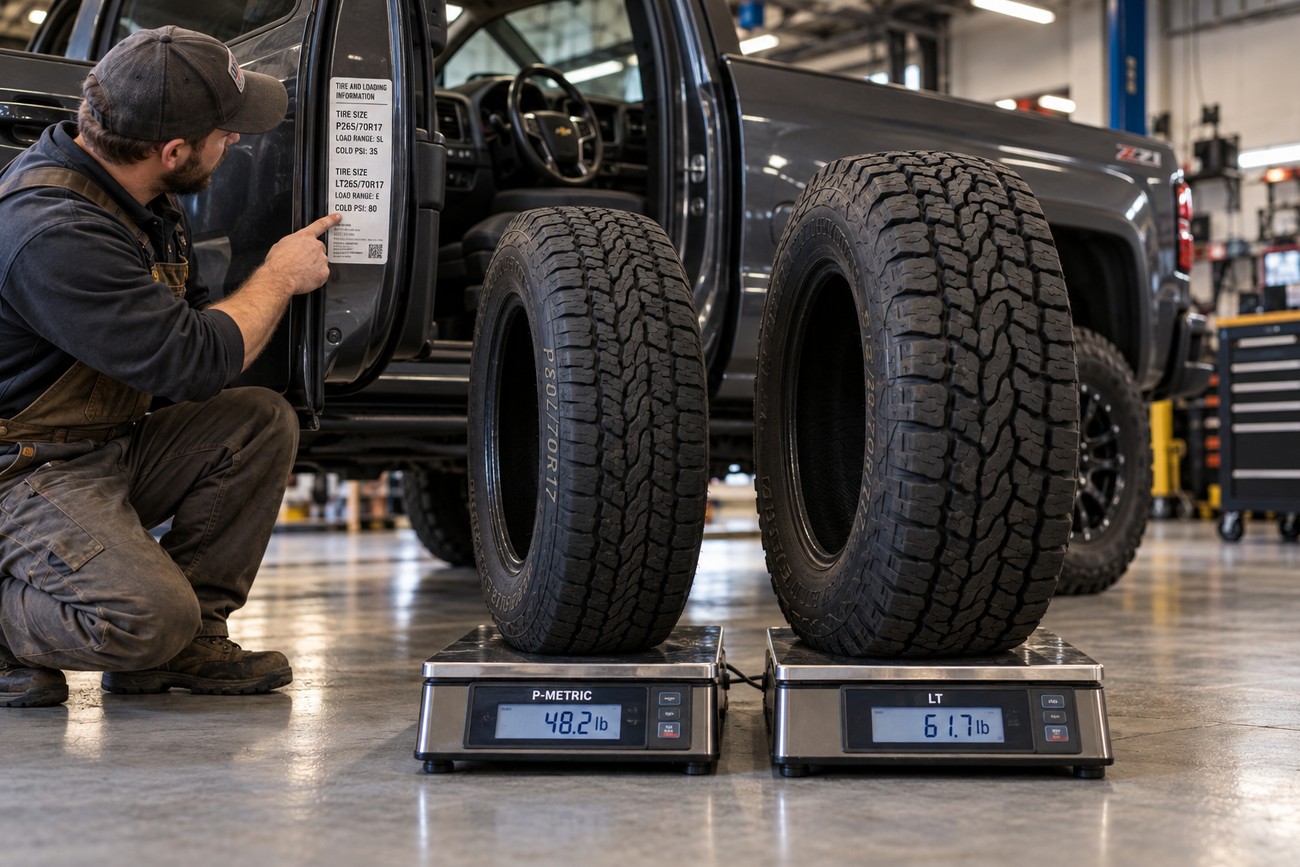
Start with the vehicle placard and the tire specification, then compare models within the same size and construction. A P-metric tire and an LT tire with the same nominal dimensions can differ substantially in stiffness, weight, load capacity, and pressure requirements. Comparing a light-duty AT3W with an LT KO2 creates a construction comparison disguised as a brand comparison.
Load range matters even when the vehicle can physically accept either option. An unnecessarily heavy LT or load-range version can increase firmness, noise, fuel consumption, and suspension load. It may be justified by repeated heavy loads, towing, or severe trail use, but it can be a poor fit for a lightly loaded SUV that spends most of its time on pavement.
Verify the exact load range, set pressure for the actual load, and correct alignment before blaming KO2 or AT3W for uneven wear, harshness, or noise. Fitment work separates the tire’s character from problems created by the vehicle setup.
Pressure should be judged against the vehicle’s load and the tire maker’s guidance, rather than copied from another truck or an online trail setup. Alignment and rotation are equally important because irregular wear can erase the intended advantages of either tread design. The same tire can feel smooth on one vehicle and harsh or loud on another because the operating conditions are different.
Choose KO2 when sharp rocks, sidewall exposure, and casing confidence dominate your routes, and accept that the trade-off may include more noise or a firmer feel. Choose AT3W when wet pavement, snow use, and everyday refinement matter more than maximum rock-oriented durability. In both cases, verify the exact size, load index, construction, and warranty terms before ordering.
Frequently asked questions
Do I need to replace all four tires when changing from KO2 to AT3W?
On many AWD and full-time 4WD vehicles, replacing all four is the safer default because the driveline may be sensitive to differences in rolling circumference. The nominal size printed on the sidewall does not guarantee identical circumference: tread depth, wear, inflation pressure, and construction can all change the effective rolling radius.
Replacing only one axle may be acceptable on some vehicles, but the owner’s manual or manufacturer’s driveline guidance should decide that point. Measure the existing tires and compare their actual wear before mixing a new AT3W with substantially worn KO2 tires. Even a small difference can create unwanted driveline strain on systems designed to keep all wheels turning at closely matched speeds.
Why can the same KO2 or AT3W feel different after installation on another truck?
Axle load, suspension geometry, wheel width, balance, and cabin insulation can change the result substantially. A tire that feels controlled on a heavy pickup may feel stiff on a lighter SUV, while a well-insulated cabin can make the same tread seem quieter than it does in a bare-cab truck.
Installation details also matter. Incorrect pressure, worn steering or suspension components, poor balance, and alignment errors can alter steering effort, vibration, noise, and wear. The tire model is only one part of the system being evaluated.
Which tire is better, the Falken Wildpeak AT3W or the BFG KO2?
The AT3W is usually the better fit for wet-road driving, snow use, and a quieter everyday experience. The KO2 is usually the better fit when sidewall and rock durability are the primary concerns.
That answer changes with the exact construction and vehicle. A light-duty AT3W may be more comfortable than an LT KO2, while an appropriately specified KO2 can be the more sensible choice for a loaded truck on sharp, rocky trails.
Which is better, BFG or Falken?
Neither brand is better for every application. In this comparison, BFG KO2 favors a durability-oriented off-road identity, while Falken AT3W more often favors wet-road manners, snow use, and daily versatility.
Choose by the tire specification and route rather than the badge. Matching load range, pressure, alignment, and vehicle use is more important than treating either brand as universally superior.
Which tire is better, Goodrich or Falken?
For a vehicle that regularly sees sharp rocks and sidewall hazards, Goodrich KO2 is the more logical starting point. For a vehicle used mainly on roads with rain, occasional snow, gravel, and mild trails, Falken AT3W is often the more balanced choice.
Both remain all-terrain compromises. They trade some noise, mass, ride comfort, and ice performance for broader surface capability, so the best choice is the one whose compromises match your driving conditions.