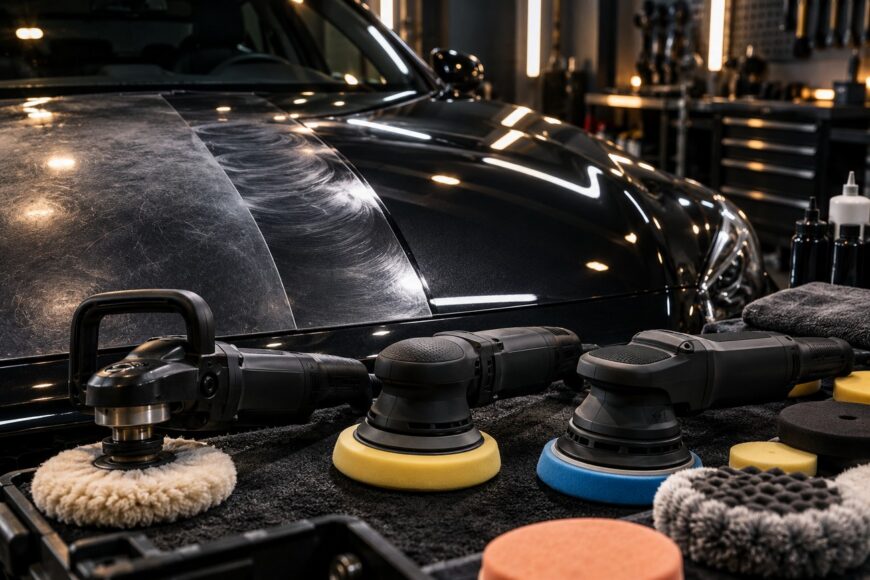
Choosing between Rupes, Flex, and Griot’s looks simple because all three brands have strong reputations. The real decision depends on machine type, your paint-correction skill, panel shape, physical tolerance for vibration and weight, and the ongoing cost of pads, compounds, and service.
No brand is universally best. Rupes emphasizes system-matched performance and efficient large-panel correction, Flex brings power and professional-duty construction, while Griot’s offers accessible pricing, familiar accessories, and a manageable entry point. The right choice is the one whose correction behavior and ownership demands match the work you actually do.
- The Machine Type Matters More Than the Badge
- Rupes vs. Flex vs. Griot’s: Which Polisher Fits Your Work?
- Rupes BigFoot: Best for System-Led, Fast DA Correction
- Flex: Maximum Control and Correction—With More Physical Demand
- Griot’s: A Sensible Entry Point for Enthusiasts and Studios
- Choose by Paint Condition, Panel Shape, and Operator Skill
- The Costs, Mistakes, and Risks Reviews Often Skip
- A Safer Correction Workflow for Any of These Brands
- Frequently asked questions
- What polisher is better than Rupes for someone who already owns mixed-brand pads and compounds?
- Which is better, the Rupes polisher or the Flex polisher when local service support is limited?
- How can you tell that a panel is getting too hot during polishing?
The Machine Type Matters More Than the Badge
Rotary, free-spinning dual action (DA), and forced-rotation DA polishers behave differently on paint. A rotary spins the backing plate on one fixed axis, which can remove defects quickly but increases the risk of holograms and uneven heat. A free-spinning DA combines rotation with an orbit, generally making it easier to finish cleanly and reducing hologram risk.
Forced-rotation DA machines add mechanical drive to the backing plate. The backing plate cannot stop rotating on the paint surface, so correction remains consistent when pressure or panel resistance would stall a free-spinning DA. That extra drive can shorten correction time, although it also makes the machine more demanding on curved panels and edges.
Rupes, Flex, and Griot’s offer combinations of these formats across their ranges. Free-spinning DA machines are usually the safest starting point for a new operator because they provide more forgiving feedback. Rotary and forced-rotation tools can correct faster, but poor positioning, excessive pressure, or lingering in one place has more serious consequences.
The claim that every DA is impossible to misuse should be rejected. Aggressive compound, pressure, speed, and poor temperature control can still damage or burn through clear coat with a DA machine. A free-spinning tool lowers certain risks; it does not replace inspection, a test section, or disciplined movement.
Rupes vs. Flex vs. Griot’s: Which Polisher Fits Your Work?
The following comparison describes brand tendencies and representative model families. Individual models can differ in balance, power delivery, noise, and control, so treat the table as a buying filter rather than a substitute for handling the machine.
| Brand and representative models | Machine format and drive behavior | Correction use | Control difficulty | Ergonomics | Accessory ecosystem | Likely user | Key ownership caution |
|---|---|---|---|---|---|---|---|
| Rupes: LHR15, LHR21, Mille | Large-orbit free-spinning DA in the 15–21 mm range; Mille is forced rotation | Efficient on broad panels; Mille adds stronger correction drive | Large orbits are less forgiving on tight, convex, and intricate areas | Generally refined when used with the intended system; balance depends on model and pad | Optimal BigFoot performance is designed around a matched Rupes machine, pad, and compound system | Enthusiasts and professionals willing to follow a system | High purchase price and greater sensitivity to poorly matched accessories |
| Flex: XFE 7-15, 3401 VRG, PE14-2 | Free-spinning DA, forced-rotation DA, and rotary formats | Strong correction capability, particularly with forced rotation or rotary drive | 3401 and rotary models demand more control and can pull the operator | Professional-duty construction, but weight, noise, and fatigue can matter during long jobs | Broad professional accessory choice, with correct pad and backing-plate matching still important | Experienced detailers and high-use operators | Reported fatigue, service delays in some regions, and higher consequences of poor technique |
| Griot’s: G9, G15, G21 | Enthusiast-oriented free-spinning DA formats | Capable correction and finishing for personal and studio work | Usually approachable; large-orbit versions still need care on narrow or curved panels | Lower weight, long cord, and accessible controls are commonly valued | Commonly compatible with widely available backing plates and accessories | First serious machine buyers, enthusiasts, and some professional studios | Some owners report maximum-speed vibration, gearbox noise, or play over time |
Rupes BigFoot: Best for System-Led, Fast DA Correction
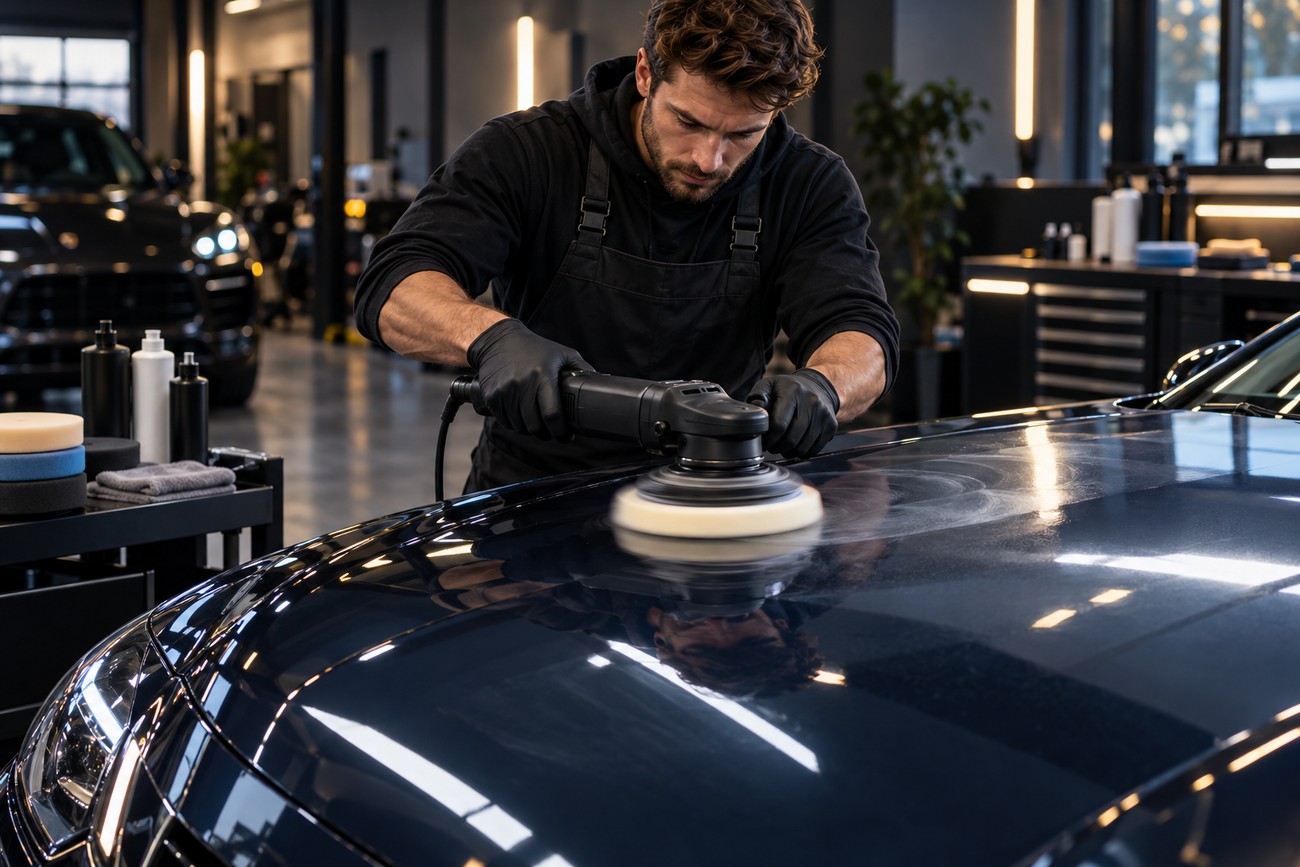
Rupes BigFoot DA machines such as the LHR15 and LHR21 use large 15–21 mm orbits to cover broad panels efficiently. On a hood, roof, or door, that movement can reduce the number of passes required and make a large vehicle less tiring to correct. The same orbit travels farther from the center of the pad, so it becomes less controlled around tight contours, narrow pillars, and strongly convex sections.
Rupes designs optimal BigFoot performance around a matched Rupes machine, pad, and compound system. This does not mean every other pad or compound will fail, but mixing products without checking balance and behavior can reduce the advantage of the platform. The machine may vibrate more, cut less consistently, or require more correction passes.
Users often cite Rupes pricing as high beside alternatives with similar headline power. The cost also continues after the machine purchase because the intended pad and compound system can become a meaningful part of ownership. For someone correcting one vehicle, that total may outweigh the productivity benefit of a large-orbit tool.
Low-quality or poorly matched accessories are a particular weakness. They can create imbalance, noise, vibration, inconsistent correction, and accelerated wear. A Rupes can reward precise technique and a coherent system, but it is a less attractive choice if you want to use whatever pads and compounds are already on the shelf.
Flex: Maximum Control and Correction—With More Physical Demand
Flex covers the professional end of the comparison with the free-spinning XFE 7-15, forced-rotation 3401 VRG, and rotary PE14-2 representing different working styles. Its tools are built around strong power delivery and, in several models, durable metal gearbox components. That orientation suits operators who use a machine repeatedly rather than storing it between occasional detailing jobs.
The 3401 VRG uses forced rotation, so its backing plate cannot stop rotating on the paint surface. This helps maintain correction when a free-spinning DA would stall, especially on resistant paint or under moderate pressure. It also means the machine can pull the operator across a curved panel, and the mechanically driven motion can build heat more quickly when the pad is held in one place.
Flex owners commonly report greater weight, hand or back fatigue, strong machine pull, and noise during extended work. Those traits may be acceptable in short correction stages, but they become important when a mobile detailer works outdoors or a studio operator spends a full day moving around vehicles. Grip shape, trigger feel, and lock-button placement can matter as much as published power.
The professional construction can support intensive use, but it does not eliminate service needs. Reported experiences include bearing or gearbox work after prolonged studio use and repair waits of several weeks in some regions. Those are not universal failure rates, yet local parts access and repair turnaround should be checked before choosing Flex for paid work.
Griot’s: A Sensible Entry Point for Enthusiasts and Studios
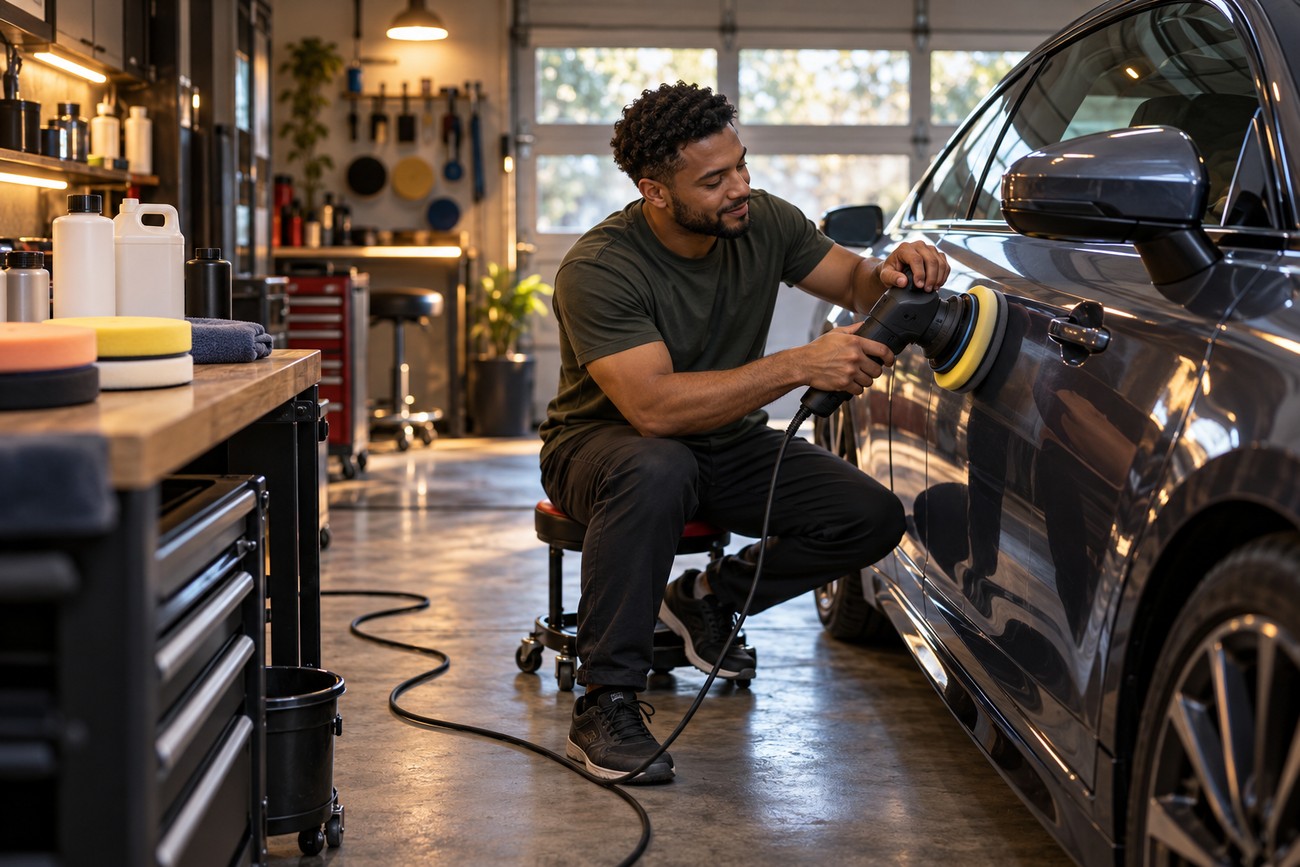
Griot’s G9, G15, and G21 are commonly positioned as enthusiast-friendly free-spinning DA polishers. They provide a practical route into paint correction without requiring the buyer to commit immediately to the price and accessory structure of a premium system. Their useful power is sufficient for many correction and finishing jobs when the pad and compound are chosen sensibly.
Ergonomics are a major part of the appeal. Owners commonly value the lower weight, long cord, and straightforward handling, especially during a first full-vehicle correction. Griot’s machines also commonly work with widely available backing plates and accessories, which makes replacement parts and experimentation easier in markets with strong distribution.
That accessibility does not make the brand purely recreational. Some professional studios use G15 and G21 machines as dependable finishing or general-purpose tools. A detailer may prefer the lower physical demand of a Griot’s DA for long sessions, even when a more powerful machine remains available for isolated heavy defects.
Reported drawbacks include noticeable vibration at maximum speed and differences in perceived smoothness between individual units. Some owners also describe increasing gearbox noise or play over time. These reports do not define every machine, but they make inspection, warranty terms, and realistic workload planning important when the tool will run continuously.
Choose by Paint Condition, Panel Shape, and Operator Skill
A beginner is generally better served by a controllable free-spinning DA than by a powerful rotary or forced-rotation machine. The safer choice gives more time to notice pad angle, pressure, heat, and product behavior before a mistake becomes permanent. A conventional or moderate-orbit DA is particularly suitable when the paint condition is unknown or the vehicle has many delicate edges.
Large-orbit Rupes DA machines save time on broad, relatively flat panels. They are less forgiving around narrow sections, deep curves, spoilers, and areas where the pad cannot remain flat. If the vehicle has complex bodywork, a smaller or more conventional DA may reduce repositioning and make the correction more predictable.
Forced rotation or rotary power is justified when defect removal speed has a clear financial or practical value and the operator already understands heat management and pad control. It can be useful for severe correction, hard paint, or a high-volume workflow. The extra power is wasted if the operator must slow down constantly to prevent the machine from steering itself or overheating an edge.
A two-machine setup often makes more sense than one universal polisher: keep a gentler free-spinning DA for finishing and delicate panels, then use forced rotation or rotary power only where heavy correction genuinely requires it.
Grip shape and lock-button placement can determine whether a machine remains comfortable after several hours. Handle position changes wrist angle, and a poorly placed lock can encourage awkward hand positions. If possible, hold the actual model with a backing plate and pad installed before buying; specifications cannot predict how it will load your shoulders or pull across a panel.
The Costs, Mistakes, and Risks Reviews Often Skip
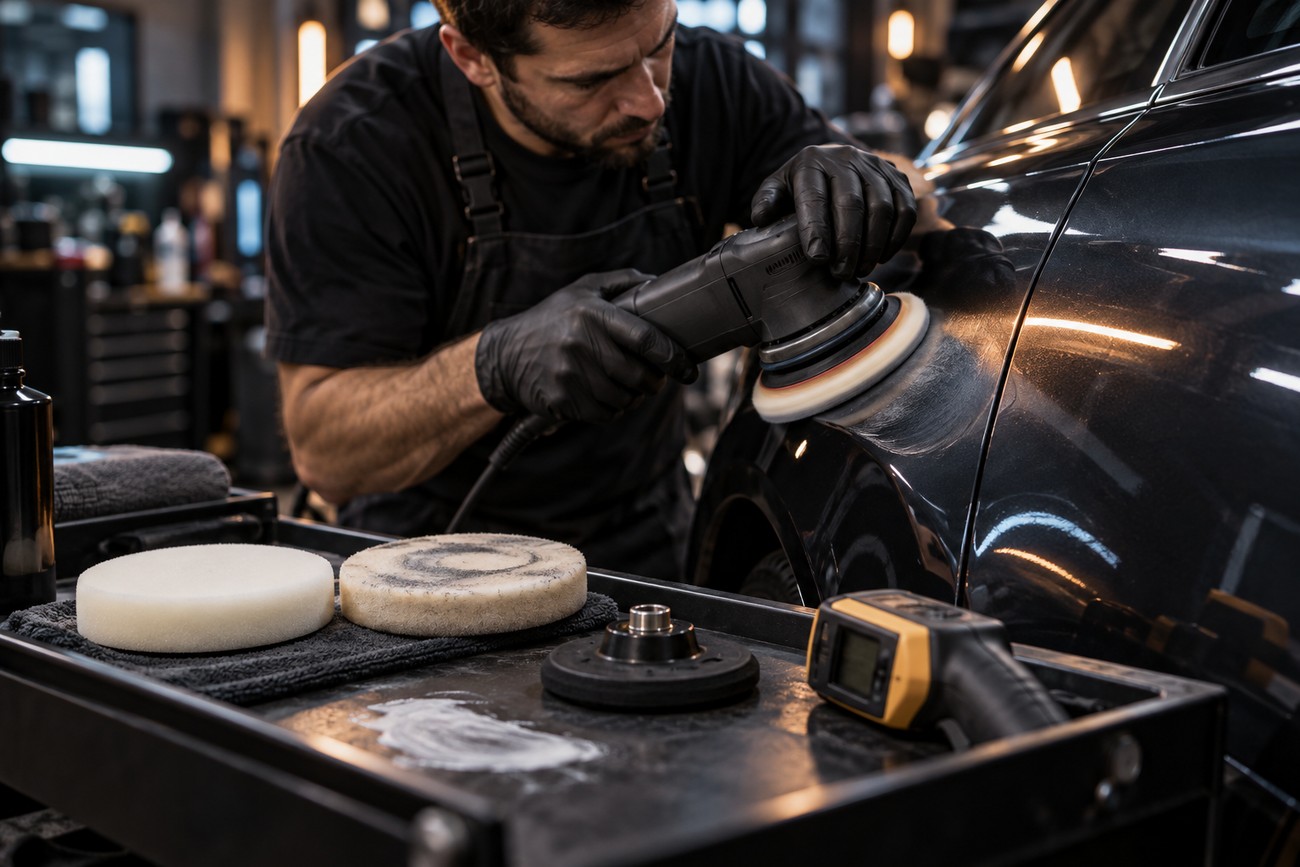
The purchase price is only the first ownership cost. Pads wear, compounds are consumed, backing plates may need replacement, and a premium machine may reward the expense of compatible accessories. Buying an expensive Rupes or Flex for one job can be poor value once consumables, training, and maintenance are included.
Temperature control is a core safety task. Working too long in one area at high speed can overheat the panel and risk cutting through clear coat, especially near edges where paint coverage is often less forgiving. Skipping a test spot and using one aggressive combination across the vehicle can leave dull areas while unnecessarily removing clear coat from already thin sections.
Accessory quality affects both results and machine life. Cheap universal pads can introduce imbalance, vibration, and inconsistent correction, particularly on machines designed around a specific pad and compound relationship. Clean pads regularly, replace collapsed or contaminated foam, and confirm that the backing plate size and pad construction suit the machine.
Heavily used machines may need bearing or gearbox service after 1–2 seasons of intensive studio work, according to reported user experiences. That is not a universal service interval, and occasional hobby use may produce a different result. Formal warranty coverage also does not guarantee rapid repair; several-week delays are reported in some regions.
Workspace claims deserve similar skepticism. Polishing still creates dust and compound aerosol, and breathing protection may be appropriate depending on the product and ventilation. Noise can also become tiring, particularly with some Flex machines or a Griot’s operating at maximum speed, so hearing protection and sensible ventilation are part of the ownership calculation.
A Safer Correction Workflow for Any of These Brands
Begin by inspecting the paint under strong, controlled light and identifying repainted areas, thin edges, chips, and existing defects. Mask vulnerable trim and sharp edges before placing the pad on the panel. Clean the surface thoroughly so embedded dirt does not become an abrasive contaminant between the pad and clear coat.
Perform a test section before correcting the entire vehicle. Start with the least aggressive pad and compound combination likely to achieve the desired improvement, then increase aggression only if the test result is insufficient. This preserves more clear coat and shows how the specific paint responds to the machine rather than relying on a generic product recommendation.
Use moderate working speed, controlled pressure, and overlapping passes while keeping the pad as flat as the panel allows. Reduce pressure and movement speed around curves, edges, and raised body lines. Monitor the panel by touch with care or use an appropriate non-contact method; if the area is becoming excessively hot, stop and allow it to cool before continuing.
Clean or change pads as they load with compound, and do not assume a premium polisher can correct poor pad maintenance. Generic low-quality pads can create imbalance and vibration even on an expensive machine. Expect dust and compound aerosol despite low-dust marketing, and provide ventilation and breathing protection appropriate to the product instructions and workspace.
Frequently asked questions
What polisher is better than Rupes for someone who already owns mixed-brand pads and compounds?
Choose the machine with the broader accessory tolerance and local availability, rather than paying for a system you do not intend to follow. Griot’s is often the practical fit because its machines commonly use widely available backing plates and accessories. Flex can also work well with a mixed professional setup, provided the pad, backing plate, and machine format are correctly matched.
Rupes remains attractive when you are willing to use its matched machine, pad, and compound system, particularly for large-panel DA correction. If your existing shelf contains varied products and you want to avoid replacing them, easier compatibility can outweigh the productivity benefits of BigFoot system optimization.
Which is better, the Rupes polisher or the Flex polisher when local service support is limited?
Use repair turnaround and parts access as the deciding test. Ask the distributor whether common wear parts are stocked locally, how warranty repairs are shipped, and what downtime is typical for your exact model. A technically excellent machine becomes a poor business tool if a fault leaves you without a working polisher for several weeks.
Also consider whether you can keep a backup machine. Flex may suit demanding professional use, while Rupes may better suit a system-led DA workflow, but regional service support can reverse that preference. Choose the brand with the more dependable local repair path, even if its headline correction performance is less compelling.
How can you tell that a panel is getting too hot during polishing?
Warning signs include a panel that becomes uncomfortable to touch, compound that dries unusually quickly, a pad that feels hot or collapses, and a sharp change in machine behavior as the product flashes off. Heat can concentrate near edges, body lines, and areas where the pad is not moving freely, so the center of a panel is not the only area that needs monitoring.
Stop the machine, lift the pad from the paint, and let the area cool naturally before inspecting it. Do not immediately add more compound and continue at higher speed. Once cool, shorten the working cycle, reduce pressure or speed, clean the pad, and retest a smaller section with a less aggressive combination.