A large tool case can still leave you stranded when a tire goes flat, a battery loses charge, or a wheel fastener will not move. The useful question is whether the equipment fits your vehicle and works under roadside conditions, rather than how many pieces the case contains.
Build your kit around vehicle compatibility, wheel-service essentials, and dependable quality. Keep formal emergency equipment separate from tools for practical roadside help: a first-aid kit, fire extinguisher, and warning triangle serve a different purpose from a jack, lug wrench, pump, or basic hand tools.
- What Every Car Owner Actually Needs
- Core Car Tools by Job, Not by Piece Count
- Choose Tools That Fit Your Specific Car
- Wheel and Tire Tools: The First Place to Spend More
- Why Cheap Automotive Kits Disappoint
- The Small Accessories That Make Repairs Possible at Night
- When to Add a Multimeter or OBD-II Scanner
- Frequently asked questions
- How can I check which socket sizes my car uses before buying a kit?
- What are the essential tools for a car owner?
- What is the $3000 rule for cars?
- What are the top 10 tools every man should have?
- What does every car owner need?
What Every Car Owner Actually Needs
The commonly cited formal emergency minimum is a first-aid kit, fire extinguisher, and warning triangle. Local requirements vary, so check the rules where you drive. These items help you manage an incident and make the vehicle more visible, even when you cannot repair the problem yourself.
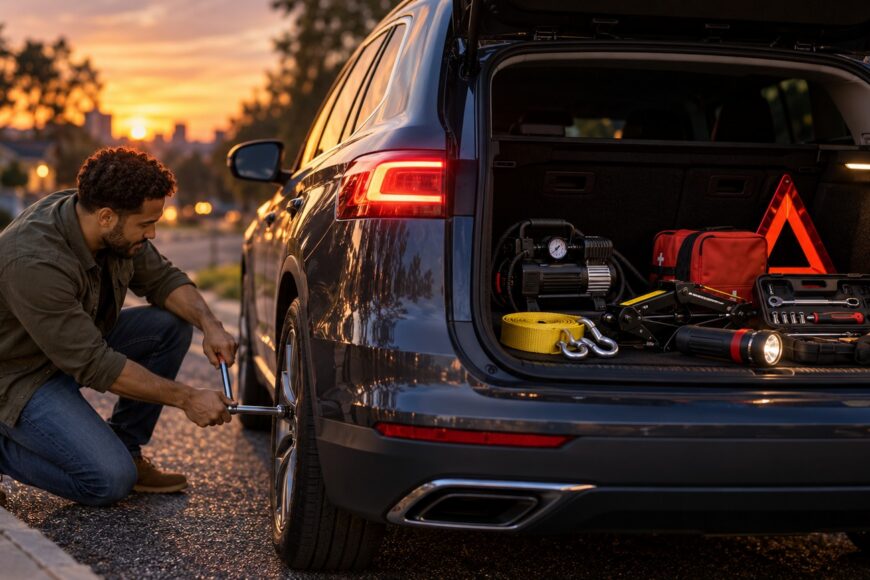
A practical roadside baseline adds a jack, vehicle-matched lug wrench, pump or compressor, tow strap, and flashlight. This group covers common problems such as a low tire, a wheel change, a short-distance recovery, or work beside the vehicle after dark. It does not turn a roadside kit into a full workshop.
Basic hand tools commonly include sockets, a ratchet, extensions, screwdrivers, and pliers. They can help with loose fasteners, battery terminals, trim, clamps, and simple adjustments. The useful sizes depend on the vehicle, so a compact selection that fits your car is better than a heavy case filled with unsuitable pieces.
Every item also needs a storage plan. A kit that stays organized and light enough to remain in the vehicle is more useful than a larger set left in a garage. Keep safety equipment accessible, and avoid burying the warning triangle, flashlight, or gloves beneath tools.
Core Car Tools by Job, Not by Piece Count
Choose tool groups according to the roadside job they must perform. The table below focuses on fit checks and limitations that are easy to miss in a general-purpose kit.
| Tool group | Job it handles | What must match the vehicle | Main limitation |
|---|---|---|---|
| Jack, lug wrench, and pump or compressor | Wheel changes and restoring tire pressure | Jack lifting points and capacity, wheel-nut size, and the vehicle’s required tire pressure | A factory or inexpensive jack may suit an emergency wheel change without being a full maintenance setup. A short wrench may struggle with seized wheel nuts. |
| Sockets, ratchet, and extensions | General repairs and access to recessed fasteners | Common fastener sizes and drive size; passenger-car sizes commonly fall in the 8–19 mm range, sometimes up to 21 mm | They do not replace specialty bits, deep sockets, or model-specific tools where access is restricted. |
| Screwdrivers and pliers | Clamps, terminals, trim, hose work, and light adjustments | Tip types, shaft length, jaw shape, and insulated handles where appropriate | They can damage fasteners or parts when used as substitutes for the correct tool. |
| Spark-plug socket | Removing and installing spark plugs | Plug size, socket depth, reach, and access for the specific engine | It is vehicle- and engine-specific, so a general kit may omit the correct size or reach. |
| Tire-repair kit and compressor | Temporary help with some tread punctures | Compressor power, connector, pressure capability, and the tire manufacturer’s repair limits | They do not cover every tire-damage scenario or replace a spare in all situations. |
| Flashlight, gloves, tow strap, and jump leads | Night work, dirty handling, recovery, and battery assistance | Light output and battery condition, strap rating, cable length, and safe connection procedure | They improve access and recovery but do not diagnose every fault or make unsafe towing safe. |
Choose Tools That Fit Your Specific Car
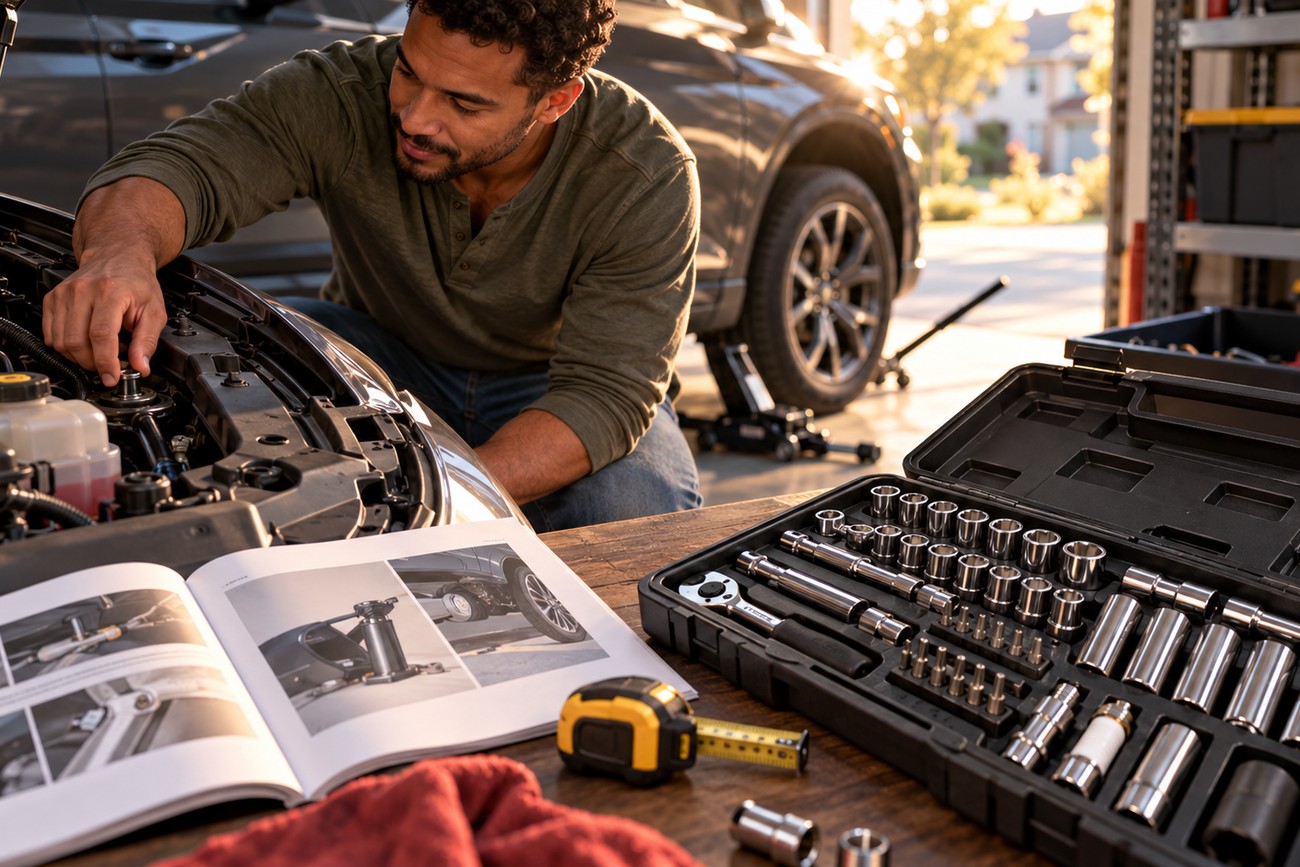
A generic automotive kit is only conditionally universal. Cars use different wheel-nut sizes, fastener sizes, Torx fittings, spark-plug dimensions, and access paths around the engine bay. Recessed bolts may require a deep socket or extension even when the nominal fastener size is common.
Before buying, check the owner’s manual and inspect the hardware already on the vehicle. Confirm the wheel-nut size, common service fasteners, Torx requirements, spark-plug size and reach, and the jack’s approved lifting points. Also check whether the proposed case fits the storage compartment without interfering with other emergency equipment.
Verify the actual wheel-nut and spark-plug sizes on the specific vehicle before buying a supposedly universal kit. Socket reach and Torx access can matter as much as the marked size.
The most useful selection contains the common sizes for your car, rather than the largest possible key range. A wider range of 6–24 mm appears in some kits, but it is not automatically necessary for every passenger car. Sockets, a ratchet, and extensions are generally more versatile than isolated open-end wrenches in confined spaces.
Model-specific information is especially important for spark-plug tools and jacking equipment. A kit can contain many pieces and still fail at the one fastener you need. Treat the advertised piece count as a description of contents, not proof of compatibility.
Wheel and Tire Tools: The First Place to Spend More
Wheel work is where a roadside kit earns its space. The practical core is a jack, a lug wrench matched to the wheel nuts, and a pump or compressor. If one of those items is missing or unsuitable, the rest of the tool case may have little value during a flat-tire emergency.
A weak jack can feel unsafe when lifting the vehicle, particularly on uneven ground or in poor weather. Use it only at the vehicle’s specified lifting points and on a firm surface whenever conditions allow. A factory or inexpensive jack may be suitable for an emergency wheel change, while routine maintenance requires a setup designed for that work.
A short or weak lug wrench may struggle with seized wheel nuts. Check the wrench fit before an emergency, and carry a tool that gives adequate access and leverage without striking nearby bodywork. Wheel nuts should be loosened with the vehicle secure and, where applicable, before it is lifted, following the vehicle manufacturer’s instructions.
A tire plug kit and compressor help with some punctures, especially when the damage is limited to the tread and the tire remains suitable for repair. They do not cover sidewall damage, severe casing damage, or every loss-of-pressure scenario. Treat this combination as a temporary roadside option, not a universal spare-tire replacement.
Why Cheap Automotive Kits Disappoint
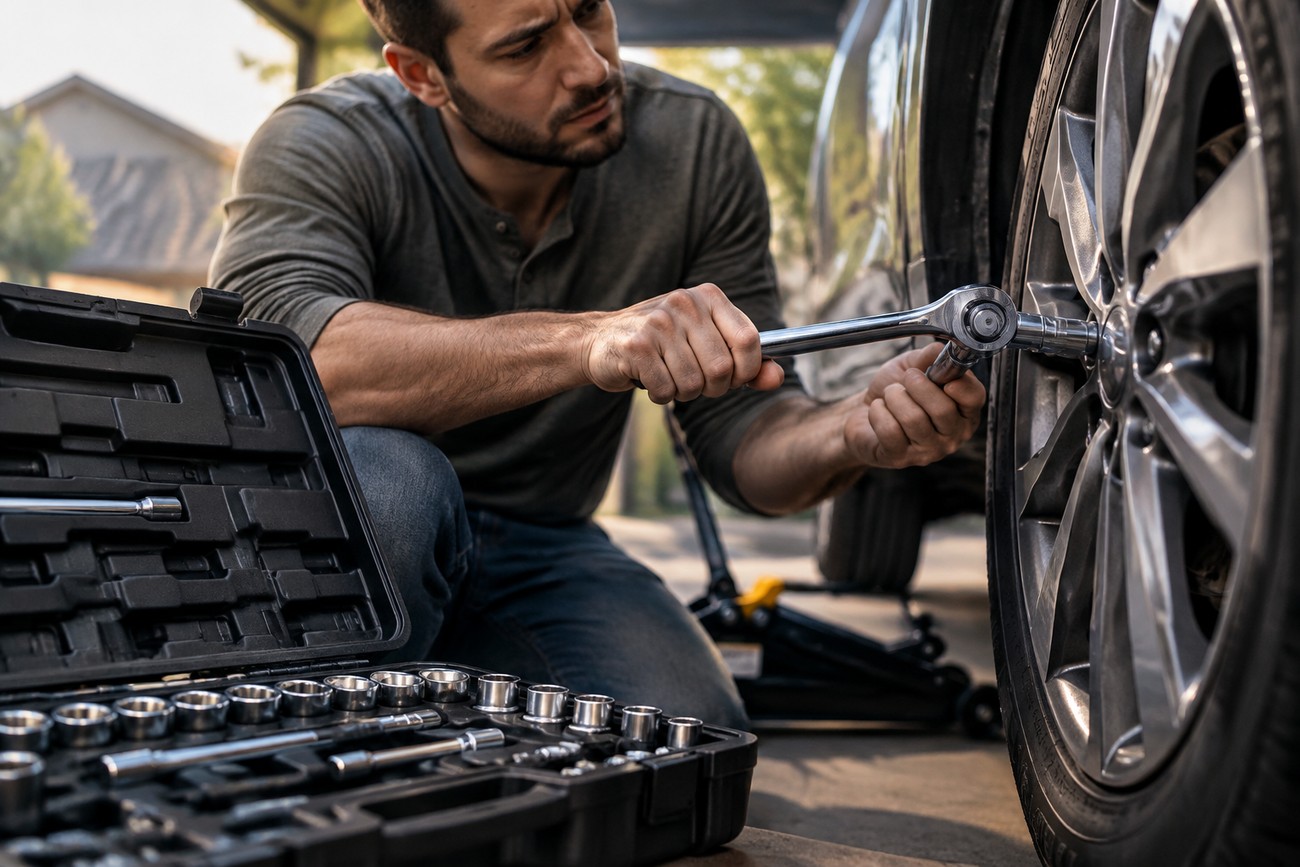
A kit can look generous while using weak steel, poor socket geometry, and drive interfaces that wear quickly. A loose-fitting socket may round a fastener or slip under load, creating a larger repair problem. Correct fit matters more than a long list of rarely used pieces.
Many automotive cases include secondary items while economizing on the ratchet, sockets, or jack that matter most. A ratchet should engage cleanly, reverse reliably, and provide useful access in tight spaces. The sockets should seat fully and match the fastener without excessive play.
Compressors create a separate set of complaints. A noisy or slow unit may be difficult to use beside traffic, in cold weather, or when the tire has lost substantial pressure. Check the connector, cable length, pressure capability, and storage method rather than judging the compressor by its packaging.
Storage quality affects actual performance. A fragile case that lets sockets and bits fall loose turns a complete kit into a search problem during stress. Quality, fit, ratchet performance, and organization matter more than advertised piece count.
The Small Accessories That Make Repairs Possible at Night
A flashlight and work gloves may be more useful than another uncommon wrench when a problem occurs after dark. A light lets you inspect the tire, find the lifting point, and see socket markings. Gloves improve grip and reduce contact with dirt, sharp edges, and cold metal.
Winter conditions make small usability details more important. Cold hands reduce dexterity, wet surfaces make tools harder to control, and darkness hides hazards beside the road. Keep the flashlight charged or supplied with fresh batteries, and choose gloves that preserve enough feel to operate fasteners.
Out-of-town emergency kits commonly add a tire-repair kit, tow strap, flashlight, and jump leads. These items extend what you can do before help arrives, though each has limits: towing needs a suitable attachment point, jump leads require correct polarity and procedure, and a repair kit cannot address every tire failure.
Keep the kit compact, organized, and light enough to remain in the vehicle. A small bag or case with fixed locations is easier to use than a large box that shifts in the cargo area. Store emergency visibility equipment where you can reach it before unloading tools.
When to Add a Multimeter or OBD-II Scanner
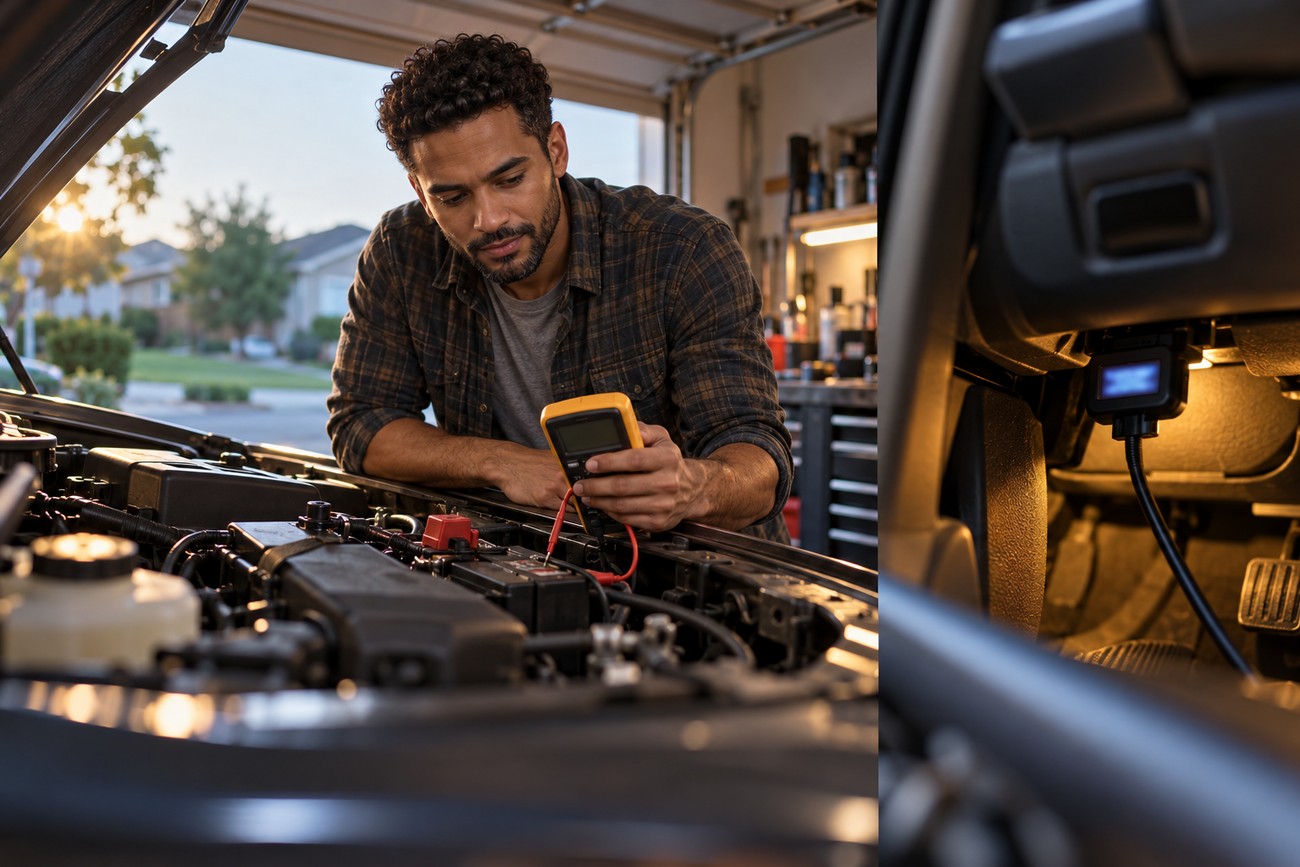
A tester or multimeter and an OBD-II scanner are useful additions for owners who regularly investigate electrical symptoms or warning lights. A multimeter can help check voltage and continuity, while an OBD-II scanner can read diagnostic information from compatible vehicle systems.
These tools require correct interpretation. A stored fault code identifies an area for investigation, not necessarily the failed component. Likewise, a voltage reading can point toward a charging or battery issue without proving which part should be replaced.
Diagnostic tools should supplement dependable wheel-service and emergency equipment. A scanner does not loosen a wheel nut, inflate a tire, illuminate a dark engine bay, or make an unsafe roadside location safer. Start with the practical roadside baseline before expanding into diagnostics.
The expanded set is most useful for owners who regularly maintain their vehicles or investigate recurring symptoms. For occasional drivers, a flashlight, gloves, pump, lug wrench, and organized hand tools usually provide more immediate roadside value.
Frequently asked questions
The right roadside kit depends on the vehicle, the work you can safely perform, and the conditions in which you drive. Fit, access, storage, and tool quality matter more than the advertised piece count. The following answers cover common questions about choosing and using a car tool kit.
How can I check which socket sizes my car uses before buying a kit?
Start with the owner’s manual, especially the wheel, maintenance, and spark-plug sections. Check the wheel hardware with the correctly fitting lug wrench, then identify accessible fasteners in the engine bay or underbody using properly fitting tools. Record the socket sizes, drive size, Torx types, and any need for deep sockets or extensions.
For spark plugs, confirm both the plug size and the required reach. If access is recessed, measure the practical clearance rather than relying on a socket that matches the hex size alone. This approach is more reliable than choosing a case because its label lists many sizes.
What are the essential tools for a car owner?
For practical roadside help, start with a jack, vehicle-matched lug wrench, pump or compressor, flashlight, tow strap, and basic hand tools. The hand-tool group usually includes sockets, a ratchet, extensions, screwdrivers, and pliers. Keep the first-aid kit, fire extinguisher, and warning triangle as separate formal emergency equipment.
What is the $3000 rule for cars?
The $3000 rule is an informal budgeting guideline suggesting that a vehicle may become financially difficult to keep when a major repair approaches a chosen dollar threshold. It is not a universal mechanical or financial standard. Repair history, vehicle condition, replacement cost, reliability, and your available budget matter more than one fixed figure.
Use the rule as a prompt to compare options, then obtain a clear diagnosis and estimate. A smaller repair on a poorly maintained vehicle may be a worse decision than a larger repair on a sound vehicle with a known service history.
What are the top 10 tools every man should have?
A practical, inclusive list for car ownership is a vehicle-matched lug wrench, jack, pump or compressor, socket set, ratchet, extensions, screwdrivers, pliers, flashlight, and work gloves. Add a tow strap or jump leads when you regularly travel outside urban areas. The right ten tools depend on the vehicle and the jobs you can safely perform, so fit and usefulness matter more than a universal ranking.
What does every car owner need?
Every owner needs equipment appropriate to the vehicle, driving conditions, and local emergency rules. The formal emergency minimum is commonly a first-aid kit, fire extinguisher, and warning triangle; the practical roadside baseline adds wheel-service tools, a pump or compressor, a flashlight, a tow strap, and basic hand tools.
Owners should also keep the kit organized and inspect it periodically. Check the jack, compressor, batteries, gloves, and tool fit before a trip, because a larger case is not automatically better when its tools do not fit the vehicle or cannot be stored securely.