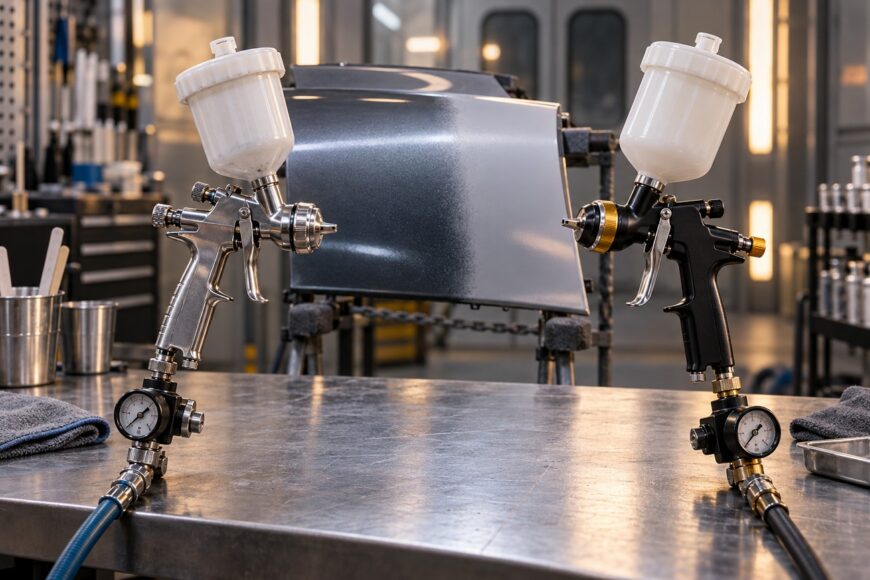
The Anest Iwata LPH-80 has a clear attraction for small repairs: low air demand and predictable control. The newer DeVilbiss DV1 Mini offers a different spray character and refined control on small elements, but its air demand may ask more of a modest compressor. If supply pressure falls while you spray, the appeal of either gun disappears quickly.
The useful comparison starts with the repair in front of you. A blend on a small panel, a clearcoat repair, and a broad panel each place different demands on fan shape, material flow, and working speed. Your nozzle choice, air system, setup habits, and the cost of keeping the gun in service matter more than a blanket claim that one model is better.
- What These Two Mini Guns Are Actually Designed For
- LPH-80 vs DV1 Mini: Specification and Setup Comparison
- Spray Pattern, Finish Quality, and the Dry-Spray Trap
- Nozzle, Material, and Pressure Matching
- Compressor, Air Filtration, and Trigger Stability
- Which Gun Fits Which Repair Workflow?
- Ownership Cost, Common Mistakes, and the Upgrade Question
- Frequently asked questions
- Which Iwata spray gun is best for small spot repairs?
- What is the best clearcoat gun on the market?
- How can I tell whether my compressor is truly suitable for a detail gun?
What These Two Mini Guns Are Actually Designed For
The LPH-80 is commonly used for local repairs, blends, small panels, substrates, and precision work. Its relatively low air demand makes sense where a controlled, narrow application matters more than covering a large area quickly. Many painters also value its predictable response when adjusting the fan and fluid delivery for a small repair zone.
The DV1 Mini occupies much the same scale of work: detail spraying and small repairs. Its newer spray geometry is aimed at control on small elements, which may appeal to someone who frequently applies basecoat or clearcoat in confined areas. That description does not settle how it will perform with your material, nozzle, and air supply; those combinations determine the usable result.
Both are specialist tools for small repair zones, not full replacements for conventional guns on large panels. As the area grows, a narrow fan requires more passes and more overlap decisions. Maintaining an even wet edge becomes harder, and the time saved by using a small cup and a compact gun can be lost in slow coverage or extra blending work.
Repair boundaries matter as much as the visible damaged spot. A small mark can require a much larger blend or clearcoat area than expected. Choose the gun for the full coating plan, including where each layer must finish, rather than for the dimensions of the original defect alone.
LPH-80 vs DV1 Mini: Specification and Setup Comparison
Published figures are a starting point, especially because configurations and regional listings differ. Check the documentation for the exact gun and nozzle you intend to buy. The comparison below keeps approximate values separate from shop observations.
| Consideration | Anest Iwata LPH-80 | DeVilbiss DV1 Mini |
|---|---|---|
| Air consumption | Approximately 90–110 L/min in commonly cited product sheets and manuals; figures vary by source, region, and configuration. | Manufacturer specifications vary by mini version. Practical reports commonly describe demand as higher than the LPH-80; there is no single flow figure for every setup. |
| Working pressure | Approximately 1.1–1.3 bar in commonly cited configurations. | Approximately 1.0–1.4 bar, depending on version and nozzle. |
| Intended work | Local repairs, blends, small panels, substrates, and precision work. | Detail work and small repairs, with newer spray geometry aimed at control on small elements. |
| Spray-control emphasis | Predictable small-area control valued by many practitioners. | Controlled fan behavior; user descriptions of a relatively dry spray depend on material, nozzle, and technique. |
| Configuration and air-supply implication | Low stated air demand can favor a limited air system, provided delivery remains stable. | Verify the exact version and sustained air demand before pairing it with a small compressor. |
Pressure figures describe a working range, not a finish setting to copy onto every regulator. A gauge reading taken without the trigger pulled says little about the pressure available while air is flowing. Hose restriction, regulator behavior, and compressor recovery can all change what reaches the gun during a pass.
The LPH-80 figures also deserve care: marketplace listings do not always agree with manuals, and an apparently precise number may refer to a different configuration. For the DV1 Mini, avoid treating “mini” as an air-consumption specification. Compare documentation for the actual version, then confirm that your equipment can hold a steady supply during spraying.
Neither column predicts finish quality by itself. A gun with enough air, a suitable nozzle, and a well-matched material can be easier to use than a theoretically finer-atomizing setup starved of air. Specifications help you reject an unsuitable pairing; a spray test tells you whether the remaining pairing works.
Spray Pattern, Finish Quality, and the Dry-Spray Trap
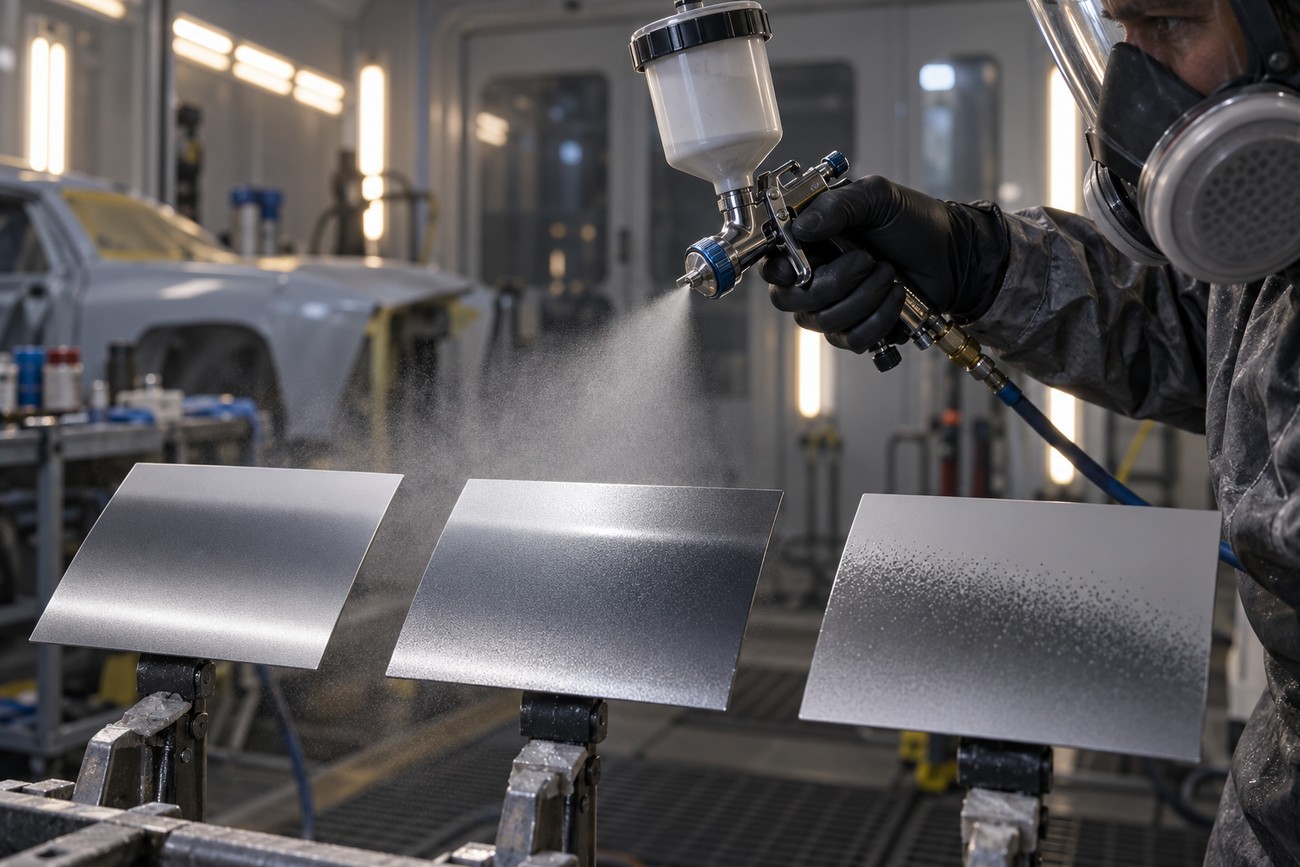
For a spot repair, useful fan control means more than achieving a wide, attractive pattern on masking paper. Look for an even center, clean edges, and a narrow fan that remains usable without obvious tails. Those details affect how smoothly color or clearcoat tapers into the surrounding work, especially where the repair leaves little room for correction.
Many practitioners like the LPH-80 because its behavior on small areas feels predictable. User tests often describe the DV1 Mini as controlled and relatively dry on basecoat and clearcoat, but “dry” describes a result, not a guaranteed setting or an automatic advantage. The same character that helps contain material on a small element can leave a rough edge if droplets fail to wet the surface.
Both guns can produce dry spray, texture, or a visible dry edge when pressure, distance, reduction, or material choice is wrong. Excessive pressure or spraying too far away can let the material arrive insufficiently wet. Too little pressure can also leave coarse atomization, texture, and poor wetting. Lowering the regulator until overspray looks modest is therefore a poor substitute for checking the finish.
A mini gun also makes movement errors conspicuous. Work too close or hesitate at the end of a pass, and a small zone can become a concentrated wet spot; move away to avoid that spot, and the outer edge may turn dry. Judge the pattern after it lands and begins to flow, not solely by how fine the mist appears in the air.
Nozzle, Material, and Pressure Matching
Nozzle selection can change the result more than switching between these guns. Commonly discussed options include 0.8, 1.0, and 1.2 mm, but none is a universal choice for basecoat, clearcoat, or substrate material. The correct combination depends on the coating’s application guidance, the specific gun configuration, and the amount of material the repair needs.
A smaller opening can help keep fluid delivery manageable on a tiny repair, yet it may make a thicker product difficult to apply at the required wetness. A larger opening may supply material more readily while demanding better trigger and pass control in a confined area. Changing size also changes how the fluid control, fan, and working distance interact; a nozzle swap is more consequential than a minor adjustment to a single dial.
Material preparation deserves the same attention. Coating that is too thick, or reduced with an unsuitable product, can spray poorly through either gun and prompt an unnecessary equipment purchase. Follow the coating maker’s mixing and reducer guidance, then make a test pass on a suitable panel using the intended application technique.
Set pressure by observing that test fan with the specific material and nozzle, rather than copying a published PSI or bar number. Check for tails, coarse droplets, even delivery, and sufficient wetting at a realistic working distance. Make one adjustment at a time so you know whether pressure, fluid delivery, or technique corrected the problem.
Compressor, Air Filtration, and Trigger Stability
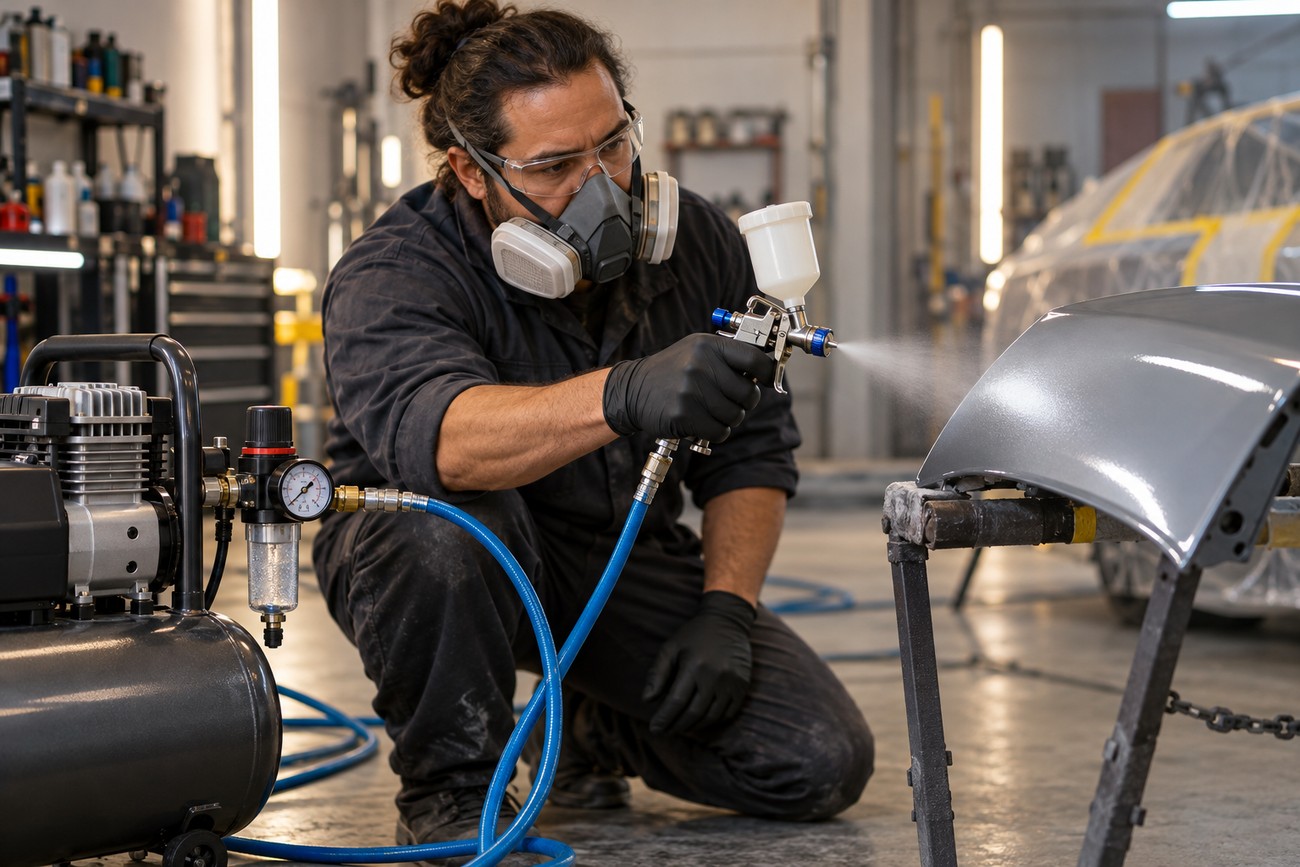
Pressure sag at the trigger is a common reason a promising mini gun disappoints. Some DV1 Mini users report higher-than-expected air consumption, particularly with small compressors. Its stated working pressure may look similar to the LPH-80’s, but similar pressure figures do not mean the two versions demand the same volume of air.
Check the compressor’s delivered performance under load, rather than relying on a prominent advertised rating. With the regulator set for spraying and the trigger held open, watch whether pressure at the gun settles and stays stable long enough for the planned pass. A brief burst may look fine even when the system cannot support sustained work.
Restrictions between the compressor and gun can make that test fail despite adequate nominal capacity. A poorly flowing hose, restrictive fittings, or an unstable regulator can cause the gun-side gauge to dip as soon as air moves. Testing at the gun is more useful than assuming the pressure shown near the compressor is what the air cap receives.
Clean, dry air is equally important for both models. Effective filtration and moisture separation help prevent contamination that can be mistaken for a spray-gun fault, while sound hose and regulator choices support repeatable delivery. If defects appear only after the compressor has run for a while, inspect the air supply before altering a nozzle or blaming the gun’s spray design.
Which Gun Fits Which Repair Workflow?
For regular local blends, small panels, substrate application, and precision work, the LPH-80 is a sensible candidate where low air demand and familiar, predictable control are priorities. It can also suit an occasional user who has a limited but stable air supply. That does not make it automatically easier: the nozzle and material still have to fit the job.
The DV1 Mini may be a better fit for a technician who prefers its fan geometry and spends substantial time coating small elements. Its behavior with basecoat and clearcoat should be judged on actual repair materials, particularly where edge wetting and clearcoat flow matter. A controlled spray that works well for one operator may need different distance and fluid settings in another person’s hands.
During repeated work, ergonomics become part of application control. Balance, weight, and trigger travel affect how steadily you can follow a curved repair and how tired your hand feels after several passes. If possible, handle both guns with a cup fitted and check whether you can ease into the trigger and release it cleanly without shifting the gun.
Mini guns have a narrow working range: a small change in distance or pace can create a dry edge or a concentrated wet spot. The best workflow is the one you can reproduce, including your preferred masking, test-panel routine, and cleaning between materials. If a job repeatedly expands into broad panels, moving to a conventional gun is often a better workflow decision than stretching either mini gun beyond its intended scale.
Ownership Cost, Common Mistakes, and the Upgrade Question
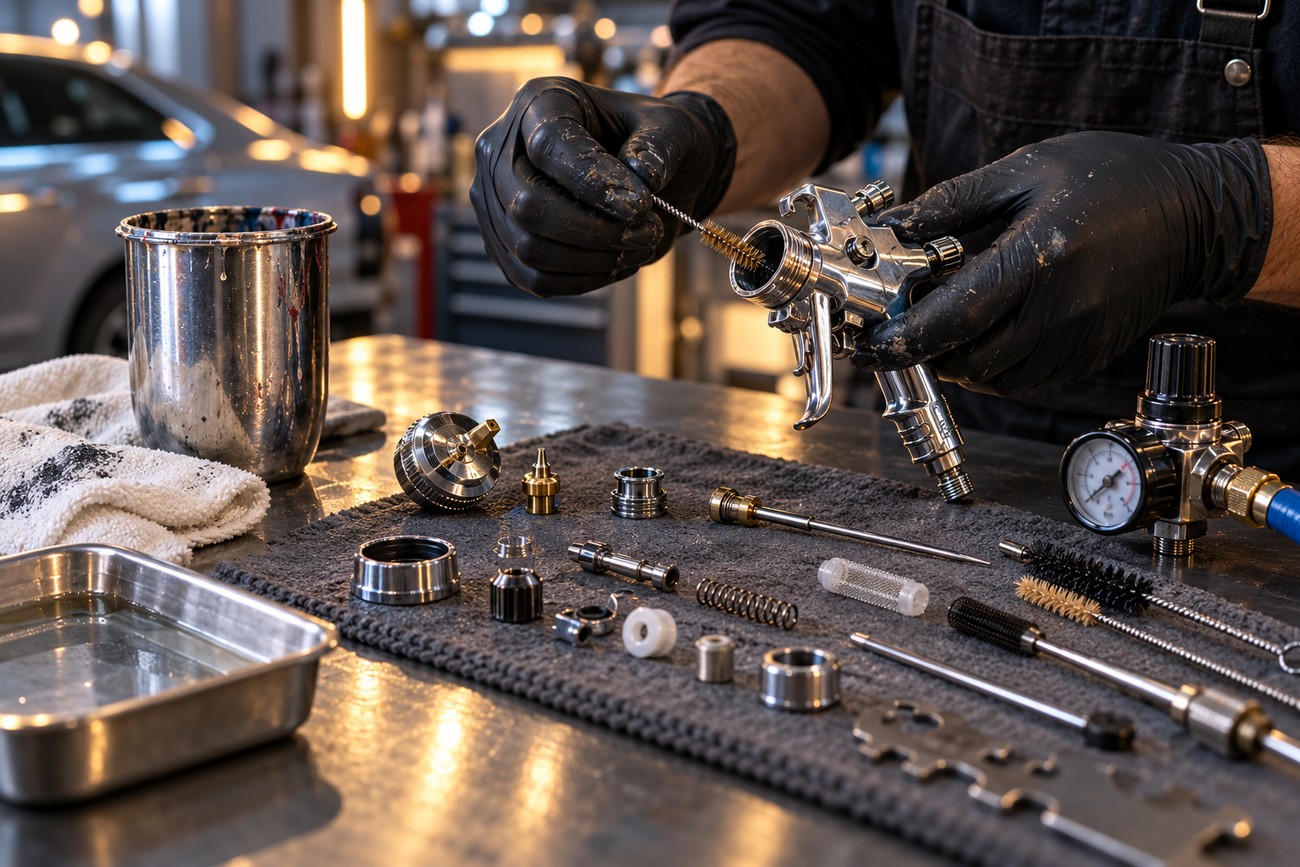
The purchase price is only part of ownership. Budget for replacement nozzles and needles, repair kits, filters, a dependable regulator, suitable hoses, cleaning supplies, and the time spent maintaining the gun. Users sometimes find genuine replacement parts expensive, so check availability for the exact version before committing to it.
Cleaning matters especially when a small gun changes between products or sits unused after an occasional repair. Residue around the fluid passages or air cap can disturb a narrow pattern enough to mimic a setup problem. Keeping the supplied components clean and in good condition protects repeatability; trying to adjust around a dirty pattern does the opposite.
One costly mistake is buying the DV1 Mini on the assumption that newer design makes it better in every task. It is marketed as an economical, newer-generation alternative, yet some practitioners report more air demand and no proportionate improvement over the LPH-80 for their work. Conversely, choosing the LPH-80 solely for its lower stated consumption will not solve poor air preparation or an unsuitable material setup.
Another mistake is expecting a mini gun to replace a full-size gun. On a broad panel, slower coverage and the difficulty of maintaining a wet edge can outweigh the precision you gained on a spot repair. Brand reputation alone is an equally weak guide: nozzle match, viscosity, air stability, and operator technique can change the result more than the badge on the gun.
Upgrade only after identifying the limitation you need to remove. If your current LPH-80 produces repeatable small repairs and your compressor has limited reserve, a DV1 Mini may add cost without improving the finished work. If the current fan behavior or handling consistently holds you back, and your air system supports the exact DV1 Mini version, a hands-on spray test is a sounder basis for changing guns than a marketing description.
Frequently asked questions
These buying questions are easiest to answer by defining the work and checking the equipment already available. A small spot, a broad clearcoat panel, and a marginal compressor call for different decisions. Use the practical checks below before treating any model as the default choice.
Which Iwata spray gun is best for small spot repairs?
The LPH-80 is a strong Iwata candidate for small spot repairs when low air demand and precise local control are priorities. It sits in the specialist mini-gun role rather than serving as a ranking of every Iwata gun for every repair size. If the spot requires a broad blend or a large clearcoat area, plan the entire coated area before deciding that a mini gun is appropriate.
Match the proposed nozzle to the material, then check whether your compressor can sustain the gun during a real pass. “Best” depends on that pairing and on how reliably you can reproduce the repair, not on the brand name alone.
What is the best clearcoat gun on the market?
There is no universal best clearcoat gun. For a small, controlled repair, a properly configured mini gun may let you apply clearcoat without using a broad fan over the surrounding area. For a large panel or repeated production work, a conventional gun is normally the more suitable tool because it can cover the area and maintain a wet edge more readily.
Before buying for clearcoat, confirm that the intended nozzle and gun configuration suit the specific product’s application guidance. Test for the required flow and finish on a panel; a fine-looking spray that does not wet and level properly is a poor clearcoat setup.
How can I tell whether my compressor is truly suitable for a detail gun?
Compare the compressor’s delivered air capacity with the specification for the exact gun version, then test pressure behavior during a sustained trigger pull at the gun. Watch for a falling gauge reading or changing fan as the compressor cycles. A stable reading during a brief burst alone does not prove that the system can support the length of pass your repair requires.
Run that check through the hose, fittings, regulator, filters, and moisture separator you will actually spray with. Inspect for moisture after the system has been operating, because a setup that supplies enough air while cold can still cause coating defects if it delivers wet air during the job.