
The Proton Satria GTi was an affordable Malaysian hot hatch with Lotus and Proton chassis input. That description explains both its appeal and its present risk: the original car had a sharper, more cohesive platform than an ordinary Satria, while surviving examples are now old performance cars that may need major structural and mechanical work.
Its attraction lies less in headline acceleration than in steering response, cornering balance, and the originality of a locally developed performance hatch. A healthy GTi can feel unusually communicative on a winding road. A neglected one can deliver little more than noise, harshness, and a long restoration bill, making the central issue clear: is the Satria GTi a rewarding classic or an expensive project?
- What the Proton Satria GTi Actually Is
- 4G93P Power and the Performance Numbers
- Where the Lotus Tuning Makes a Difference
- The Age Problem: What Usually Goes Wrong
- How to Buy an Original GTi in a Modified Market
- What a Good Satria GTi Feels Like Today
- Frequently asked questions
- How much horsepower does the Proton Satria GTi have?
- Was the Proton Satria GTi available with a factory automatic transmission?
What the Proton Satria GTi Actually Is
The Satria GTi appeared in the late 1990s and early 2000s as the performance and homologation-style version of Proton’s compact Satria. It was aimed at buyers who wanted a genuinely sporting hatchback from a Malaysian manufacturer, rather than a cosmetic trim package with a larger spoiler. Its importance is therefore regional as much as mechanical: the car became a cult performance model primarily in Malaysia.
Lotus and Proton chassis development and tuning input gave the GTi a different brief from the regular Satria. The work centered on suspension response, body control, steering feel, and the way the car behaved through corners. That involvement matters because it shaped the driving character, although it does not make the Satria a Lotus-built car.
The common comparison with a Lotus Elan is misleading. The GTi is a Proton Satria with Lotus-influenced chassis development, not a Lotus-branded vehicle or a Lotus construction project. Its value comes from the quality of that input within a compact front-wheel-drive hatchback, not from borrowed badges or a hidden Lotus identity.
Global recognition remained limited because the model was never a mass-market international performance hatch in the way that some Japanese and European rivals were. Today, that relative obscurity can make a good example more interesting, but it also complicates parts sourcing, verification, and specialist support outside its strongest markets.
4G93P Power and the Performance Numbers
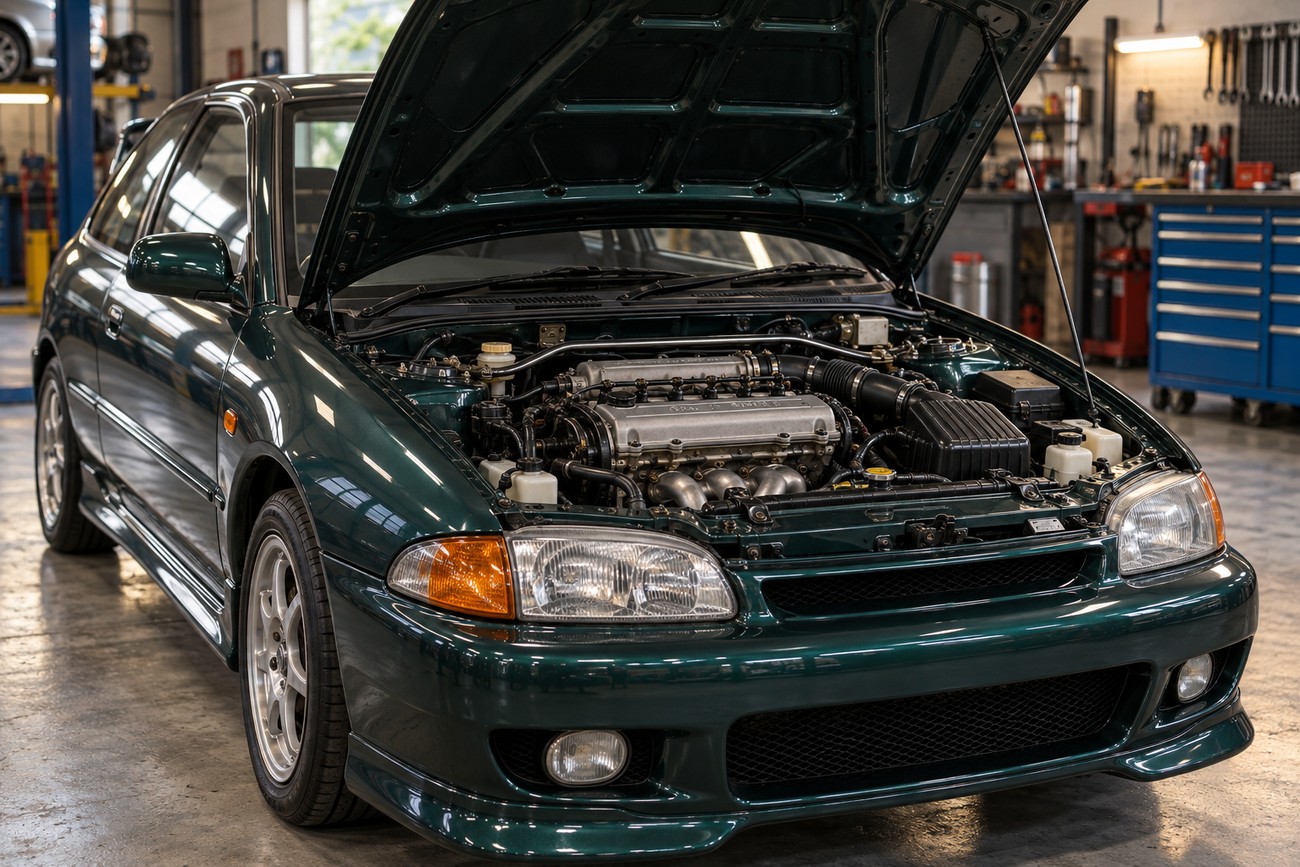
Power comes from a naturally aspirated 1.8-liter Mitsubishi 4G93P DOHC 16V engine. The commonly quoted figures are about 138 hp and 164 Nm, delivered through a five-speed manual gearbox. The original factory GTi range generally did not include an automatic, so a car presented as an automatic GTi needs careful examination of its identity and transmission history.
Period performance claims should be treated as a reference rather than a promise. Reported 0–100 km/h times commonly range from about 8.5 to 9.5 seconds, with brochure figures and magazine tests often differing. Tires, launch technique, road surface, temperature, fuel system condition, and measurement method all influence the result.
Age adds another layer of uncertainty. An engine with low compression, oil consumption, unstable idle, or tired fueling components may feel substantially slower than a correctly maintained example. The manual gearbox can still make the car engaging, but worn shift cables, a tired clutch, or damaged mounts may dilute the directness that buyers expect.
The engine’s naturally aspirated delivery is part of the car’s appeal. It rewards clean gear changes and momentum rather than relying on a dramatic turbocharged surge. That also means mild engine modifications rarely compensate for poor fundamentals; cooling, compression, fueling, and drivetrain condition have to be established first.
Where the Lotus Tuning Makes a Difference
The GTi’s defining work is found in its chassis. Compared with a regular Satria, it received firmer springs and dampers, revised geometry, body reinforcement, and Lotus-influenced tuning intended to improve control. Four-wheel disc brakes and wider tires supported the more sporting brief, while distinctive GTi exterior details helped identify the model.
On a good road, the result is most obvious in the first turn of the steering wheel. The car responds promptly, changes direction with little hesitation, and feels cohesive when the driver links several bends together. Its strongest performance is therefore in cornering and chassis communication, rather than in a straight-line acceleration figure.
That same setup has clear costs. Firm suspension, road noise, and vibration are part of the concept, and poor surfaces can make the GTi tiring as a daily driver. A properly sorted car should feel controlled rather than chaotic, but it will not provide modern hatchback isolation or a soft ride over broken pavement.
Condition can disguise the original engineering. Worn bushes, sagging springs, leaking dampers, incorrect tire sizes, and uneven alignment may leave a car feeling harsh without feeling precise. Replacing those components can restore the intended balance; simply fitting stiffer aftermarket parts often makes the ride worse while adding little useful grip.
The Age Problem: What Usually Goes Wrong
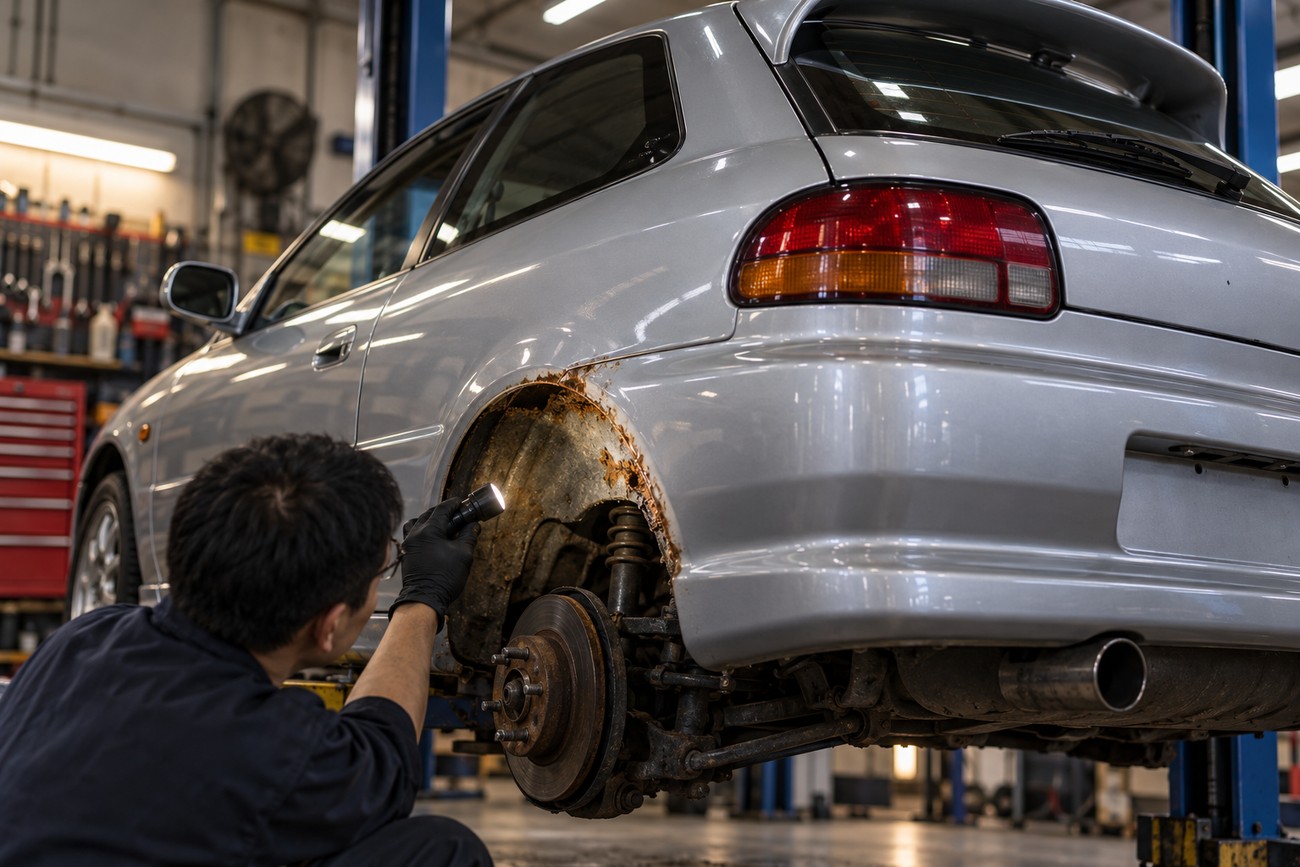
Many surviving Satria GTis now need comprehensive restoration or mechanical refreshing. Rust, concealed corrosion, accident damage, and poor-quality repairs are common inspection concerns, especially on cars that have spent years outdoors or passed through several owners. Fresh paint can hide problems under seals, around wheel arches, along seams, and beneath the underbody coating.
Cooling-system condition deserves its own inspection rather than a quick glance at the temperature gauge. The radiator, water pump, thermostat, cooling fans, and hoses all need checking, because an old system may cope on an open road and struggle in traffic. A history of overheating can create wider engine problems even when the car starts and idles acceptably during a short viewing.
The 4G93P can also lose its original character through age. Low compression, oil consumption, unstable idle, and tired fuel-system components reduce response and make the car feel flat. A clean engine bay is not proof of health; compression testing, cold-start behavior, smoke under load, and stable temperature matter more than polished covers.
Electrical faults are another ownership nuisance. Poor repairs, corroded connections, aftermarket alarms, audio installations, and improvised wiring can create intermittent failures that take longer to diagnose than their symptoms suggest. Modified examples may also contain non-standard engine or suspension components, making parts provenance and future servicing uncertain.
Parts availability is uneven. Shared mechanical items may be manageable through specialist or cross-reference channels, while GTi-specific body trim, interior pieces, emblems, brackets, and other mounting details can be scarce. These small parts often become expensive restoration items because finding a correct replacement is harder than repairing a major service component.
How to Buy an Original GTi in a Modified Market
Begin with identity and structure, not the engine bay or the badge. A regular Satria converted to look like a GTi can be mistaken for an original car, especially after a respray. Check documentation, factory identification, body details, interior specification, and the consistency of the car as a whole rather than accepting an attractive body kit as proof.
Inspect the shell in strong light and, where possible, on a lift. Wheel arches, seams, door and hatch apertures, seal edges, suspension mounting areas, and the underbody can reveal concealed corrosion. Uneven panel gaps, mismatched paint, fresh welding, ripples in the floor, or inconsistent underseal may indicate accident repair or structural work of uncertain quality.
Correct tires and fresh suspension bushes should be the baseline before judging the Lotus-tuned handling. Engine modifications belong later, if they belong at all.
Next, establish whether the car can survive ordinary use. Confirm that the cooling fans operate, inspect the radiator and hoses, and look for signs of coolant loss or overheating. Test the clutch, gearbox, driveshafts, steering, dampers, bushes, and all four brakes. A short drive should include a cold start, urban traffic, firm braking, and several corners, provided the car is safe to operate.
Give unusual attention to wiring and swaps. A non-standard engine, automatic transmission, altered suspension, or improvised electrical system may work well, but it makes the car’s history and parts requirements harder to establish. An automatic-looking GTi is especially important to verify because the transmission may be a conversion rather than a rare factory specification.
Previous workmanship matters more than mileage as an isolated number. A higher-mileage car with honest documentation and sound repairs can be a better purchase than a low-mileage example with corrosion, unknown swaps, or cosmetic preparation hiding damage. Price the car as an old specialist performance hatch, not as a cheap mass-market Satria that happens to carry GTi badges.
What a Good Satria GTi Feels Like Today

A well-maintained GTi feels compact, direct, and unusually unified. The steering has more importance than the power output, because the car communicates its attitude through the front axle and remains satisfying when driven quickly without excessive speed. It is a period chassis with modest modern performance, rather than a modern-power benchmark.
The difference between a living car and a tired one can be substantial. Engine response, gearbox condition, suspension geometry, bush condition, brake balance, and tire choice all shape the experience. Correct tires and renewed suspension bushes can restore the car’s character more effectively than a mild engine tune that adds complexity without solving basic wear.
Ownership makes sense for someone who values a distinctive driving tool and accepts the work involved in preserving it. The strongest candidate is structurally sound, mechanically coherent, and supported by evidence of previous maintenance. Cosmetic perfection is less important than a straight shell, a healthy cooling system, and suspension that has been rebuilt correctly.
Restoration costs can arrive in unexpected places. Interior panels, original trim, emblems, exterior fittings, and rare brackets may be harder to source than routine engine service parts. Rarity therefore increases restoration difficulty rather than guaranteeing reliability or investment value, and a complete, honest car is often worth more than a heavily modified project with impressive-looking hardware.
Frequently asked questions
How much horsepower does the Proton Satria GTi have?
The commonly quoted factory output is about 138 hp from the naturally aspirated 1.8-liter Mitsubishi 4G93P DOHC 16V engine, with about 164 Nm of torque. That figure describes the original specification, not the guaranteed output of an old car on today’s road.
Compression loss, oil consumption, unstable idle, tired fueling components, poor maintenance, and exhaust or intake changes can make a surviving GTi feel substantially weaker. A buyer should assess compression, cold-start behavior, throttle response, and temperature control instead of relying on the badge or a quoted brochure figure.
Was the Proton Satria GTi available with a factory automatic transmission?
The original GTi specification is associated with a five-speed manual, and an automatic was generally not part of the factory GTi range. An automatic-looking car should therefore be treated as a possible conversion or identity problem until its documentation and transmission history are established.
That does not automatically make the car unusable, but it changes the buying calculation. Confirm the vehicle’s original identity, inspect the quality of the conversion, identify the transmission and control wiring, and check whether the dashboard, mounts, cooling system, and drivetrain have been adapted correctly.