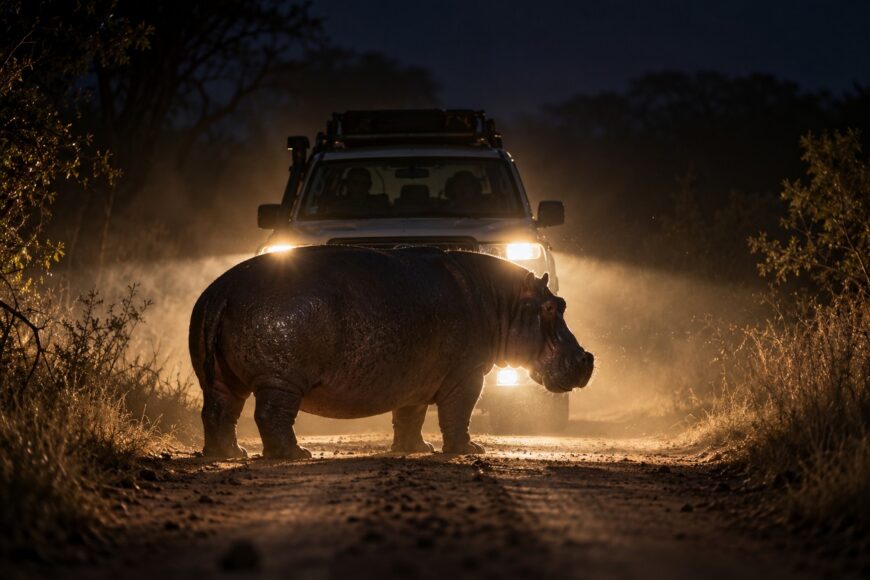
A hippo standing across a dark track in front of a Toyota Land Cruiser creates a powerful image: headlights, a heavy vehicle, and an animal close enough to make the road disappear. Darkness makes the distance difficult to judge, while the animal’s body position and line of sight may be unclear.
No reliable source in the supplied material confirms a hippo blocking a Toyota Land Cruiser at night. The available incident reports mainly concern rhinos, not hippos, so those reports cannot be treated as evidence of a hippo striking a Land Cruiser.
The practical lesson is about distance, vehicle position, reaction time, and a clear route away. A Land Cruiser may offer meaningful physical protection, but controlled behavior and an open exit route matter more than the apparent toughness of the vehicle.
- What a Nighttime Hippo-and-Land-Cruiser Scene Actually Shows
- Why a Hippo May Be on the Road After Dark
- The Driver’s Priority: Keep an Exit Route Open
- Why a Land Cruiser Is Not a Safety Bubble
- Common Mistakes, Hidden Risks, and Persistent Myths
- Frequently asked questions
- What does a hippo do at night?
- How can you tell whether a nighttime clip shows a hippo or a rhino?
- What should passengers do if a hippo approaches the vehicle?
- What animal can overpower a hippo?
What a Nighttime Hippo-and-Land-Cruiser Scene Actually Shows
A dark clip or photograph can show a vehicle stopped near a large animal, but it rarely proves the species, location, timing, or outcome on its own. Shadows can hide the animal’s body shape, and headlights can flatten depth, making a gap look wider or narrower than it is.
No reliable source in the supplied material confirms the exact event of a hippo blocking a Toyota Land Cruiser at night. The available incident reports mainly concern rhinos, not hippos. Keeping that distinction clear prevents a dramatic but unidentified image from being presented as a documented hippo encounter.
Vehicle contact also needs careful interpretation. Large hoofed animals may respond to a vehicle as a threat and show warning or aggressive behavior. Contact may be warning or territorial behavior rather than an attempt to destroy the vehicle, although the result can still be dangerous for people and machinery.
For safety purposes, the uncertainty does not make the scene harmless. A driver should treat an unidentified large animal in the road as a genuine hazard, avoid moving closer to improve a recording, and follow the instructions of a guide, ranger, or park authority rather than relying on an online caption.
Why a Hippo May Be on the Road After Dark
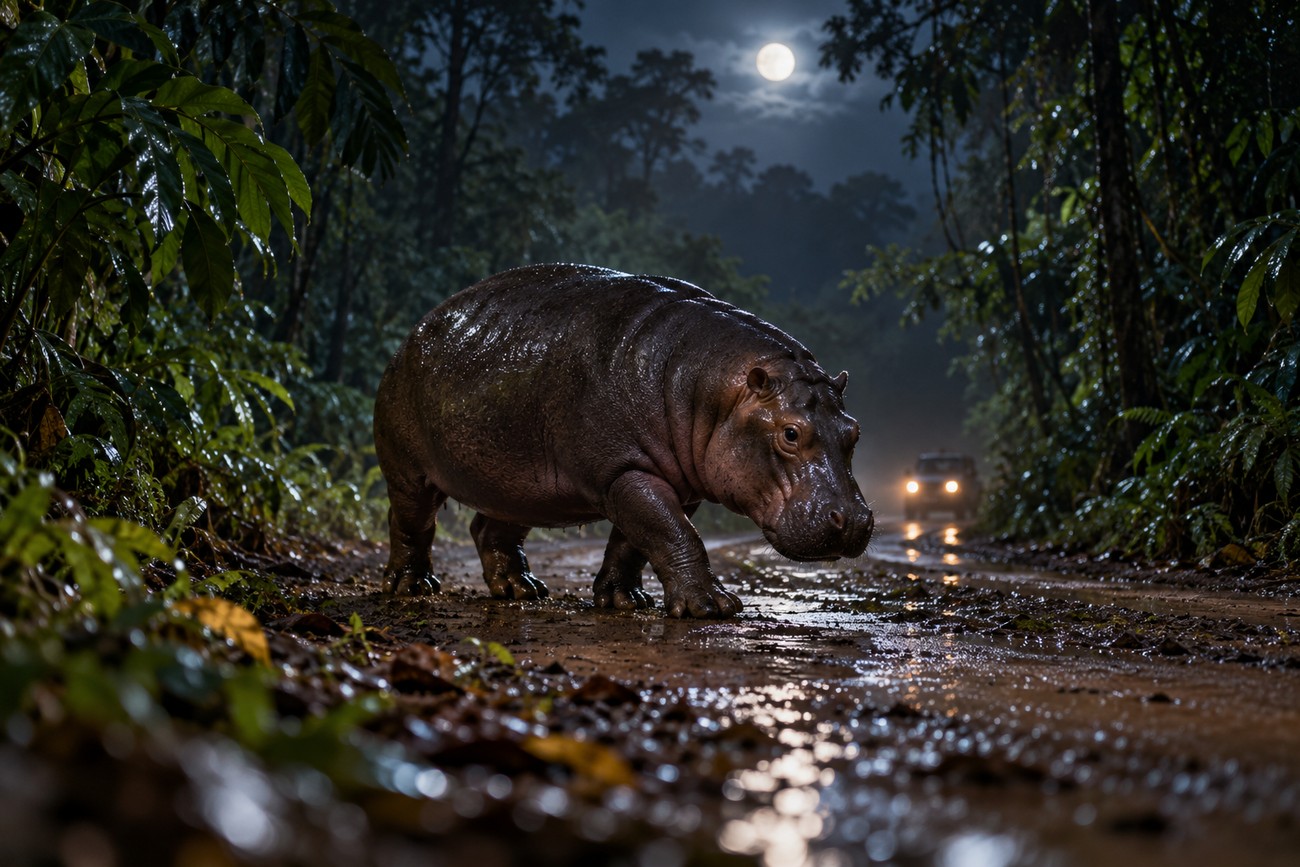
Nighttime movement is normal for some hippos. Dwarf hippos are mainly active and mobile at night, and they live in dense forest, where darkness and vegetation make observation difficult. A dark road scene therefore cannot establish that an animal is resting, lost, or behaving unusually.
An adult dwarf hippo can weigh up to 275 kg. That is enough mass to make close vehicle interaction hazardous, especially when the animal is surprised, feels cornered, or treats the vehicle as an object that should leave its path.
Large hoofed animals may respond to a vehicle as a threatening object and show warning or aggressive behavior. Their intent is difficult to read from a distance, and darkness makes distance, body position, and the animal’s line of sight difficult to judge.
The species itself also matters. A dark silhouette does not prove that the animal is a hippo, and the available material does not establish a verified hippo-versus-Land-Cruiser incident. Drivers should base their actions on the immediate risk and the available retreat route, not on an uncertain identification.
The Driver’s Priority: Keep an Exit Route Open
The first operational priority is to preserve a way out. If the vehicle is already stopped and it is possible to do so safely, safari personnel may start the engine and move the vehicle away while avoiding escalation. Local guides, rangers, and park procedures take priority because they account for the terrain and the animal’s behavior.
Positioning matters before the animal reaches the vehicle. Stopping with the front pointed into a dead end, against a bank, or close to another vehicle can remove the space needed for a controlled retreat. A driver should avoid creating a situation in which a turn or reverse movement requires sudden acceleration.
A vehicle pointed into a dead end can turn a manageable sighting into an operational failure. The retreat route should be considered before the animal closes the distance, while there is still room to move without abrupt steering or acceleration.
Noise, sudden movement, and a close approach can worsen an already tense encounter. Do not try to push the animal through with the bumper, and do not use a slow advance as a test of whether it will yield. If passengers are present, keeping them quiet and allowing the driver or guide to concentrate reduces distraction at the moment decisions matter most.
Why a Land Cruiser Is Not a Safety Bubble
A heavy SUV can create a false sense of security. It remains vulnerable at the glass, pillars, doors, and suspension, particularly if a large animal presses against it, strikes from the side, or forces it onto uneven ground.
Reported rhino incidents have included dents, impact marks, and vehicle rollovers. One reported rhino incident involved a vehicle being overturned several times. These reports are warnings about the limits of safari vehicles, not proof of a hippo striking a Toyota Land Cruiser.
Vehicle toughness does not remove the need for distance and an escape path. A strong body may reduce some consequences of contact, yet it cannot guarantee that windows, doors, suspension components, or occupants will remain unharmed.
The useful safety advantage is created before impact: enough space to react, a stable position, and a route away that does not require a confrontation. Once the vehicle is trapped against an animal or an obstacle, its construction becomes far less important than the lack of options.
Common Mistakes, Hidden Risks, and Persistent Myths
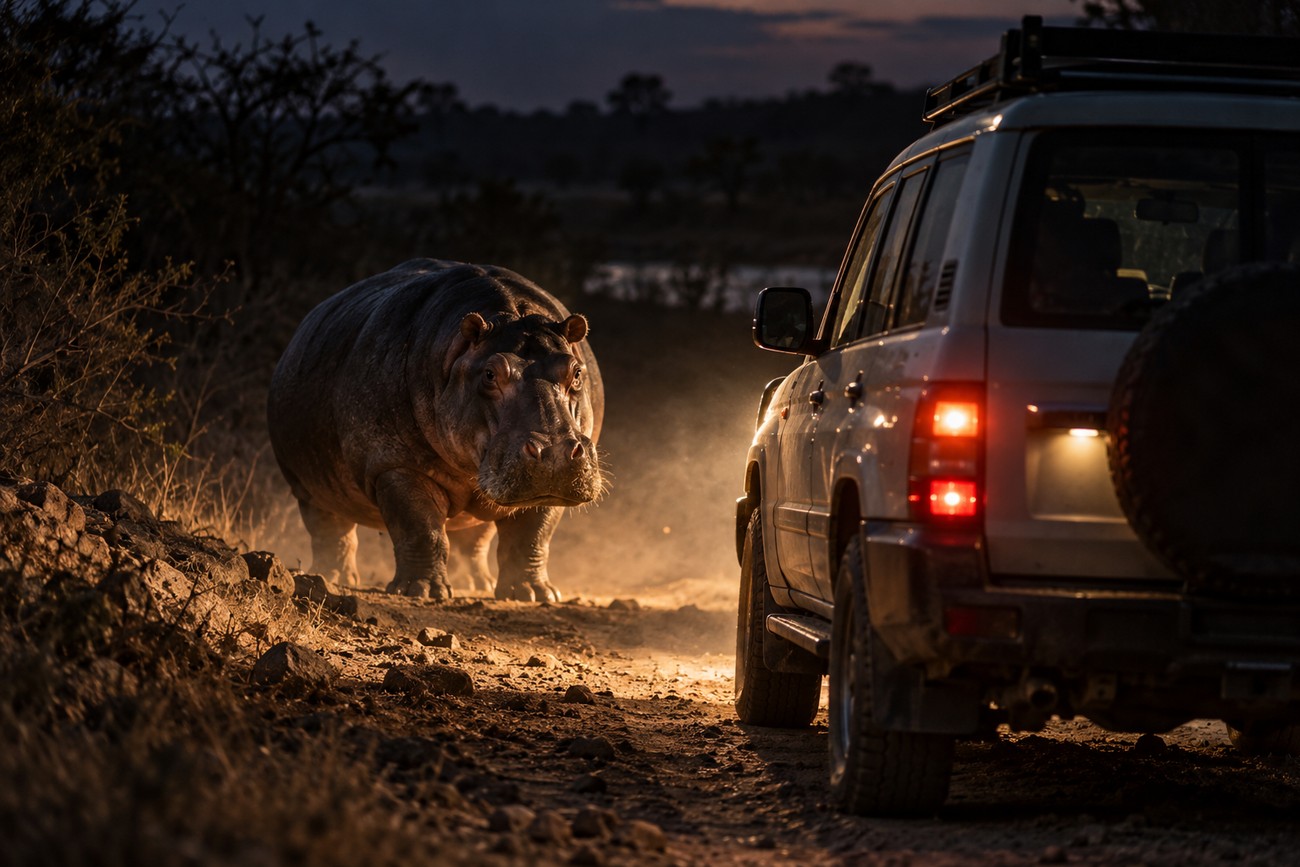
Approaching too closely for a photograph reduces the chance of a safe retreat. In darkness, people may misjudge distance and the animal’s line of sight, especially when headlights illuminate only part of its body. A vehicle that appears to have plenty of room may already be too close for a calm reversal.
Noise is another common mistake. Shouting, banging on the vehicle, slamming doors, or making sudden movements can increase attention or agitation. Engine noise and headlights do not reliably frighten every large animal and may increase attention or agitation instead.
Trying to slowly push through is equally unsafe. A driver can also create a problem by stopping with no turning space, while passenger panic may distract the person operating the vehicle. The safer response is to reduce unnecessary stimulation, preserve room, and follow local instructions.
Darkness does not guarantee protection, and a Land Cruiser is not complete protection against a large animal. At the same time, not every vehicle contact is a lethal attack; some contacts may be warning or territorial behavior. That distinction does not justify waiting for contact, and the hippo-versus-rhino evidence gap must remain explicit whenever footage is discussed.
Frequently asked questions
The questions below focus on what can and cannot be inferred from a nighttime scene and how passengers should respond. They also separate general animal behavior from the unverified claim about a hippo and a Land Cruiser. In every case, preserving distance and a clear retreat route remains the practical priority.
What does a hippo do at night?
Hippos may move, feed, or travel after dark, depending on the species and habitat. Nighttime activity is normal for dwarf hippos, which are mainly active and mobile at night and live in dense forest.
Darkness should therefore not be treated as evidence that a hippo is resting or inactive. It also makes the animal harder to identify and makes distance, body position, and intent more difficult to judge from a vehicle.
How can you tell whether a nighttime clip shows a hippo or a rhino?
You cannot reliably identify the species from a dark silhouette alone. Check the original caption, claimed location, date, and any reliable reporting before repeating the identification.
The available incident reports mainly concern rhinos, not hippos, and the supplied material does not establish a verified hippo-versus-Land-Cruiser incident. A reposed video or a confident title is not sufficient evidence of species or outcome.
What should passengers do if a hippo approaches the vehicle?
Passengers should remain quiet, avoid opening doors or windows, and stop distracting the driver. They should follow the guide’s instructions and keep their movements controlled, even if the animal is close enough to appear in the headlights.
Passengers should also avoid shouting, banging on the bodywork, or leaning out to film. These actions can increase attention or agitation and can make it harder for the driver to preserve a clear retreat route.
What animal can overpower a hippo?
There is no single reliable ranking that answers this safely. The result depends on the species, size, terrain, distance, and circumstances, so a comparison does not provide a useful decision for a vehicle encounter.
For drivers, the relevant question is whether the animal can damage, obstruct, or destabilize the vehicle. A heavy SUV remains vulnerable, and vehicle position, reaction time, and a clear retreat route matter more than trying to predict which animal is physically stronger.