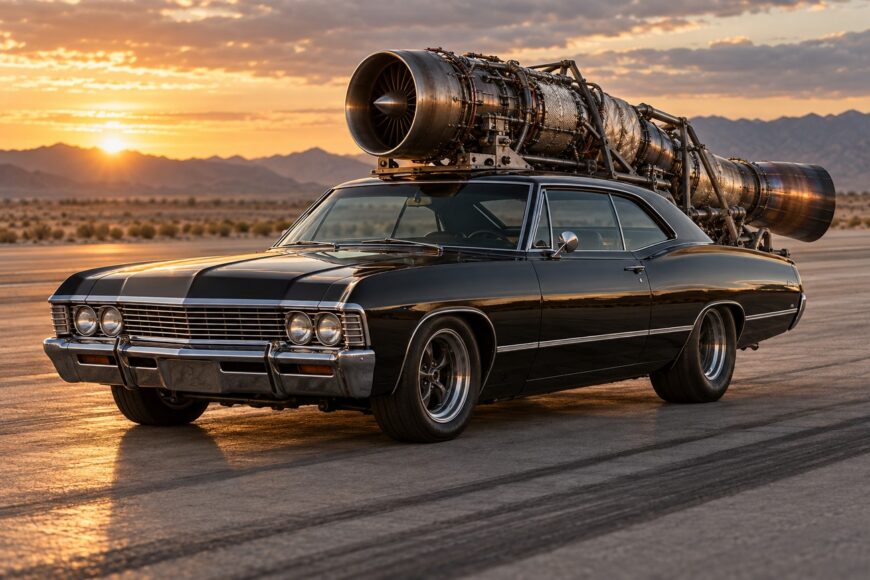
A jet-powered Chevy Impala has an appeal that is easy to understand: a familiar full-size car, an aircraft-style engine, and the promise of a startling launch. The engineering becomes less familiar where the engine meets the car. A jet mounted to the body produces direct thrust; it does not automatically deliver torque to the wheels.
That distinction separates a brief spectacle from a usable automobile. A car can move under jet thrust without its conventional drivetrain doing any work, yet still face questions about balance, steering, braking, heat, and repeated operation. The test is less whether an Impala can be made to move than whether the whole vehicle can remain stable and controllable while it does.
- What bolting a jet engine to an Impala actually does
- The 1967 Impala show build—and what it cannot prove
- Why the chassis becomes the hard part
- Jet thrust versus powering the wheels
- The hidden cost of a spectacular short run
- The realistic verdict for an Impala
- Frequently asked questions
- How much does a jet engine for a car cost?
- How can you assess a claimed jet-powered Impala build?
- What is the bolt pattern for a Chevy Impala?
- How much is a 1970 Impala worth today?
What bolting a jet engine to an Impala actually does
A conventional Impala engine sends torque through a drivetrain to the driven wheels. A body-mounted jet works differently: it accelerates mass rearward and pushes directly on the vehicle. If the jet supplies the propulsion, the transmission and driven axle need not transmit that force at all.
This changes what a performance claim means. Horsepower figures for a conventional V8 describe engine output delivered into a drivetrain; a jet-thrust claim describes a force acting on the car. Neither figure alone tells you how quickly a particular Impala will accelerate, because vehicle mass, resistance, and the way the force enters the chassis also matter.
The word “bolting” makes the conversion sound like an engine swap. Factory Impala engine mounts serve conventional engine configurations for the relevant model years, not a bolt-in jet installation. Their existence says little about how a body-mounted jet would load the car or expose nearby parts to heat.
There is also a practical consequence to bypassing the wheels: familiar transmission choices cannot turn a direct-thrust installation into an ordinary driveline. Assessing such a car means looking at the complete vehicle, rather than treating the engine as an unusually powerful replacement part.
The 1967 Impala show build—and what it cannot prove
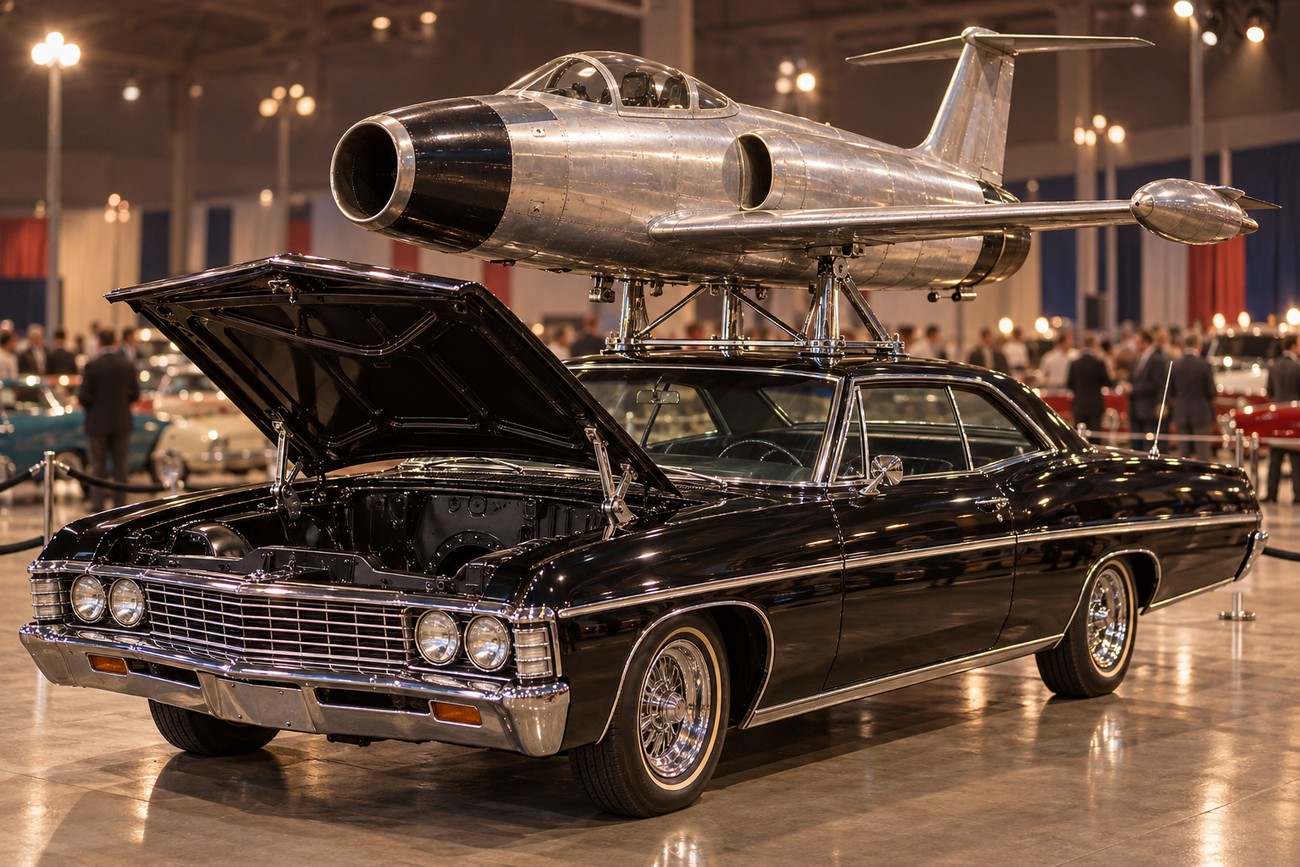
A reported 1967 Impala show build had its conventional engine removed and a jet mounted on the roof. That arrangement explains why the car attracts attention: its propulsion hardware is visible above a recognizable road-car body. It also places the example far outside a standard automotive engine configuration.
The roof location matters as much as the choice of engine. Added mass high on a vehicle changes its balance, while the external installation changes how air flows around it. A photograph can establish that the layout is striking; it cannot establish how the car handles under thrust or whether it could be used on public roads.
For context, cited conventional engine options for the 1967 Impala include 283, 327, and 427 cubic-inch V8s, with output up to 385 hp. Those are conventional-engine figures, not measures of the roof-mounted jet’s thrust. Comparing them as though they describe interchangeable powertrains would obscure the central engineering difference.
The reported build is therefore best understood as a show example, with the limits that description implies. Its appearance supports an account of an unusual layout, not assumptions about unverified performance, hardware, or roadworthiness. It is a poor template for an ordinary Impala conversion precisely because the visible engine is only one part of the problem.
Why the chassis becomes the hard part
With direct thrust, the pushing force enters the car through the jet’s attachment to the structure. The body then has to carry that load while the suspension, tires, and steering keep the vehicle pointed where intended. An Impala designed around conventional propulsion was not designed for jet thrust as a factory operating condition.
A roof-mounted installation adds another complication: it raises the placement of added mass. That can affect how the car responds to steering and surface changes, quite apart from whether the engine can produce enough thrust to move it. The exact behavior cannot be inferred from a photo or a claimed engine rating.
Heat and exhaust exposure extend the problem beyond the attachment point. The Impala’s body and surrounding components were not designed around a jet installation’s thermal conditions. Protecting the car and its occupants would be a major engineering concern, rather than a finishing detail hidden beneath dramatic bodywork.
Finally, a vehicle that accelerates must still steer predictably and stop. A short, straight run offers limited evidence about either task, particularly if it shows only the moment the jet produces thrust. Treating movement as proof of control is the easiest mistake to make when the spectacle dominates the footage.
Jet thrust versus powering the wheels
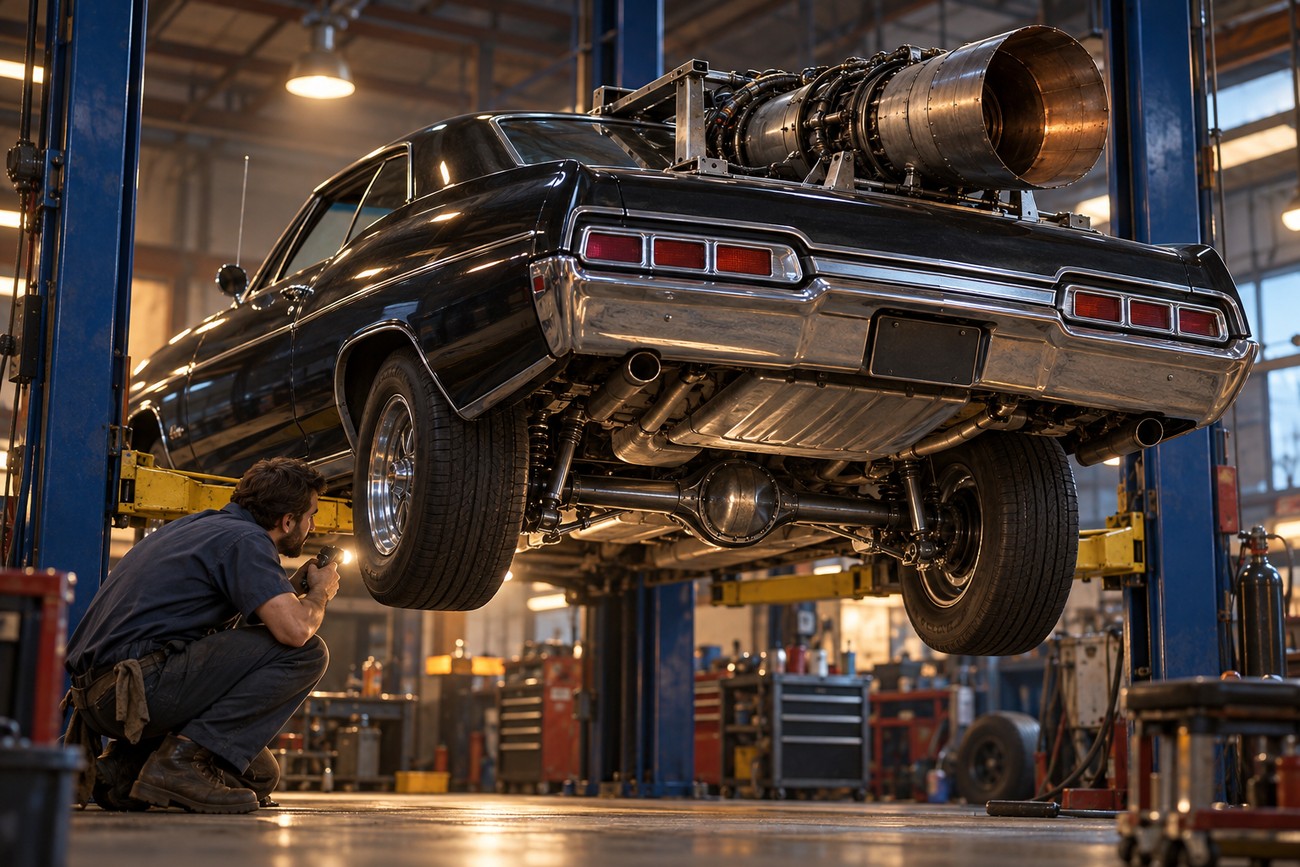
Cars casually described as “jet-powered” can follow two distinct propulsion approaches. A body-mounted jet pushes the vehicle through direct thrust. A separate approach transfers turbine output through a drivetrain to drive the wheels, making the driven axle part of the propulsion system.
Those layouts pose different engineering questions. In a wheel-driven system, the drivetrain must transmit turbine output to the tires; in a direct-thrust system, the jet pushes on the car independently of wheel torque. Calling both vehicles jet-powered is reasonable shorthand, provided it does not erase the distinction.
One reported comparison favored the wheel-driven approach for speed. That result does not establish that wheel-driven turbine cars are always faster: the vehicles, operating conditions, and measures of performance would determine what the comparison actually shows. It does, however, challenge the assumption that the most dramatic exhaust must produce the quickest car.
For an Impala, identifying the propulsion method should come before comparing power claims. Otherwise, figures from a conventional V8, a turbine output shaft, and a direct-thrust jet can appear comparable even though they describe different things happening to the vehicle.
The hidden cost of a spectacular short run
A jet-car project needs far more than the engine visible from outside. Fuel supply, thermal protection, integration with the vehicle, testing, and ongoing maintenance all affect what it takes to produce a run. An engine’s asking price therefore cannot stand in for the cost of a complete project.
Noise, heat, and upkeep also narrow the car’s usefulness. These are reasons jet-car builds are generally demonstrations or record-oriented projects, rather than practical everyday road modifications. A run that lasts long enough to impress an audience may say little about how often the vehicle could operate reliably.
Short footage has a further limitation: it can show that an engine operated and the car moved, while leaving braking, repeatability, and control largely unseen. Concerns about expense or damage are real project risks, but they should not be presented as documented outcomes of the reported 1967 Impala without evidence.
The realistic verdict for an Impala
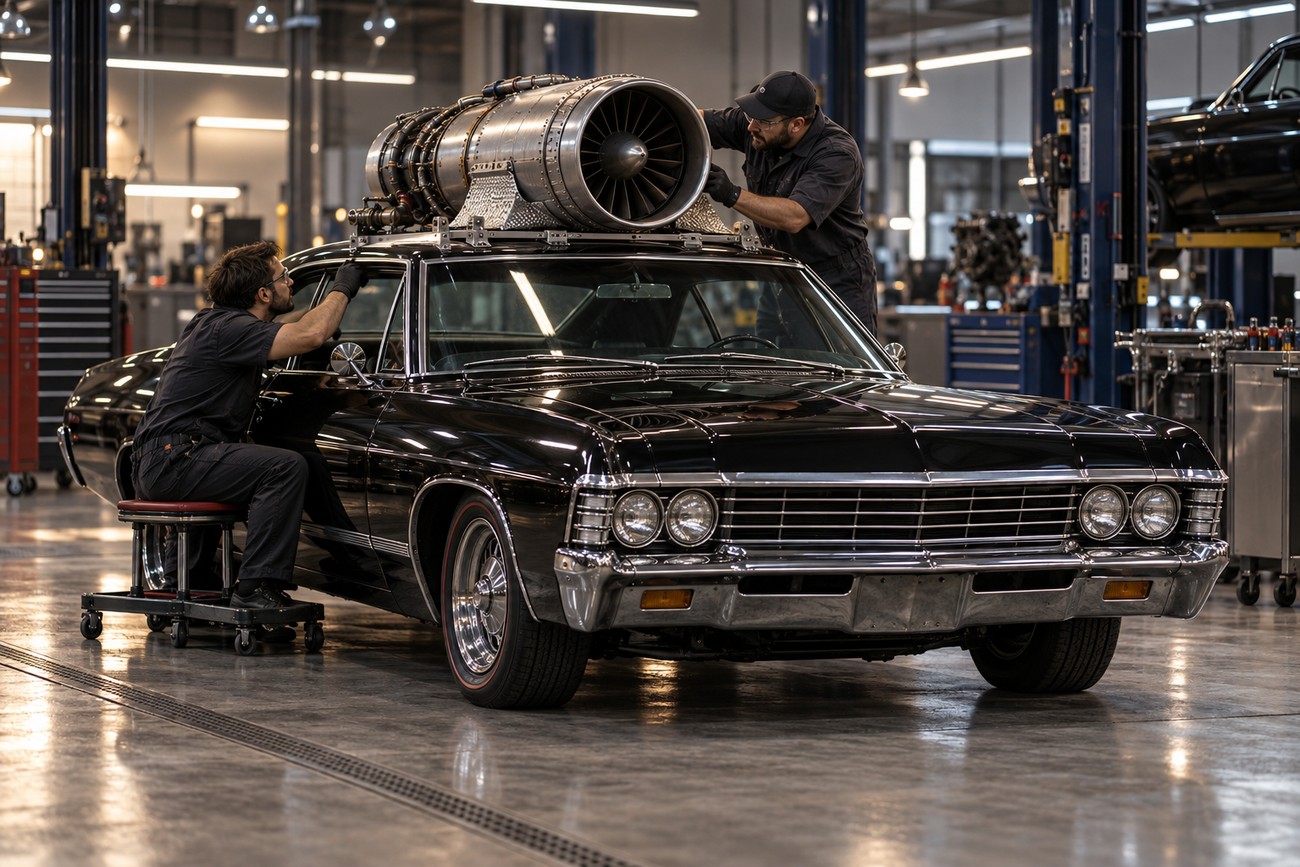
The Impala name covers cars from different years with substantially different conventional engines and configurations. A claim about one year’s engine options or mounts should not be applied to every Impala. Even for a specified year, factory engine mounts serve conventional layouts; they do not make a jet installation a bolt-in conversion.
Admiring the reported roof-mounted 1967 show build is different from treating it as a transferable plan. Its visible engine tells only part of the story, while the demands on structure, balance, heat protection, and vehicle control remain central. A visually convincing car is not, on that basis, a roadworthy one.
The defensible verdict is that a jet-powered Impala can be a striking engineering demonstration, provided its claims are judged by what has actually been shown. As an everyday modification, it offers little of what makes a conventional Impala usable. The hardest work lies beyond making thrust: it lies in ensuring the entire car behaves safely and consistently.
Frequently asked questions
Claims about jet-powered cars often mix an engine’s specifications with the performance of the finished vehicle. The same caution applies to ordinary Impala questions: year and configuration matter. These answers separate what can be established from what needs vehicle-specific evidence.
How much does a jet engine for a car cost?
There is no single reliable price: the engine’s type, condition, completeness, and suitability all matter. An engine’s asking price is not a useful total-project figure. Integration, fuel and thermal-protection systems, testing, and upkeep can be substantial parts of the undertaking. A price for the engine also says nothing about whether a particular car can safely carry or use it.
How can you assess a claimed jet-powered Impala build?
First identify whether the jet pushes the body directly or turbine output drives the wheels through a drivetrain. Then distinguish an engine operating on a stationary car from a controlled vehicle run. Evidence beyond a short clip would need to show more than launch footage, particularly if the claim concerns repeatable handling or braking.
What is the bolt pattern for a Chevy Impala?
There is no single bolt-pattern answer that should be applied to every Impala year and wheel configuration. For wheel fitment, identify the exact model year and verify the wheel’s bolt circle against vehicle-specific specifications before selecting a replacement. Engine-mount bolt patterns are a different question and likewise require the relevant year and hardware.
How much is a 1970 Impala worth today?
A 1970 Impala’s value depends on its body style, engine, condition, originality, documentation, and local market. A useful estimate requires comparable recent sales for cars with similar specifications and condition; an asking price alone does not establish market value. Major modifications need separate scrutiny because their cost does not automatically translate into resale value.